

T+A Talis S 330 black (pack of 2)


T+A Talis S 330: the three-way aluminium floorstanding speaker
This 105-centimetre floorstanding speaker has a cabinet made entirely of hand-brushed aluminium. It is manufactured in the T+A workshops in Herford, Germany. It succeeds the Talis S 300 and introduces a new magnesium dome tweeter, drivers that are now black, and a redesigned front baffle. On paper, the formula is conventional: three ways, four drivers and a bass-reflex design. The care taken with the cabinet and crossover clearly sets it apart.
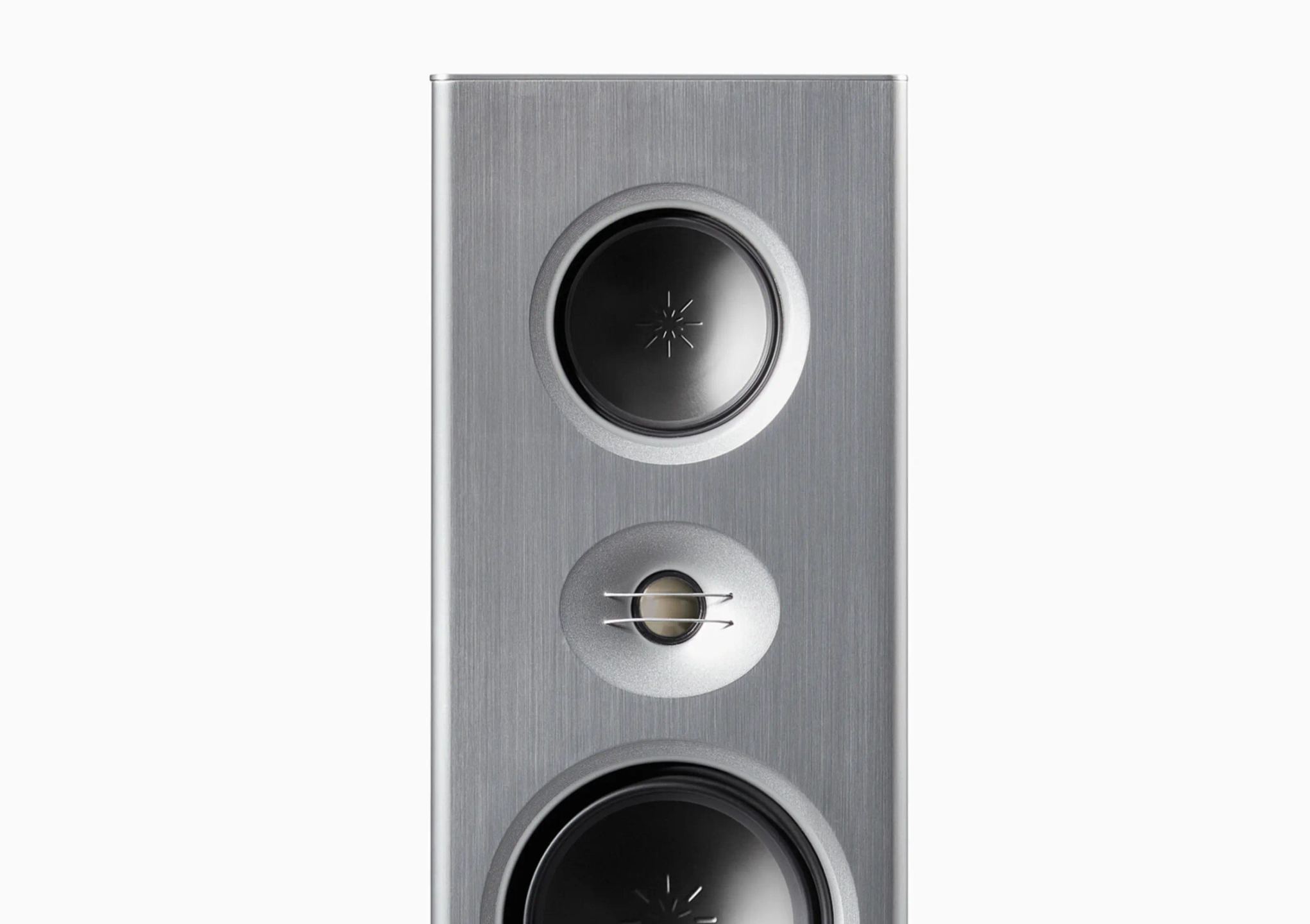
An aluminium cabinet housing more than 55 litres
T+A calls the front baffle unique to the Talis series WrapAround. It extends around the sides, joins the cabinet with an almost invisible chamfer, then the sides taper towards the rear. No screws are visible: the drivers and fittings are secured from the inside. This evolution of the brand’s Organic Baffle also serves an acoustic purpose. The smooth transition prevents the shortest treble wavelengths from reflecting off the edge of the front baffle, a reflection that would slightly colour the midrange and treble.
The slim profile conceals a substantial internal volume. Within 105 × 21 × 28 cm, the structure provides more than 55 litres of usable volume. A system of machined chambers seals off the bass and midrange sections so that vibrations cannot travel between compartments or to the cabinet walls. Two anodised finishes are available. In black (42), the front baffle and drivers blend into a uniform whole. In silver (43), the black drivers stand out against the aluminium. A magnetic grille is supplied: it protects the diaphragms in everyday use, but T+A recommends removing it for listening.
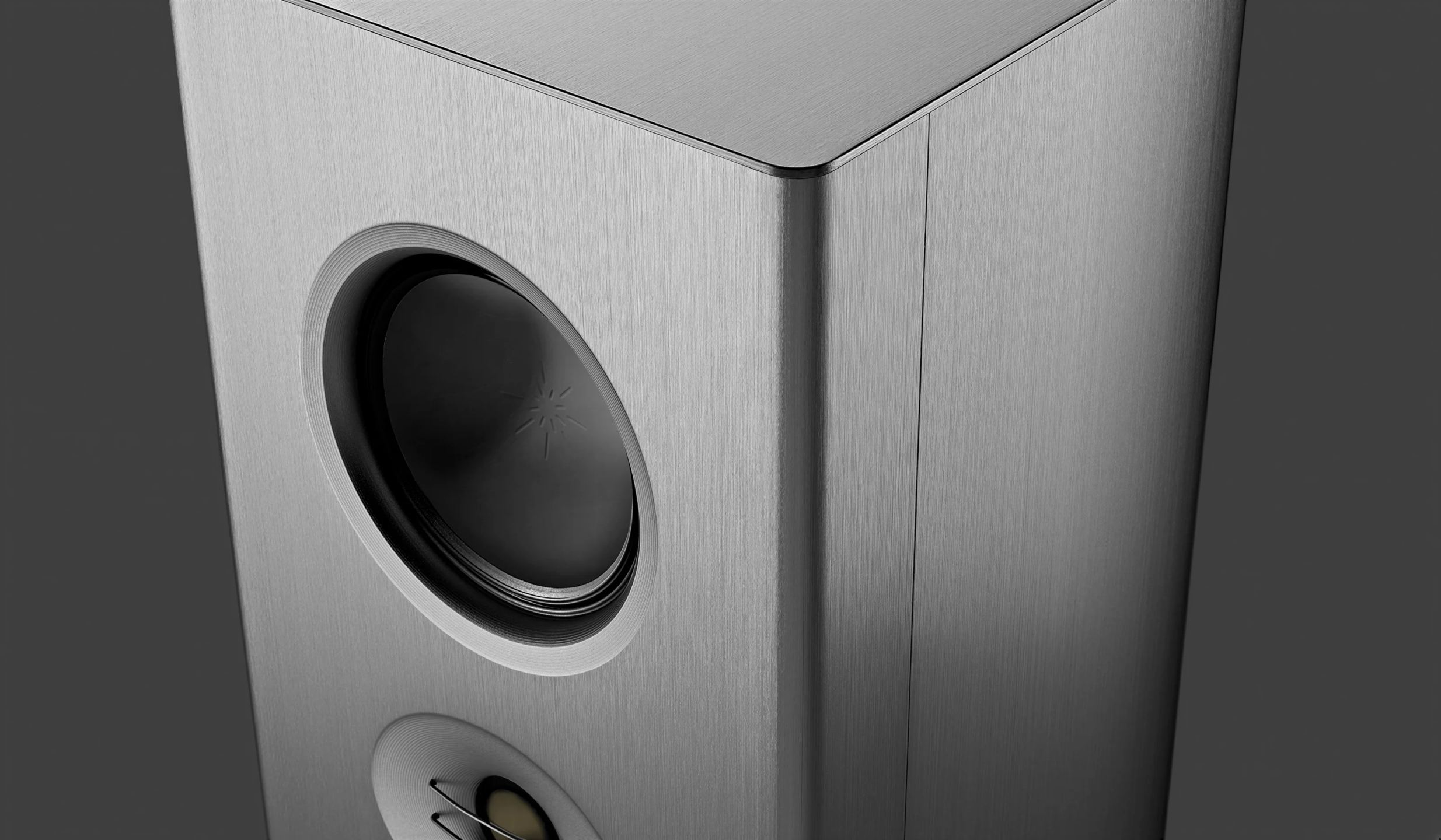
A magnesium tweeter and a midrange driver with star-shaped reinforcement
The 25 mm tweeter is the main new feature of this generation. Its magnesium diaphragm combines lightness and rigidity, and has a coating that damps the high-frequency resonances common in metal domes. The aim is treble with fast attack, without harshness, that remains comfortable over long listening sessions.
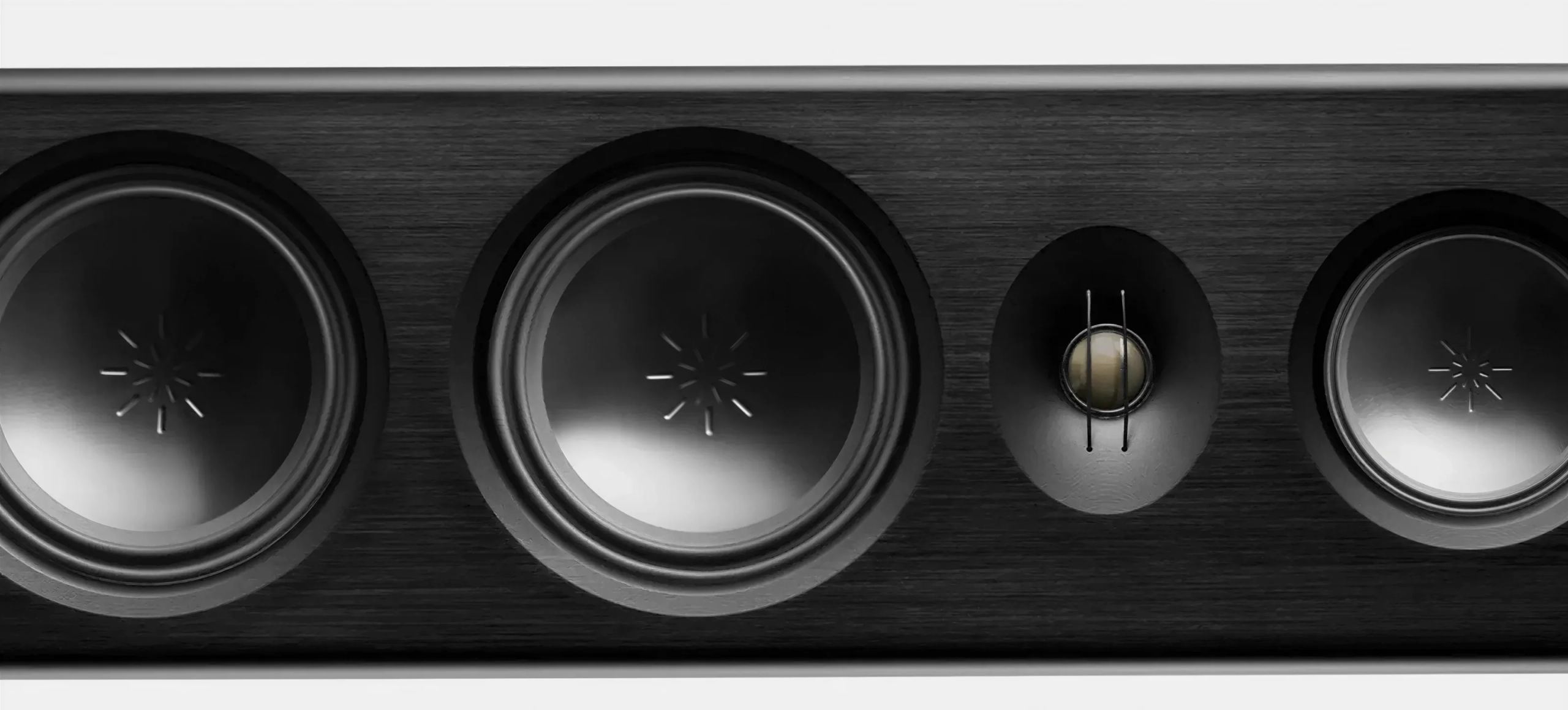
The 120 mm midrange driver uses T+A’s StarStabilizer diaphragm, reinforced at its centre by a star-shaped structure. This reinforcement neutralises the cone’s resonances and natural modes, allowing it to move as a single unit, like a piston. With crossover points at 250 Hz and 2,200 Hz, this midrange driver alone covers the entire range of the human voice, with no transition between two drivers in the middle of a sung phrase. Bass is handled by two 170 mm drivers with matched resonant frequencies. Their powerful magnets, large voice coils and long-excursion suspension are designed to deliver high levels of deep bass without distortion, down to the stated 25 Hz at the bottom of the frequency range.
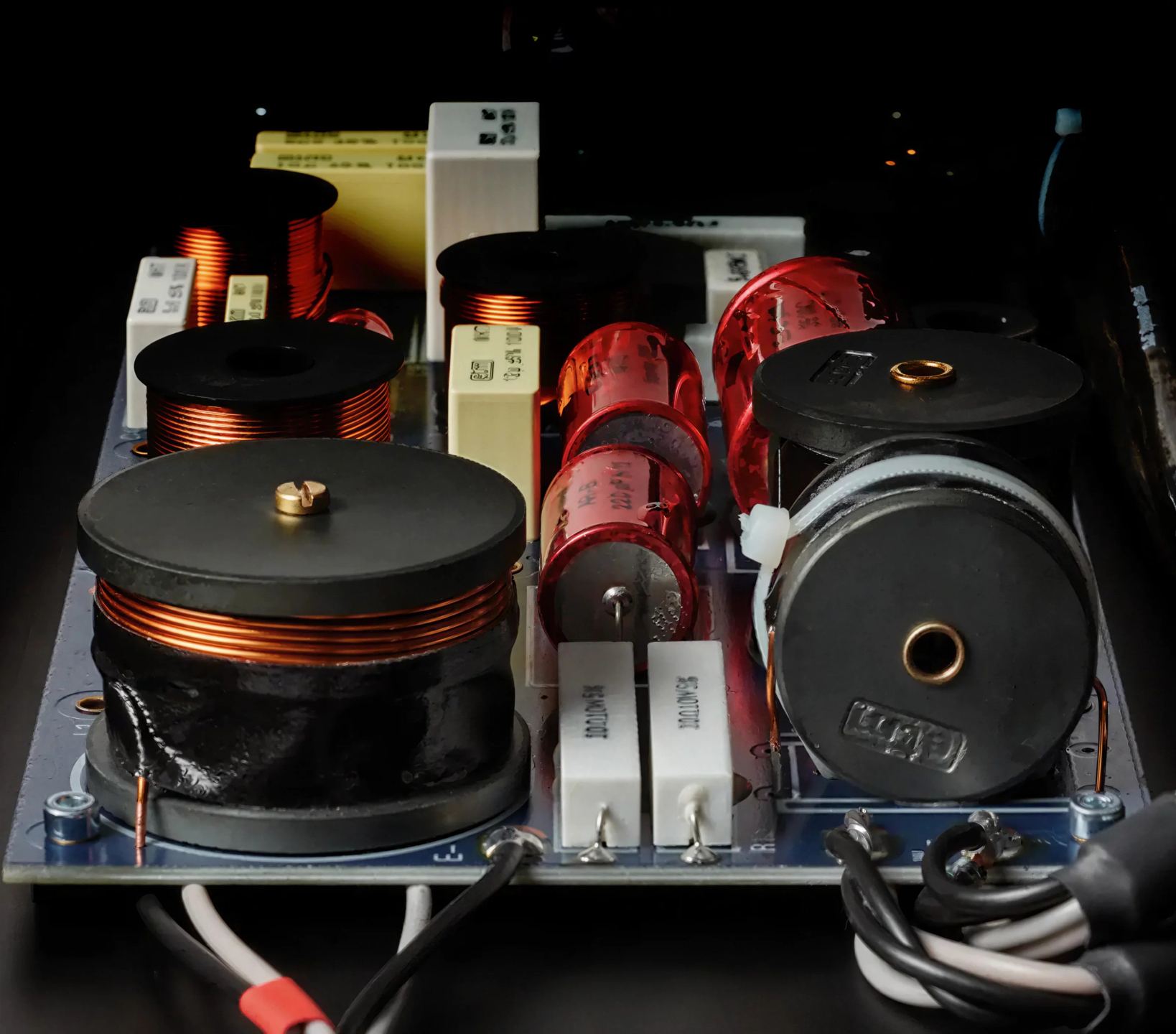
A two-board crossover for bi-wiring and bi-amping
The three-way FSR (Fast Signal Response) crossover is built on double-sided circuit boards. A dedicated ground layer allows it to handle the strongest pulses and high currents without distortion. Its various stages are tuned to control phase and group delay: the components of the same sound, distributed across the three drivers, reach the ear at the same time. Each driver is connected to the crossover by a dedicated cable.
The bass and midrange/treble sections each have their own board, hence the dual terminals at the rear. For single-wiring, one cable per speaker is sufficient, with the supplied jumpers left in place between the two pairs of terminals. For bi-wiring, the jumpers are removed and two cables are run to each speaker. These connect to the amplifier’s A and B outputs, or in parallel to a single output. Bi-amping goes further: one stereo amplifier powers the bass sections of both speakers, while a second powers the midrange/treble sections. In all cases, the cables must be the same length.
Finding the right position for a 33 kg floorstanding speaker
The speakers and listener should form a roughly equilateral triangle, with a listening distance of at least three metres. The speakers should therefore also be spaced at least three metres apart. The tweeter and midrange driver should sit roughly at ear height, and angling the speakers slightly towards the listening position improves stereo imaging precision. A floorstanding speaker hidden behind furniture or a curtain loses a large portion of its treble.
Bass is strongly affected by proximity to walls: around +3 dB against a wall and up to +6 dB in a corner. Allow at least 50 cm of clearance from side walls. When the room does not allow this, the two supplied foam plugs fit into the ports and reduce the bass level.
The plinth consists of two front pieces and one rear piece, screwed beneath the speaker using the supplied hex key. It is assembled with the speaker lying on the foam from its packaging, with two people required given its weight. The four combination feet offer two uses. With their spikes fitted, they decouple the speaker from a carpeted floor. With the spikes removed, their upper section serves as a pad on parquet or tiled flooring. Four special spikes and an assembly tool complete the set.
A 4-ohm load that requires current
With an impedance of 4 Ω and a sensitivity of 87 dB, the Talis S 330 is average in efficiency among passive floorstanding speakers. However, it requires an amplifier that is stable into a low-impedance load, as current demand rises as impedance falls. T+A recommends an amplifier capable of delivering more than 10 amps. The power handling rating (200 W nominal, 270 W music power) indicates what the speaker can handle, not what is needed to drive it. The most important factor remains sufficient amplifier headroom. An amplifier pushed to its limits clips: it cuts off the tops of signal peaks and produces audible distortion, which is also dangerous for the tweeter.
Documentation
Technical specifications
Overview
- Type: passive 3-way floorstanding speaker
- Bass loading: bass reflex
- Manufacturer: T+A elektroakustik, Herford (Germany)
Drivers and crossover
- Tweeter: 1 × 25 mm
- Midrange driver: 1 × 120 mm
- Woofers: 2 × 170 mm
- Crossover frequencies: 250 Hz, 2200 Hz
Acoustic and electrical performance
- Frequency response: 25 to 40000 Hz
- Sensitivity: 87 dB
- Impedance: 4 Ω
- Nominal power: 200 W
- Music power: 270 W
Amplification and connection
- Recommended amplification: amplifier stable into 4 Ω, current capability greater than 10 A
- Terminals: dual, compatible with bi-wiring and bi-amping
Installation and placement
- Recommended distance from side walls: 0.5 m minimum
- Recommended listening distance: 3 m minimum
Supplied accessories
- 1 removable magnetic grille
- 3 base elements, 6 hex socket screws
- Base composition: 2 front pieces, 1 rear piece
- Mounting: screws onto the underside of the speaker
- 1 hex key
- 4 combination spike / pad feet, 4 special spikes
- Use: as spikes, or as pads for delicate floors, particularly parquet and tiles
- 1 spike mounting tool
- 2 foam plugs
- Bass adjustment: insert into the port to reduce bass level near a wall or in a corner
- Jumpers for single-wiring
- Positioning: between the bass and mid-treble inputs
- Warranty card, user manual
Finishes, dimensions and weight
- Finishes: black anodized aluminum (42), silver anodized aluminum (43)
- Dimensions without base (H × W × D): 105 × 21 × 28 cm
- Weight: 33 kg
Frequently Asked Questions
Should the Talis S 330 be broken in before judging them?
Yes. Allow up to around a hundred hours of operation. During this period, the moving parts of the speakers (diaphragms, surrounds, spiders) become more flexible and reach their final parameters. The sound evolves over these first few weeks before stabilizing.
What distinguishes the S 330 from the Talis S 300?
The main change is the new magnesium dome tweeter. Other additions include all-black drivers and the WrapAround front panel, which extends the front profile into the sides. T+A presents the S 330 as a redesign rather than a simple update.
Is there a compact speaker in the same series?
The Talis R 330 uses the same magnesium tweeter in a cabinet measuring 37 × 21 × 28 cm and weighing 15 kg. It is a two-way speaker equipped with a single 170 mm mid/bass driver, crossed over at 2,000 Hz, with a sensitivity of 85 dB at 4 Ω. It serves as a matching compact speaker in a smaller room, or as rear speakers in a multichannel system built around a pair of S 330.
What room size should I plan for?
The minimum listening distance of three meters and side clearance of at least 50 cm require a room wide enough to space the speakers about three meters apart, with room to sit at the same distance. Acoustics matter too: rugs, curtains or absorptive panels reduce reflections that blur the soundstage in a highly reverberant room.
How do you care for anodized aluminum?
A soft, dry cloth is sufficient for everyday cleaning. For heavier soiling, use only water, with a mild soap added if needed, never solvents or harsh cleaning products. Remove dust from the grille with a vacuum cleaner, without applying pressure, as the speakers are mounted directly behind it.
What should I do if the speakers arrive in cold weather?
Wait until they have returned to room temperature before playing them, allowing any condensation to evaporate. Keep the original packaging: its moulded foam inserts help with fitting the base and protect the speakers during a move.
- Eco-contribution included in the sale price.