

T+A R 2500 R silver


Specifications and features


Overview
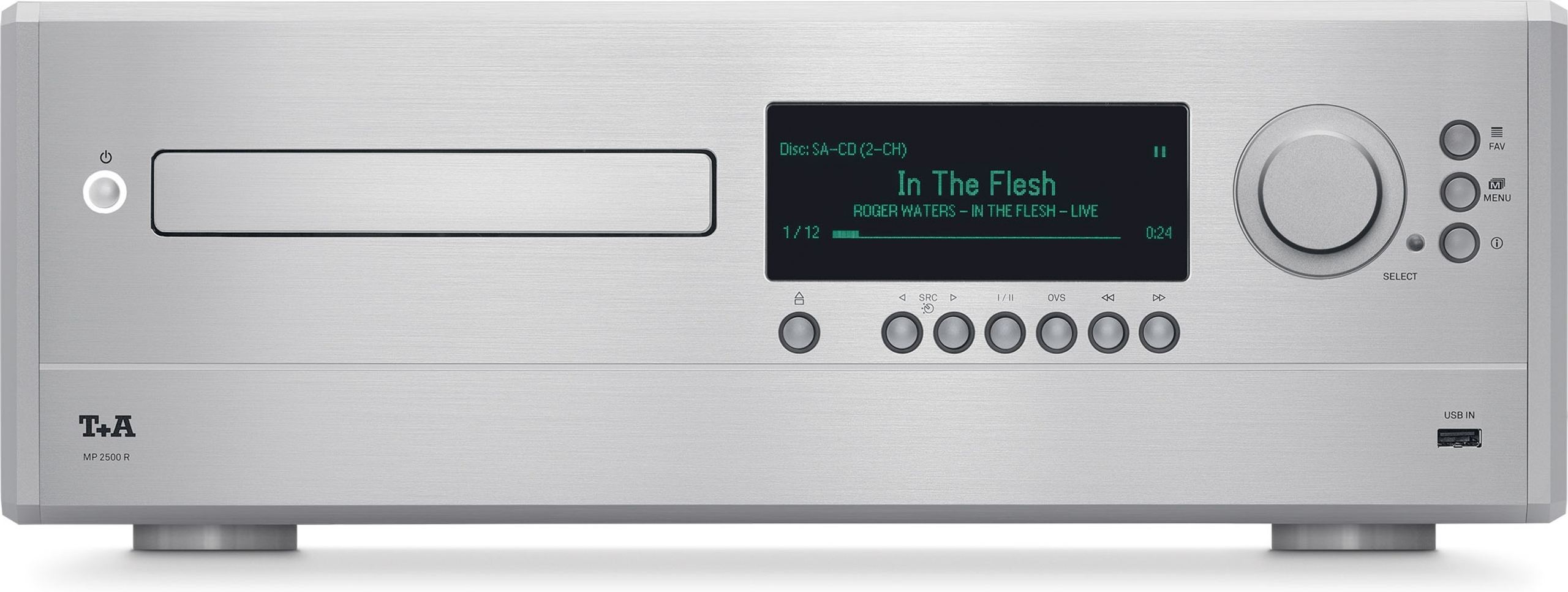
A pair of speakers and a network connection are all you need for a complete system with this R series receiver, in which T+A brings together what a hi-fi setup usually spreads across four or five components: a CD player, FM and DAB+ tuner, network player, DAC and stereo amplifier. Two HDMI inputs also accommodate TV sound. Everything fits into a 14 kg brushed aluminium chassis, developed by the Herford-based brand, established in Westphalia since 1978.
All sources in a single chassis
The R series is T+A’s oldest product line: introduced in 1992, it has always divided its components into two formats, with 2000 R model numbers for slim chassis and 2500 R model numbers for tall chassis. The R 2500 R belongs to the latter family, standing 16.5 cm high, and packs the equivalent of the multi-source player and integrated amplifier from the same range into this space.
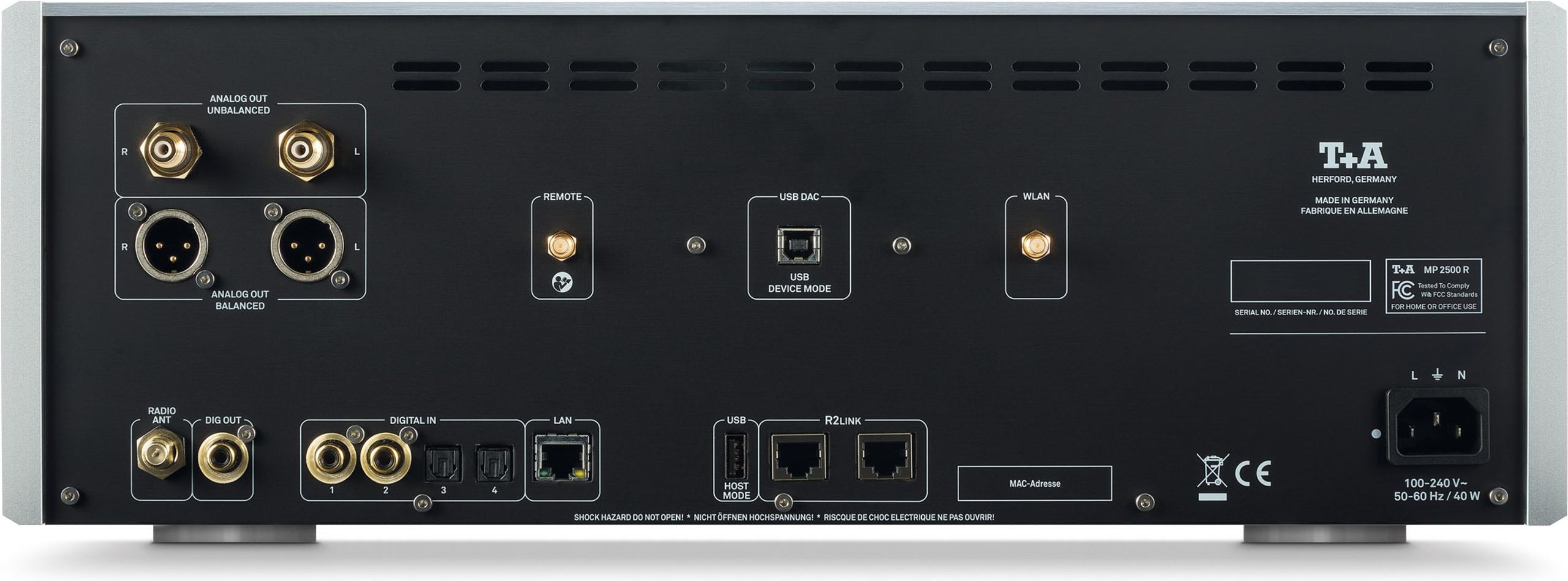
Discs enter through a slot on the front panel, with no tray, and the CD player supports CD-R, CD-RW and CD-Text display. Radio is available through three routes: FM with RDS (station name, radio text), DAB+ and Internet radio, supplemented by podcasts from the airable service. For files, two USB ports, one on the front and the other at the rear, read flash drives and hard drives, while a third USB socket turns the R 2500 R into a DAC for a computer. Three S/PDIF digital inputs (one coaxial, two optical) and three analogue inputs, including one balanced XLR input, round out the connections for older equipment.
With so many sources, navigation matters. The front-panel and remote-control buttons organise everything into four groups (network playback, disc, radio, external inputs), unused sources can be disabled in the menu, and each can be renamed. Two shortcut buttons on the remote recall the two most frequently used sources, and each tuner, along with Spotify, keeps its own list of presets.
Brushed aluminium and backlit VU meters
The front panel follows the understated styling of the R series: few buttons, chamfers that extend seamlessly towards the sides, and an enclosure made entirely of hand-brushed anodised aluminium, available in silver or black. Two needle VU meters flank the graphical display and track the average level of each channel; their backlighting can be adjusted colour by colour (red, green, blue) to match the room’s lighting. The display can stay on, turn off a few seconds after each command or remain off, and its brightness is adjustable.
Volume changes in precise 1 dB steps, with a maximum limit adjustable separately for the speakers and headphones, and a choice of power-on level (last level used, capped level or fixed level). For everyday use, the supplied SRC 2 remote control has an alphanumeric keypad for entering a Wi-Fi password or searching for a station, and the T+A MusicNavigator G3 app, on iOS and Android, takes over for browsing a library or streaming service, which remains more convenient than navigating lists from the front panel.
One DAC for PCM, another for DSD
T+A processes the two main families of digital files separately. For PCM (the format used by CDs and most high-resolution files), the R 2500 R uses a quadruple double-differential DAC: four 32-bit Burr-Brown sigma-delta chips per channel, eight in total, arranged symmetrically so that their imperfections cancel each other out. According to the brand, this arrangement reduces noise by a further 6 dB. Conversion supports up to 768 kHz.
Oversampling, which recalculates intermediate points between the original samples, offers four in-house filters with different characteristics: long FIR, with the most linear frequency response, short FIR, which handles peaks better, Bézier/IIR, with a presentation close to that of an analogue system, and pure Bézier, which T+A favours for rhythmic precision. Two non-oversampling modes (NOS 1 and NOS 2) are used when playback software already handles this calculation on the computer. At the output, a third-order linear-phase analogue Bessel filter cuts off at either 60 kHz or 120 kHz.
DSD, the SACD format, is never converted to PCM: the T+A True-1Bit DAC reproduces it in its native bitstream, up to DSD512, with two filtering modes (a long filter with very low noise or two short filters in parallel for even lower distortion). To prevent noise from the digital circuits from contaminating the analogue section, T+A’s DASS system galvanically isolates the two sections using fast Silicon Labs isolators, and each receives its own power supply. An absolute phase setting completes the options, for recordings whose polarity was reversed during recording.
Third-generation network playback
The R 2500 R is among the brand’s first components equipped with the third-generation ASA streaming platform. It provides access to Qobuz, Tidal, Deezer, Amazon Music and HIGHRESAUDIO from the T+A app, as well as the Connect features of Spotify, Tidal and Qobuz: playback is then started directly from the service’s app on the phone, and the R 2500 R appears in the list of playback devices. AirPlay 2 covers Apple devices, Roon Ready certification integrates the R 2500 R into a Roon setup, and it is compatible with Audirvana.
On a home UPnP/DLNA server, PCM files are played at up to 384 kHz and DSD at up to DSD256. This native DSD playback over the network is a first for T+A: the stream is passed unchanged to the True-1Bit DAC. Connection is via Ethernet or dual-band Wi-Fi 6 (2.4 and 5 GHz) with 2 × 2 MIMO, using two supplied antennas that screw directly onto the rear panel or sit on their magnetic base for improved reception. The Ethernet port, limited to 100 Mbit/s, retains ample headroom for audio, even at high resolution. Bluetooth, with aptX HD, AAC and SBC, is useful for guests or for quick listening from a phone.
Dual-mono amplification with discrete components
The power stage delivers 140 W per channel into 8 Ω and 250 W into 4 Ω. The left and right channels are separated even in their physical construction: two identical boards each carry their own input stage, volume control, voltage amplifier and current amplifier. The input stage uses the design of the HV series, T+A’s higher-end range: a cascoded differential amplifier with hand-selected J-FET transistors, built entirely from discrete components, with no integrated operational amplifiers. This design uses almost no global negative feedback, the process that feeds part of the output signal back to the input to correct distortion, at the risk of impairing transient response.
Volume control is based on precision resistors switched by bistable relays with gold-plated contacts, ensuring exact matching of the two channels at all levels. The voltage amplifier and current amplifier are galvanically isolated from each other, so that currents fed back by the speakers do not reach the sensitive stages.
The high-frequency sinusoidal power supply developed by T+A aims to combine the reserves of a conventional transformer with the stability of a switch-mode power supply, without the high-frequency interference inherent in the latter, thanks to a sinusoidal waveform cycle. Its smoothing capacitors recharge 100,000 times per second, supplying current without delay during dynamic peaks.
Tone controls work channel by channel, from -6 to +8 dB for bass and treble, and relays remove them entirely from the signal path when disabled. Loudness compensation, which boosts the extremes of the frequency spectrum at low volume, can be adjusted to the speakers’ sensitivity. A protection circuit monitors temperature, short circuits at each output and clipping: in the event of overload, the R 2500 R reduces the volume itself.
TV, turntable and headphones: connections to plan for
The two HDMI inputs accommodate a Blu-ray player or set-top box, whose picture is passed to the TV through the HDMI output, and this output supports the audio return channel (ARC, not eARC) to receive sound from TV programmes. The R 2500 R remains a stereo device: it decodes neither Dolby nor DTS, and the source must be set to PCM output. For a film with multichannel sound, a bypass function passes the signal through to the TV or a home cinema receiver. HDMI-CEC control offers three modes, from simple volume adjustment using the TV remote to synchronised power-on and power-off.
For vinyl, an optional phono module (PHE-P/PA R), in an MM or MC version depending on the cartridge, fits inside in a shielded enclosure and takes the place of analogue RCA input no. 2. The headphone output on the front panel is a balanced 4.4 mm Pentaconn socket, which accepts headphones rated at 16 Ω and above; an adapter to a 6.35 mm jack is available among T+A’s accessories for headphones with a conventional cable.
At the rear, two pairs of binding posts (A and B) drive either two pairs of speakers in two rooms, each rated at a minimum of 8 Ω, or a single pair using bi-wiring. The variable-level preamp output, which can be activated from the front panel, drives active speakers, a power amplifier or a subwoofer. In a home cinema setup, the analogue inputs switch to fixed gain to let the processor control the volume, and the trigger input (5 to 20 V) switches on the R 2500 R at the same time as the processor. A coaxial digital output and two R2Link sockets for controlling other T+A components complete the panel.
Documentation
Technical specifications
Device type
- Multi-source network receiver with integrated stereo amplification
Preamplification and analog inputs
- Analog inputs: 3
- Frequency response: 0.5 Hz – 300 kHz (+0 / -3 dB)
- Signal-to-noise ratio: 105 / 109 dB
- Total harmonic distortion: < 0.001%
- Intermodulation distortion: < 0.001%
- Channel separation: > 90 dB
- RCA input sensitivity: 250 mVrms – 4 Vrms / 20 kΩ
- XLR input sensitivity: 500 mVrms – 8 Vrms / 5 kΩ
- RCA preamplifier output: 1
- Nominal level: 1 Vrms
- Maximum level: 9.5 Vrms
- Impedance: 47 Ω
- Optional PHE-P/PA R MM or MC phono module Pasted text
Amplification
- Output power:
- 2 × 140 W into 8 Ω
- 2 × 250 W into 4 Ω
- Frequency response: 0.5 Hz – 150 kHz (+0 / -3 dB)
- Slew rate: 60 V/µs
- Damping factor: > 65
- Dual-mono architecture
Headphone output
- Connector: 1 × 4.4 mm Pentaconn
- Impedance: 6 Ω Pasted text
Digital-to-analog conversion
- PCM conversion: quadruple double-differential architecture, with 4 32-bit sigma-delta converters per channel
- Conversion rate: up to 705.6 / 768 kS/s
- DSD conversion: T+A True-1Bit converter, up to DSD512
- DSD512: 22.4 / 24.5 MHz
- Native DSD bitstream playback
- Synchronous oversampling via T+A signal processor
- Selectable oversampling algorithms: 4
- Short FIR, long FIR, Bézier / IIR, Bézier
- Analog output filter: 3rd-order linear-phase Bessel
- Filter cutoff frequency: 60 or 120 kHz, selectable Pasted text
Digital inputs and HDMI connectivity
- Digital inputs: 3
- 1 × coaxial S/PDIF
- 2 × optical TOS-Link
- S/PDIF:
- Up to 192 kHz / 24 bits
- DSD64 via DoP
- USB digital-to-analog converter input: 1
- PCM up to 768 kS/s
- DoP256, DSD512
- Asynchronous transfer
- HDMI inputs: 2
- HDMI output with ARC audio return channel: 1 Pasted text
Integrated CD player
- Compatible formats: CD, CD-R, CD-RW, CD-Text
- Frequency response: 2 Hz – 20 kHz
- Dynamic range: 100 dB Pasted text
Network audio playback
- T+A ASA G3 streaming architecture
- Audio formats: MP3, AAC, OGG-Vorbis, FLAC, WAV, AIFF, ALAC, DFF, DSF
- PCM: 32 – 384 kHz / 16–24 bits
- MP3: up to 320 kbit/s
- DSD: DSD64, DSD128, DSD256
- Native DSD playback over the network
- Compatible servers: UPnP 1.1, UPnP AV, DLNA
- Services: Tidal, Qobuz, Deezer, Amazon Music HD, HIGHRESAUDIO
- Direct connection functions: Tidal Connect, Spotify Connect, Qobuz Connect
- Apple AirPlay 2
- Roon Ready
- Audirvana compatible
- airable radio stations and podcasts
- USB ports: 2 × USB 2.0 in host mode Pasted text
Ethernet and Wi-Fi network
- Ethernet: Fast Ethernet 10/100 Base-T
- Wi-Fi: IEEE 802.11a/b/g/n/ac/ax
- Wi-Fi configuration: 2 × 2 MIMO
- Bands: 2.4 GHz, 5 GHz
- Maximum gain: 3.2 dBi at 2.4 GHz / 4.25 dBi at 5 GHz
- Maximum power: up to 17 dBm at the antenna Pasted text
FM and DAB+ tuner
- FM:
- Frequency range: 87.5 – 108 MHz
- Mono sensitivity: 0.9 µV
- Stereo sensitivity: 40 µV
- Stereo channel separation: 50 dB
- RDS: station name, radio text
- DAB+:
- Standards: DAB / DAB+
- Frequency band: 168 – 240 MHz (band III)
- Sensitivity: 2.5 µV
- Overload margin: 103 dBµV Pasted text
Bluetooth
- Profiles: A2DP, AVRCP 1.4
- Codecs: aptX HD, SBC, AAC
- Frequency band: 2.4 GHz
- Maximum transmission power: < 10 dBm equivalent isotropically radiated power Pasted text
Power supply and consumption
- Mains voltage: 220–240 V / 50–60 Hz or 100–130 V / 50–60 Hz
- Maximum power consumption: 800 W
- ECO standby power consumption: < 0.5 W Pasted text
Included accessories
- Mains cable, SRC 2 remote control, 2 Wi-Fi antennas, FM antenna
Dimensions and weight
- Dimensions (H × W × D): 16.5 × 46 × 40.5 cm
- Weight: 14 kg
Frequently asked questions
Does the player accept 8 cm CDs?
No. The slot-loading mechanism only accepts standard 12 cm round discs. An 8 cm CD or an unusually shaped disc may damage the mechanism.
Can you listen to SACDs with the R 2500 R?
Not with its built-in player, which only plays CDs. However, an SACD or universal player connected to one of its HDMI inputs can transmit the stereo track in DSD64, provided DSD output over HDMI is enabled on the player. The HDMI inputs also accept stereo PCM up to 384 kHz.
Is a network connection required?
The R 2500 R needs at least one connected source to function normally: an Ethernet or Wi-Fi connection, or, failing that, a plugged-in USB drive. The Internet connection is also used for firmware updates, which are launched from the “Device Info” menu and take 10 to 40 minutes. Wi-Fi is only activated if no Ethernet cable is plugged in.
How do I use it as a converter for a computer?
On macOS and Linux, no driver is required; on Windows, you need to install the T+A driver, available to download from the brand’s website. Native DSD512 is only available on Windows or Linux (kernel 4.4 or later), as macOS only transmits DSD via DoP, limiting it to DSD256. T+A recommends at least an Intel Core i5 processor or equivalent and 4 GB of memory.
Why doesn't the R 2500 R turn on with the TV?
Power-on via HDMI-CEC and wake-up from the app require “Comfort” standby mode. In “ECO” standby mode, the factory setting, power consumption drops below 0.5 W, but only the front-panel button turns the unit back on. In this mode, the R 2500 R also enters standby automatically after 90 minutes without any commands or signal.
Which USB storage devices are recognized?
Flash drives and disks formatted in FAT16, FAT32, NTFS, ext2, ext3 or ext4 can be read on both ports, and the rear port also supports exFAT. A USB-compliant 2.5-inch hard drive can operate without a separate power supply; on the front port, power consumption must not exceed 500 mA.
What installation precautions should be taken?
The R 2500 R measures 16.5 × 46 × 40.5 cm and requires 10 cm of clearance on all sides for ventilation. Nothing should be placed on the top cover: if stacked with other devices, it must be on top. The brand recommends a stone, glass or metal support rather than delicate varnished wood, and furniture capable of supporting its 14 kg weight.
- Eco-contribution included in the sale price.








