

T+A M 40 HV

Overview
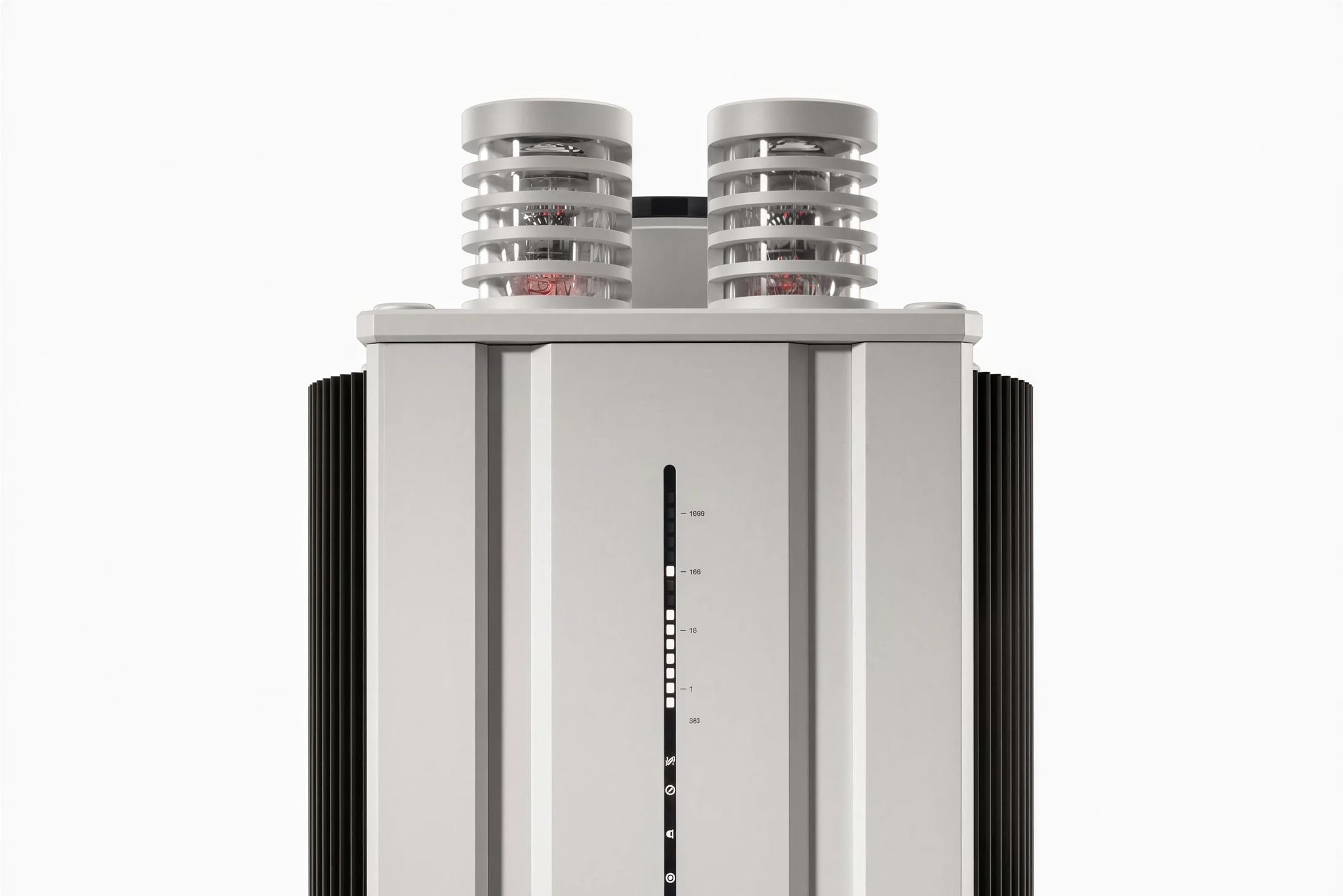
To celebrate its fortieth anniversary in 2018, T+A chose to build the final link in the chain, the one that receives the signal from the preamplifier and supplies the speakers with the energy that moves their cones. The result is a 52 kg monoblock that combines tubes at the input and transistors at the output, with two operating modes to choose from depending on the speakers and listening level. Stereo listening requires two units, one per speaker.
An anniversary edition that remains in the range
The full name, M 40 HV Anniversary Edition, sums up the project: “40” for the four decades of the manufacturer from Herford, in Westphalia, and “HV” for High Voltage, the brand’s technique that runs the transistor stages at high voltages to improve linearity and bandwidth. Originally announced for the anniversary year alone, the M 40 HV remains part of the HV series, where it is T+A’s most powerful amplifier, above the A 3100 HV stereo amplifier. It is a natural partner for preamplifiers from the same series (P 3100 HV, SDX 3100 HV, PSD 3100 HV), but accepts any high-end preamplifier via its RCA and XLR inputs.
6SN7 tubes at the input, transistors at the output
A power amplifier consists of three successive stages: an input stage that receives the signal, a voltage stage that amplifies it, then a current stage that supplies the current needed to drive the speakers. T+A entrusts the first to selected 6SN7 tubes, configured as a balanced differential amplifier in an all-tube cascode circuit. They operate in class A, meaning that their elements conduct continuously rather than sharing alternating halves of the signal: distortion is kept as low as possible, at the cost of heat generated even when no music is playing.
The following voltage stage uses high-voltage field-effect transistors (J-FET) whose behaviour resembles that of a triode, again operating in pure class A. This stage provides all of the unit’s gain, by a factor of 50. The current stages, by contrast, do not amplify the voltage (gain of 1): they receive the signal through MOSFET driver transistors, then pass it to twenty ring-emitter bipolar transistors, chosen for their ability to deliver high currents over a wide frequency range.
T+A chose to dispense with any global negative feedback, the process that feeds part of the output signal back to the input to correct amplifier errors. Here, linearity comes from components matched and calibrated in-house for each unit. The measurements published by the brand specify a frequency response of 1 Hz to 150 kHz, a slew rate of 65 V/µs (how quickly the output voltage follows abrupt changes in the signal), a signal-to-noise ratio greater than 114 dB and distortion below 0.009% at 5 W into 4 Ω.
A choice of two supply voltages
A slide selector on the rear changes the voltage supplying the output stages, and with it the amplifier’s character. In High Current mode, the output stages operate at ±50 V and their quiescent current more than doubles: the M 40 HV then delivers up to 60 W in pure class A, followed by up to 250 W in class AB, a mode in which the transistors take turns handling each half of the signal once the class A region has been exceeded. T+A recommends this mode with high-efficiency speakers and for listening at normal levels, which covers most domestic situations.
High Power mode applies the full voltage of ±100 V. Rated power rises to 550 W into 8 Ω and 1,000 W into 4 Ω (570 and 1,070 W peak), and exceeds 1,500 W into 2 Ω. The brand recommends it with speakers whose impedance exceeds 6 Ω and whenever a large power reserve is needed, for example with low-sensitivity floorstanding speakers in a large room. The figures of 60 W in class A and 250 W in class AB therefore apply only to High Current mode.
Two current amplifiers in a single chassis
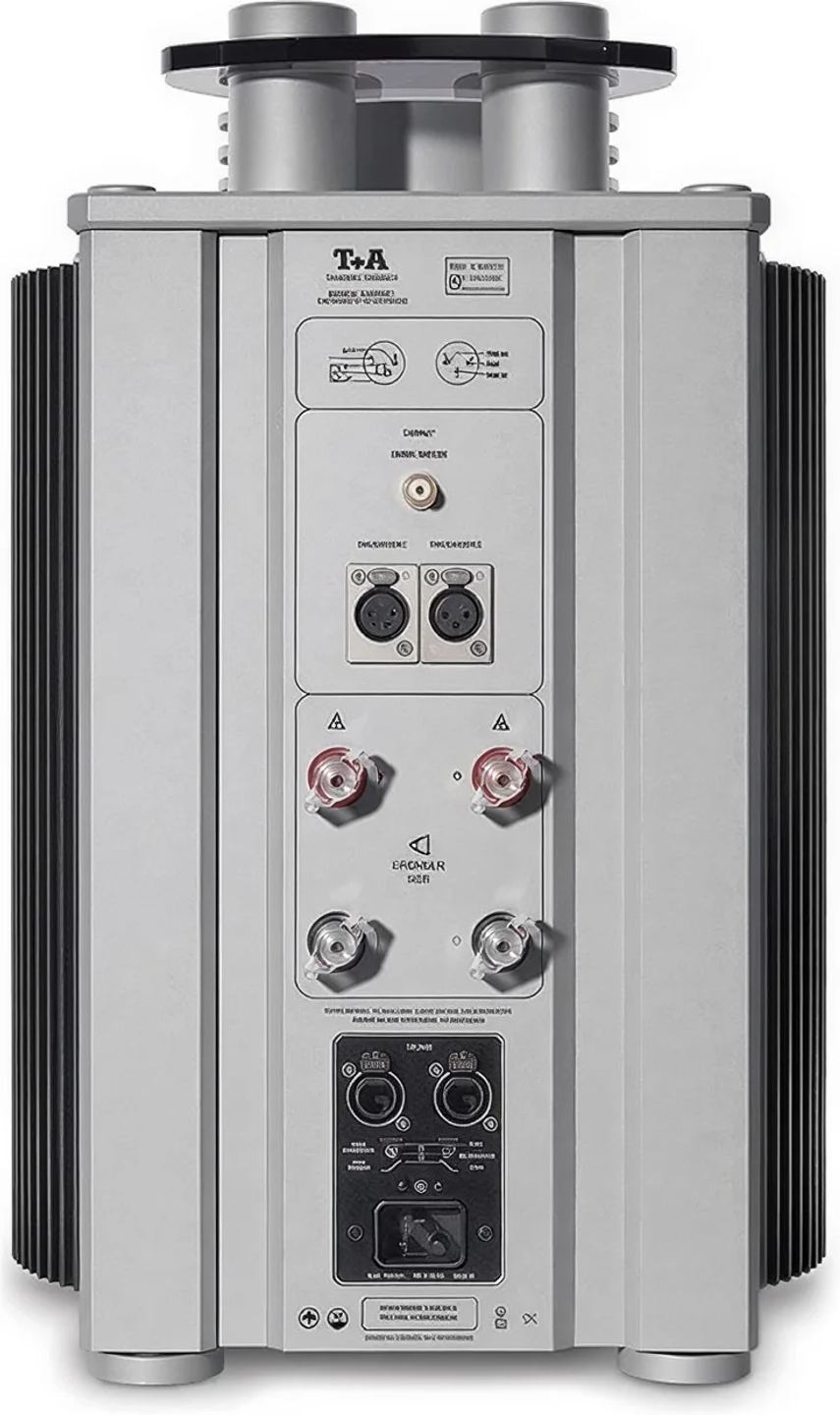
Each M 40 HV contains two independent current stages, each capable of 1,000 W and each connected to its own pair of rhodium-plated pure brass binding posts. By default, these two stages operate in parallel and combine their current-delivery capacity. The four output relays then work together, lowering the amplifier’s internal resistance and raising the damping factor above 115 into 4 Ω. This factor reflects the amplifier’s ability to brake the speaker cone once the signal has passed: the higher it is, the more tightly controlled the bass. With speakers equipped with a single pair of binding posts, the two outputs can be connected using two separate cables; with two pairs of binding posts, bi-wiring remains possible in this mode.
In the bi-amplification position, each stage handles part of the spectrum: one powers the bass, the other the midrange and treble, on speakers equipped with two pairs of binding posts with their jumpers removed. A pair of M 40 HV units is therefore enough to bi-amplify a stereo system, without adding an amplifier.
Three shielded power supplies
The power supply comprises three separate units, each with its own low-radiation toroidal transformer. The first, regulated with stability better than 10 ppm, serves the tube circuits exclusively. The other two, rated at 1,000 W each, power the two current stages and draw on more than 180,000 µF of filter capacitors, an energy reserve that handles musical peaks without the voltage collapsing.
The transformers occupy a shielded steel compartment at the bottom of the enclosure, away from the amplification section, where all materials are non-magnetic. The tube stage rests on a cradle isolated from the power section, and each tube is surrounded by a grounded shielding cylinder machined from solid aluminium. The two output stages are mounted on either side on one-piece extruded aluminium heatsinks, whose mass is sufficient to dissipate the heat: the M 40 HV operates without a fan, and therefore silently. The enclosure combines a screw-fastened aluminium outer shell with an internal chassis that supports the steel subassemblies.
At 56 × 36 × 47 cm and 52 kg per monoblock, installation requires two people, on the floor or on furniture capable of supporting this weight, leaving space for airflow around the heatsinks. The front panel is available in silver or titanium lacquer, with black heatsinks, and the HV Individual programme offers other colours to order.
Start-up, protection and control
A unit this powerful cannot switch on all at once without causing the mains voltage to drop. A microprocessor therefore manages a gradual power-up, then continuously monitors the mains voltage, internal voltages and temperature, as well as the presence of DC voltage, short circuits or overloads at the speaker outputs. In the event of an anomaly, the fault is shown on the built-in display and the speakers are protected.
The main switch offers three positions: fully off, permanently on and AUTO. In AUTO, the amplifier starts up when it detects a music signal, receives a control voltage (trigger from +5 to +20 V) or is activated via T+A’s H-Link bus, which connects the brand’s units using an RJ45 cable. A brief press of the front-panel button mutes or restores the speaker outputs; a long press changes the VU meter from peak display to average-value display, then switches it off.
At the rear, three inputs are available for the preamplifier: unbalanced RCA, balanced 3-pin XLR and 4-pin XLR, a format used by T+A to carry both the balanced signal and the power-on command in a single cable. The M 40 HV is supplied with a C19 mains cable and an H-Link cable. Its power consumption can reach 2,500 W at peak and falls below 0.5 W in standby.
Documentation
Technical specifications
Technology and amplification stages
- Amplification technology: hybrid tubes / transistors
- Input stages: 6SN7 tubes in pure class A
- Voltage stages: high-voltage junction field-effect transistors (J-FET HV) with triode characteristics, in pure class A
- Current stages: MOSFET driver transistors and 20 Ring Emitter bipolar transistors
- Class A operation: up to 60 W
- Class AB operation: up to 250 W
Power and audio performance
- Rated power:
- 550 W into 8 Ω
- 1000 W into 4 Ω
- Peak power:
- 570 W into 8 Ω
- 1070 W into 4 Ω
- Frequency response: 1 Hz – 150 kHz (+0 / –3 dB)
- Slew rate: 65 V/µs
- Damping factor: > 115
- Signal / noise ratio: > 114 dB
- Harmonic distortion: < 0.009% (5 W, 4 Ω, 1 kHz)
Connections and external control
- Audio inputs:
- 1 × unbalanced RCA
- Balanced 3-pin XLR
- Balanced 4-pin XLR
- Trigger input: +5 to +20 V for external power-on
Power supply and consumption
- Power supply: 110–150 V / 60 Hz or 220–230 V / 50 Hz
- Power supply filtering capacitance: 180000 µF
- Maximum power consumption: 2500 W
- Standby power consumption: < 0.5 W
Dimensions and weight
- Dimensions (H × W × D): 56 × 36 × 47 cm
- Weight: 52 kg
Frequently Asked Questions
Can the M 40 HV be connected directly to a player or streamer?
The M 40 HV has no volume control: it amplifies everything it receives at a fixed gain. It therefore requires an upstream preamplifier or a source with a variable-level output. The SDX 3100 HV and PSD 3100 HV from the HV series combine a network player, converter and preamplifier, and can directly drive a pair of M 40 HV units.
What electrical setup is needed for a pair?
Each unit can draw up to 2,500 W at peak, or 5,000 W for a pair, exceeding what a 16 A domestic circuit can supply (around 3,700 W). These maximum values are only reached at very high volume levels and with demanding loads, but it is wise to have an electrician assess the power supply to the listening area, ideally with a dedicated circuit for each unit. The supplied C19 power cord fits an inlet designed for high currents.
Does the 4-pin XLR input work with a preamplifier from another brand?
This format is exclusive to T+A. With a preamplifier from another brand, the standard 3-pin XLR input or the RCA input is used. Automatic power-on remains possible through signal detection or the trigger input.
Does the M 40 HV get very hot?
Yes, especially in High Current mode, where the more than doubled idle current keeps the output stages hot even at low volume; this is characteristic of Class A. The absence of a fan means air must be allowed to circulate around the side heat sinks, and enclosed cabinets or low shelves should be avoided.
Should I plan to replace the tubes?
Tubes are components that age with hours of use, unlike transistors. Since T+A selects and matches the components of each unit at the factory, replacement is preferably carried out by the brand’s after-sales service, using selected 6SN7 tubes rather than tubes chosen at random.
Can the M 40 HV be used in a home theater system?
Yes, as an amplifier for the front left and right channels after a processor or a home theater amplifier equipped with preamp outputs. The connection is made via XLR or RCA, and power-on can follow that of the processor via the trigger input. The M 40 HV remains a single-channel amplifier: it adds nothing to the system’s other channels.
Can you mix High Current and High Power modes on the two amplifiers in a pair?
Both units in a stereo pair must operate in the same mode; otherwise, the left and right channels would have neither the same power headroom nor the same behavior. The choice is made once based on the speakers and is reviewed if you change speakers or rooms.
- Eco-contribution included in the sale price.