T+A PSD 3100 HV silver


Specifications and features


Overview
A network player, DAC, tuner and preamplifier fit here into a single 26 kg chassis, handling all the source and control functions of a high-end system. All that remains is to pair it with a power amplifier or a pair of active speakers. Within T+A’s HV series, this model introduces the family of multisource streaming preamplifiers. It uses the brand’s in-house PCM and DSD converters and an analog stage built with discrete components.
True analog preamplification at the output
HV stands for “high voltage”: T+A powers its analog circuits at voltages well above average, so the transistors operate well below their limits and retain ample dynamic headroom on peaks. The input stages operate in Class A and are built with discrete components, with no integrated circuits in the signal path. Volume is adjusted by relays that switch precision resistors: the signal remains analog from end to end and loses no resolution at low levels, unlike digital volume control. The PSD 3100 HV also features balance adjustment, loudness compensation, which boosts bass and treble at low volume to compensate for the ear’s reduced sensitivity at these levels, and tone controls that can be removed from the circuit entirely.
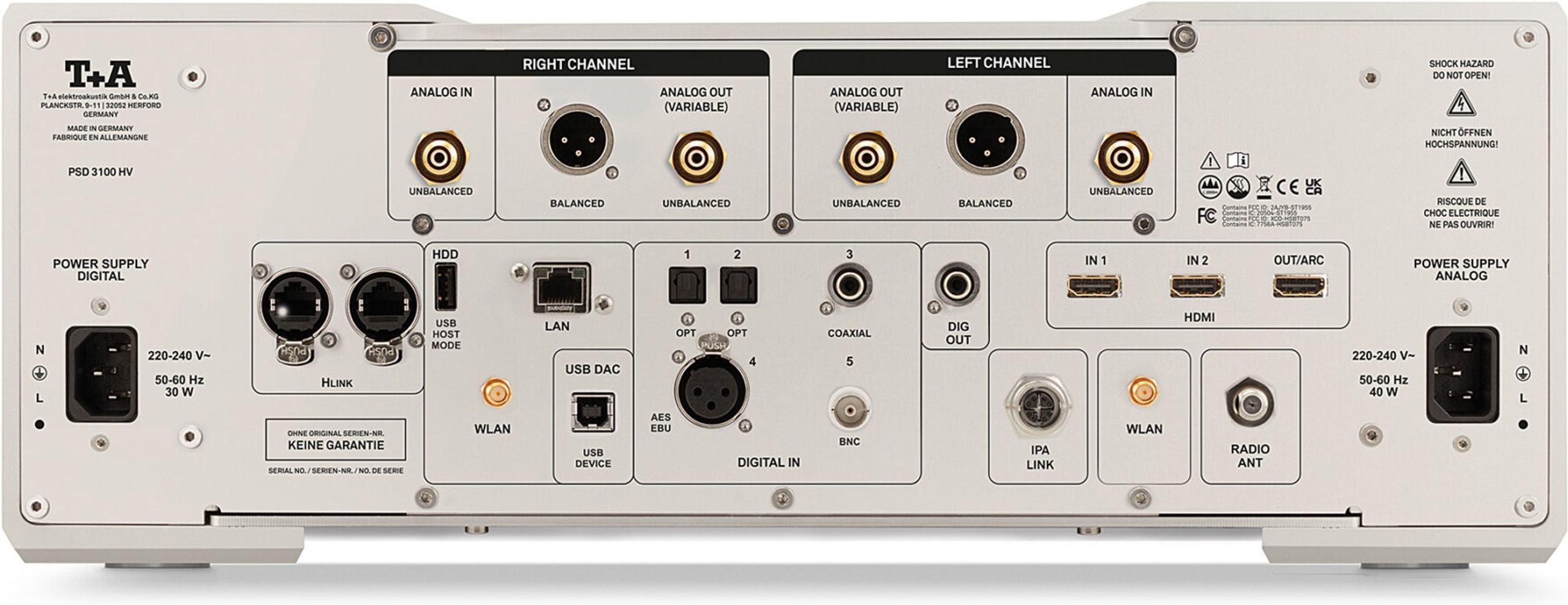
The output stages are dual mono, with a balanced XLR output and an RCA output. Their low impedance (40 and 20 Ω) allows long cable runs to the power amplifiers. Analog inputs, however, are minimal: just one RCA line input. It is sufficient for a CD player or a phono preamplifier, but you have to choose between the two.
Two separate converters for PCM and DSD
T+A does not route the two main families of digital files through the same circuit. PCM signals, used on CDs and in most high-resolution files, are handled by a quadruple double-differential converter: four 32-bit sigma-delta converters per channel work in parallel, partially canceling out their inherent noise. Conversion supports up to 768 kHz. DSD, the 1-bit format used on SACDs and in some high-resolution recordings, passes through a True 1-Bit converter developed by the brand. It is played natively, without prior conversion to PCM, up to DSD512.
For PCM, the T+A processor offers four oversampling algorithms (short FIR, long FIR, Bézier/IIR and Bézier). They alter the way the signal behaves around transients and are selected by listening. The converter’s output then passes through a third-order linear-phase analog Bessel filter, with a cutoff adjustable to 60 or 120 kHz. An in-house reference clock reduces jitter, the inaccuracies in clock timing that degrade conversion. The stated measurements remain within the series’ standards: a signal-to-noise ratio above 117 dB and distortion below 0.001%.
Separate power supplies for digital and analog sections
At the rear, two mains sockets feed two separate power supplies, one for the digital section and the other for the analog section. The two sections are physically separated inside the enclosure to prevent high-frequency noise from the processing circuits from reaching the preamplification stage. Like all devices in the HV series, the chassis is made of aluminum, with no ferromagnetic material that could disturb the transformers’ fields. Measuring 46 cm in both width and depth and 17 cm in height, the PSD 3100 HV requires a deep, sturdy rack. It is available in a silver or titanium finish.
Streaming, radio and digital sources
The third-generation streaming client is based on a quad-core processor and connects via Ethernet or Wi-Fi. It provides access to TIDAL, Qobuz and Deezer, more than 11,000 Internet radio stations via Airable, local network servers, and USB flash drives or hard drives connected to the two dedicated ports. Over the network, it plays PCM up to 384 kHz/32-bit and DSD up to DSD256. The PSD 3100 HV is Roon Ready, and Bluetooth (aptX HD, AAC, SBC) provides a fallback option from a phone. For broadcast radio, a DAB+ and FM tuner with RDS completes the package. Control is handled via the F 3100 remote control or the T+A MusicNavigator app.
The digital inputs cover all common formats: AES/EBU, coaxial and BNC S/PDIF, two optical inputs, all supporting up to 192 kHz/24-bit, and a USB-B port with asynchronous transfer that accepts a computer connection up to 768 kHz PCM and DSD512.
TV, SACD player and headphones
The two HDMI inputs extract the stereo signal from a Blu-ray or SACD player, in both PCM and DSD, and the HDMI output sends the picture to the TV. With the Audio Return Channel (ARC), sound from TV programs returns to the PSD 3100 HV through the same cable. Decoding remains stereo: a film in Dolby Atmos will be reproduced over two channels. The IPA-LINK port connects to the brand’s reference SACD transport, the PDT 3100 HV, carrying its data at full resolution.
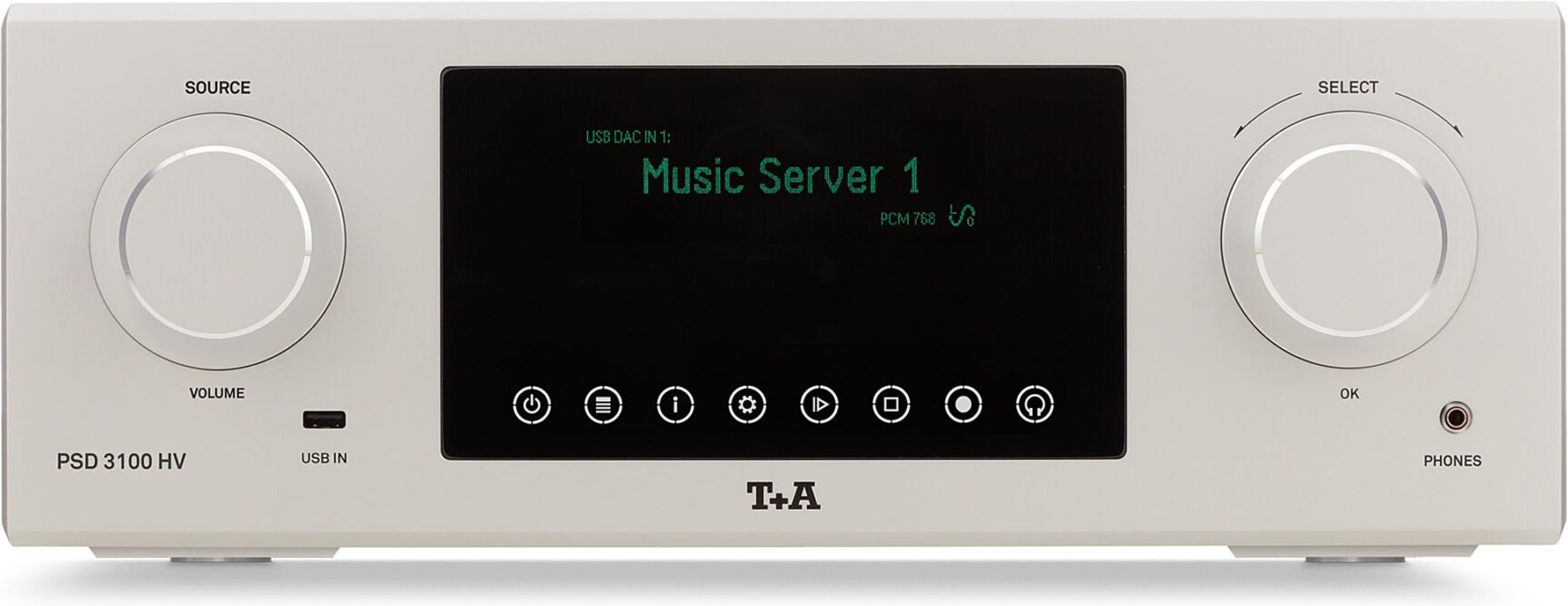
On the front panel, the balanced 4.4 mm Pentaconn headphone output is powered by a dedicated amplifier. Its 6 Ω output impedance suits low-impedance dynamic headphones as well as more demanding models.
Documentation
Technical specifications
Overview and architecture
- Type: preamplifier / network player / digital-to-analog converter (DAC)
- 3rd-generation streaming client with quad-core processor
- Class A preamplification with discrete components
- HV technology
Preamplifier
- Frequency response: 0.5 Hz – 300 kHz (+0 / −3 dB)
- Signal-to-noise ratio: 108 / 112 dB
- Total harmonic distortion (THD): < 0.001 %
- Intermodulation distortion: < 0.001 %
- Channel separation: > 108 dB
- Analog inputs:
- RCA: sensitivity of 250 mV RMS – 9 V RMS / impedance of 20 kΩ
- XLR: sensitivity of 500 mV RMS – 18 V RMS / impedance of 40 kΩ
- Analog outputs:
- RCA: 1 V RMS nominal, 9.5 V RMS maximum / impedance of 20 Ω
- XLR: 1.45 V RMS nominal, 19.6 V RMS maximum / impedance of 40 Ω
- Relay-controlled volume adjustment
- Balance and loudness adjustment functions
- Switchable tone controls
Headphone output
- 1 × 4.4 mm balanced Pentaconn headphone output
- Impedance: 6 Ω
- Dedicated high-performance headphone amplifier
PCM digital-to-analog conversion
- Quadruple double-differential converter
- 4 32-bit sigma-delta converters per channel
- Conversion rate: up to 705.6 / 768 kSamples/s
- PCM processing: up to 32 bits / 768 kHz
- T+A synchronous oversampling technology
- 4 oversampling algorithms: short FIR, long FIR, Bézier / IIR, Bézier
DSD digital-to-analog conversion
- T+A True 1-Bit DSD converter
- Native DSD conversion without prior conversion to PCM
- Support for up to DSD512 (24.5 MHz)
DAC filtering and performance
- Analog filter:
- 3rd-order linear-phase Bessel filter
- Switchable cutoff frequency: 60 / 120 kHz
- PCM frequency response:
- PCM 44.1 kHz: 2 Hz – 20 kHz
- PCM 48 kHz: 2 Hz – 22 kHz
- PCM 96 kHz: 2 Hz – 40 kHz
- PCM 192 kHz: 2 Hz – 80 kHz
- PCM 384 kHz: 2 Hz – 100 kHz
- PCM 768 kHz: 2 Hz – 120 kHz
- DSD frequency response:
- DSD64: 2 Hz – 44 kHz
- DSD128: 2 Hz – 60 kHz
- DSD256: 2 Hz – 80 kHz
- DSD512: 2 Hz – 100 kHz
- Total harmonic distortion (THD): < 0.001 %
- Signal-to-noise ratio: > 117 dB
- Channel separation: > 110 dB
Digital connectivity
- 1 × AES / EBU input: 32–192 kHz / 16–24 bits
- 1 × coaxial S/PDIF input: 32–192 kHz / 16–24 bits
- 1 × BNC S/PDIF input: 32–192 kHz / 16–24 bits
- 2 × optical TOS-Link S/PDIF inputs: 32–192 kHz / 16–24 bits
- 1 × USB-B port for the DAC:
- PCM up to 768 kHz, DSD512
- Asynchronous transfer
- 2 × USB-A ports in host mode for USB storage devices
- 2 × HDMI inputs
- 1 × HDMI output with Audio Return Channel (ARC)
- 1 × IPA-LINK input (LVDS)
Network playback and streaming
- Streaming via local network and Internet
- Network connections: Ethernet, Wi-Fi
- PCM playback: up to 384 kHz / 32 bits
- DSD playback over the network: up to DSD256
- Streaming services: TIDAL, Qobuz, Deezer
- Internet radio via Airable:
- More than 11000 Internet radio stations
- Roon Ready compatibility
Bluetooth
- Bluetooth profiles: A2DP / AVRCP 1.4
- Codecs: aptX HD, SBC, AAC
Radio receiver
- FM reception:
- Frequency range: 87.5 – 108 MHz
- FM-HD
- Sensitivity: 1 µV
- Signal-to-noise ratio: > 65 dBA
- DAB / DAB+ reception:
- Band III: 168 – 240 MHz
- DAB sensitivity: 2.0 µV
- DAB signal-to-noise ratio: > 96 dBA
- RDS / RDBS functions:
- Station name display (PS)
- Program type (PTY)
- Radio text (RT)
Power supply and consumption
- Power supply: 2 × 110–120 V or 220–240 V, 50–60 Hz
- Power consumption:
- Digital mode: 30 W
- Analog mode: 40 W
- Standby: < 0.5 W
Included accessories
- 2 × power cords
- F 3100 remote control
- BNC adapter
Dimensions and weight
- Dimensions (height × width × depth): 17 × 46 × 46 cm
- Weight: 26 kg
Frequently Asked Questions
Which amplifier should be paired with the PSD 3100 HV?
In the T+A range, HV series power amplifiers such as the A 3000 HV or A 3100 HV connect via XLR and share the same remote control. The H-Link sockets connect HV devices to each other for system control. Any power amplifier or active speaker with a line input is also suitable, since volume is controlled by the PSD 3100 HV.
Can you connect a turntable directly?
No. The only analog input is an RCA line input, with no phono stage. A turntable requires an external phono preamplifier connected to this input.
Can DSD512 be sent over USB from a Mac?
DSD512 via the USB input is only available from a Windows PC with the T+A driver installed. From a Mac or a server without a driver, the limit is lower. For network playback, the limit is DSD256.
Is FM-HD reception useful in France?
No. FM-HD (HD Radio) is a hybrid digital radio standard broadcast in North America. In France, the PSD 3100 HV receives conventional FM with RDS and DAB+, which covers a growing part of the country.
How does it differ from the other streaming preamps in the HV series?
The PSD 3100 HV is the first model in this family. The higher-end models in the HV series support conversion up to DSD1024. The SDX 3100 HV adds two balanced XLR analog inputs alongside the RCA input, and accepts an optional phono module.
Do tone controls degrade the signal?
They are switchable: when disabled, they are removed from the signal path. When enabled, they operate in the analog domain, without converting back to digital.
How much space should you allow in a cabinet?
Allow for a depth of 46 cm without cables, plus around ten centimetres at the rear for the XLR connectors and the two power cords. Given the 26 kg weight, a sturdy shelf is essential. You should also leave space above the enclosure for airflow, as the ventilation slots in the top cover help with cooling.
- Eco-contribution included in the sale price.