FLAC, DSD, MQA: understanding high-resolution audio formats
June 30, 2026
Contents
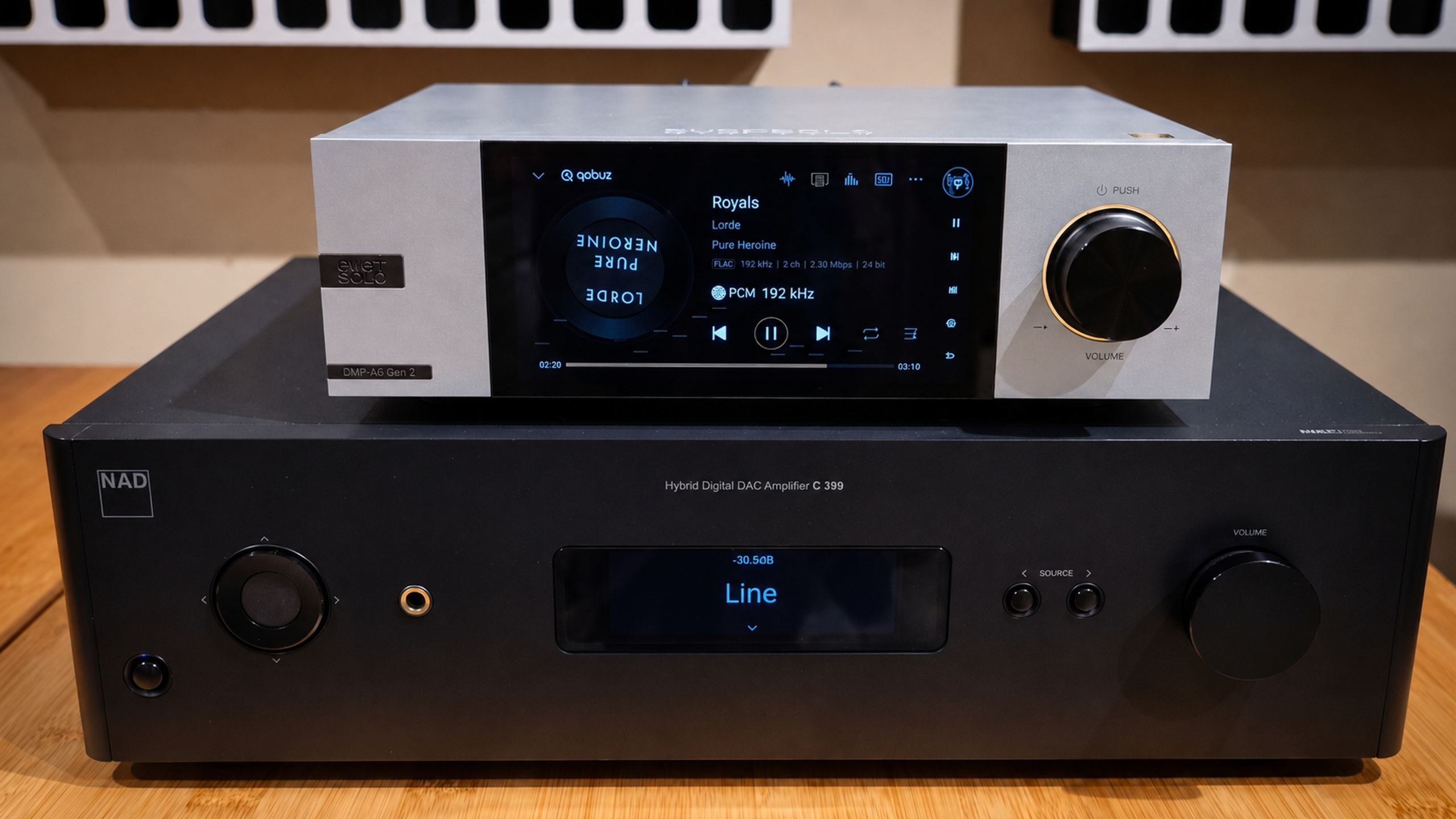
Three acronyms come up whenever high-quality digital music is discussed: FLAC, DSD and MQA. Behind these high-resolution audio formats lie opposing technical approaches, varying hardware compatibility and, for one of them, an uncertain future. This guide explains what each one actually brings to listening and how to choose based on your equipment.
Defining high-resolution audio
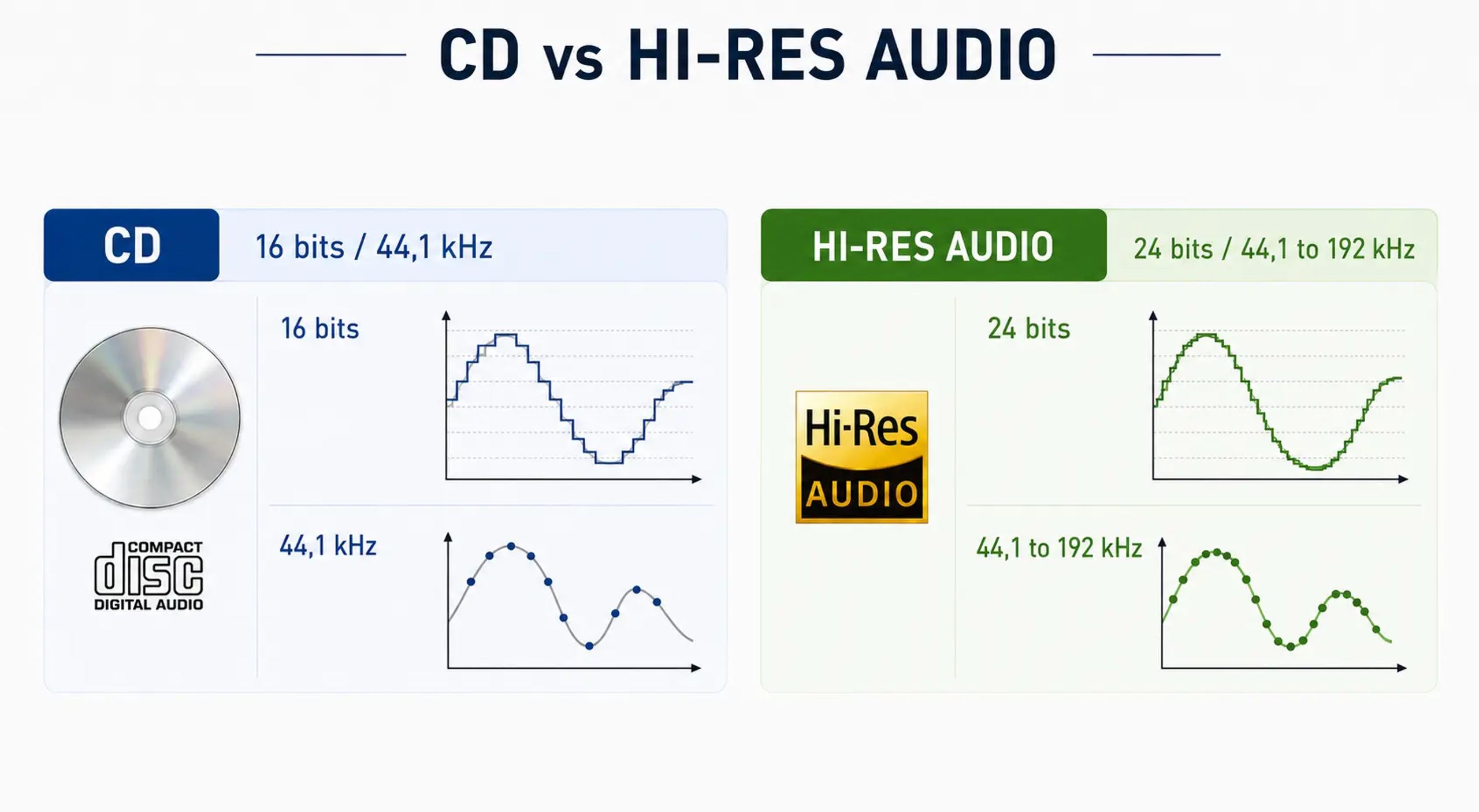
The benchmark remains the CD: 16-bit depth, sampled at 44.1 kHz. High resolution refers to anything above this threshold, most often 24 bits paired with frequencies ranging from 44.1 to 192 kHz for PCM files.
These two parameters do not measure the same thing. Bit depth determines dynamic range, meaning the difference between the quietest and loudest sounds. The sampling frequency sets the theoretically reproducible bandwidth.
One point deserves to be stated plainly: moving from 16 to 24 bits or from 44.1 to 192 kHz does not guarantee an audible difference. Recording and mastering quality often matter more than the numbers displayed on the cover. High resolution creates a larger container, not necessarily a better recording.
FLAC, an open lossless standard
FLAC (Free Lossless Audio Codec) compresses the signal without discarding anything. The file generally takes up 40 to 60% less space than an equivalent WAV, and decoding reconstructs all the original data, bit for bit. Nothing is lost in the process.
Two strengths explain its dominance. The codec is royalty-free, making it free for manufacturers and platforms to implement. And it plays everywhere: network players, smartphones, computers, DACs and recent car stereos.
It supports up to 24 bits and 192 kHz, covering virtually all masters sold as downloads. It has become the reference format for high-definition file sales and for most lossless streaming offerings.
DSD, the format derived from SACD
Launched by Sony and Philips in 1999 with the Super Audio CD, DSD (Direct Stream Digital) is based on a radically different logic from PCM. Instead of encoding amplitude across multiple bits, it uses a single bit sampled at a dizzying rate.
Its variants use a multiplier based on the CD frequency. DSD64 runs at 2.8 MHz (64 times 44.1 kHz), DSD128 at 5.6 MHz, DSD256 at 11.2 MHz and DSD512 at 22.6 MHz. The higher the number, the greater the precision, at the cost of larger files.
In practical terms, two extensions coexist. .dsf includes metadata (title, artist, cover art), while .dff does not. Choose .dsf when your player supports it.
Transmission poses a real constraint. The DSD bitrate does not pass natively over an optical or coaxial S/PDIF connection: you need a USB or HDMI connection to a DSD-compatible DAC, or a workaround called DoP, limited to DSD64. The format remains niche, sustained by SACD publishers and a few specialized download stores such as NativeDSD or HDtracks.
MQA, from a technical gamble to uncertainty
MQA (Master Quality Authenticated) offered an appealing idea: folding a high-resolution recording into a file the size of a standard FLAC, then “unfolding” it during playback through hardware or software decoding. The brand presented it as a guarantee of fidelity to the studio master.
The process has always been divisive. MQA is proprietary, and therefore subject to licensing for manufacturers and platforms. It is also not strictly lossless in the sense understood by bit-perfect purists, a recurring criticism from the audiophile community.
Recent history has decided its fate. MQA Ltd entered administration in March 2023, before Canadian company Lenbrook, owner of NAD, Bluesound and PSB, acquired its assets in September 2023. Most notably, Tidal, its main showcase, removed all MQA tracks on July 24, 2024 to switch to FLAC.
Today, Lenbrook is developing these patents under the MQA Labs banner, with new technologies such as AIRIA (formerly SCL6), FOQUS and QRONO, geared more towards signal processing and wireless transmission than a consumer streaming format. For listeners, MQA now mainly concerns owners of MQA DACs and files purchased before this reversal.
FLAC, DSD and MQA: comparison
| Criterion | FLAC | DSD | MQA |
|---|---|---|---|
| Nature | Lossless compression, open codec | 1-bit modulation, derived from SACD | Proprietary encoding with folding |
| Typical resolution | 16 to 24 bits, 44.1 to 192 kHz | DSD64 to DSD256 (2.8 to 11.2 MHz) | Up to 24 bits / 384 kHz once unfolded |
| Decoding | Universal playback | DSD-compatible DAC required | MQA decoder required for full playback |
| Streaming availability | Qobuz, Tidal, Apple Music, Amazon, Spotify | Virtually absent, download or SACD | Marginalized since Tidal’s withdrawal |
| File size | Moderate | Large | Reduced |
Choosing a high-resolution audio format
Your equipment often decides for you. A good digital-to-analog converter plays FLAC without difficulty, from any source. DSD requires a compatible chip and a USB or HDMI connection. MQA requires a dedicated decoder, increasingly irrelevant given the format’s trajectory.
For online streaming, offerings have largely standardized around FLAC. Qobuz and Tidal go up to 24 bits / 192 kHz, Apple Music offers the same ceiling through its ALAC codec, and Amazon Music Unlimited does as well. Spotify finally launched its lossless tier in September 2025, in FLAC, but capped at 24 bits / 44.1 kHz. These high-definition subscriptions cost around €11 to €13 per month.
DSD follows a different path. It is obtained by purchasing files, extracting SACDs or using a dedicated player, rather than through streaming. If you mainly listen through headphones or on a connected system, a compatible audio network player and capable high-fidelity headphones matter just as much as the format you choose.
Should you aim for the highest possible definition
The race for megahertz is somewhat misleading. A poorly mastered DSD512 file will sound worse than a 24-bit FLAC from a carefully recorded production. The format is only one link in the chain, and rarely the most decisive one compared with the quality of the recording, the master and the rest of your Hi-Fi system.
In practice, FLAC has established itself as the pragmatic solution: open, universal and sufficient for the human ear in virtually all cases. DSD retains its place among SACD enthusiasts and users of specific catalogs. MQA, meanwhile, increasingly belongs to the past of streaming, even if its patents are finding a second life in signal processing. The right approach is not to chase the highest number, but to match the format to equipment capable of reproducing it.
Frequently Asked Questions
What is the difference between FLAC and DSD?
FLAC encodes amplitude at 16 to 24 bits at frequencies from 44.1 to 192 kHz, with lossless compression. DSD uses a single bit sampled at a very high rate (2.8 MHz and above). FLAC plays everywhere, while DSD requires a compatible DAC and a USB or HDMI connection.
Is MQA truly lossless?
No, not in the strict sense. MQA reduces file size through a folding process that is not 100% reversible, unlike FLAC. The brand claimed fidelity to the studio master, but the debate over bit-perfect reproduction has never been settled in its favor within the audiophile community.
Do you need a special device to listen to DSD?
Yes. Native DSD playback requires a DAC equipped with a compatible chip and a USB or HDMI connection, as the data rate cannot pass through a standard optical or coaxial link. A workaround called DoP exists on computers, but it remains limited to DSD64, the lowest resolution in the family.
Can you really hear high resolution?
It depends on the system and the recording. On a revealing setup and with a carefully mastered track, some people perceive a difference in smoothness or spaciousness. On modest headphones or via Bluetooth, the gap compared with a CD-quality file often remains inaudible. Mastering generally matters more than resolution figures.
Which format should I choose to get started?
FLAC. It is lossless, royalty-free, supported by almost all hardware, and available on most lossless streaming platforms. It offers the best balance of quality, compatibility, and simplicity, without requiring any particular hardware investment to enjoy it.
Popular products
You may also like to read
 Canton Movie 200 and Movie 400: two 5.1 speaker packages to simplify your home theater setupHi-fi and home cinema news
 Best subwoofers of 2026 for music and moviesComparisons and buying guides
 Sonos Beam Ultra review: everything has been rethought, and you can hear it from the very first listenProduct reviews
 Roberts Revere: a new range of DAB+ radios with Bluetooth and CD playersHi-fi and home cinema news
 XGIMI Titan, Titan Noir and Titan Noir Pro: what are the differences between the three projectors?Comparisons and buying guides
 Sonos 27: ChatGPT, Claude and Gemini take control of your Sonos speakersHi-fi and home cinema news