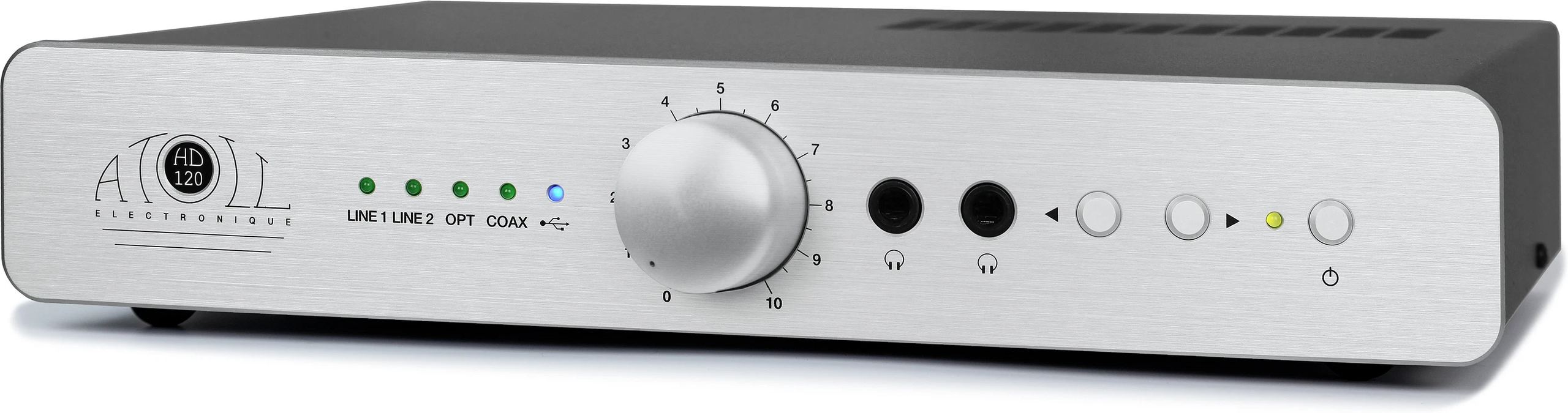
The Atoll Electronique HD120 combines three main functions: a preamplifier, a headphone amplifier, and a digital-to-analog converter. It uses a Class A architecture with discrete components. It supports digital signals up to 32 bits/384 kHz and offers connectivity including Bluetooth. Its power output allows it to be used with a wide range of headphones.
Technical Architecture: Excellence Through Discrete Components
Pure Class A transistor audio stages (without operational amplifiers)—this purist approach immediately sets the HD120 apart from its competitors. Atoll has made the bold choice to avoid any integrated circuits in the audio section, favoring an architecture entirely based on carefully selected bipolar transistors.
The power supply forms the foundation of this remarkable architecture. Three independent linear transformers (including two ultra-low-noise units dedicated to analog audio in a dual-mono configuration) ensure optimal separation between the digital and analog sections. This setup, unusual in such a compact device, eliminates any interference between the different circuits.
The power system stands out with 8 regulated power supplies (including 4 specific to the audio stages), guaranteeing exemplary stability. The total filtering capacity of 12,425 µF provides a substantial energy reserve, particularly beneficial during complex musical passages.
High-end CLARITY CAP MKP coupling capacitors contribute to sonic transparency. These audiophile-grade components, renowned for their neutrality and durability, preserve the integrity of the audio signal throughout its path.
Modern Connectivity and State-of-the-Art Digital Conversion
The digital heart of the HD120 is built around the Burr Brown PCM5102 converter, a Texas Instruments chip renowned for its musicality. This DAC offers a direct current output, a technique favored for its superior linearity.
The management of digital signals impresses with its versatility:
- The coaxial input accepts signals up to 32 bits/384 kHz
- The optical and asynchronous USB-B inputs handle 24 bits / 192 kHz
- Bluetooth connectivity, absent on the HD100, uses a direct i2S link to optimize quality
The USB interface requires installation of a specific XMOS driver under Windows, downloadable from the Atoll website. This driver is not needed for Mac and Linux, as these systems natively recognize the device.
The two analog inputs on RCA connectors allow integration of traditional sources. Volume control is handled via an ALPS potentiometer, a benchmark for precision and durability.
Audio Performance: Musicality in the Service of Emotion
Atoll delivers firm, highly defined bass. Its enviable articulation provides a solid foundation for the musical message. This characteristic is a direct result of the Class A design and the generous power supply.
The frequency response, ranging from 1 Hz to 150 kHz, far exceeds the audible spectrum, ensuring exemplary phase response in the useful range. The 1.5 µs rise time demonstrates the speed of the circuits, essential for accurate transient reproduction.
This definition is also found in the midrange, combining tonal accuracy and fluidity. Vocals benefit from a natural presence, without artificial coloration. Acoustic instruments retain their authentic timbre.
The distortion rate, below 0.01% at 1 kHz, guarantees remarkable signal purity. The signal-to-noise ratio of 112 dBA ensures a silent background, allowing you to appreciate the micro-details of recordings.
Evolution from the HD100: The Improvements That Make a Difference
The HD120 represents a significant evolution from the already acclaimed HD100 model. It offers, in addition to the Atoll HD100: 1 asynchronous USB-B input at 24/192kHz (instead of 96kHz) and a Bluetooth receiver.
The improvement in USB resolution is a major asset for audiophiles using high-resolution files. The jump from 96 kHz to 192 kHz allows you to fully exploit modern studio recordings and high-definition streaming services.
The addition of Bluetooth meets contemporary usage needs. While this type of connection remains of lower quality compared to a wired connection, it offers appreciable convenience for casual listening from a smartphone or tablet.
The signal-to-noise ratio increases from 100 dB on the HD100 to 112 dBA on the HD120, a significant improvement resulting in an even quieter background and better resolution of fine details.
Headphone Amplification: Power and Control for All Models
With a nominal power of 1.4 W / 32 Ω and a peak capacity of 6.8 W / 32 Ω, the HD120 has ample reserves to drive the vast majority of headphones on the market.
The exceptionally low output impedance of 1 Ω is a major advantage. This feature ensures optimal headphone control, particularly in the bass range, and maintains a linear response regardless of the headphone’s impedance.
There are users who are satisfied with the HD120 paired with an AKG K701, which is already a demanding headphone. User feedback confirms compatibility with a variety of models:
- AKG K701, K702, K712, Q701
- Sennheiser HD598, HD599, HD660
- Focal Clear MG, Elear
- Grado SR225, SR325
The two 6.35 mm headphone outputs allow for simultaneous listening. The HD100 has only one amplifier but its power is sufficient to accommodate two headphones in parallel—the same principle applies to the HD120.
Synergy with the MA100: Towards an Exceptional Compact Hi-Fi System
The HD120 finds its natural complement in the MA100 power amplifier. It delivers 2×60 W of power into an 8-ohm load. It operates in Class A up to 10 W; beyond that, it switches to Class AB.
The connection is made simply via the HD120’s RCA preamp output. The 12V trigger output allows for synchronized power-up of both devices, simplifying daily use.
Operation is straightforward: follow the manufacturer’s recommended wiring and flip a small switch on the back of each MA100 for mono configuration. This setup allows you to achieve 120W per channel with two MA100s.
The HD120/MA100 combination forms a compact system with remarkable performance. The system skillfully brings out the liveliness of the music; this trio creates a delightful synergy, combining performance and precision to convey the music’s subtlety.