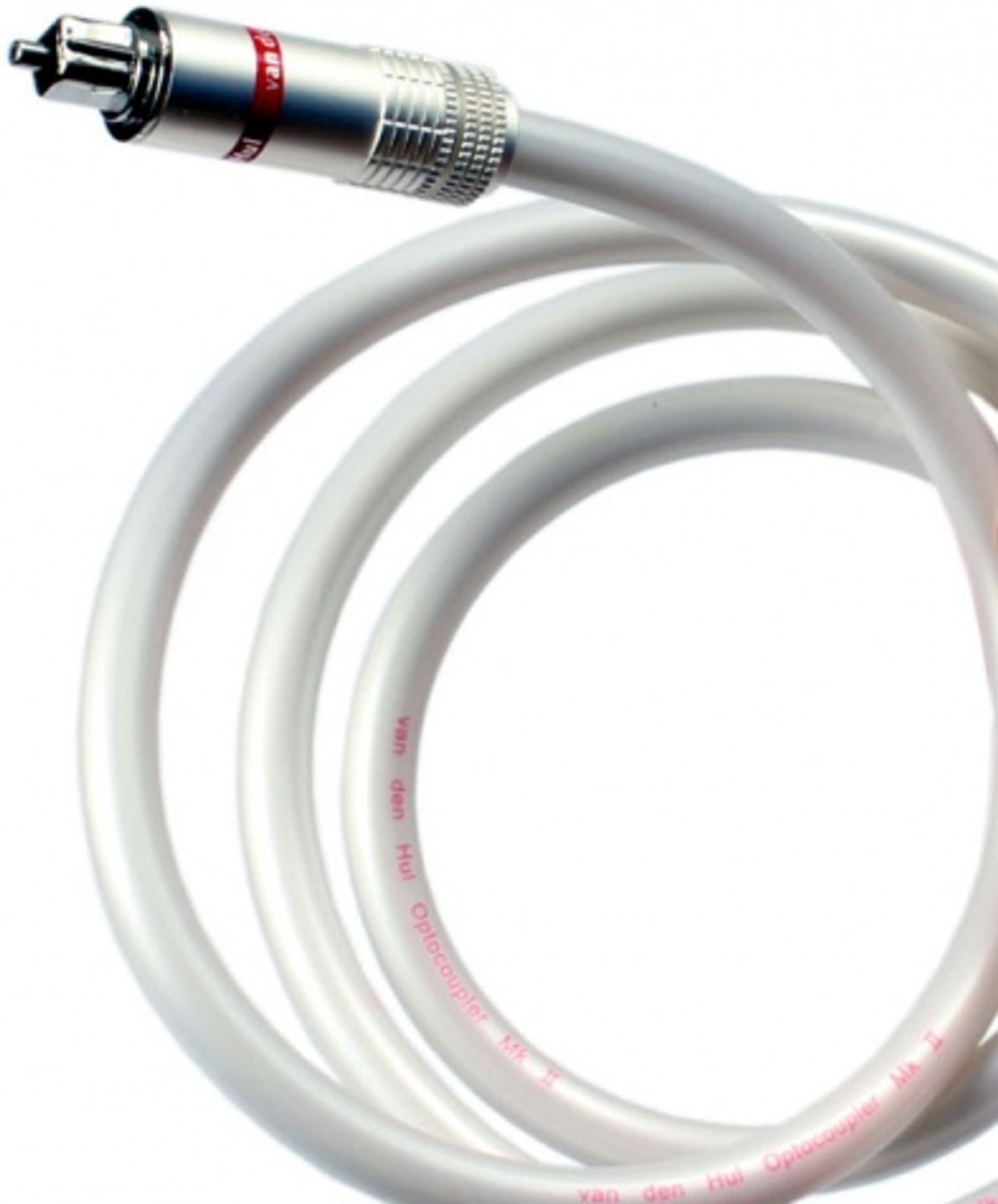
The optical link between source and converter often remains a neglected weak point in an audio chain. Yet transmission quality directly affects the level of jitter received by the digital-to-analog converter. This is precisely the issue the Dutch company set out to solve with the Optocoupler MKII, a Toslink cable whose design is based on an optical principle rarely used in this field: fiber ends shaped as convex lenses.
An optical principle serving digital fidelity
In a conventional optical fiber, light bounces against the inner walls at different angles, thus traveling paths of varying lengths. This phenomenon, called modal dispersion, causes a temporal spread of light pulses which, once the signal is converted, results in increased jitter.
The Optocoupler MKII circumvents this limitation thanks to its convex, spherical lens-shaped ends. When light enters the fiber, it is focused rather than scattered. Van den Hul claims a 50% reduction in internal reflections per unit length, which shortens the effective path of the light and reduces the time spread between the different rays. The D/A converter therefore receives a cleaner signal with fewer timing fluctuations.
This convex geometry also improves the contact between the fiber and the optical components of the devices (transmitter and receiver). The lens surface conforms better to the interface, minimizing insertion losses.
Construction and handling
The Toslink connectors on the Optocoupler MKII feature fully metal bodies, ensuring a secure fit in the sockets and better durability than standard plastic plugs. The cable guarantees a transfer capacity of 250 Mbit/s, sufficient for all common digital audio streams.
The intrinsic optical isolation of the fiber naturally eliminates any electrical or magnetic interference: ground loops, mains noise, or surrounding radiation have no impact on the signal. Optical fibers also have the advantage of not degrading over time, unlike certain metallic conductors that are sensitive to oxidation.
The trade-off for the lens-based design lies in its relative fragility. Van den Hul recommends handling the cable with care and never forcing when inserting the plugs. If mating proves a bit tight, an infinitesimal amount of lubricant (without touching the lens itself) can make the operation easier. For cleaning the ends, only a soft optical cloth is suitable.
User reviews
Norbert
Optical cable providing high definition, but on my system it produces a bright sound and once the amplifier is warmed up, the treble is too prominent even after reducing it by three quarters.
In short, it is not well suited for my usage. I remain convinced that in a different configuration it could give satisfaction considering the resolution of details it provides.
Comment from February 19, 2024 — Experience from February 08, 2024
Automatically translated — Show original (French)
Câble optique donnant une grande définition, mais sur mon système donne une sonorité montante et une fois l'ampli chaud, les aigus sont trop présents même après les avoir réduits des trois quarts.
Bref, il ne convient guère à l'usage que j'en fais. Je reste persuadé que dans une autre configuration il pourrait donner satisfaction compte tenu de la résolution des détails qu'il apporte.
Alban
At the top, much better than everything else, it's simple, small, good cheap optics.
Comment from July 03, 2022 — Experience from June 12, 2022
Automatically translated — Show original (French)
Au top, bien meilleur que tout c'est simple petit optique bon marché.