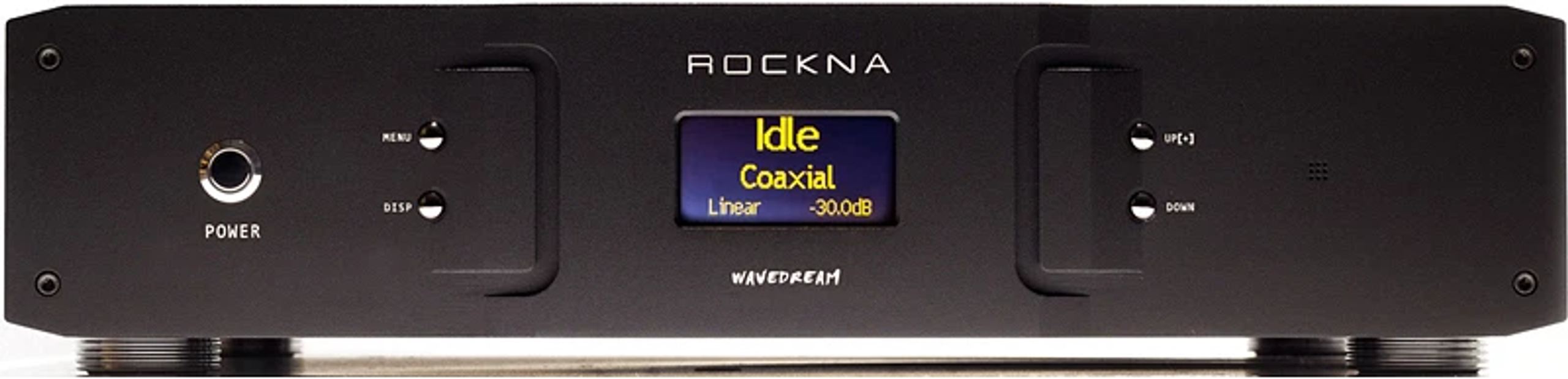
Proprietary Software Architecture
We have always believed that high-end audio is a matter of innovation. Playing with off-the-shelf chips is certainly fun and allows for producing good sound at a low cost, but to design a high-end product, this immediate approach is not suitable. Of course, a proprietary solution was chosen, free from the limitations of available components, allowing us to design and develop a complete digital audio system from A to Z.
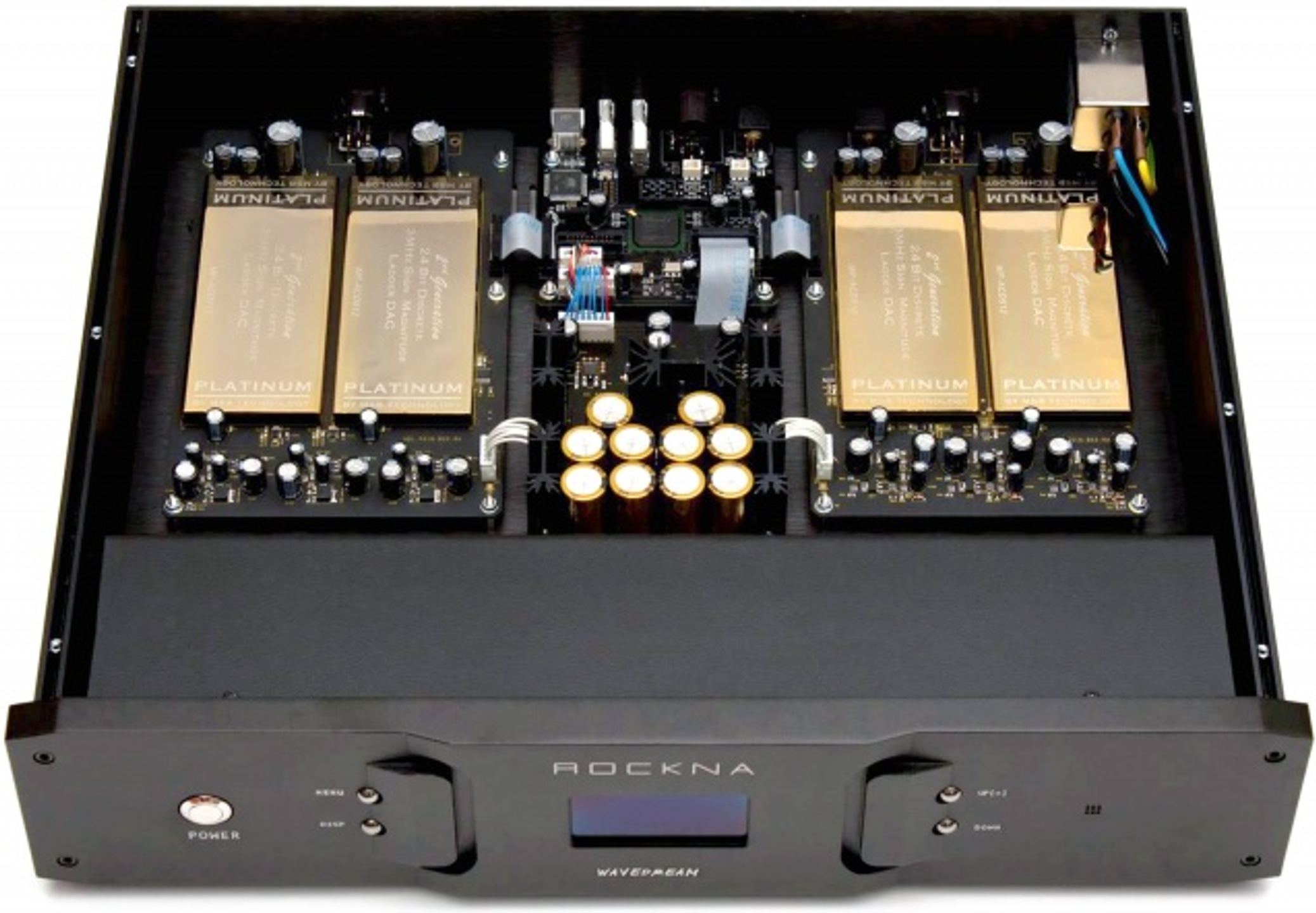
All the logic blocks of the Wavedream DAC converter concerning the digital process are entirely built on a single programmable silicon card: an FPGA. With an FPGA, the entire internal hardware architecture can be described by a program that has become complex over time. Any improvement of the Wavedream through new software actually changes the hardware. This system allows great flexibility, keeps us from obsolescence, and allows us to improve the reproduction of the converter by simply modifying its internal architecture, refreshing its characteristics, or improving existing ones.
The Femtovox Clock System
The clock is the heart of a digital reproduction system. Its precision and jitter rate are critical data for sound quality. Only an excellent clock is truly capable of leading to an analog output from your converter. If it is defective, digital harshness will be caused and musicality will be severely impaired. In addition to the performance of the clock itself, another characteristic is also critical: the clock tree (the clock distribution architecture) inside the DAC. The jitter rate that really matters is not only related to the performance of the clock itself, but to the clock that actually times the conversion operation, which could be called the conversion clock. The clock that manages the conversion section depends on the clock tree which not only usually determines its quality, but often conditions and alters it. A poorly designed tree can significantly degrade the quality of the input clock to the conversion section even if the performance of the latter is very high.
Based on these principles, we have designed an advanced clock system for Wavedream called Femtovox. The implementation of Femtovox guarantees a very low jitter rate at the input of the conversion clock. Its unique architecture is such that the conversion clock is directly synthesized at the input of the DAC, without any conditioning, with low and constant jitter and for any sampling frequency. The clock accuracy is controlled with a precision of about 1 ppb and the jitter is displayed at about 300 fS. Probably the lowest jitter rate currently recorded in the world.
Proprietary Digital Filtering
The Wavedream upsamples any signal by a constant factor of 16. The DAC decodes the digital stream at a frequency of 768 kHz or 705.6 kHz depending on whether the incoming stream is based on a frequency of 48 kHz or 44.1 kHz. For us, this is the optimal frequency to obtain the best analog performance from the conversion modules. Behind this simple factor (x16) hides a huge and powerful process. The digital filters are realized by the combined work of 58 DSP blocks resulting in an amazing processor with a power equivalent to 15 GMACS.
Filtering
The filtering we have developed is unique. We avoided standard Nyquist filters that did not provide the expected performance for the DAC. After multiple mathematical simulations and attentive listening sessions, we created our own oversampled Parks-McClellan filter. The current software offers three variations: linear phase, minimum phase, and hybrid phase.
These are highly optimized filters, offering stunning performance with a large number of taps (5000) and differing in impulse response. In “Linear Phase”, the resonant energy (Gibb’s overshoot) is evenly distributed before and after the impulse. “Minimum Phase” shows all the energy after the impulse while our special “Hybrid Phase” offers a combination of both linear and minimum responses, exhibiting very low overshoot before the impulse.
Digital-to-Analog Conversion
For the digital-to-analog conversion itself, we have developed dedicated conversion modules: RD-0 used in a 27-bit structure in the Signature version and RD-1 in 26 bits in the Edition version. The modules are complex technological realizations, sharing a hybrid ladder topology with discrete components, powered by a complex algorithm implemented in their own FPGA. The software managing the conversion modules can be updated for both performance and feature relevance. Currently, the RD 0/1 can support a maximum sampling frequency of 6 MHz, which is the maximum sampling frequency specified in the industrial domain of audio conversion. No buffer is present at the output of the conversion modules, for the benefit of maximum transparency and naturalness of sound reproduction.
Output Stage
The last stage on the signal path being the analog output stage, its contribution to the final result is of course of utmost importance. Designed from the ground up to pair with the RD-0 and RD-1 conversion modules, the output stage is entirely in discrete components and acts as an ultra-fast buffer. No surface-mount components, only through-hole, we have combined J-Fet transistors and bipolars in class A with a closed-loop impedance of less than one ohm and an equivalent noise in the order of one nV: ideal performance for a perfect match to the converter.
Power Supply
We have of course dedicated a power supply to each of the analog and digital sections. Three different transformers were required and all power supplies are linear and low noise (no switching power supplies of course!). The converter has a total of 20 linear regulators. We paid particular attention to the regulators of the conversion modules, designed from the ground up to have low impedance and ultra-low noise.