

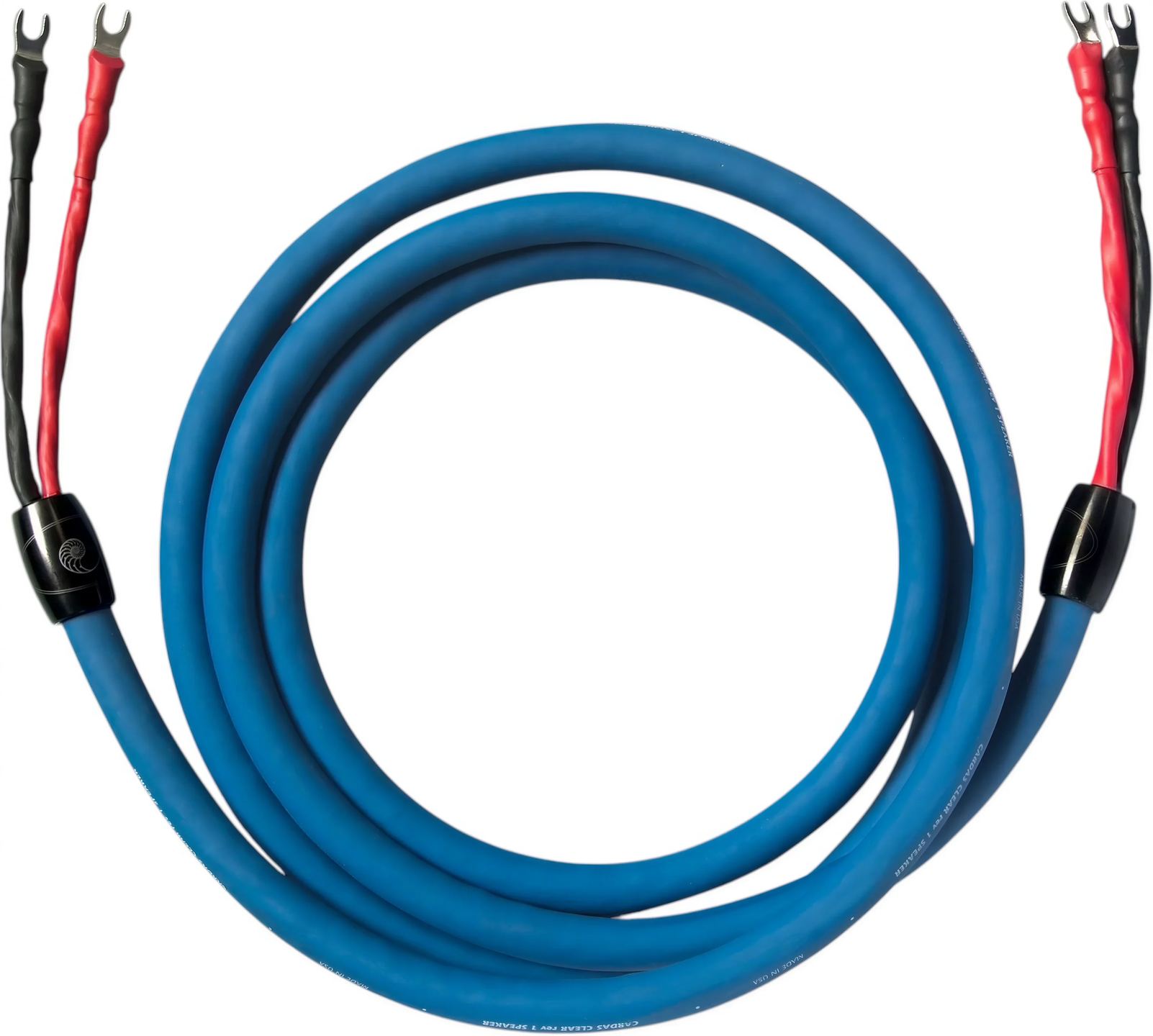
Cardas HP Clear (2 x 4m) custom


Complementary product
Overview
A strong current covering the entire audio band flows between the amplifier and the speaker, and every element of the cable affects its transfer: the metal, the insulation, the strand arrangement, the contacts. Within the Clear line from Cardas, a manufacturer based in Bandon, Oregon, this cable sits just below the Clear Beyond. It combines the brand’s Matched Propagation conductors with solder-free forged connectors for neutral, highly detailed reproduction.
Strands sized according to the golden ratio
Each conductor is made of Grade 1 oxygen-free copper, with 99.9999% purity, divided into a multitude of strands individually coated with clear enamel. This Litz wire construction insulates the strands from one another: current does not pass between them, limiting eddy currents and the skin effect, the phenomenon that pushes the signal towards the metal’s surface as frequency rises. The strand diameters, from the thinnest to the thickest, follow the proportions of the golden ratio (1.618). Strands of different diameters do not resonate at the same frequency, so their resonances do not add together. The whole assembly is wound around a Kevlar core that supports the structure and dampens mechanical vibrations.
Cardas groups these design choices under the name Matched Propagation, reserved for its high-end lines. The aim is for the signal to travel uniformly through the cable, regardless of which strand it takes, and for the insulation to disturb it as little as possible. The layers of strands are wound in alternating directions (crossfield geometry), so that their magnetic fields cancel one another out.
Four conductors in a mirrored arrangement
The cable brings together four concentrically wound conductors, two per polarity, in a perfectly mirrored quadriaxial arrangement: positive and negative occupy symmetrical positions, and both poles operate under identical electrical conditions. Antistatic fibres surround the assembly.
This construction brings the conductors close together, resulting in very low inductance. The treble retains its full extension and the bass remains controlled, even with low-impedance speakers. The trade-off is higher capacitance than in a cable with widely spaced conductors. With the vast majority of amplifiers, this has no consequences. With the few models that are unstable when faced with a capacitive load, it is best to discuss this before buying.
Fluorinated insulation beneath a flexible jacket
Each conductor is sheathed in wound FEP (fluorinated ethylene propylene) tape, an insulator from the same family as Teflon. These fluorinated polymers store very little electrical energy and release very little of it, whereas a common insulator such as PVC releases it with a slight delay relative to the signal. On the outside, a thermoplastic rubber (TPR) jacket gives the cable appreciable flexibility for a model in this category, making it easier to route behind furniture and limiting strain on the binding posts.
Solder-free connectors forged in Bandon
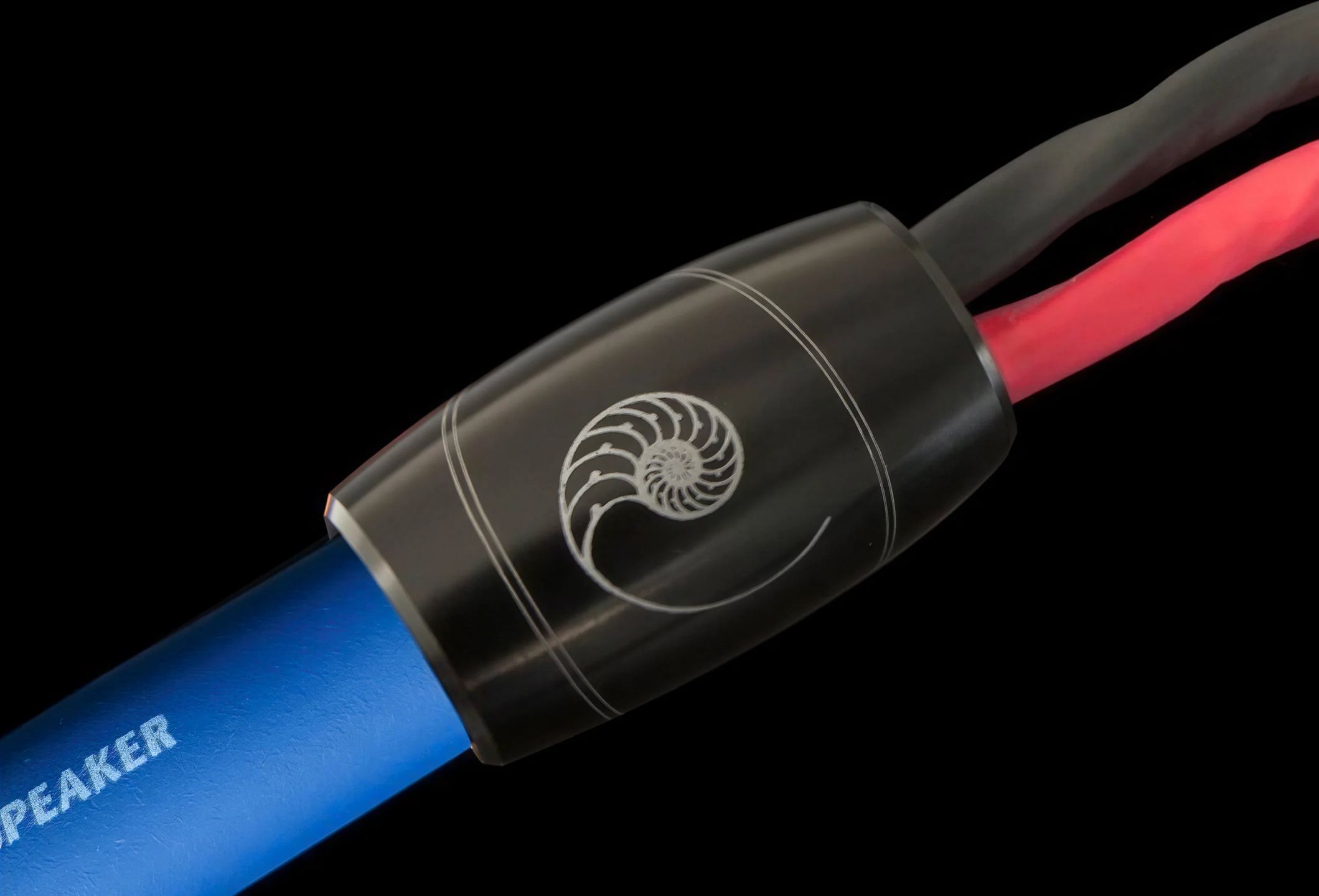
The Clear is terminated with a choice of Cardas copper banana plugs or spades, forged under a pressure of 10,000 psi (approximately 690 bar) in the Bandon workshop. Forging compacts the strands inside the connector without filler metal: the connection remains copper to copper, with no layer of tin between the conductor and the contact. The plating combines silver, an excellent conductor, with a layer of rhodium, a hard metal that resists oxidation and wear from repeated connections. These terminations cannot be dismantled: changing the connector type requires retermination in the workshop.
This degree of neutrality has its downside. The Clear adds neither warmth nor brightness, reproducing a precise stereo image and a wealth of detail, but correcting nothing. Slightly harsh electronics or a poor recording will be heard as they are.
Speakers with dual binding posts: use Clear jumpers
Unlike most Cardas speaker cables, and the Clear Reflection positioned just below it in the range, the Clear is not available in a bi-wire version. For a speaker with dual binding posts, the solution is to use Clear Jumpers in place of the original bridging plates. They use the same conductor as the cable and extend the connection to the second set of binding posts without changing technology along the way.
Technical Specifications
Conductors and Materials
- Conductors: 4 x 10.5 AWG OFHC copper (99.9999% pure)
- Kevlar core
- Matched propagation technology
- Processing: Litz wires with clear SPN coating
- Sizes ranging from 41 AWG to 25 AWG according to the golden ratio
- Insulation materials:
- Inner sheath in FEP tape (fluorinated ethylene propylene)
- Outer flexible sheath in TPR (thermoplastic rubber)
- Polytetrafluoroethylene (Teflon)
- Finishes: rhodium, silver plated
- Copper type: oxygen-free copper (OFC)
Construction and Geometry
- Conductor geometry: 4 conductors in concentric winding
- Surrounded by anti-static fibers
- Perfect mirror quad-axial configuration
- Constant ratio according to the golden ratio
- Outer diameter: 17.14 mm
- Dielectric diameter: 15.24 mm
Connectors
- Connector types: Cardas bananas or spades
- Forged under 10,000 psi in Bandon, Oregon
- Bi-wiring compatibility: not compatible
- Alternative solution: use Clear Jumpers for this application
Electrical Characteristics
- Inductance: 0.0176 µH / m / loop
- Capacitance: 278 pF / m (double wiring)
Sound Performance
- Sound signature: ultra-transparent and holographic
- Extremely musical with uncompromising detail
- Recommended use: designed for high-end systems demanding neutrality, musicality, and ultimate precision
Frequently Asked Questions
Banana plugs or spade connectors: which should you choose?
Spade connectors are suitable for screw terminals: when tightened firmly, they provide a large contact area and stay securely in place. Banana plugs are more convenient if you frequently disconnect your speakers or if the terminals are difficult to access. Check the shape of your terminals before ordering, as the termination cannot be changed afterwards.
Is this cable suitable for a tube amplifier?
Yes. Most tube amplifiers drive speakers through an output transformer, which makes them relatively insensitive to cable capacitance. Simply connect the cable to the transformer impedance tap that matches your speakers’ impedance (4 or 8 Ω).
Can the terminations be repaired or replaced?
Yes, Cardas offers retermination and repair of its cables at its Bandon workshop through your dealer. This is the procedure to follow to switch from banana plugs to spade connectors or to repair a damaged terminal.
How do you maintain the contacts?
Rhodium does not oxidize and requires no special maintenance. A clean, dry cloth is enough to remove dust. Avoid abrasive products, which would damage the plating, and occasionally retighten the screw terminals, which can loosen with temperature changes.
Which interconnect cable should be paired with the Clear?
The Clear Interconnect, an interconnect cable from the same line, is available in RCA and XLR versions. It uses the same Matched Propagation conductors, with a three-conductor geometry tailored to low-level signals, creating a consistent signal chain from source to speakers.
How can you verify the authenticity of a Cardas cable?
Counterfeit Cardas cables are in circulation, especially on online marketplaces. Buying from a brand-authorized dealer guarantees the cable’s authenticity and access to repair and retermination services at the Bandon workshop.
- Eco-contribution included in the sale price.