Russound MCA-66 black
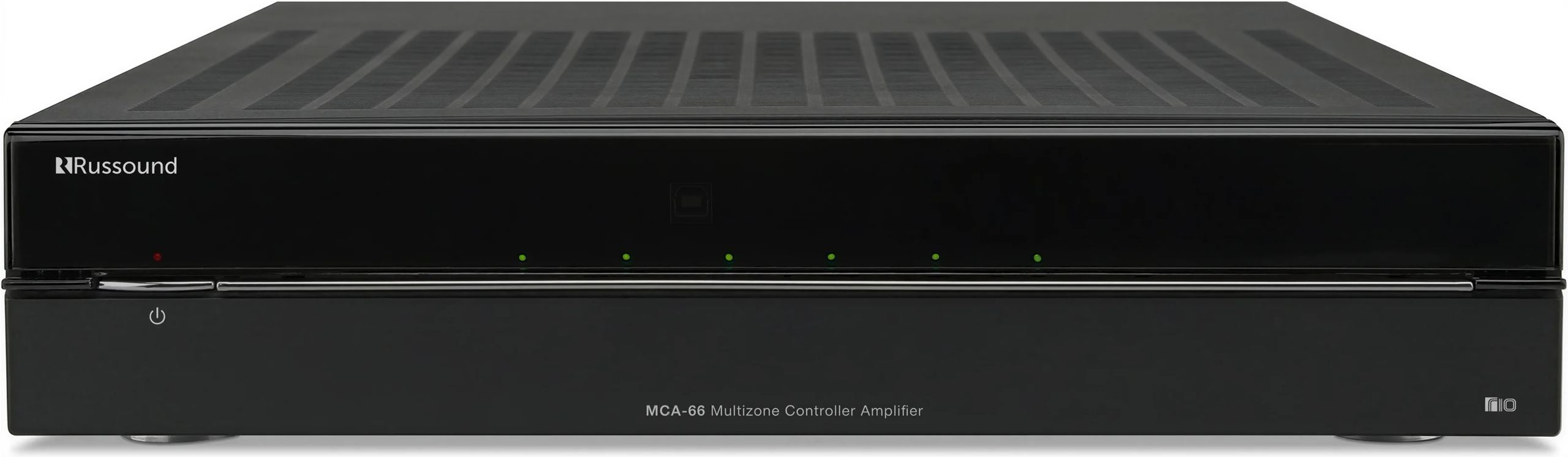
Russound MCA-66: 6-source multi-zone amplifier
Six rooms, six independent sources, all in a single 2U rack chassis weighing under 9 kg. The MCA-66 is Russound’s controller-amplifier for residential or light commercial audio distribution, with a distinctly modular approach. No superfluous features: you connect it, configure it via a web browser, and each zone listens to what it wants, when it wants.
An audio matrix designed for scalability
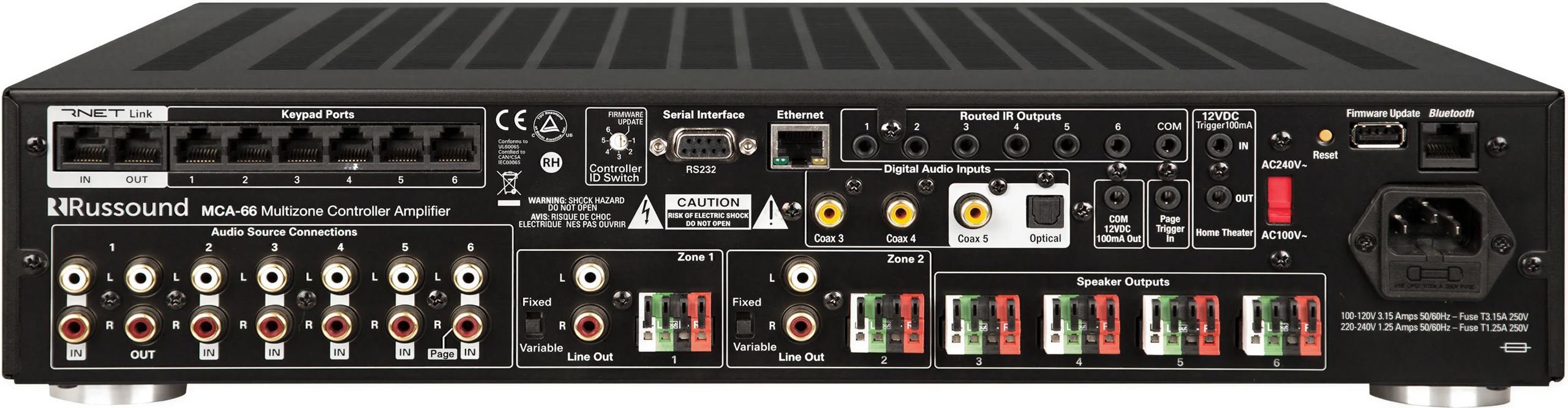
The MCA-66 works standalone or in a network. Each unit handles 6 amplified zones and 6 audio sources. Need to cover more rooms? By chaining up to six controllers via the RNET ports, the system scales up to 36 zones while sharing the same sources. Links between controllers use CAT-5e RJ-45 cable, with a maximum length of 45 cm to avoid crosstalk between IR signals.
Zones 1 and 2 feature fixed or variable line outputs, allowing you to feed external power amplifiers for large spaces or outdoor installations. The other four zones only offer speaker outputs. To work around this limitation, Russound offers an optional adapter (referenced in their documentation) that extracts a line-level signal from the speaker connectors.
Mixed analog and digital inputs
The source connectivity combines traditional and digital formats. Six stereo RCA line-level inputs accommodate any CD player, tuner, streamer, or preamp. On the digital side, there are up to three coaxial S/PDIF inputs, one of which can be replaced by a TOSLINK optical input. The total remains capped at six simultaneous inputs, with each zone choosing its source independently.
Input 6 can serve as a paging channel to connect a third-party intercom or telephone system. With Russound keypads or touchscreens, the MCA-66 displays metadata: station name, artist, track title, and album artwork, depending on the capabilities of the source used.
Remote Bluetooth via BTC-1X
There is no built-in Bluetooth receiver, but there is a dedicated port for the separately sold BTC-1X module. This receiver can be installed up to 300 feet (about 90 m) from the controller via CAT-5e cable, allowing it to be placed in the room where the smartphone is actually used, rather than in the equipment rack. The BTC-1X supports the aptX codec for audio quality superior to standard Bluetooth. It is powered directly via the network cable, with no additional power adapter.
This physical separation between the controller and the Bluetooth receiver solves a common problem in multiroom systems: the limited Bluetooth range of devices centralized in a rack.
Integrated amplification of 20 W per channel
Each zone receives 20 W RMS per channel into 8 ohms, with a frequency response of 20 Hz to 20 kHz (± 1 dB). Total harmonic distortion stays below 0.10%, and the signal-to-noise ratio reaches 96 dB A-weighted. These figures correspond to multiroom-grade amplification, not high-end audiophile gear, but sufficient to provide sound in medium-sized rooms with in-wall or standmount speakers of standard sensitivity.
For power-hungry zones (terraces, reception rooms, installations with low-sensitivity speakers), the preamp outputs of zones 1 and 2 allow you to insert an external amplifier.
Control via app and wall-mounted interfaces
The free MyRussound app for iOS and Android controls the entire system: source selection, volume adjustment, creation of zone groups, and programming of alarms and sleep timers. Zone groups created in the app are persistent: they remain even after power-off or power outages.
Initial configuration is done via Web Config, a browser-based interface accessible from any device on the same local network. The installer no longer needs dedicated PC software as was required with older C-series models.
For physical controls, the MCA-66 supports several wall keypads: the MDK-C6 with LCD screen, the simplified SLK-1, or the compact IPK-1. For more visual control, the 7-inch XTS7 touchscreen, wall-mounted, runs on Android and can also control other home automation devices (lighting, blinds).
Integration with home automation systems
The RIO (Russound I/O) protocol enables bidirectional IP communication with third-party controllers. Drivers are available for Control4, URC Total Control, RTI, Fibaro, and other platforms. The RS-232 port remains available for systems using serial control. Home Assistant natively supports the RIO protocol and automatically detects active zones and sources.
For KNX installations, the KNX-RIO-1 gateway allows KNX panels and keypads to control up to 16 zones on Russound controllers compatible with RIO.
Technical Specifications
Main Features
- 6 amplified zones (20 W per channel)
- Fixed or variable line output for zones 1 and 2
- Removable screwless speaker connectors
- Expandable up to 36 zones
- Compatible with Bluetooth wireless technology (via BTC-1X option)
- Compatible with KNX protocol (via BKNX-RIO-1 option)
- Rack mounting brackets included
Audio Performance
- Output power: 20 W RMS at 8 Ω
- Frequency response: 20 Hz - 20 kHz (± 1 dB at 1 W into 8 ohms)
- Minimum impedance: 8 Ω
- Signal-to-noise ratio: 93 dB unweighted, 96 dB A-weighted
- Total harmonic distortion: < 0.10%
Audio Inputs / Outputs
- Source inputs:
- 6 stereo RCA line-level inputs
- 2 digital coaxial inputs
- 1 digital coaxial/optical (up to 6 inputs)
- Zone outputs:
- 6 speaker outputs of 20 W / channel
- 2 fixed or variable line-level outputs
System Connectivity
- Triggering:
- Home theater: 12 V DC Input / Output
- General call: 12 V DC Input
- Common: 12 V DC Output, 100 mA
- Infrared: 6 dedicated outputs, 1 common
- 6 RJ-45 keyboard ports (T568A) with detachable 4-pin connector
Communication Ports
- USB (firmware updates only)
- RS-232 (19.2 kHz baud rate)
- Ethernet 10/100BaseT
- 2 RJ-45 RNET ports (Input / Output)
Physical Specifications
- Power supply: 220-240 V AC, 50 Hz
- Fuse: 220-240 V / T1.25A 250 V
- Dimensions (W × H × D): 43.2 × 9 × 34 cm
- Weight: 8.7 kg
Frequently Asked Questions
Does the MCA-66 have a built-in radio tuner?
No. Unlike older C-series controllers (CAM, CAV), the MCA-66 does not include an AM/FM tuner. Russound offers the external ST-1 tuner or the XSource streaming player as alternatives to be connected to one of the inputs.
Can 4-ohm speakers be used?
The specified minimum load is 8 ohms per channel. Connecting 4-ohm speakers may trigger the amplifier’s thermal protection and shorten its lifespan. For lower-impedance speakers, it is better to use the preamp outputs of zones 1–2 with a suitable external amplifier.
What is the range of the BTC-1X Bluetooth module?
The BTC-1X receives Bluetooth devices up to about 15 m (50 feet) indoors. Since it can be located 90 m from the controller via network cable, it is generally placed in the main listening room to optimize reception.
Can the MCA-66 operate without an Internet connection?
Yes. Local control via wall keypads, the MyRussound app on the local network, and XTS touchscreens does not require Internet access. Only firmware updates and certain streaming services integrated into external sources require it.
- Eco-contribution included in the sale price.