United States
EN
Contact
Account
Quote
Basket

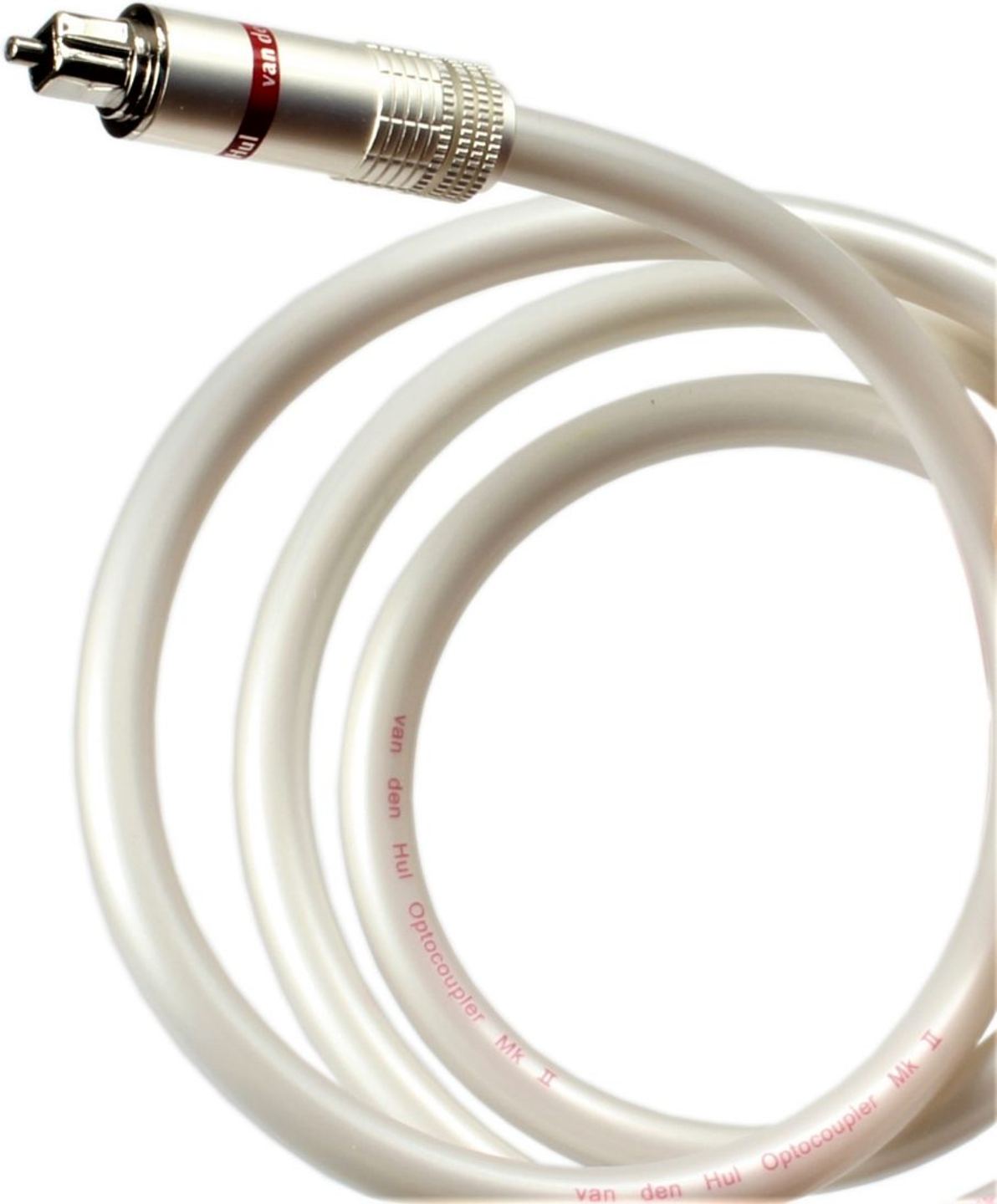
Van den Hul The optocoupler MKII 1.5m

Overview

The optical link between source and converter remains an often-overlooked weak point in an audio chain. Yet transmission quality directly affects the level of jitter received by the digital-to-analog converter. This is precisely the problem the Dutch company set out to solve with the Optocoupler MKII, a Toslink cable whose design is based on an optical principle rarely exploited in this field: fiber ends shaped into convex lenses.

An optical principle in the service of digital fidelity

In a conventional optical fiber, light bounces off the inner walls at various angles, thus traveling paths of different lengths. This phenomenon, known as modal dispersion, causes a temporal spreading of light pulses which results, once the signal is converted, in an increase in jitter.

The Optocoupler MKII bypasses this limitation thanks to its convex, spherical-lens-shaped ends. When light enters the fiber, it is focused rather than scattered. Van den Hul claims a 50% reduction in internal reflections per unit length, which shortens the effective path of the light and reduces the time offset between the different rays. The D/A converter thus receives a cleaner signal, with fewer timing fluctuations.

This convex geometry also improves contact between the fiber and the optical components of the devices (transmitter and receiver). The lens surface mates more closely with the interface, reducing insertion losses to a minimum.

Construction and handling

The Toslink connectors of the Optocoupler MKII feature fully metal bodies, ensuring a secure fit in the sockets and greater durability than standard plastic plugs. The cable guarantees a transfer capacity of 250 Mbit/s, sufficient for all common digital audio streams.

The inherent optical isolation of the fiber naturally eliminates any electrical or magnetic interference: ground loops, mains noise, or surrounding radiation have no effect on the signal. Optical fibers also have the advantage of suffering no degradation over time, unlike certain metal conductors that are sensitive to oxidation.

The trade-off of the lens-based design lies in its relative fragility. Van den Hul recommends handling the cable with care and never forcing when inserting the plugs. If the fit proves somewhat tight, a tiny amount of lubricant (without contact with the lens itself) can make the operation easier. For cleaning the ends, only a soft optical cloth is suitable.

Technical features

Optical fiber technology

  • Convex-ended optical fiber with spherical lenses
    • Reduction of internal reflections and modal dispersion
    • Minimized signal loss even when the cable is bent
    • Optimized optical insertion thanks to precise control of contact surfaces

Technical advantages

  • Data transmission capacity: > 250 Megabits/second
  • Optimized focusing of the light beam
    • The light beam entering at an angle is focused, reducing reflections against the fiber walls by 50%
    • Shorter light travel distance, reducing attenuation and propagation time between different light rays
  • Reduced modal dispersion
    • Less jitter at the digital-to-analog converter
    • Optimized end contacts to minimize optical losses
  • Full protection against interference
    • Transmission completely immune to electrical or magnetic noise and interference
    • Stable optical fibers that do not deteriorate over time

Technical specifications

  • Cable type: digital optical interconnect
  • Technology: optical fiber with convex ends
  • Interference protection: complete, no electrical or magnetic noise

Frequently Asked Questions

Can this cable be used for a multichannel home theater connection?

Toslink connections can transmit PCM stereo streams as well as compressed streams such as Dolby Digital or DTS. However, uncompressed high-definition formats (Dolby TrueHD, DTS-HD Master Audio) exceed the bandwidth of the Toslink standard and require an HDMI connection.

What should I do if the plug is difficult to insert into the socket?

Van den Hul advises applying a tiny amount of lubricant to the body of the plug, taking care not to touch the lens itself. Never apply excessive pressure, as this could damage the convex surface.

Does this cable improve the sound compared with a standard optical cable?

The improvement depends on the quality of the original cable and the converter’s sensitivity to jitter. The lens-based design aims to reduce modal dispersion and insertion losses; on a revealing system, this can result in better definition and a more stable soundstage.

Do optical fibers deteriorate over time?

Unlike metal conductors that are prone to oxidation, optical fibers do not undergo chemical deterioration. Their service life is theoretically unlimited, provided the ends are protected from shocks and contamination.

Can this cable be bent without affecting its performance?

A moderate bend radius does not significantly affect transmission thanks to the focusing provided by the lenses. However, avoid sharp kinks or crushing, which could damage the fiber.

User reviews

Eric

Good quality cable, with the advantage of being very supple and flexible

Comment from March 26, 2026 — Experience from December 26, 2025

Automatically translated — Show original (French)
Cable de bonne qualité, avec l'avantage d'être très souple et flexible
  • Eco-contribution included in the sale price.
  • Manufacturer reference: B42AL015

Van den Hul product ranges

HomeCineSolutions
Loading