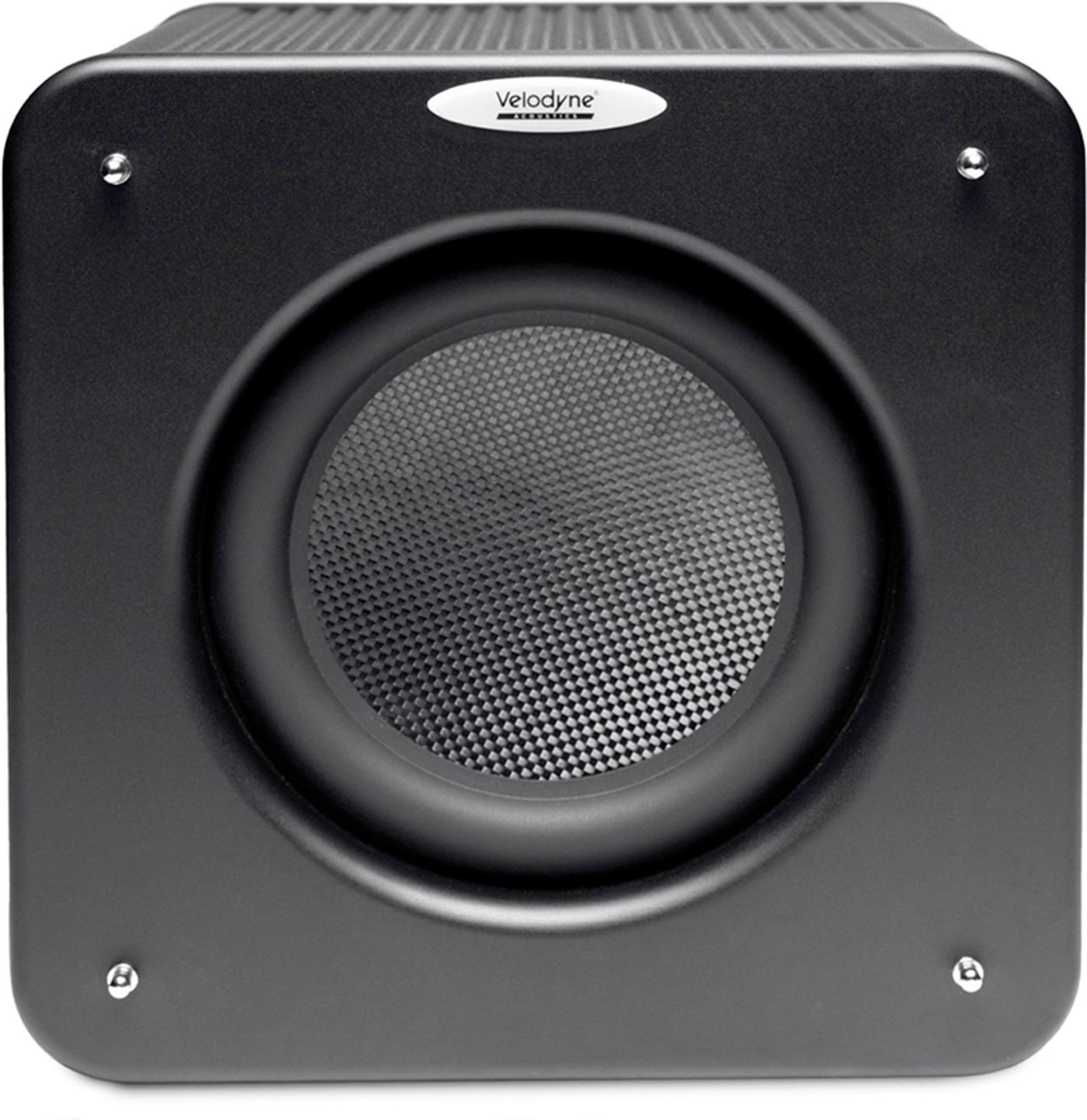
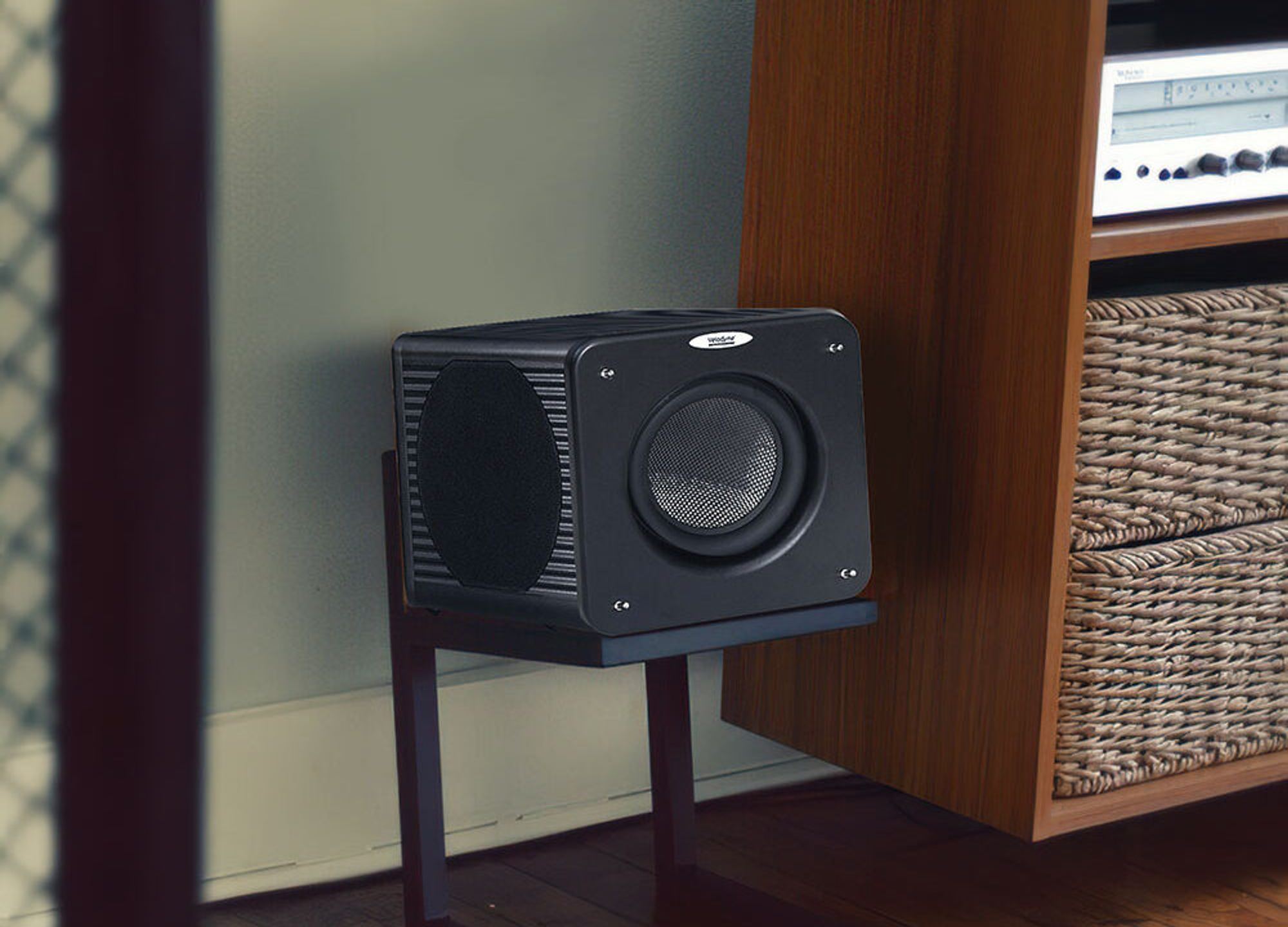
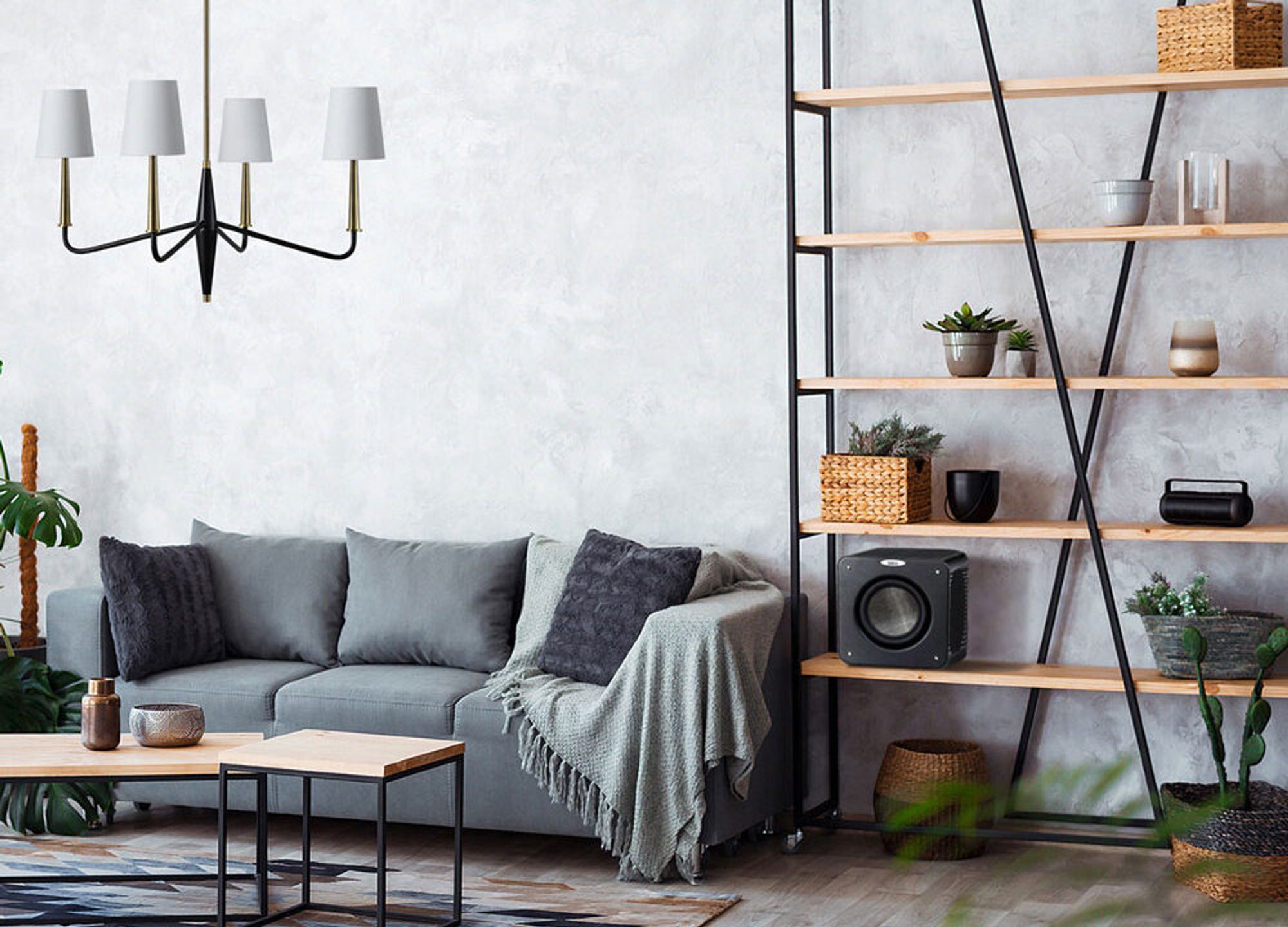
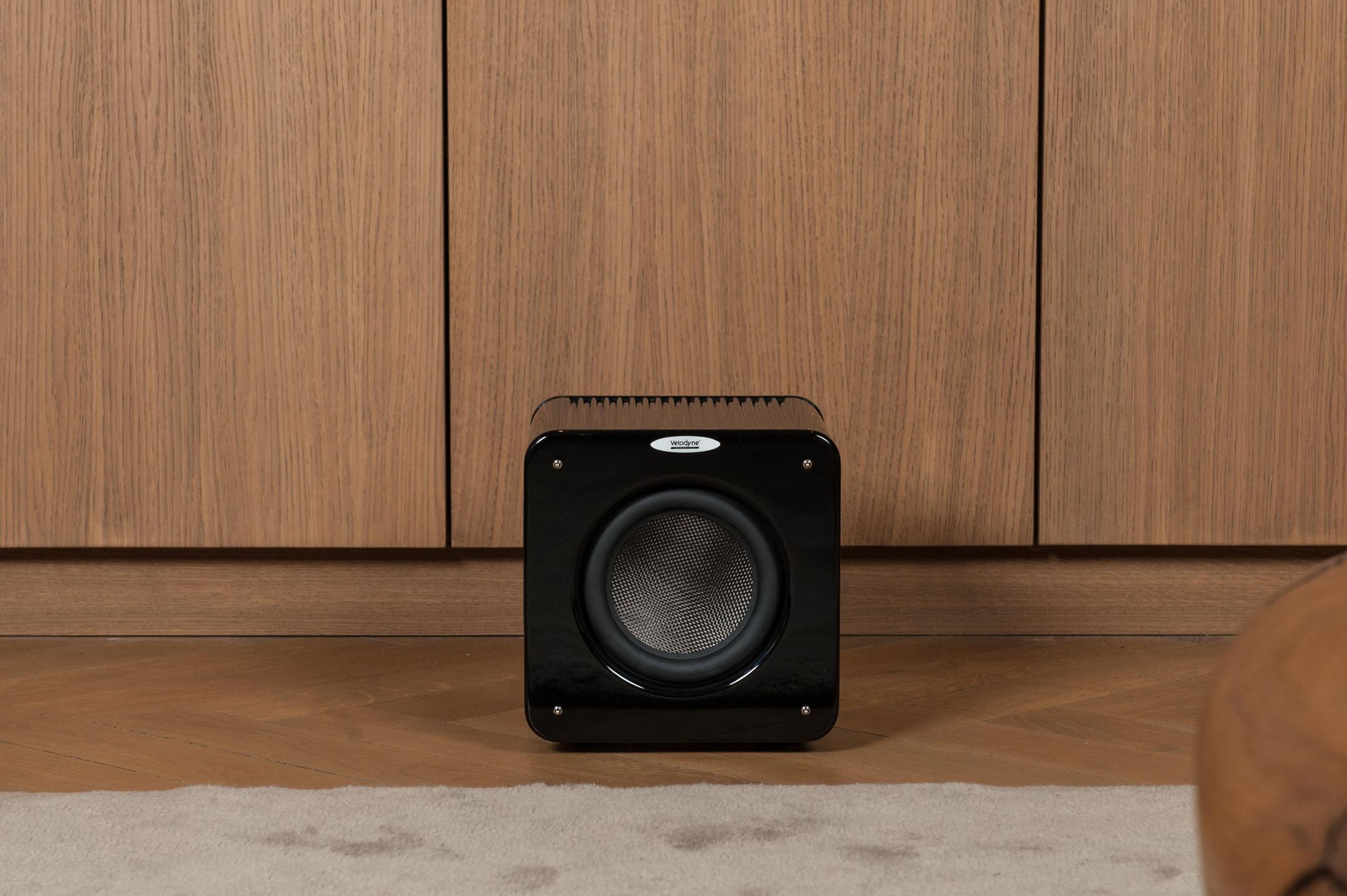
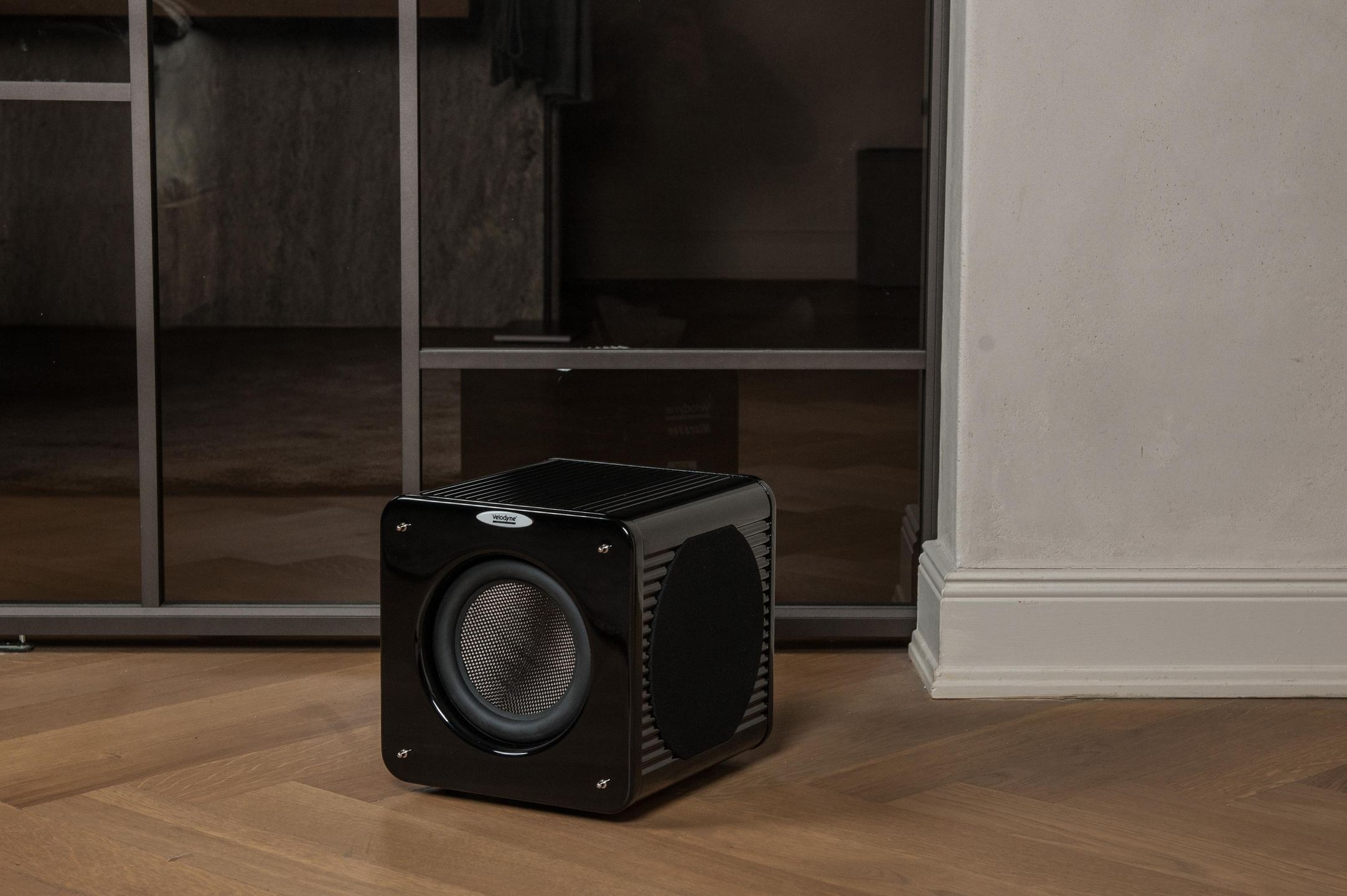
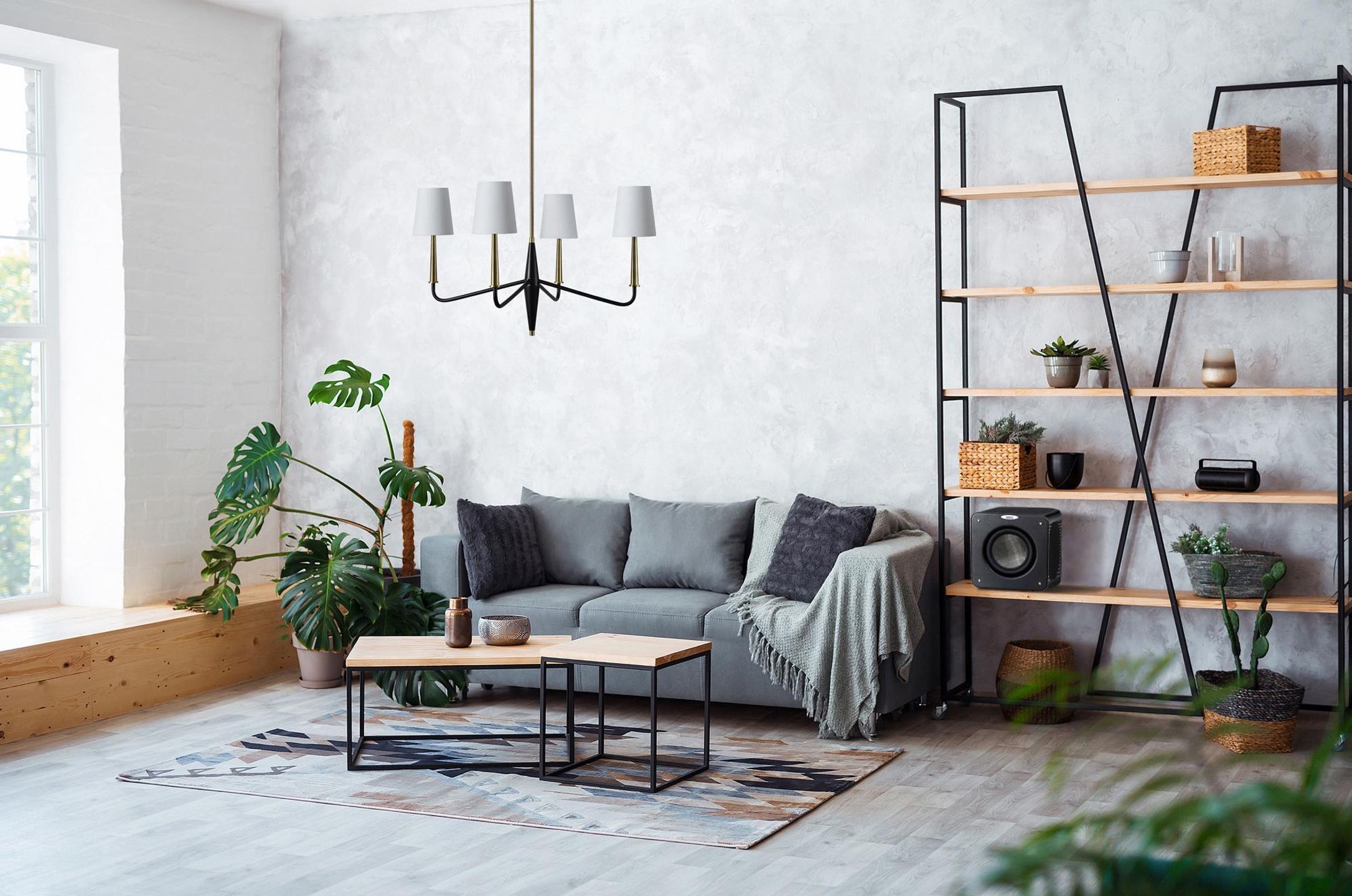
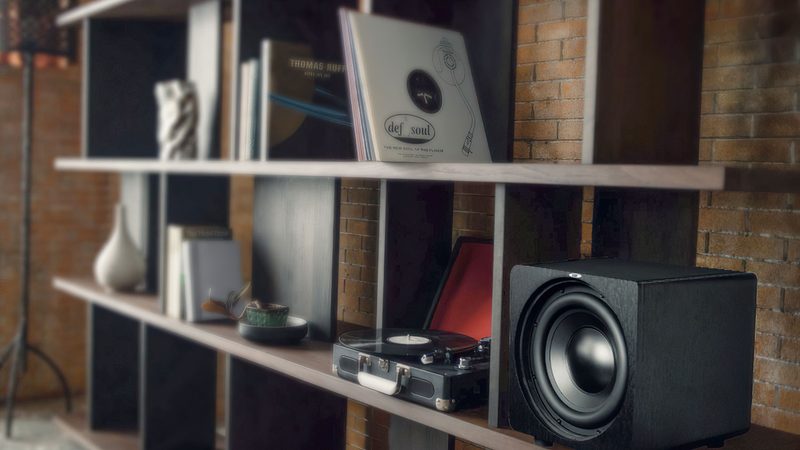
Three generations for the same challenge. Since 2006, the MicroVee range has stayed the course: fitting serious bass into a 23 cm cube enclosure. The MicroVee X builds on this principle by replacing the MKII’s aluminum diaphragms with a carbon composite, adopting a high-current Class AB amplifier, and adding an infrared remote control. The format, however, remains unchanged: a 9.5 kg aluminum cube that slips under a coffee table or behind a piece of furniture.
An aluminum enclosure machined to the millimeter
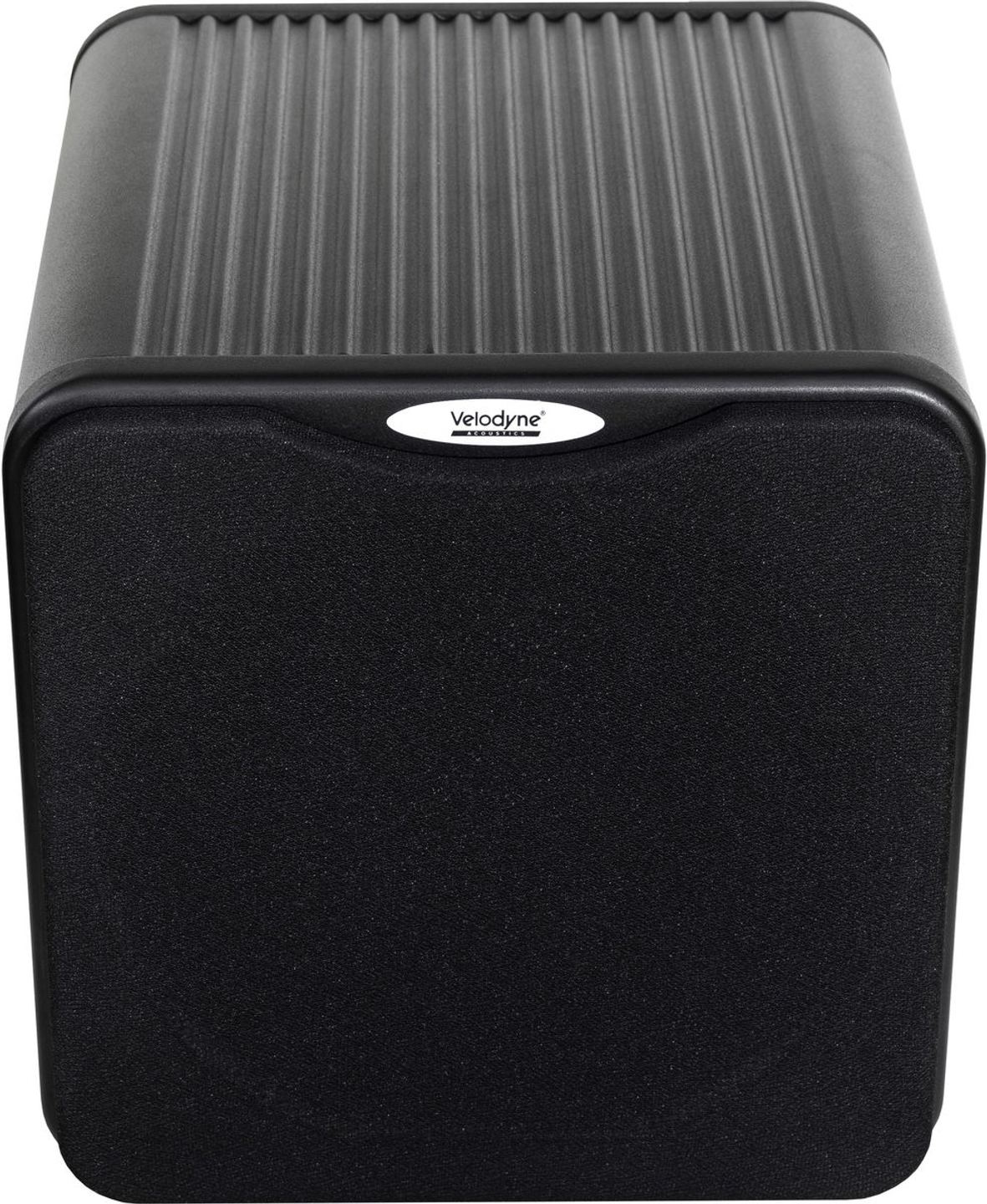
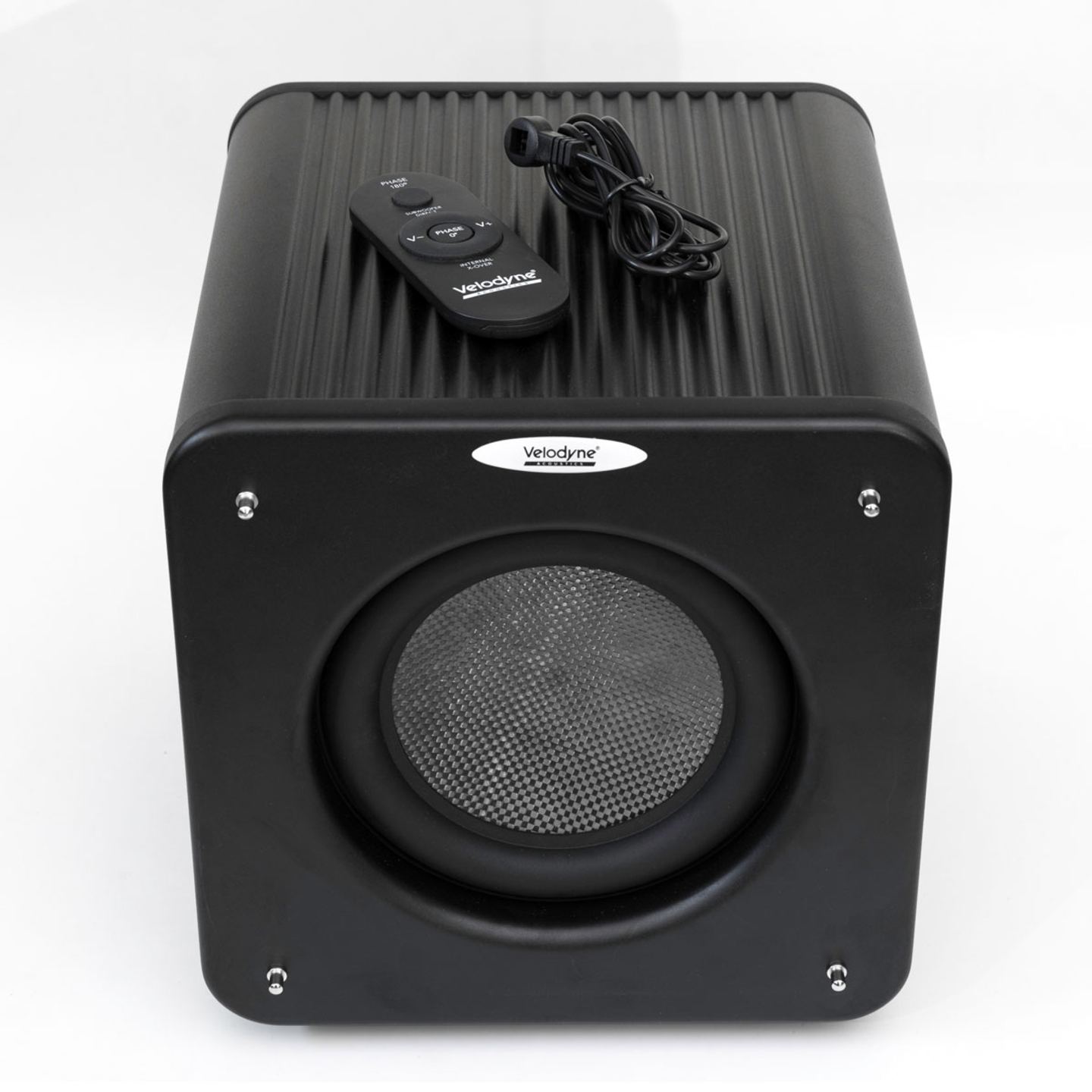
The MicroVee X’s extruded aluminum profile is not cosmetic cladding. The ribbing on the walls stiffens the structure while helping dissipate heat from the amplifier, and the rounded edges (redesigned compared with the MKII) soften the silhouette. The front grille, made of thick MDF, dampens residual vibrations. Four iso-elastomer feet decouple the enclosure from the furniture or floor it rests on, which limits the transmission of unwanted vibrations to surrounding surfaces.
At 23 x 23 x 25 cm without grille (27 cm including grille) and weighing 9.5 kg, the subwoofer can be placed easily in a TV cabinet, on a low shelf, or on the floor against a wall.
Three transducers in a compact volume
The configuration is based on a front-facing 16.5 cm long-throw active driver, supported by two side-mounted passive radiators of the same diameter. This principle is the same as on previous generations, but the diaphragms change: the carbon/Kevlar composite replaces the MKII’s anodized aluminum. This composite material is both stiffer and lighter, which reduces the diaphragm’s own resonance modes and improves transient response.
The 52 mm voice coil, wound in four layers of high-purity copper, operates in an oversized dual ferrite motor. The long-throw nitrile rubber surround allows substantial excursion without mechanical compression. The cast aluminum basket is dual-vented, preventing the moving assembly from overheating during prolonged use.
The two passive radiators, mounted on either side of the enclosure, increase the total radiating surface without requiring additional air volume or dedicated amplifier power. Their role is to extend the response toward the bottom of the spectrum (the subwoofer reaches 18 Hz in extended response, 32 Hz at ±3 dB) while smoothing the impedance seen by the amplifier.
Class AB amplification and DDCS digital processing
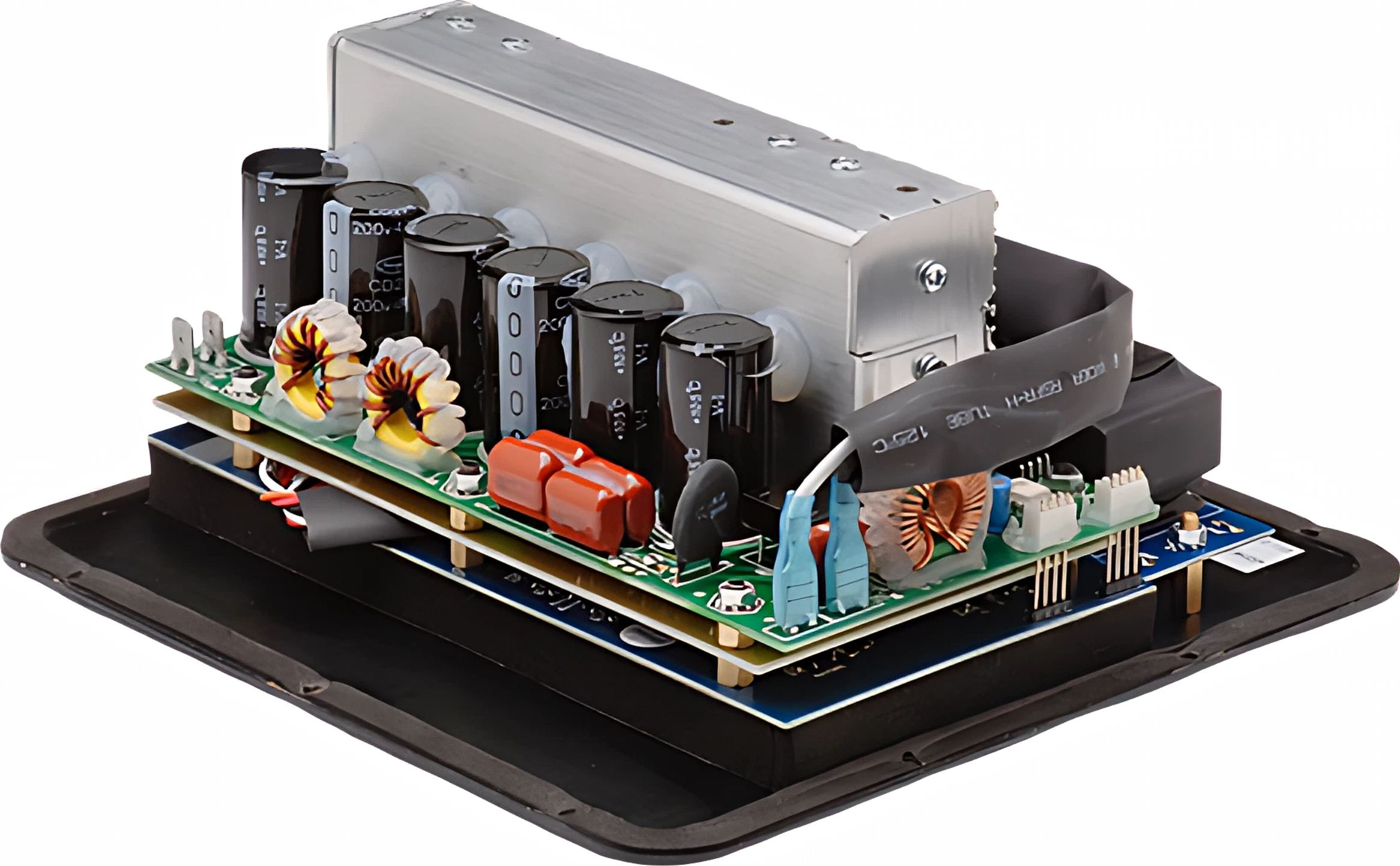
The move from the MKII to the X comes with a change in amplifier topology. The MKII used a Class D (ERS) amplifier rated at 1000 W RMS / 2000 W peak. The MicroVee X adopts Class AB with 300 W RMS power and 800 W dynamic power. On paper, the difference seems unfavorable. In practice, Velodyne states that the current capability of the new power stage (equipped with four 34 A / 180 V MOSFETs) is significantly higher than that of the MKII, and that the MicroVee X can play about 15% louder across the entire bandwidth. The switching power supply ensures high efficiency and sufficient energy reserve for signal peaks.
Digital processing is based on a high-resolution Analog Devices DSP, which manages the DDCS (Digital Drive Control System). This system, patented by Velodyne, controls the diaphragm so as to maintain linear cone movement, which reduces harmonic distortion. Velodyne claims distortion reduced to about one sixth of that of subwoofers of comparable size, a statement based on the DDCS and on the built-in anti-clipping circuit, which continuously monitors the amplifier to prevent overload.
Settings and integration into an existing system
The low-pass filter is adjustable from 50 to 180 Hz with a 12 dB per octave slope. Phase is switchable between 0° and 180°. Both settings are accessible from the rear panel, but also from the supplied infrared remote control, allowing adjustment from the listening position.
The Subwoofer Direct function bypasses the subwoofer’s internal low-pass filter. This mode is useful when the processor or home theater amplifier already handles filtering via its LFE output: the signal reaches the subwoofer without redundant filtering, which preserves phase coherence and the precision of the blend with the main speakers. The remote control allows this mode to be activated or deactivated without accessing the rear panel.
Connectivity includes stereo RCA and LFE inputs, an RCA/LFE output (to daisy-chain a second subwoofer or send the signal back to another device), and stereo high-level inputs for amplifiers without a preamp output. Auto On/Off mode puts the subwoofer into standby when it no longer detects a signal, with standby power consumption of 0.5 W.
The remote control, an addition on the MicroVee X
Previous generations of the MicroVee did not offer a remote control. The MicroVee X includes one, infrared, providing access to volume, phase, activation of Subwoofer Direct mode, and power on/off. An external IR receiver, connected to the subwoofer by a 3 m cable, allows the subwoofer to be hidden behind a piece of furniture or in an alcove while retaining remote control. This receiver can be placed on the front of the furniture or near the listening position.
This detail has real practical value: setting up a subwoofer (volume, crossover frequency, phase) is ideally done by ear from the listening point, and being able to adjust these parameters without getting up speeds up the process.
Frequency response and physical limits
The stated frequency response extends from 18 Hz to 300 Hz in extended bandwidth, and from 32 Hz to 180 Hz at ±3 dB. For a 16.5 cm driver in an enclosure of this size, reaching 32 Hz at ±3 dB is a notable result, made possible by the passive radiator configuration and the diaphragm’s substantial excursion.
It is important to remain realistic about what a subwoofer of this size can produce in terms of sound pressure. In a 15 to 25 m² room, the MicroVee X will deliver precise, well-defined bass, capable of complementing compact speakers or small floorstanding speakers. In a 40 m² living room or larger, or for very high sound pressure levels in home theater, a subwoofer equipped with a 25 or 30 cm driver will be more comfortable. The MicroVee X prioritizes definition and speed over raw air displacement.
Carbon composite diaphragm for improved responsiveness
High-excursion nitrile rubber surround
Double-vented cast aluminum chassis
52 mm four-layer voice coil in high-purity copper
Oversized dual ferrite motor
Amplification
High-performance Class AB amplifier
RMS power: 300 W
Dynamic power: 800 W
High-resolution Analog Devices DSP
High-efficiency switching power supply
Built-in anti-clipping system
Frequency Response
Extended range: 18 Hz – 300 Hz
Range at ±3 dB: 32 Hz – 180 Hz
Audio Settings
Adjustable low-pass filter from 50 to 180 Hz
Crossover slope: 12 dB / octave
Phase adjustment: 0° / 180°
Subwoofer Direct function for bypassing the internal crossover
Connectivity
Stereo RCA / LFE inputs
RCA / LFE output
Stereo high-level inputs
Auto On / Off mode with signal detection
Control and Included Accessories
Infrared remote control providing the following functions
Volume control
Phase management
Activation of Subwoofer Direct mode
Remote power on / off
External IR receiver with 3 m cable
Construction
Compact enclosure with aluminum profile
Thick anti-resonance MDF grille
Iso-elastomer feet included
Standby power consumption: 0.5 W
Dimensions and Weight
Dimensions with grille: 23 × 23 × 27 cm
Dimensions without grille: 23 × 23 × 25 cm
Net weight: 9.5 kg
Packaged weight: 13 kg
Frequently Asked Questions
Can the MicroVee X work with a stereo amplifier without a subwoofer output?
+
Yes. The stereo high-level inputs allow the subwoofer to be connected directly to the amplifier’s speaker terminals. The signal is taken in parallel, with no impact on the impedance seen by the amplifier.
What is the difference between LFE mode and Subwoofer Direct mode?
+
In standard LFE mode, the signal passes through the subwoofer’s internal low-pass filter (adjustable from 50 to 180 Hz). In Subwoofer Direct mode, this filter is bypassed: the subwoofer reproduces the signal as it arrives, without additional filtering. This mode is recommended when the processor or home theater amplifier already applies filtering on the LFE output.
Does the remote control allow adjustment of the low-pass filter crossover frequency?
+
No. The crossover frequency is adjusted via the potentiometer located on the subwoofer’s rear panel. The remote control manages volume, phase, activation of Subwoofer Direct mode, and power on/off.
Can two MicroVee X units be used in a stereo configuration?
+
The RCA/LFE output allows a second subwoofer to be daisy-chained. Using two subwoofers improves bass uniformity in the room by reducing the effects of room modes related to placement.
User reviews
Gunter
Very good and unbelievable small subwoofer. It works very harmonic together with my small KEF LS50 speakers . Together they build a melodic team. Last not least it is an attractive case It would be a shame to hide it behind furniture . I only can recommend this speaker
Comment from August 18, 2025 — Experience from August 02, 2025
Fabrice
I bought this subwoofer to complement my Kef R300 speakers. It is very compact with quality craftsmanship. It remains very discreet yet delivers incredible presence. Perfect for me.
Comment from January 23, 2025 — Experience from January 12, 2025
Automatically translated — Show original (French)
J'ai acheté ce caisson de basse pour compléter mes enceintes Kef R300. Il est très compact d'une fabrication de qualité. Il se fait très discret mais d'une présence incroyable.. Parfait pour moi.
Uli
Since I hardly have any space for a subwoofer in the living room, I needed a very small unit. After a long search, I decided on the Microvee X. It completely convinced me, with its deep, rich bass. The perfect addition to my 5.1 system.
Comment from August 27, 2024 — Experience from August 16, 2024
Automatically translated — Show original (German)
Da ich im Wohnzimmer kaum Platz für einen Subwoofer habe, musste ein sehr kleines Teil her.. Nach langer Suche ha habe ich mich für den Microvee X entschieden. Er hat mich voll überzeugt, abgrundtiefer Bass. Die perfekte Ergänzung für meine 5.1 Anlage.
Eco-contribution of €0.84 included in the sale price.
To better understand our visitors, measure marketing effectiveness and personalise ads, we and our partners use cookies and mobile advertising identifiers on your device. This data makes it possible to display personalised and non-personalised ads and measure their performance. Some cookies, which are technically necessary, are exempt from consent. You can accept those that require your consent, refuse them by clicking "Refuse", or customise your choices via the settings screen.
To find out how Google uses the data collected once you have given your consent, see Google’s Business Data Responsibility site.
You can change or withdraw your consent at any time via the "Consent and cookies" link. Your choices will apply on our site for 12 months.