
GoldenEar Invisible SPS
This product is no longer available for sale!
Other products in the “In-Wall Speakers, in-wall” category
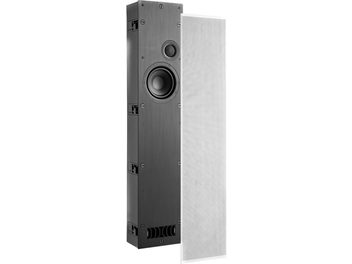
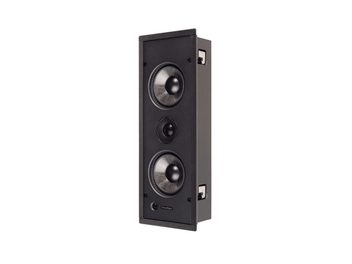
Overview
GoldenEar, with three decades of acoustic innovation, has designed the Invisa Signature Point Source, an in-wall speaker just 82.5 mm thick. This built-in speaker incorporates technologies usually reserved for reference floorstanding models, delivering high sound quality in a compact format.
The Invisa Signature Point Source offers a built-in solution that combines audio performance with visual discretion, providing sound reproduction comparable to traditional speakers while maintaining a clean aesthetic suited to modern interiors.
Point Source Design for Outstanding Spatial Coherence
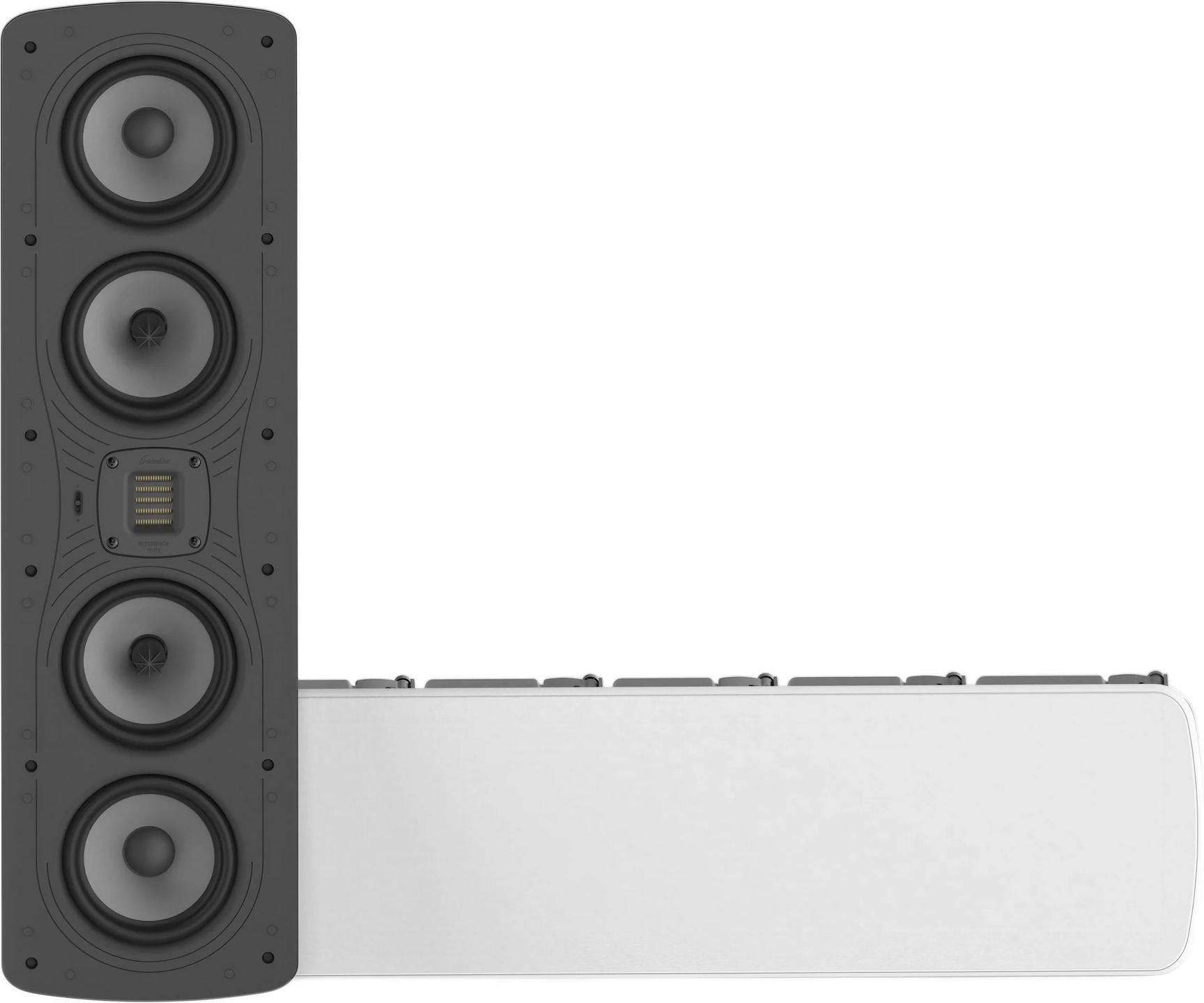
The fundamental feature of the Invisa SPS lies in its unique configuration of four 133 mm drivers that do not operate identically. This differentiated approach marks a departure from conventional in-wall speaker designs. The two outer transducers limit their response to 500 Hz, focusing exclusively on bass and lower midrange frequencies. The two central drivers, equipped with MVPP (Multi-Vaned Phase Plug) technology, extend up to 3 kHz to ensure a smooth transition with the folded ribbon tweeter.
This arrangement creates a point source radiation pattern that significantly enhances sound dispersion and stereo imaging precision. The complex crossover network, using a fully balanced topology inherited from the brand’s high-end models, orchestrates this frequency distribution with surgical precision. A polystyrene film capacitor specifically handles the high-frequency section, ensuring optimal transparency in the treble range.
The inclusion of a switch to adjust the tweeter level in three positions demonstrates a deep understanding of the varied acoustic constraints found in residential installations. This flexibility allows for fine-tuning the speaker’s response to the specific acoustic characteristics of each room, whether it features mostly reflective or absorbent surfaces.
The HVFR Tweeter: Cutting-Edge Technology Directly from the Triton Reference Series
At the heart of the treble reproduction, the HVFR (High-Velocity Folded Ribbon) tweeter represents a direct technology transfer from GoldenEar’s Triton Reference and One.R models. This high-velocity folded ribbon transducer uses high-flux-density neodymium magnets to move a Kapton diaphragm in an accordion-like fashion. Rather than pushing air as conventional tweeters do, this system compresses and releases it in a controlled manner, generating sound waves with superior efficiency and minimal distortion.
The ability to rotate the tweeter module is a particularly relevant technical feature for home theater installations. Pre-installed in a vertical position for use as front or surround speakers, the assembly can be rotated 90 degrees for horizontal installation as a center channel. This mechanical flexibility, combined with the controlled directivity of the folded ribbon, ensures optimal acoustic integration regardless of the chosen orientation.
The frequency response extending up to 35 kHz far exceeds the human audible spectrum, but this extension contributes to a natural reproduction of transients and upper harmonics. This technical capability results in a sense of air and space in the sound reproduction, a sought-after characteristic in high-fidelity systems.
Architectural Integration Thought Out to the Last Detail
The dimensions of the Invisa SPS have been meticulously calculated to fit standard North American and European construction constraints. With a depth of 82.5 mm without the optional backbox, the speaker can be installed in a standard wall cavity without major structural modifications. The required cutout of 674.3 × 182.5 mm remains compact, minimizing the impact on wall integrity.
The chassis uses a mineral-loaded reinforced structure that eliminates unwanted resonances that could color the sound. Specially designed mounting clips ensure a solid anchor in the wall while making installation easier. This attention to practical details reflects an understanding of the challenges faced by professional installers in the field.
The flush magnetic grille, measuring 715.9 × 217.4 mm, becomes visually unobtrusive once painted the color of the wall. This “flangeless” approach, popularized by GoldenEar in its Invisa range, represents a significant advancement over traditional grilles with visible frames. The MagneLock magnetic mounting system makes it easy to remove the grille for maintenance or adjustments without risking damage to the wall finish.
The Optional Backbox: Mastering Acoustic Isolation
The option of a backbox deserves special attention for demanding installations. Designed with damping EVA foam inside and open-cell foam outside, this enclosure effectively limits sound transmission to adjacent rooms. With the backbox installed, the total depth increases to 95 mm, still compatible with standard wall cavities.
Unlike some approaches that systematically recommend using a backbox to optimize performance, GoldenEar has deliberately designed the Invisa SPS to take advantage of the wall cavity’s volume. This philosophy recognizes that in many installations, the available space within the wall can positively contribute to bass extension, allowing the speaker to reach the remarkably low frequency of 25 Hz for a built-in model.
For installations where sound isolation between rooms is a priority, or in buildings with irregular wall cavities, the backbox provides an elegant technical solution. Optional pre-construction brackets also facilitate integration in new builds, allowing precise positioning before drywall installation.
GoldenEar Technology: Three Generations of Acoustic Innovation
To fully understand the philosophy behind the Invisa SPS, one must look back at the exceptional career of Sandy Gross, co-founder of GoldenEar Technology. A graduate of Johns Hopkins University in 1972, Gross first co-founded Polk Audio in a garage with two college friends. This first entrepreneurial venture laid the foundation for an approach focused on democratizing high-fidelity audio without technical compromise.
After Polk Audio, Gross created Definitive Technology, continuing his quest for speakers that combine outstanding performance with remarkable value. In 2010, at an age when many consider retirement, he launched GoldenEar Technology with Don Givogue, convinced that there were still revolutionary speakers to be created. This third entrepreneurial chapter draws on decades of expertise to push the boundaries of what’s possible even further.
GoldenEar’s engineering team, led by Bob Johnston and including eight specialized engineers, has access to a full-size anechoic chamber, an exact replica of the one at the National Research Council of Canada. This sophisticated technical infrastructure enables absolutely precise measurements, essential for developing truly neutral speakers. Johnston’s rigorous approach combines objective measurements with extensive critical listening, with each product undergoing countless hours of fine-tuning before final approval.
Technical Specifications
Speakers
- 1 × High-Velocity Folded Ribbon (HVFR) Tweeter
- 2 × 133 mm High-Definition Midrange Drivers (MVPP)
- 2 × 133 mm High-Definition Bass Drivers with Cast Chassis
Audio Performance
- Frequency Response: 25 Hz - 35 kHz
- Sensitivity: 92 dB
- Impedance: Nominal 4 Ω (8 Ω compatible)
- Recommended Amplification Power: 20 - 350 W / channel
Dimensions and Weight
- Dimensions (W × H)
- Cutout: 182.5 × 674.3 mm
- Speaker: 202 × 700 mm
- Depth: 82.5 mm
- Grille: 217.4 × 715.9 mm
- Weight: 6.4 kg
Frequently Asked Questions
Does installing the Invisa SPS require special skills?
Installation requires basic DIY knowledge and the ability to make a precise cut in a wall. The cutout dimensions are clearly specified (674.3 × 182.5 mm), and the mounting clips make placement easier. However, it is essential to first check for the absence of wiring, pipes, or structural elements in the installation area. For horizontal installation as a center channel, rotating the tweeter requires removing and reinstalling four screws—a simple operation, but one that requires a minimum of care.
Is the optional backbox really necessary?
The backbox is not essential for excellent performance. The speaker is designed to take advantage of the wall cavity’s volume, which helps extend the bass. The backbox becomes relevant in three situations: when sound isolation between rooms is a priority, in buildings with irregular wall cavities that could create unwanted resonances, or in new construction where it facilitates precise positioning before the walls are closed.
How do I properly adjust the tweeter level?
The three-position switch allows you to tailor the high-frequency response to your room’s characteristics. Start with the center position, suitable for rooms with a balance of reflective and absorbent surfaces. If the sound seems too bright or harsh (very reverberant room with many hard surfaces), reduce the level. Conversely, in a heavily damped room with thick carpet, drapes, and upholstered furniture, slightly increase the level to restore presence in the treble.
What spacing should be maintained between multiple Invisa SPS speakers in a home theater setup?
For the left and right front channels, position the speakers to form an equilateral triangle with the main listening position. The spacing depends on the width of your screen or TV, but generally aim for 2 to 3 meters between the front speakers. The speakers should ideally be installed at ear level when seated. For the center channel, place the speaker as close to the screen as possible, ideally just below or above it.
Can the Invisa SPS operate without a subwoofer?
Absolutely. With a response down to 25 Hz, the Invisa SPS covers most of the musical spectrum. For stereo music listening, a pair is sufficient for most genres. However, for home theater, adding one or two subwoofers is still recommended to reproduce the LFE (Low Frequency Effects) of modern soundtracks and to deliver the physical sensation characteristic of professional cinema rooms.
- Eco-contribution included in the sale price.
- GTIN / EAN: 92592013148