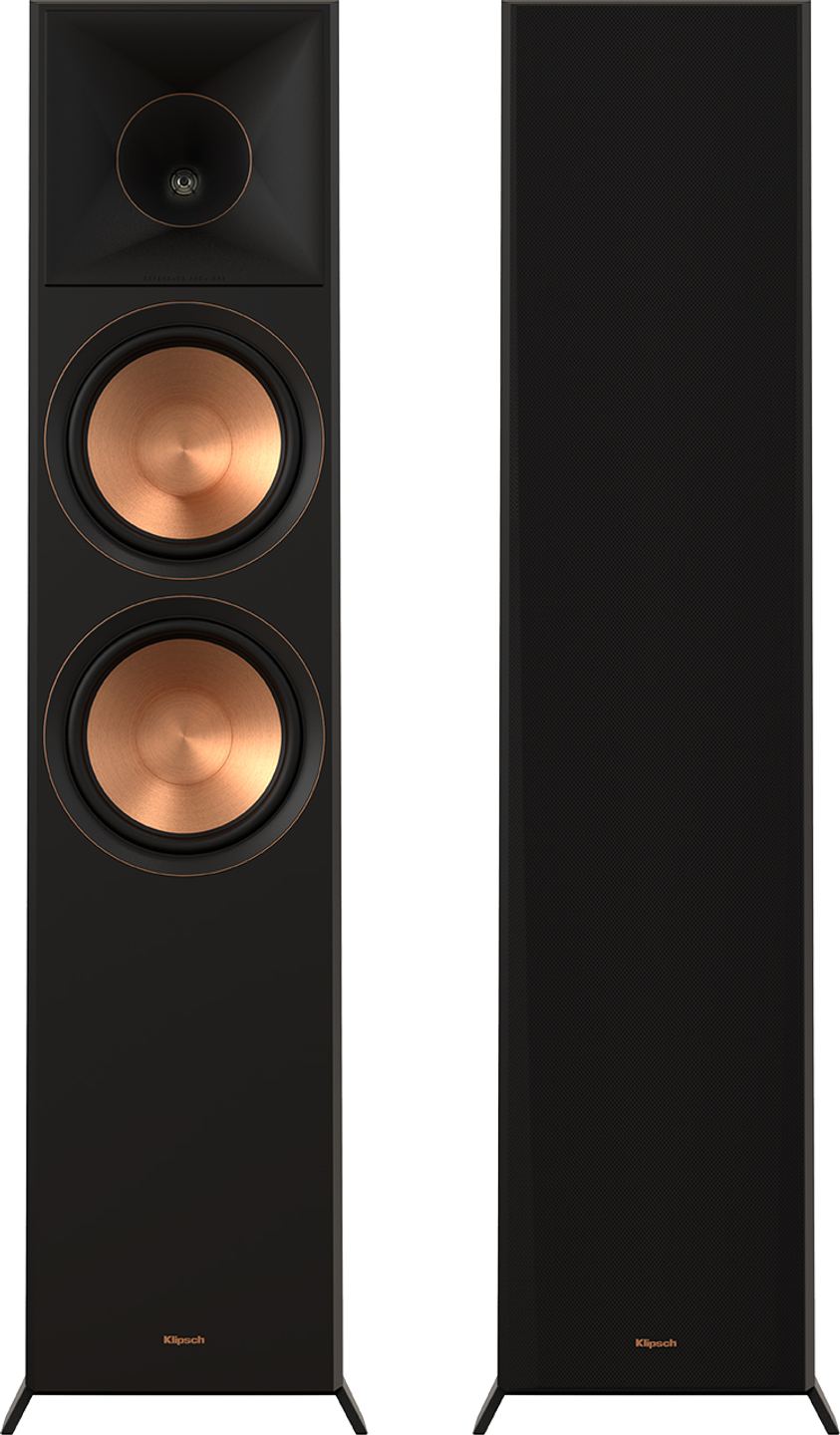
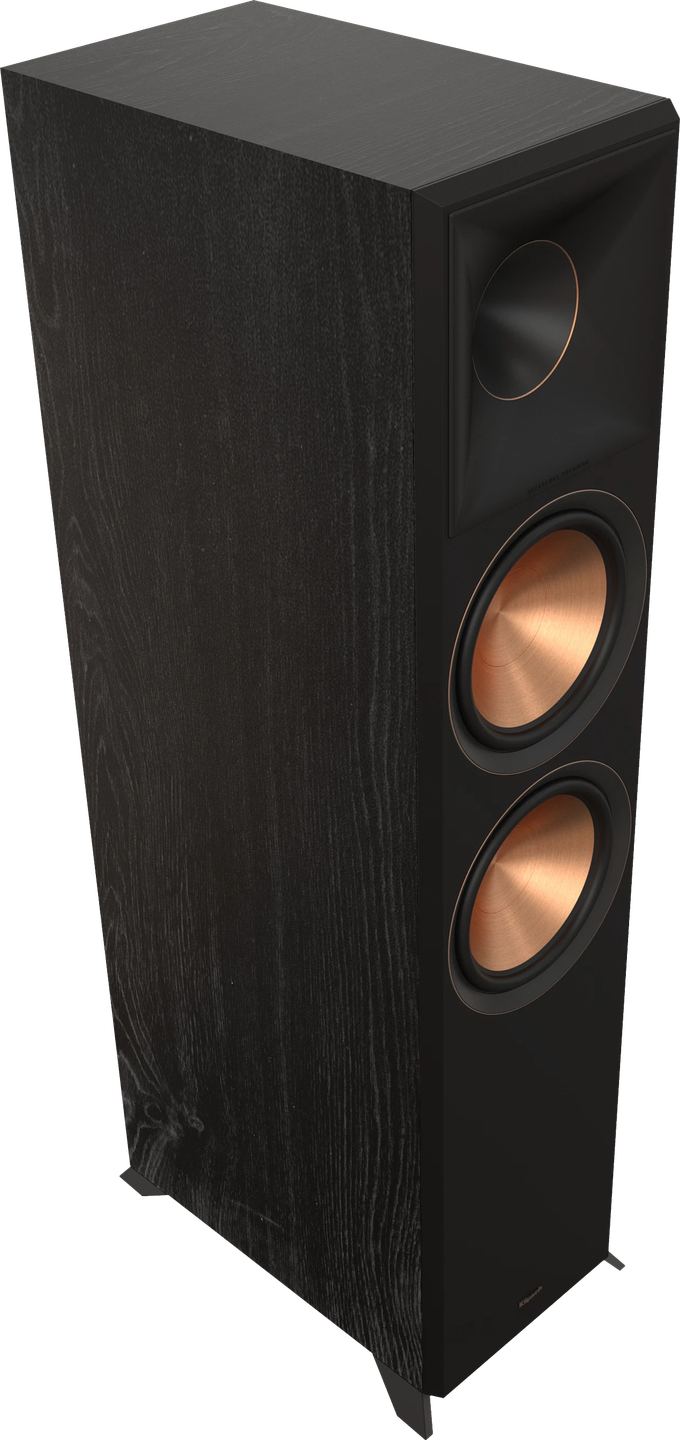
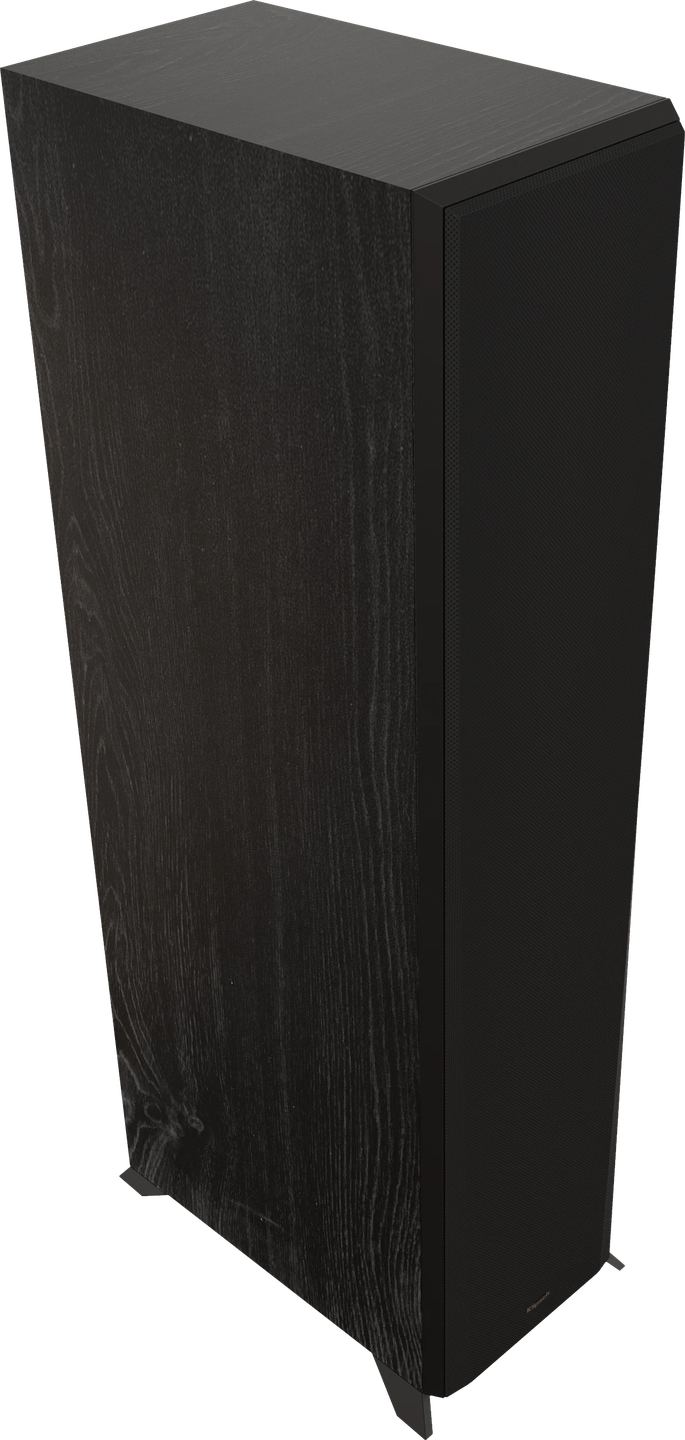
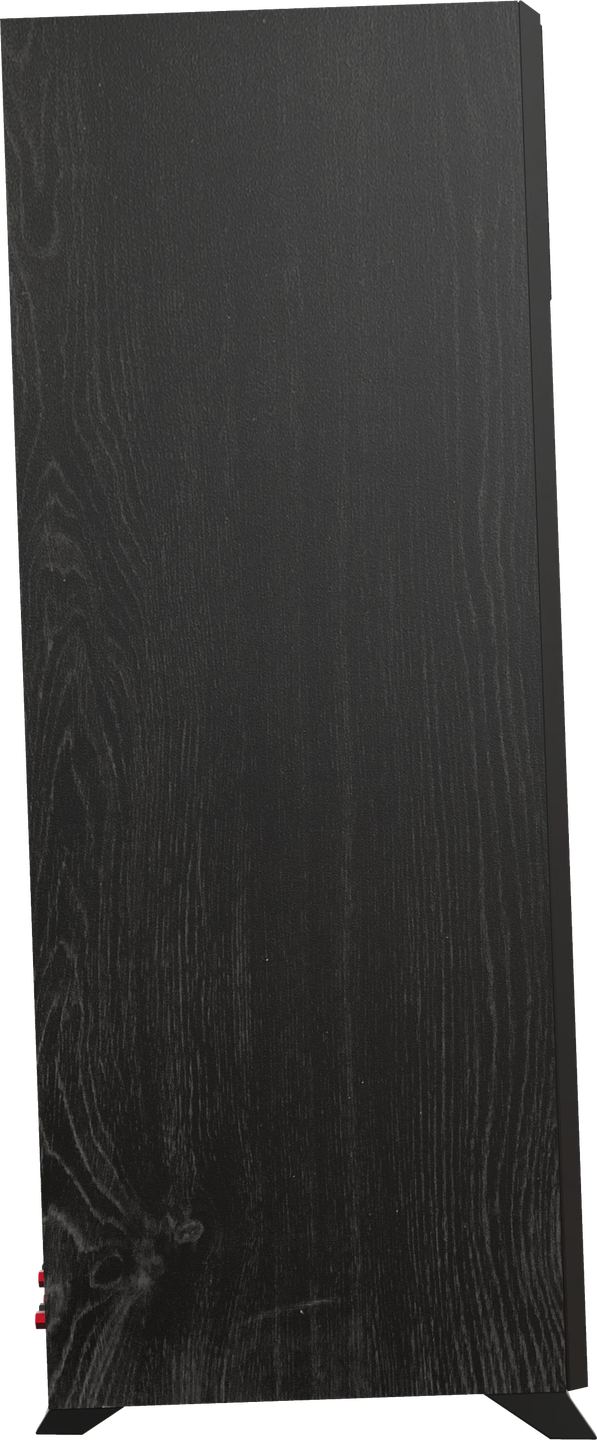
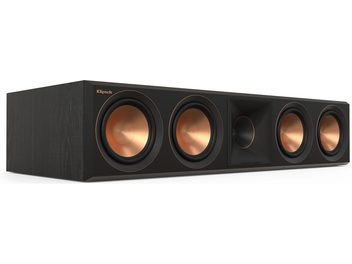
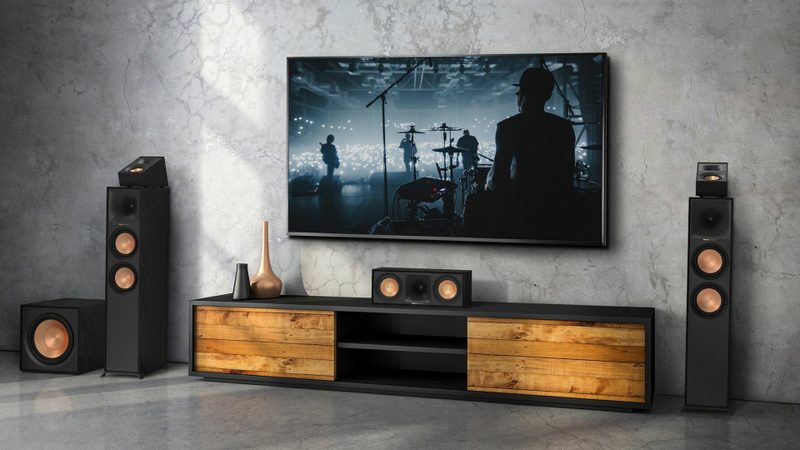
Seventh generation of the Reference Premiere series, the RP-8000F II uses the formula that made Klipsch successful: a horn-loaded design paired with copper-spun woofers. This 2022 version brings significant changes to the tweeter and woofers, with a larger horn and bigger voice coils. The ebony model features a black wood-grain vinyl finish with a matte satin front baffle.
A thoroughly redesigned Tractrix horn
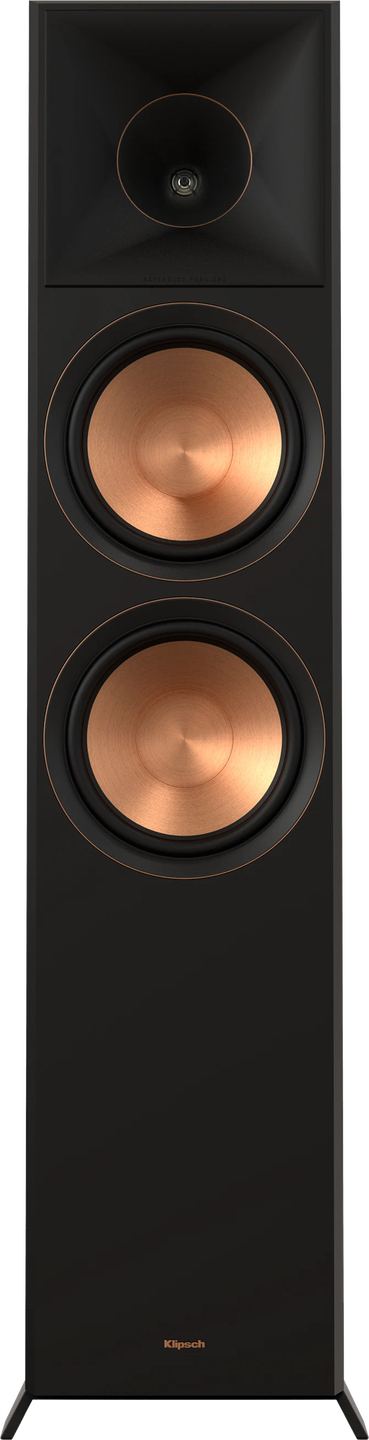
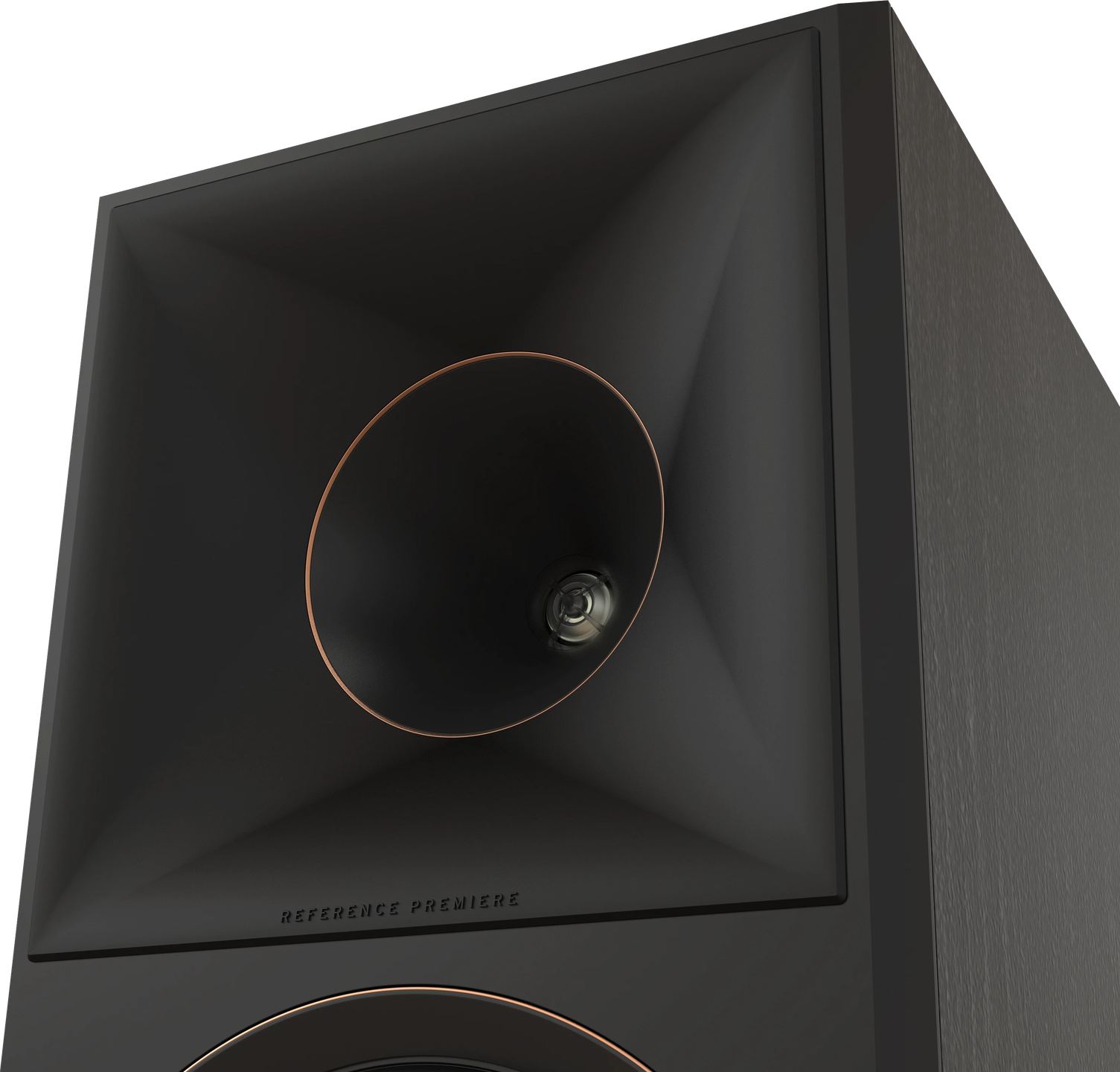
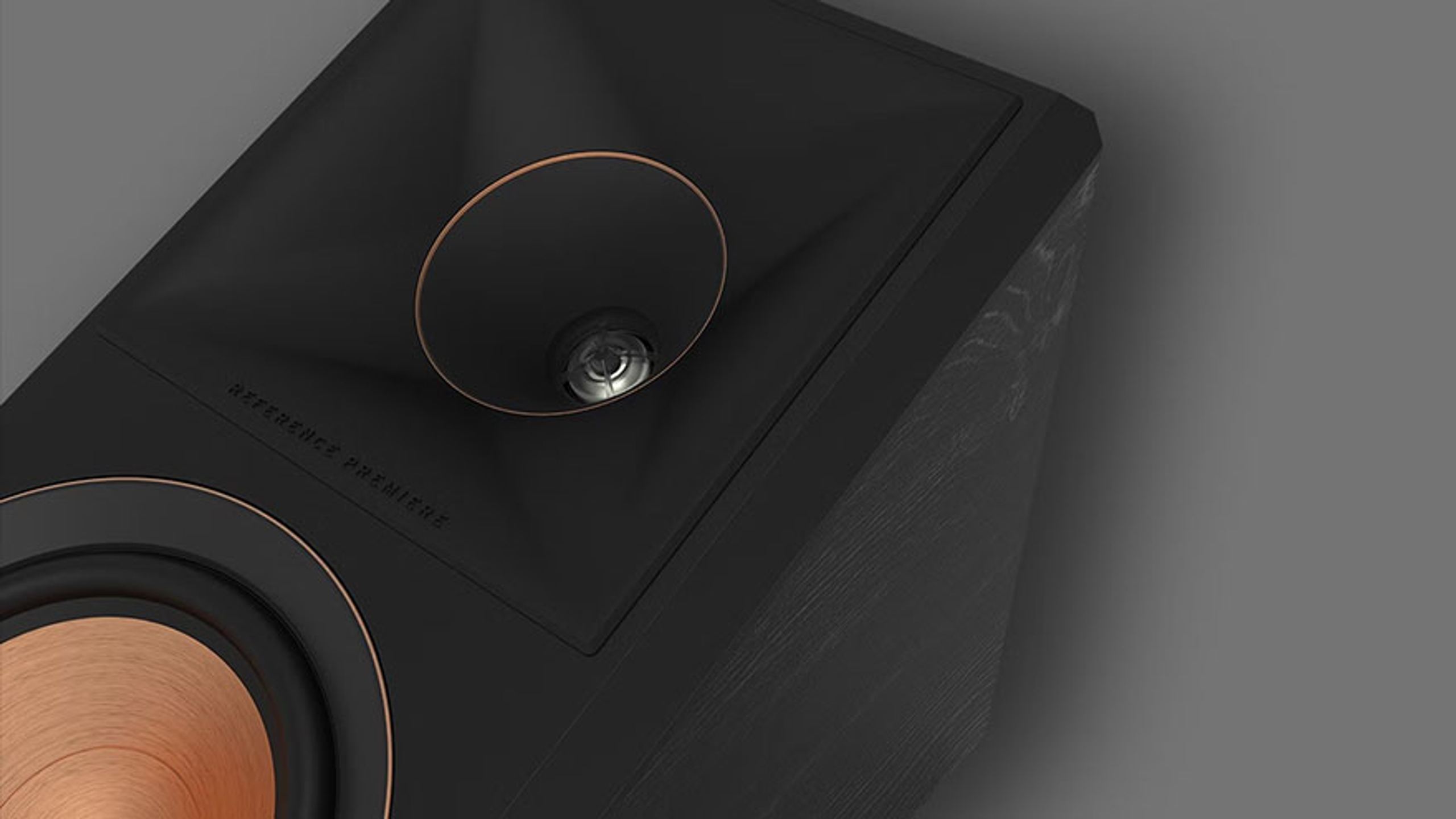
The most visible change in this generation concerns the tweeter horn. Its surface now occupies almost the full width of the front baffle. This extension is not cosmetic: a wider horn makes it possible to control sound directivity down to lower frequencies, where most compact horns lose their guiding effect. The Tractrix geometry, a particular mathematical curve used for decades in acoustic horns, is here combined with a hybrid section that evolves from a conical shape in depth to a square opening at the exit.
The horn itself is molded from compressed silicone rather than rigid plastic. This material dampens parasitic resonances that can color the sound. A phase plug at the center of the titanium dome evens out high-frequency output. The 2.54 cm LTS tweeter retains its linear travel suspension, a technology Klipsch has used for several generations to reduce distortion during violent transients.
Two Cerametallic woofers with enlarged coils
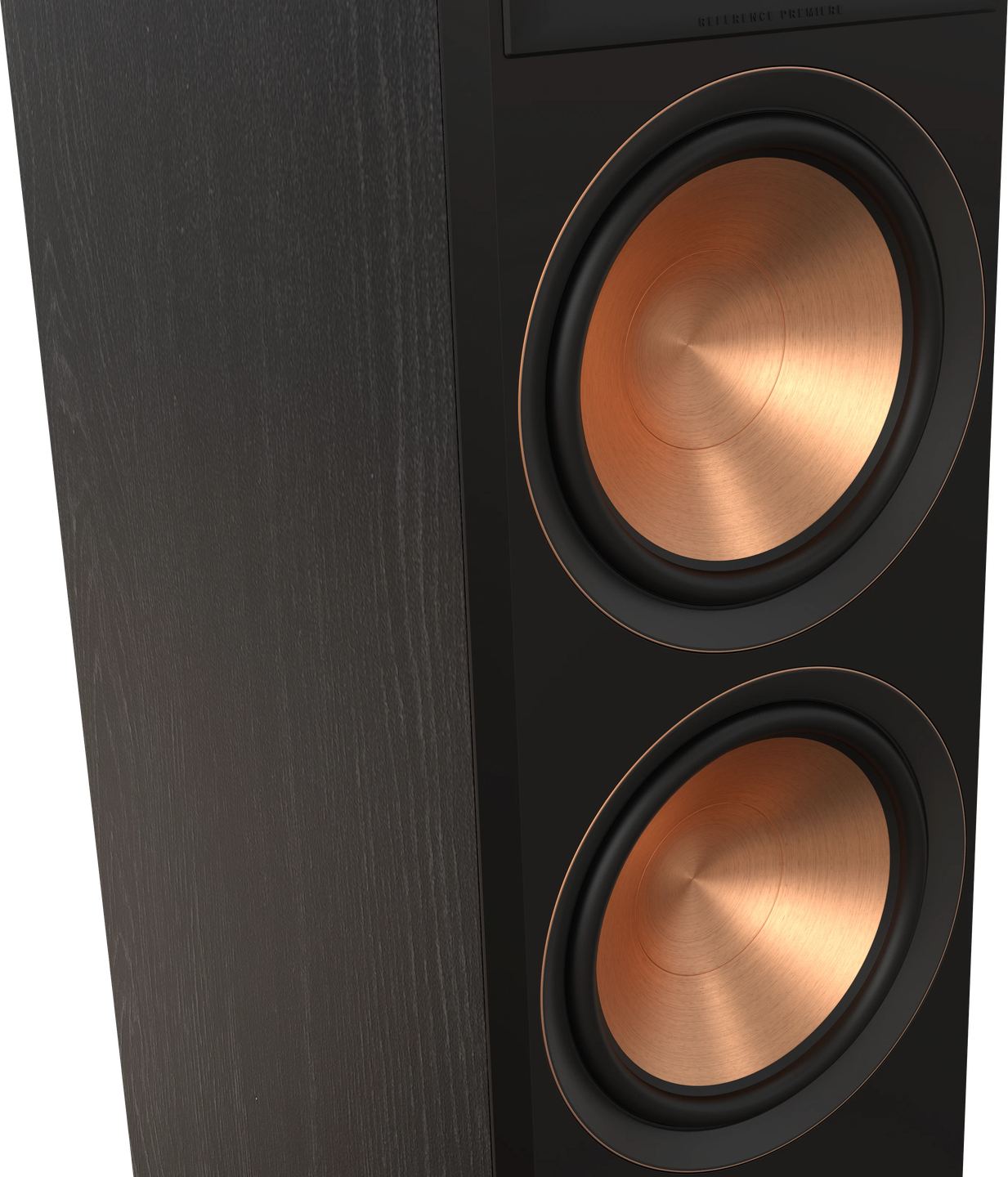
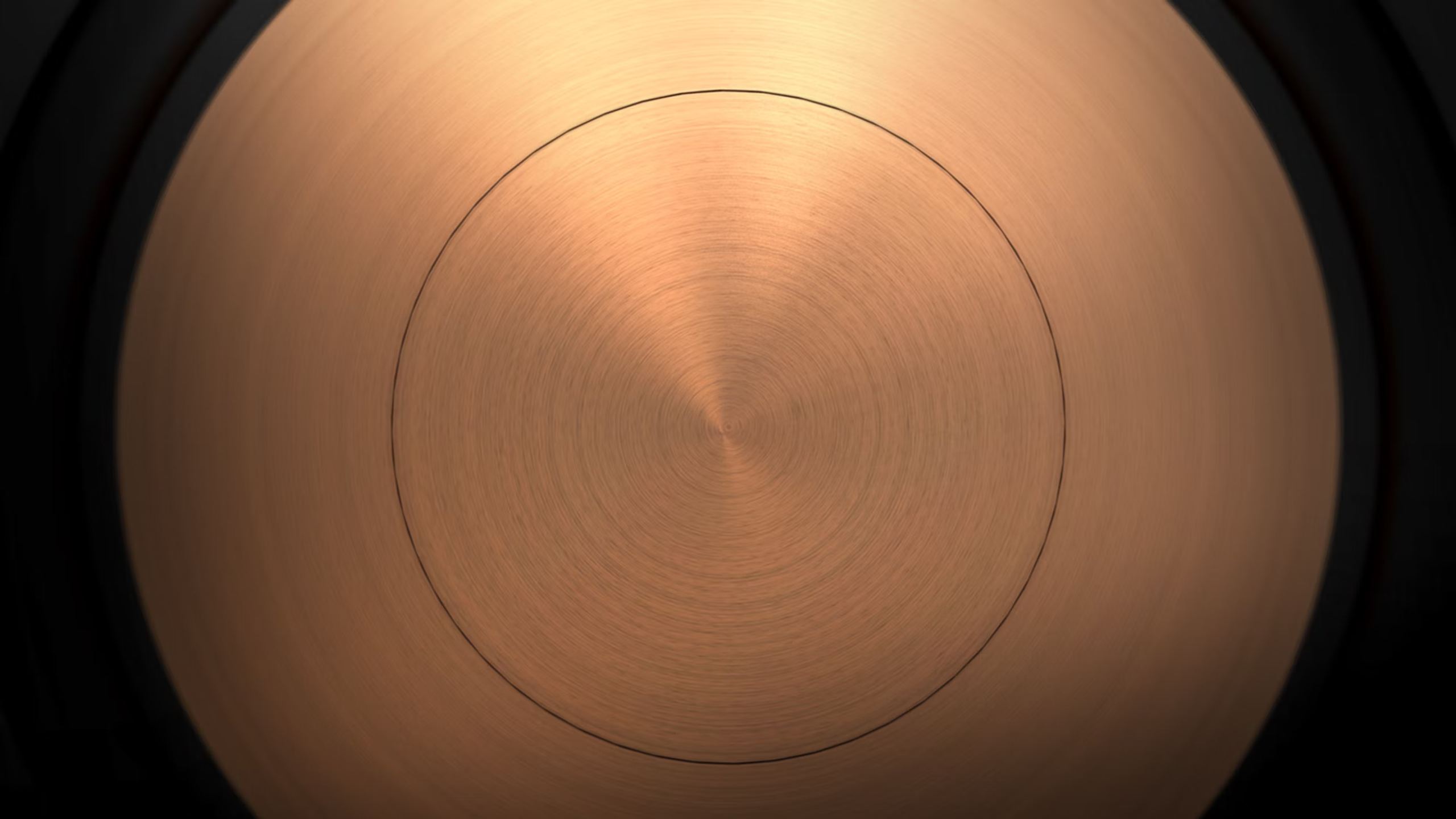
The two 20.3 cm drivers use Klipsch’s characteristic Cerametallic diaphragm: an aluminum base coated with ceramic anodizing that stiffens the cone and pushes its resonance modes toward inaudible frequencies. The orange-copper shade is not paint but the result of the anodizing process itself.
On this generation, the voice coils have been enlarged by 70% compared with the original RP-8000F. A larger coil handles high currents better and improves cone control during large excursions, resulting in tighter bass. The woofers are mounted on stamped steel baskets connected to large magnetic motors.
A reinforced and modular construction
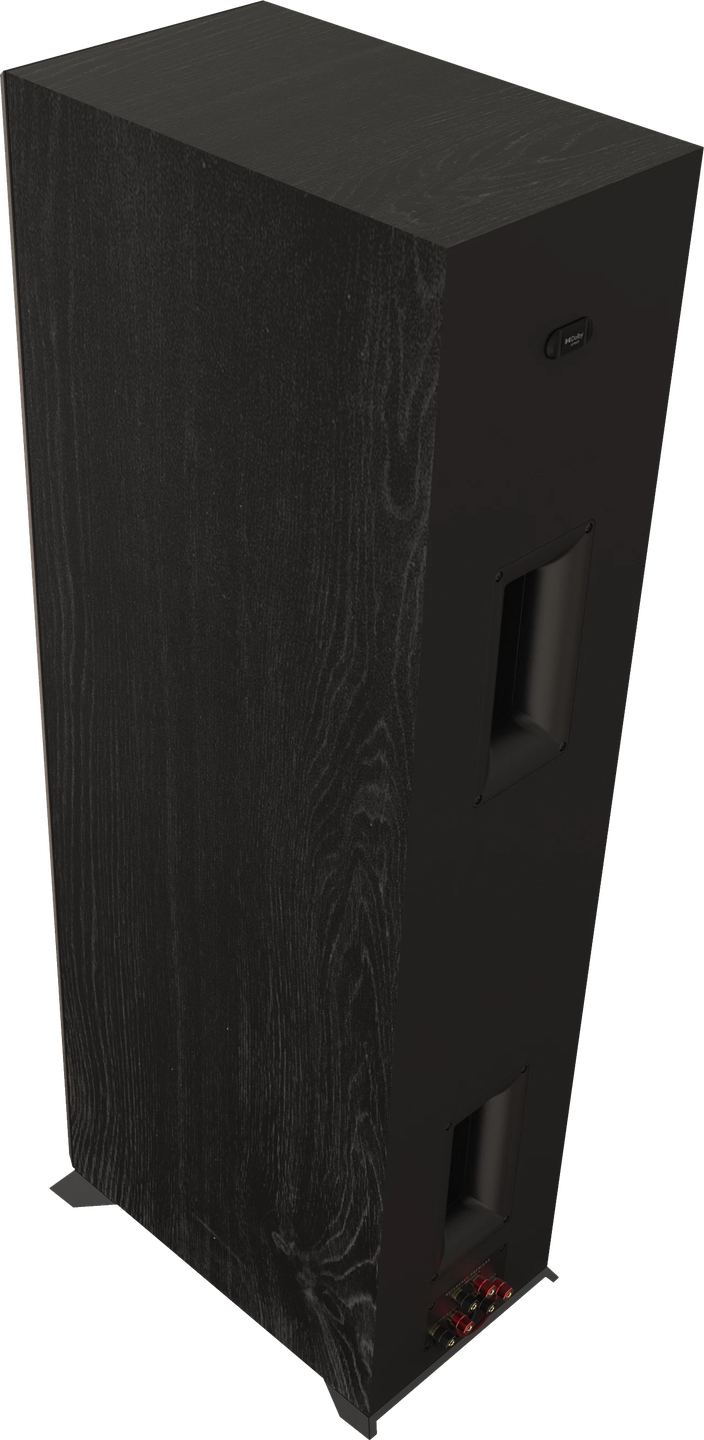
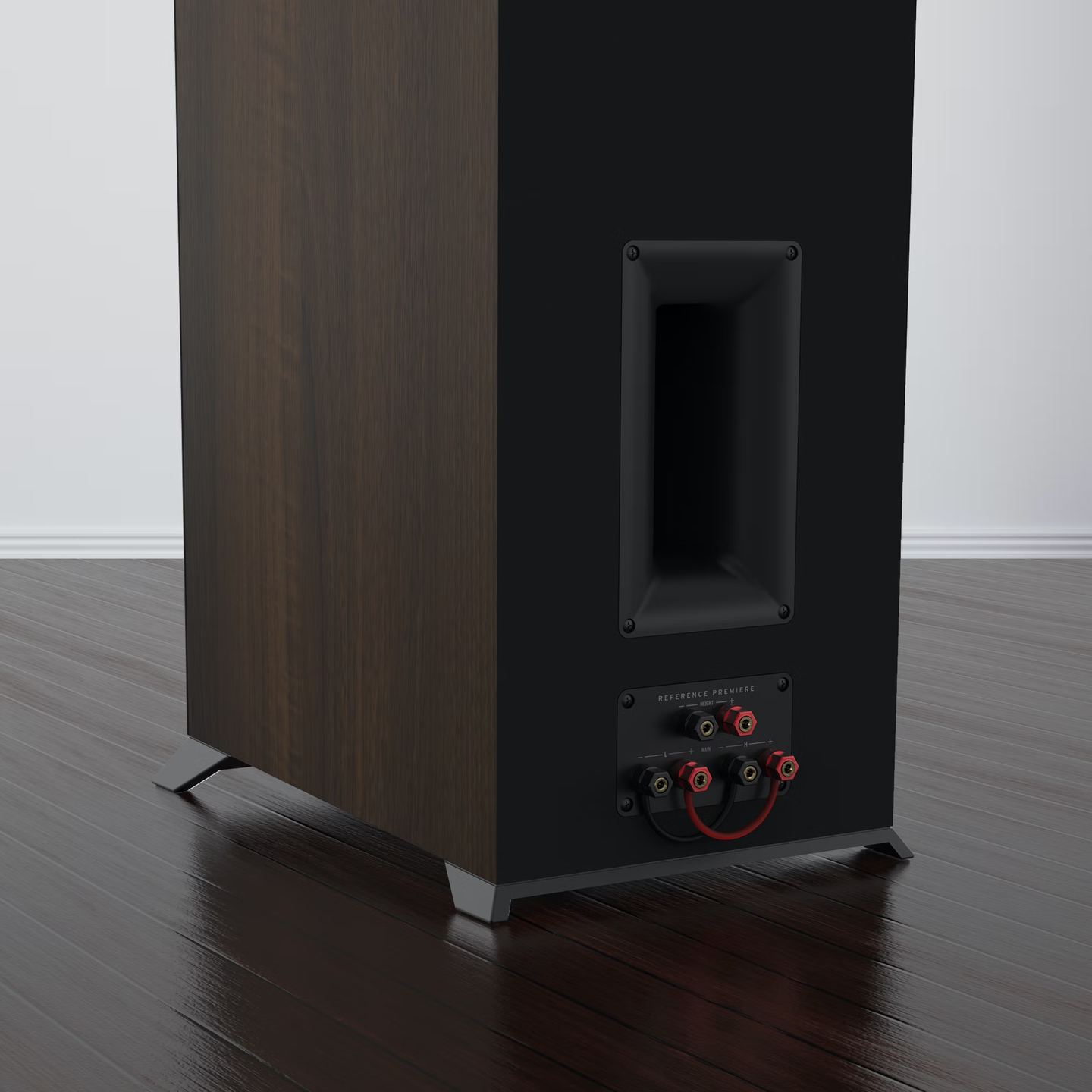
The MDF cabinet features internal bracing and a partition that divides the volume into two sections. These additions stiffen the structure and limit panel vibrations that blur the audio signal. The rear bass-reflex port also adopts a Tractrix geometry flared inward to reduce air turbulence and chuffing noises at high volume.
The cast aluminum feet minimize the contact surface with the floor. This approach decouples the speaker from the floor and reduces vibration transfer, with a beneficial effect on bass definition.
The protective grille attaches magnetically with no visible mounting points. Once removed, it reveals the copper-colored cones and matching rings surrounding each driver.
A terminal panel designed for home theater
The connection panel offers two pairs of aluminum binding posts for bi-wiring or bi-amping. A switch allows toggling between standard mode and a mode intended for Dolby Atmos configurations. In the latter case, an additional pair of connectors at the top of the panel powers a surround speaker placed on top of the cabinet. The cables run inside the enclosure and emerge near the top, avoiding visible wires.
This integration makes it easier to add speakers such as the RP-500SA II to create height channels without multiplying visible cables.
Sensitivity and placement
With a stated sensitivity of 98 dB in half-space (about 92 dB in anechoic measurement), the RP-8000F II is among the easiest speakers on the market to drive. An entry-level or mid-range home theater amplifier is enough to push them to very high levels. The 150 W continuous and 600 W peak power handling nevertheless means they should not be paired carelessly with oversized amplifiers.
Impedance remains close to 8 Ω over most of the spectrum, but drops noticeably in the upper bass and lower midrange. Most amplifiers handle this load without difficulty.
Positioning deserves particular attention. The tweeter response is slightly more pronounced on axis than at 20 or 30 degrees off axis. Two options are available: aim the speakers straight at the listener for a more direct and brighter sound, or point them straight ahead in parallel to soften the treble. The bass has been tuned with relatively close placement to rear walls in mind, which compensates through acoustic loading for a deliberately moderate low-frequency level in free space.
Crossover frequency and filtering
The crossover between the tweeter and the woofers occurs at 1,630 Hz, a little lower than on the previous generation. This frequency corresponds to the point where the 20 cm cones begin to narrow their dispersion. Handing over to the horn at this precise moment ensures a smooth transition. The crossover uses a fourth-order high-pass filter on the tweeter and a second-order low-pass filter on the woofers.
Material: Medium Density Fiberboard (MDF) with internal reinforcements
Terminal switchable between Atmospheric (Atmos) and Surround modes in aluminum
Magnetic attachment grilles for easy swapping
Bi-wiring, bi-amping
Speakers
2.54 cm vented tweeter
Titanium dome with low-compliance suspension (LTS)
Hybrid Tractrix horn
2 x 20.3 cm woofers
Cerametallic cones
Aluminum ring
Performance
Power handling: 150 W / 600 W
Nominal impedance: 8 Ω compatible
Sensitivity: 98 dB
Frequency response: 35-25 kHz ± 3 dB
Crossover frequency: 1,630 Hz
Dimensions
Width: 27.5 cm
Height: 109.5 cm
Depth: 46.3 cm
Weight: 27.85 kg
Frequently Asked Questions
Do these speakers need a powerful amplifier?
+
No. The 98 dB sensitivity makes it possible to reach high sound levels with a standard home theater amplifier delivering 80 to 100 W per channel. An entry-level model is perfectly suitable for typical home use.
Is adding a subwoofer necessary?
+
The response extends down to 35 Hz, which covers most music and movie content. For fans of very deep bass or in large rooms, a subwoofer provides a welcome supplement below 40 Hz.
How much distance should be left between the speaker and the rear wall?
+
A distance of 30 to 40 cm is a good starting point. Placement closer to the wall reinforces the bass but may create resonances in some rooms. Adjustment depends on the room acoustics.
Can these speakers be used only for stereo music?
+
Yes. Their dynamics and projection suit music listening, especially energetic genres such as rock or metal. For more intimate acoustic styles, their frank and direct character may require some adjustment time.
What is the main difference compared with the previous generation?
+
The tweeter horn has been enlarged for better directional control, and the woofer coils have gained 70% in cross-sectional area to improve control and power handling. The cabinet also benefits from additional bracing.
User reviews
Lukasz
After almost 3 months with my Klipsch speakers, I can honestly say I’m really happy with them. They sound great with pretty much everything, but especially with rock and metal - that’s where they really shine.
Once I got the placement right, the soundstage is great!!!. Overall, super happy with this setup.
Comment from March 17, 2026 — Experience from January 25, 2026
Pierre
Very good speakers. Paired with a Cayin Jazz 80 KT88 amp and Supra cable. Sources: Rega Planar 1 Plus and SMSL 200 T for the CD player. An absolute delight, I’m rediscovering (discovering?) music. The silences are deep, everything is super well defined. These speakers with a tube amp are the best.
Comment from December 31, 2025 — Experience from December 20, 2025
Automatically translated — Show original (French)
Très bonnes enceintes.
Couplées à un ampli Cayin Jazz 80 KT88, câble supra.
Sources rega planar 1plus et smsl 200 T pour le lecteur CD.
Un régal absolu, je redécouvre (découvre ?) la musique.
Les silences sont profonds, tout est super défini.
Ces enceintes et un ampli à tubes c’est le top.
Alan
Great customer service through out the sale fast reply’s and updates on delivery speakers were delivered in perfect condition would definitely purchase again of homecine solutions in the near future
Comment from August 29, 2025 — Experience from June 07, 2025
To better understand our visitors, measure marketing effectiveness and personalise ads, we and our partners use cookies and mobile advertising identifiers on your device. This data makes it possible to display personalised and non-personalised ads and measure their performance. Some cookies, which are technically necessary, are exempt from consent. You can accept those that require your consent, refuse them by clicking "Refuse", or customise your choices via the settings screen.
To find out how Google uses the data collected once you have given your consent, see Google’s Business Data Responsibility site.
You can change or withdraw your consent at any time via the "Consent and cookies" link. Your choices will apply on our site for 12 months.