PSB Imagine T54 white (pack of 2)


Overview
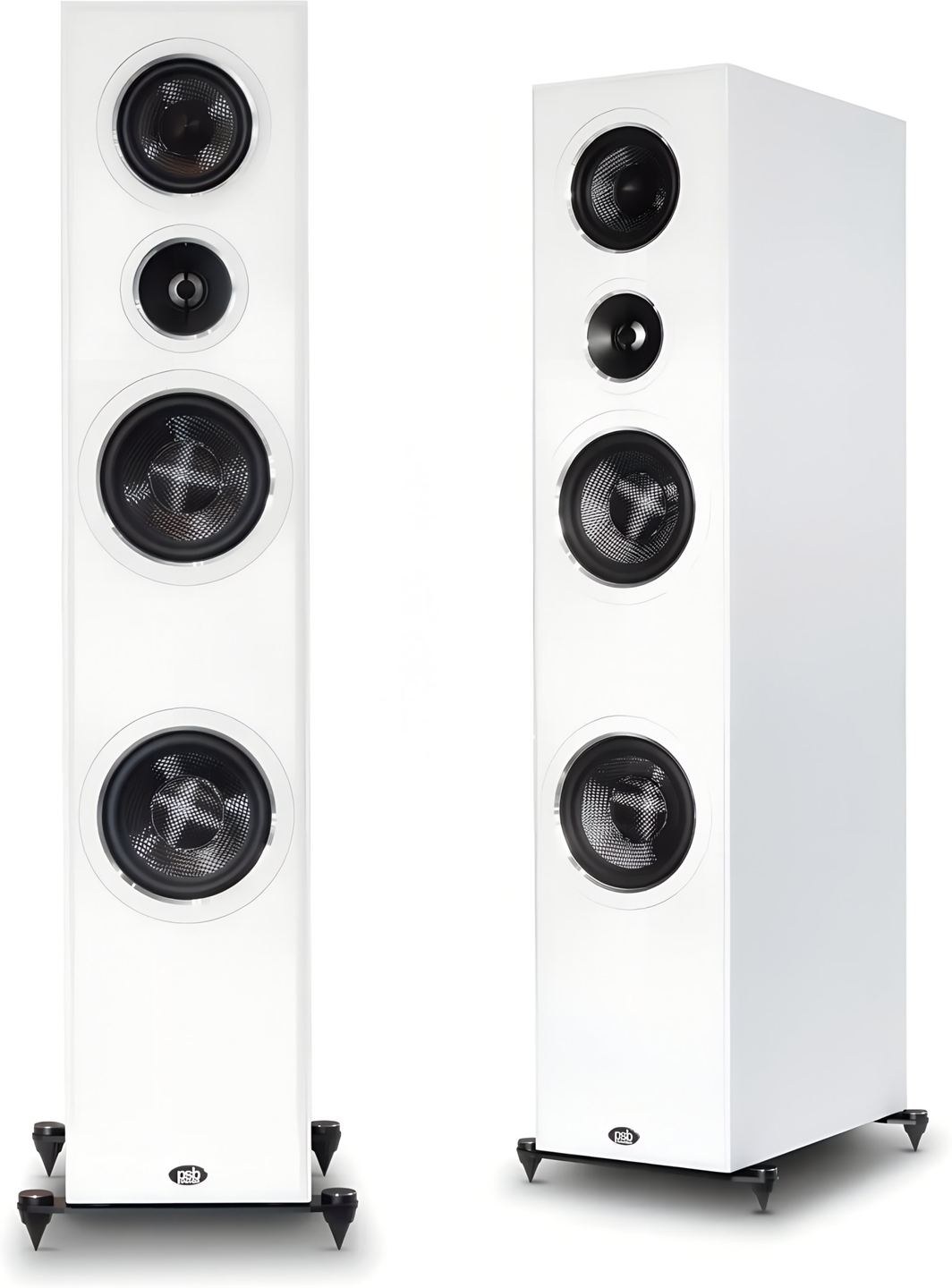
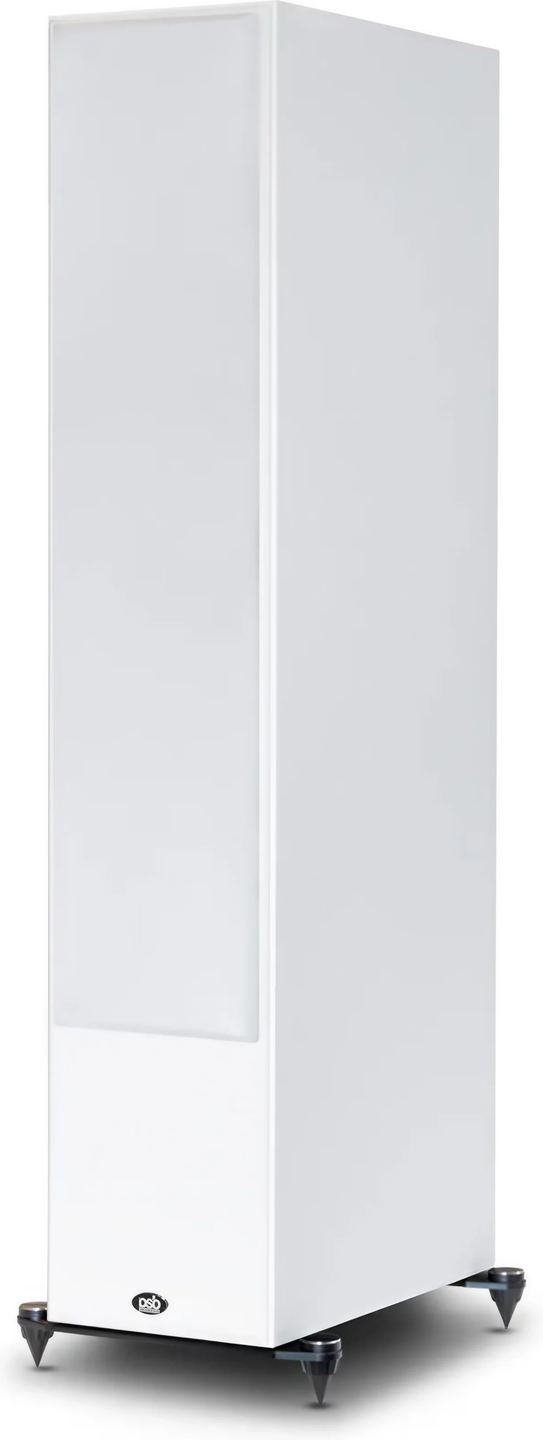
The PSB Imagine T54 are designed to deliver extended sound reproduction while maintaining a compact form factor. Introduced in late 2023, these floorstanders are part of the new generation of the Imagine series and demonstrate that small dimensions can coexist with significant acoustic performance.
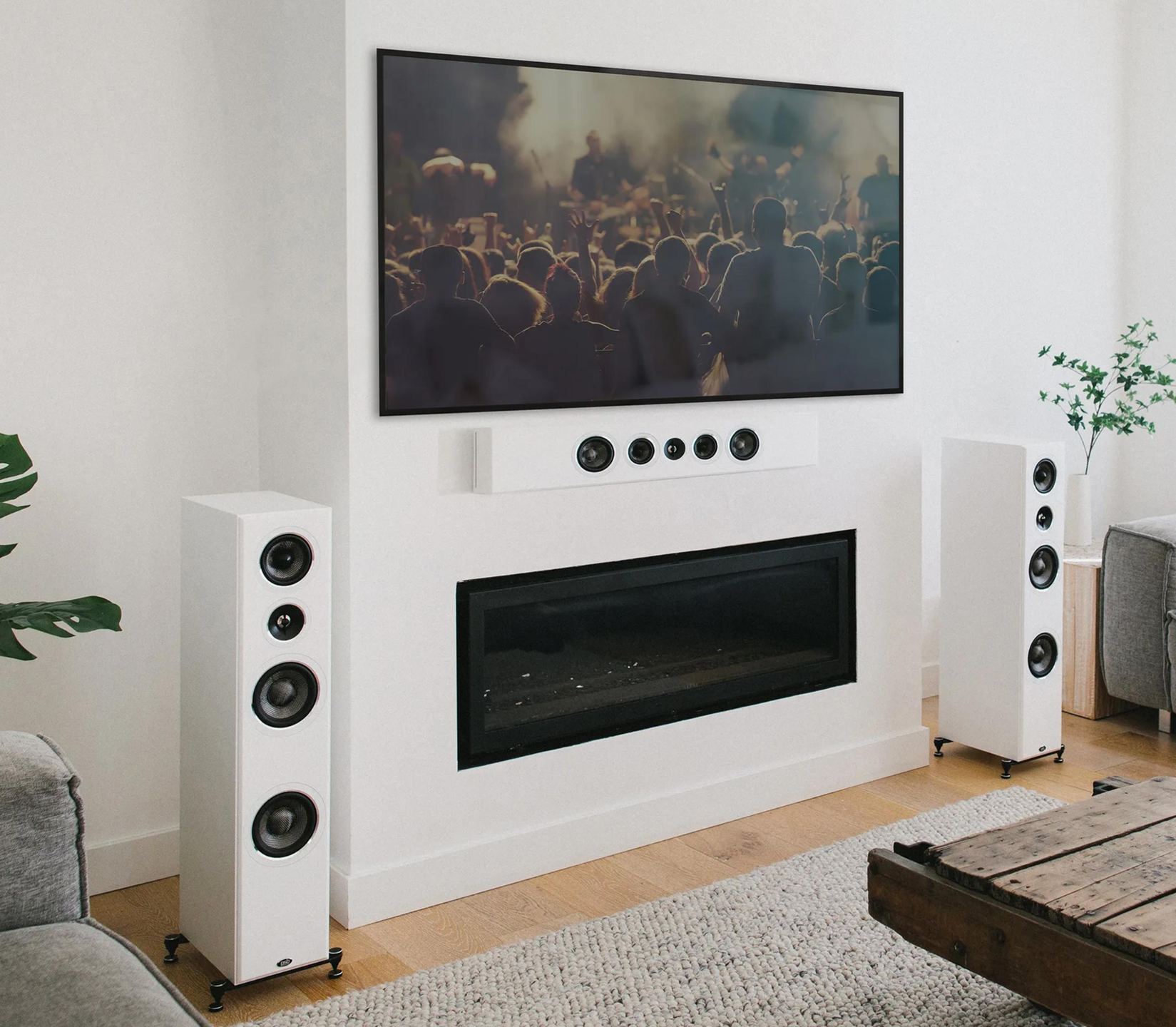
A concentration of technology in a slender silhouette
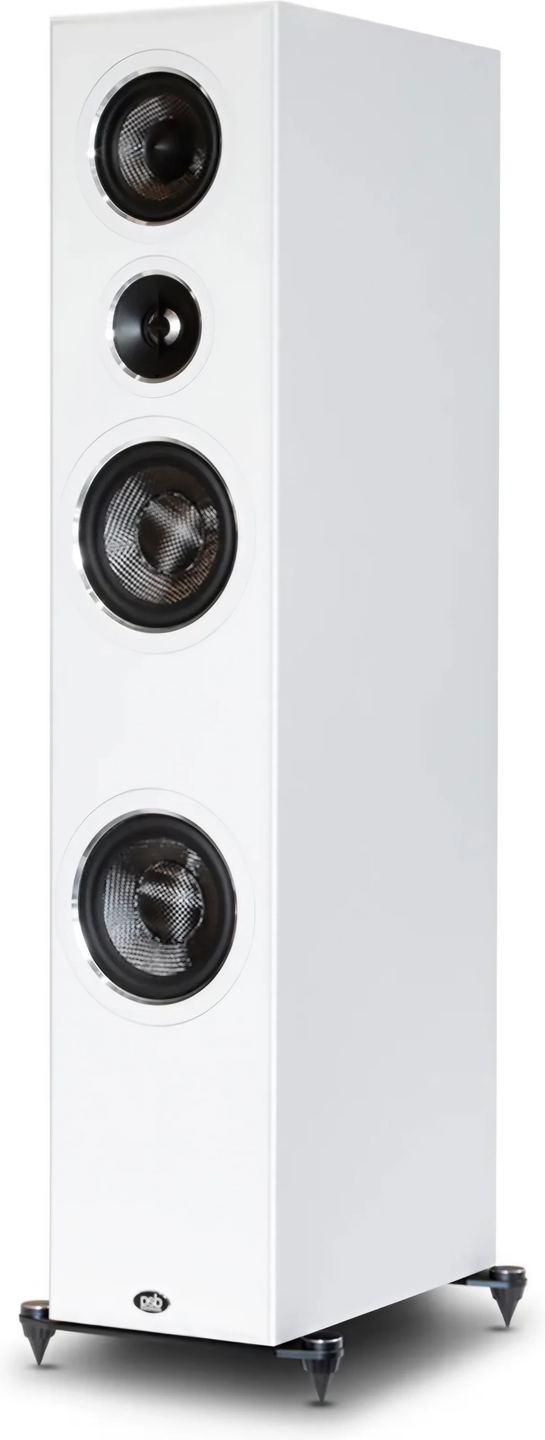
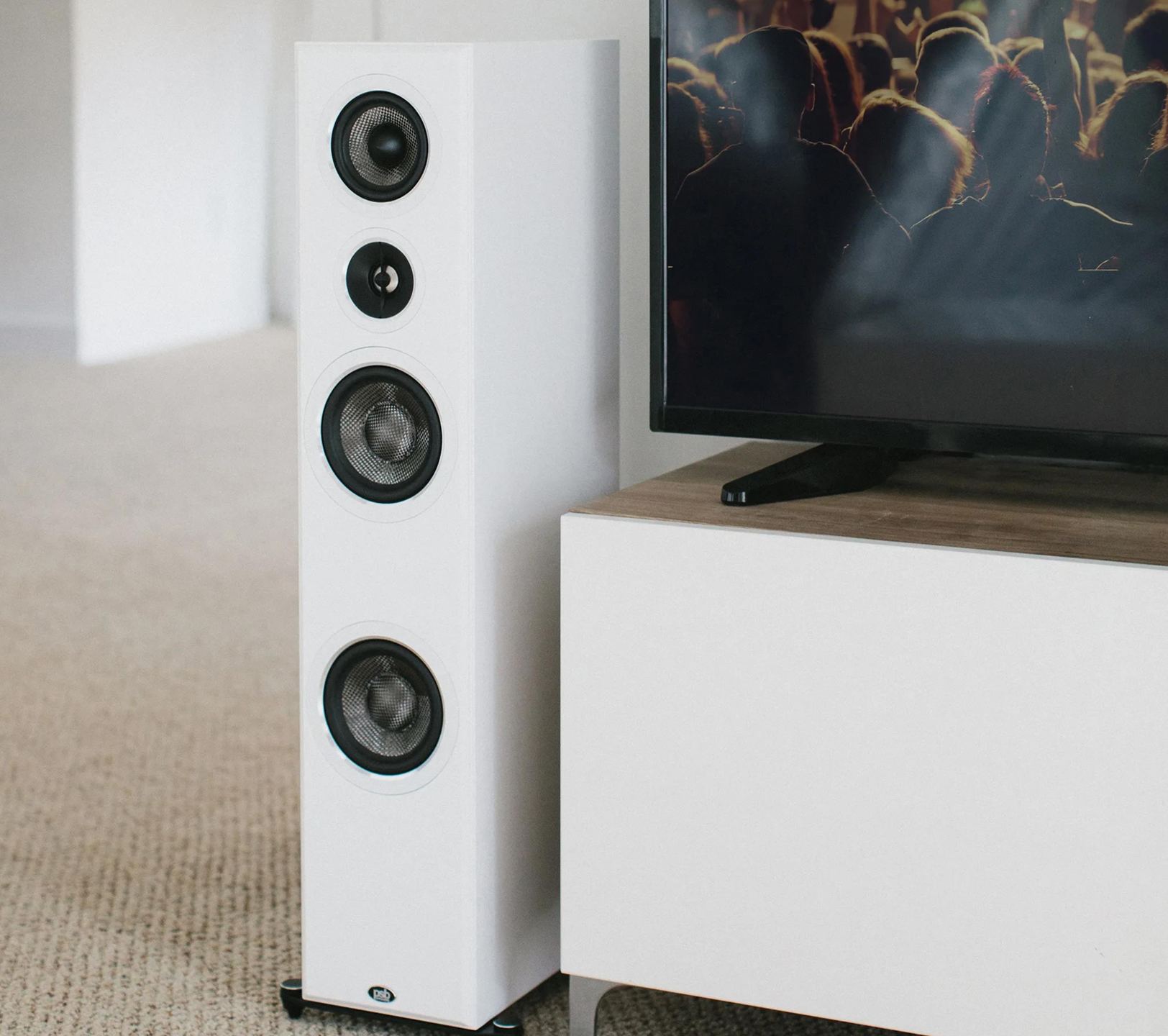
The Imagine T54 adopt a sophisticated three-way, dual bass-reflex acoustic configuration, directly inherited from the higher-end T65. The cabinet, measuring just 171 mm wide, 830 mm high, and 302 mm deep, conceals complex engineering. This remarkable compactness hides a 25 mm titanium dome tweeter with neodymium magnet and ferrofluid, a 102 mm midrange, and two 133 mm woofers, all featuring woven carbon fiber cones.
Woven carbon fiber, a material PSB previously explored in its Platinum series two decades ago, makes a strong comeback in this new generation. This technology gives the diaphragms exceptional rigidity while keeping mass low, enabling fast transient response and minimal distortion. Solid rubber surrounds ensure precise control of cone movement, even during demanding dynamic passages.
One of the most distinctive aspects of the design lies in the rear slot ports, borrowed from the PWM (Performance Wall Mount) series. This approach differs radically from traditional tubular ports. The slots allow a more gradual evacuation of air, reducing parasitic turbulence and port noise often audible with conventional bass-reflex speakers. Each woofer has its own individually tuned acoustic chamber, a feature usually reserved for high-end models.
The PSB imprint: fifty years of acoustic research
To understand the philosophy behind the Imagine T54, we need to go back to the origins of PSB Speakers. Founded in 1972 by Paul Barton in the small town of St. Jacobs, Ontario, the company takes its name from the initials of Paul and Sue Barton, his wife of more than fifty years. Barton, a trained violinist and self-taught acoustician, began by assembling speaker kits for students at the University of Waterloo, where he worked in a hi-fi shop while studying.
A decisive meeting with Dr. Floyd Toole in 1974 at the National Research Council of Canada (NRC) transformed Barton’s approach. PSB became the first company to systematically use the NRC’s anechoic chambers for acoustic design. This collaboration led to the development of what is now called the “Canadian sound,” a sonic signature based on objective measurements correlated with listening preferences established through double-blind tests.
This rigorous scientific approach set PSB apart from many manufacturers who relied primarily on subjective listening. Barton and his team discovered that listening preferences converge remarkably when listening conditions are controlled. On-axis and off-axis frequency response measurements became crucial parameters, allowing accurate prediction of how a speaker will be perceived in real-world listening conditions.
Acoustic performance and spatial integration
PSB’s signature fourth-order Linkwitz–Riley crossover ensures coherent integration between the drivers. This filter topology, more complex to implement than conventional crossovers, minimizes disturbances in both amplitude and phase domains. The result is an imperceptible transition between ranges, particularly critical in the 2500 Hz crossover zone between the midrange and tweeter, where the human ear is especially sensitive.
The crossover points at 500 Hz (third-order Butterworth) and 2500 Hz (fourth-order Linkwitz–Riley) were carefully selected to optimize directivity and minimize interference between drivers. This approach allows the 102 mm midrange to reproduce the majority of critical musical information—voices, acoustic instruments, fundamental harmonics—without the colorations typical of two-way configurations where the woofer must reach too high in frequency.
A sensitivity of 89 dB in-room (87 dB anechoic) places the T54 in a comfortable zone for most amplifiers. With a nominal impedance of 8 ohms dipping to a minimum of 4 ohms, they do not present a particularly difficult load. PSB recommends power between 20 and 150 watts, with a 200-watt program capacity, suggesting a robust build capable of handling significant dynamics without thermal compression.
Technical specifications
Audio performance
- Frequency response
- On-axis @ 0° ± 3 dB: 35 Hz – 23,000 Hz
- On-axis @ 0° ± 1.5 dB: 48 Hz – 20,000 Hz
- Off-axis @ 30° ± 1.5 dB: 48 Hz – 10,000 Hz
- Low-frequency cutoff (-10 dB): 28 Hz
- Sensitivity
- Anechoic chamber: 87 dB
- In-room: 89 dB
- Impedance
- Nominal: 8 ohms
- Minimum: 4 ohms
- Recommended amplifier power: 20 – 150 W
Acoustic design
Drivers
- Tweeter: 25 mm titanium dome with ferrofluid, neodymium magnet
- Midrange: 102 mm woven carbon fiber cone with rubber surround
- Woofers: 2 x 133 mm woven carbon fiber cones with rubber surround
Crossover and design
- Crossover points: 2,500 Hz (LR4) and 500 Hz (B3)
- Design type: 3-way, dual bass reflex, separate woofer chambers, 2 rear slot ports
Dimensions and weight
- Dimensions (W x H x D): 171 x 830 x 302 mm
- Net weight: 14 kg per speaker
- Shipping weight: 18.1 kg per speaker
Connectivity and accessories
- Gold-plated 5-way dual binding posts
- Bi-wiring and bi-amping capable
- Rear slot ports (inspired by the PWM series)
- Stabilizer bars and aluminum spikes
- Gold-plated jumpers
Frequently Asked Questions
Do the PSB Imagine T54 require a subwoofer for home theater?
For home theater use, adding a subwoofer is strongly recommended. Although the T54 reach down to 28 Hz (-10 dB), modern special effects often demand extension and power in the extreme low end that compact towers cannot fully deliver. PSB offers its own range of subs designed to integrate seamlessly with the Imagine series.
How do the slot ports affect speaker placement?
The rear slot ports require a minimum clearance of 30 to 50 cm from the back wall to operate optimally. However, their design reduces turbulence compared to tubular ports, making the T54 less sensitive to placement than some traditional bass-reflex speakers. The individual tuning of the woofer chambers also contributes to better adaptation to different room configurations.
Can the titanium tweeter cause listening fatigue?
PSB has carefully optimized the titanium dome tweeter with ferrofluid and a powerful neodymium magnet to achieve an extended response without aggressiveness. The sophisticated filtering and integration with the midrange prevent the resonance peaks typical of poorly controlled metal tweeters. Listening feedback generally highlights detailed yet non-fatiguing highs.
Which amplifier is best suited for the Imagine T54?
With their decent sensitivity and relatively stable impedance, the T54 work well with a wide range of amplifiers. A model delivering 50 to 100 watts into 8 ohms and comfortable with 4-ohm loads is an optimal choice. Quality trumps quantity: a well-designed 50-watt amplifier will yield better results than a mediocre 150-watt unit.
How do the T54 compare to the higher-end T65?
The T65 use 165 mm woofers versus 133 mm for the T54, and a 133 mm midrange versus 102 mm, offering superior low-end extension (28 Hz versus 35 Hz at -3 dB) and increased dynamic capability. The T54 compensate with a more focused presentation thanks to their narrower baffle, which can be advantageous for stereo image precision. The choice will depend on room size and listening priorities.
- Eco-contribution included in the sale price.