Taga Harmony PC-5000 (2025) black
Complementary product
Overview
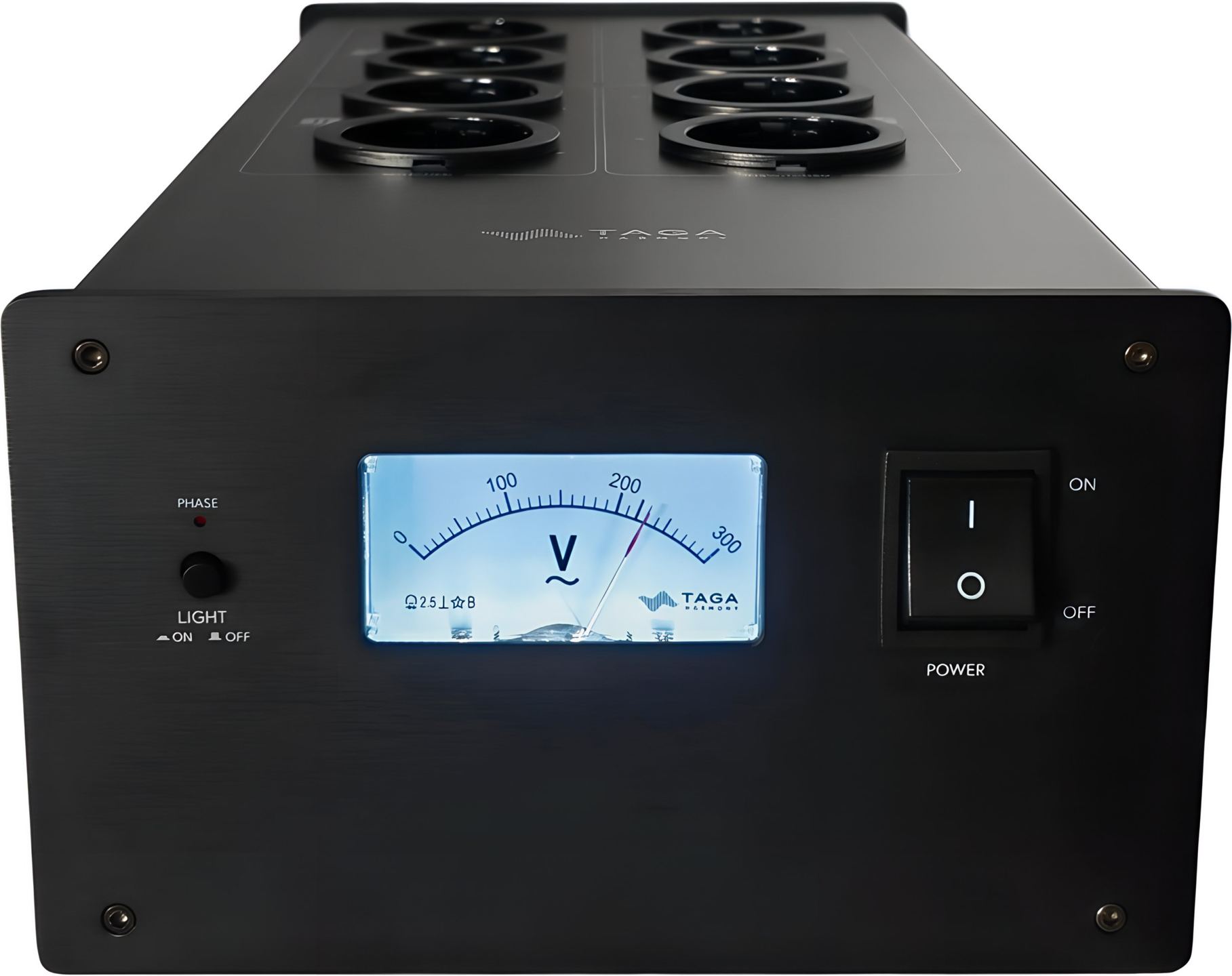
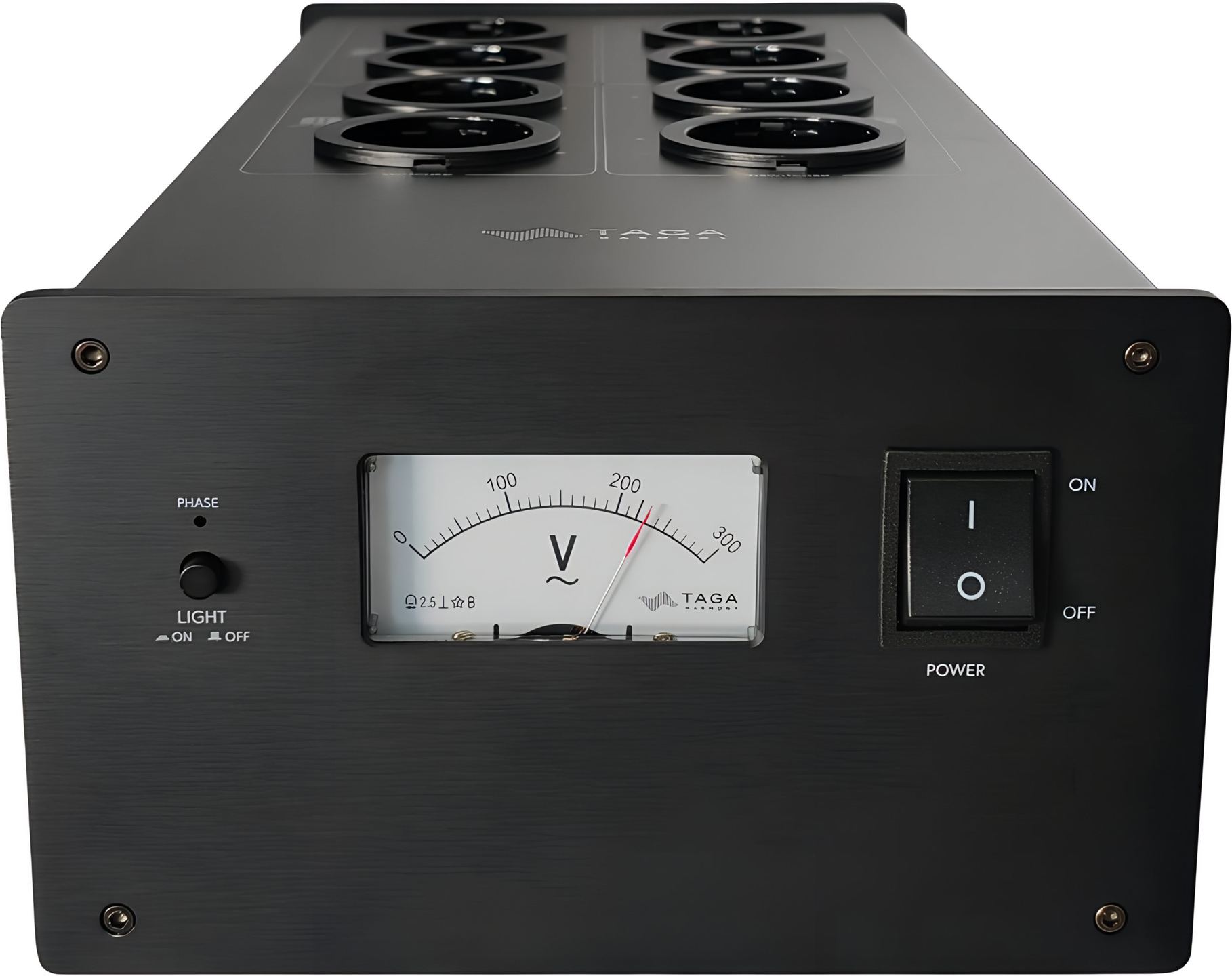
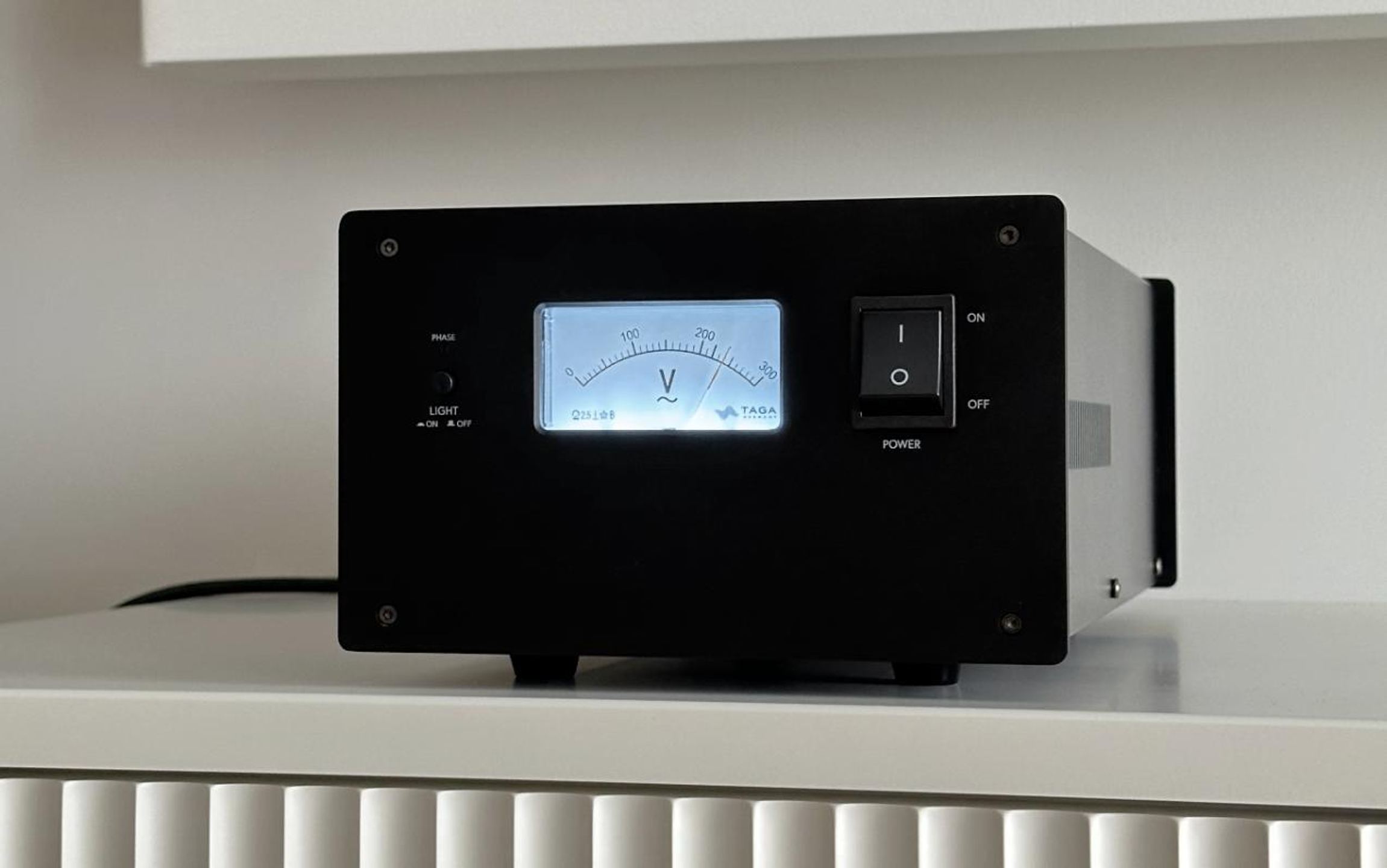
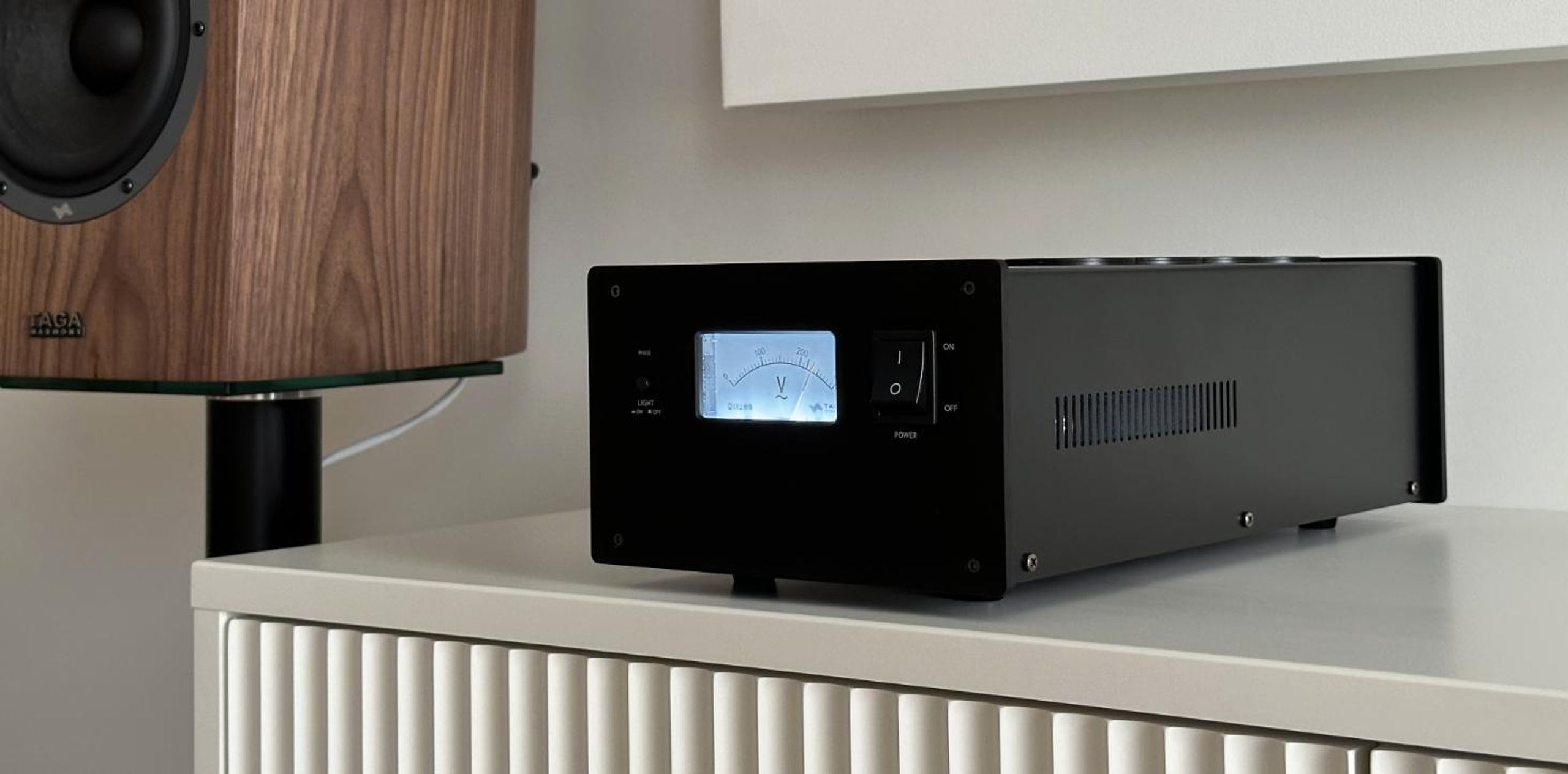
The PC-5000 (2025) from Taga Harmony is a power conditioner housed in a 6.5 kg metal chassis. It distributes current across eight Schuko outlets arranged in four groups, each equipped with filtering tailored to the type of connected equipment. A 200 W toroidal transformer provides isolation for audio sources, while an analog voltmeter allows you to monitor mains stability.
Custom filtering by outlet group
The PC-5000 (2025) stands out for its approach to electrical filtering. Rather than applying a uniform treatment to all outlets, it splits its 8 Schuko outputs into 4 groups of 2 outlets, each optimized for a specific type of device.
Group I (switched, 3 A max): intended for digital accessories such as signal processors or converters. The filtering reduces noise generated by these devices that can contaminate the rest of the system.
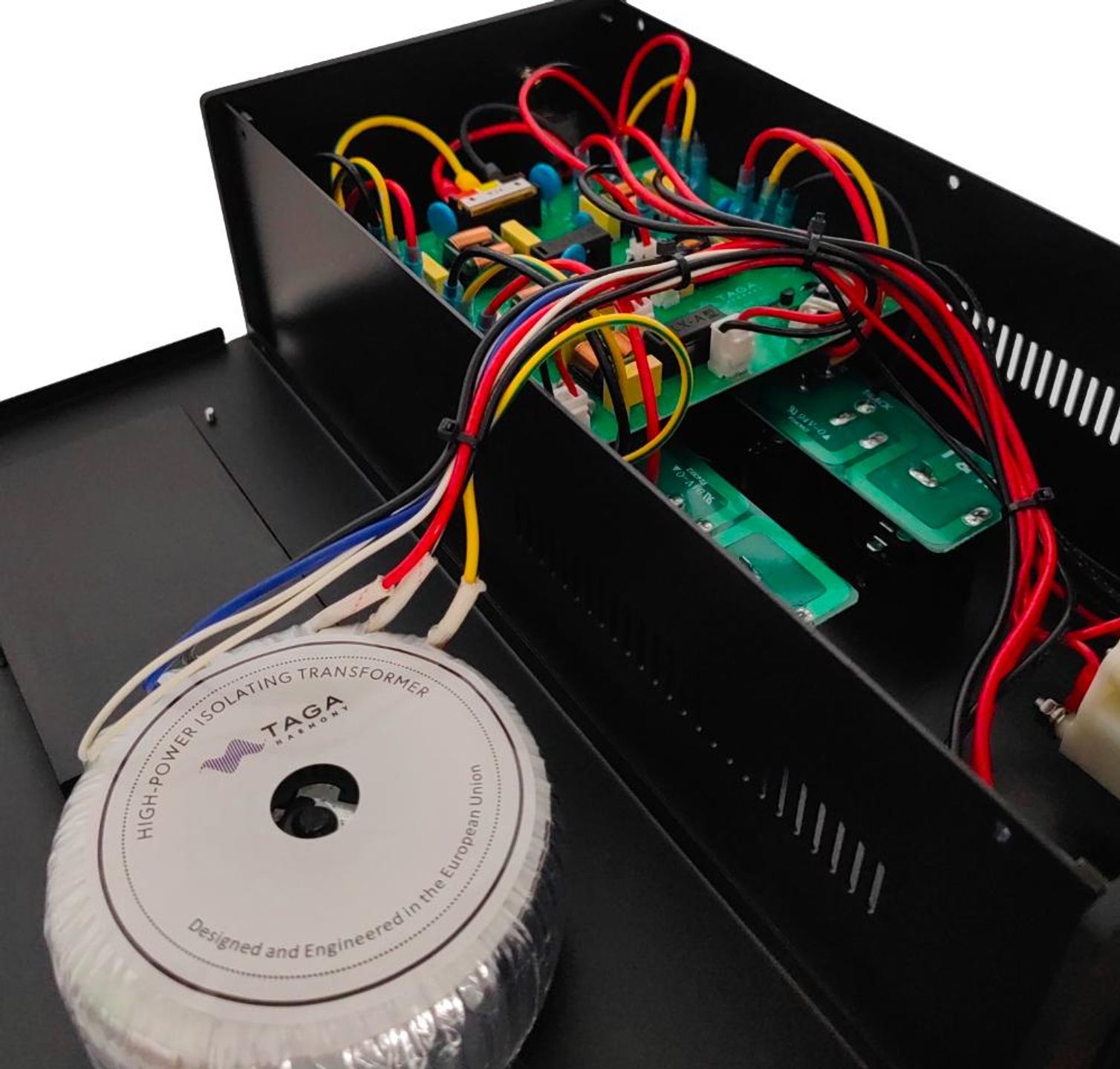
Group II (switched, 1 A max): reserved for audio sources such as CD players, turntables, and network streamers. A 200 W toroidal transformer completely isolates these devices from line noise. This galvanic isolation prevents mains disturbances from reaching the fragile analog signals from these sources. The aluminum shielded cover protects the transformer from external electromagnetic interference.
Group III (unswitched, 5 A max): designed for preamplifiers and accessories that must remain constantly powered. The absence of interruption preserves the operating stability of sensitive circuits.
Group IV (unswitched, 5 A max): dedicated to power amplifiers. These devices benefit from a direct power feed capable of delivering the high current required during dynamic peaks, without limitation from excessive filtering that could hamper their responsiveness.
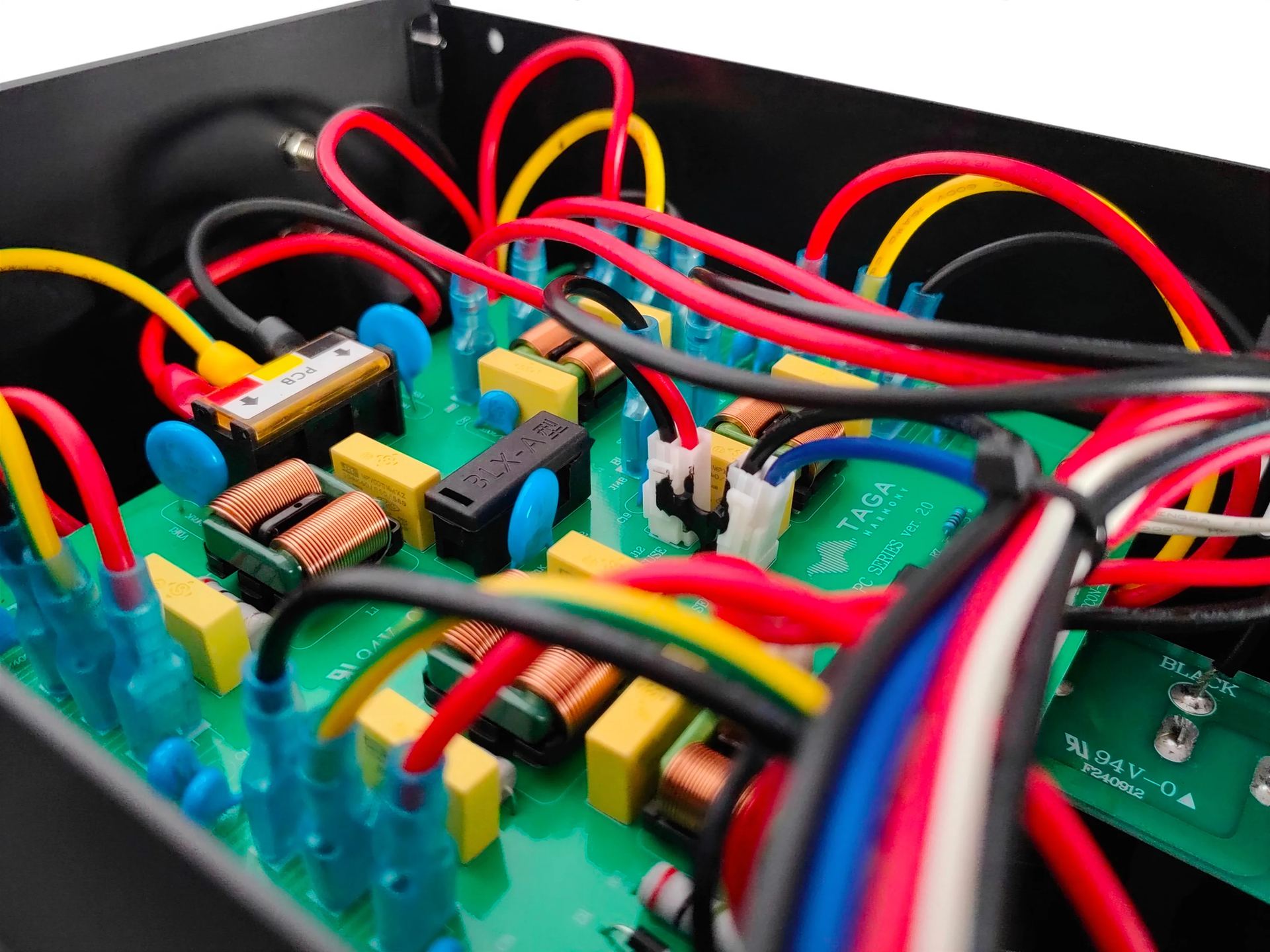
Each group has its own oxygen-free copper inductors and class X capacitors. This independence prevents interactions between devices of different natures. Filtering reaches between -10 dB and -55 dB in the 2–100 MHz range, covering the main noise frequencies present on the home mains.
The internal wiring uses exclusively oxygen-free copper in different gauges: AWM 1015 14AWG for the mains input and phase switch, AWM 1015 16AWG for connections between the main board and outputs. This maximum conductivity minimizes resistive losses and preserves the integrity of the electrical signal.
Mains protection and monitoring
The PC-5000 (2025) protects all outputs against surges, spikes, and overloads. The protection components withstand a surge current up to 4500 A for 8/20 μs, a peak voltage of 3000 V, and a maximum energy of 140 J. This protection is particularly useful during thunderstorms or significant grid fluctuations caused by the startup of powerful appliances nearby.
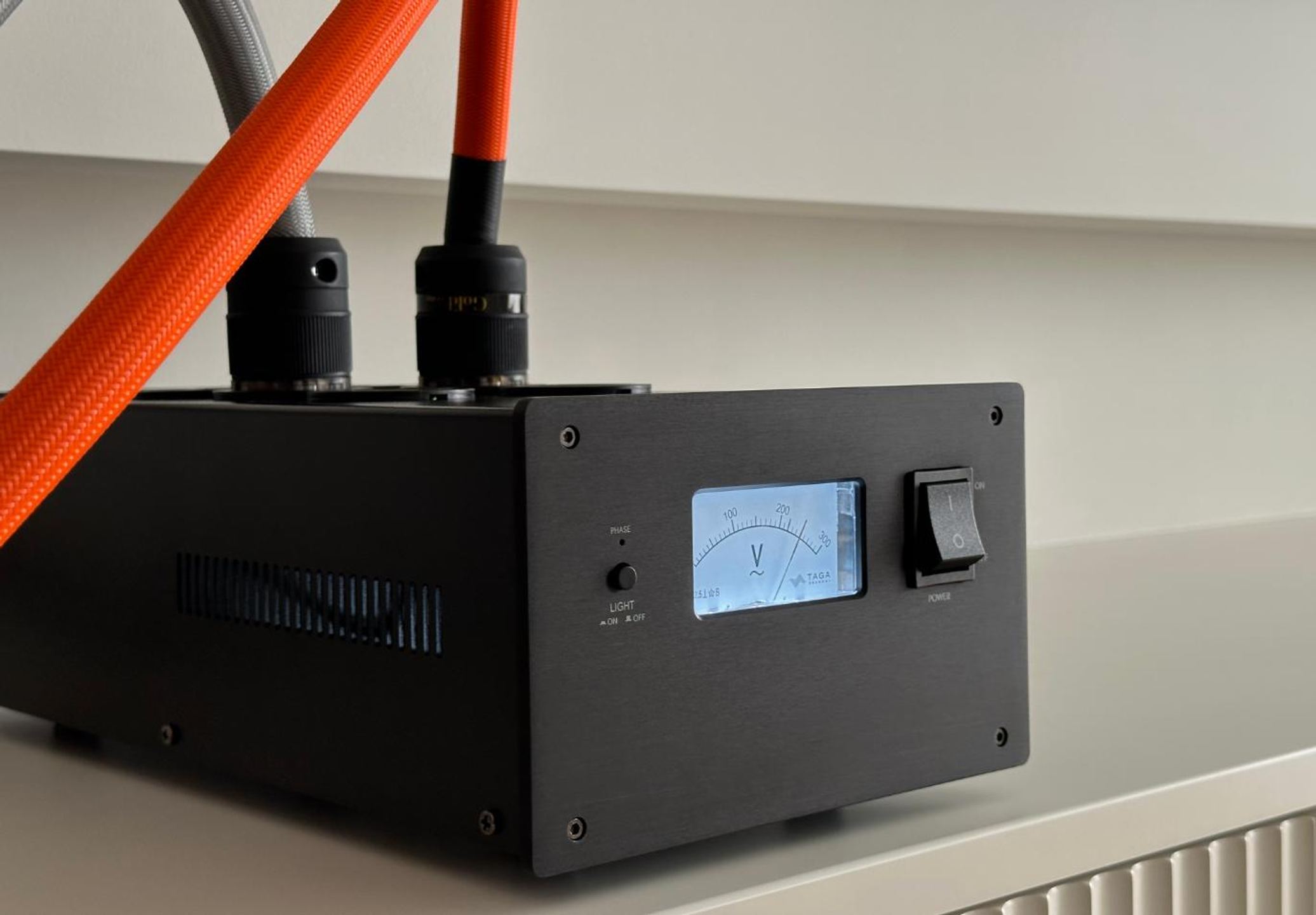
The front panel integrates an analog needle voltmeter that lets you monitor mains voltage in real time. Optional backlighting makes it easier to read—its activation adds 0.2 W to the conditioner’s base consumption, which remains below 0.1 W with no device connected.
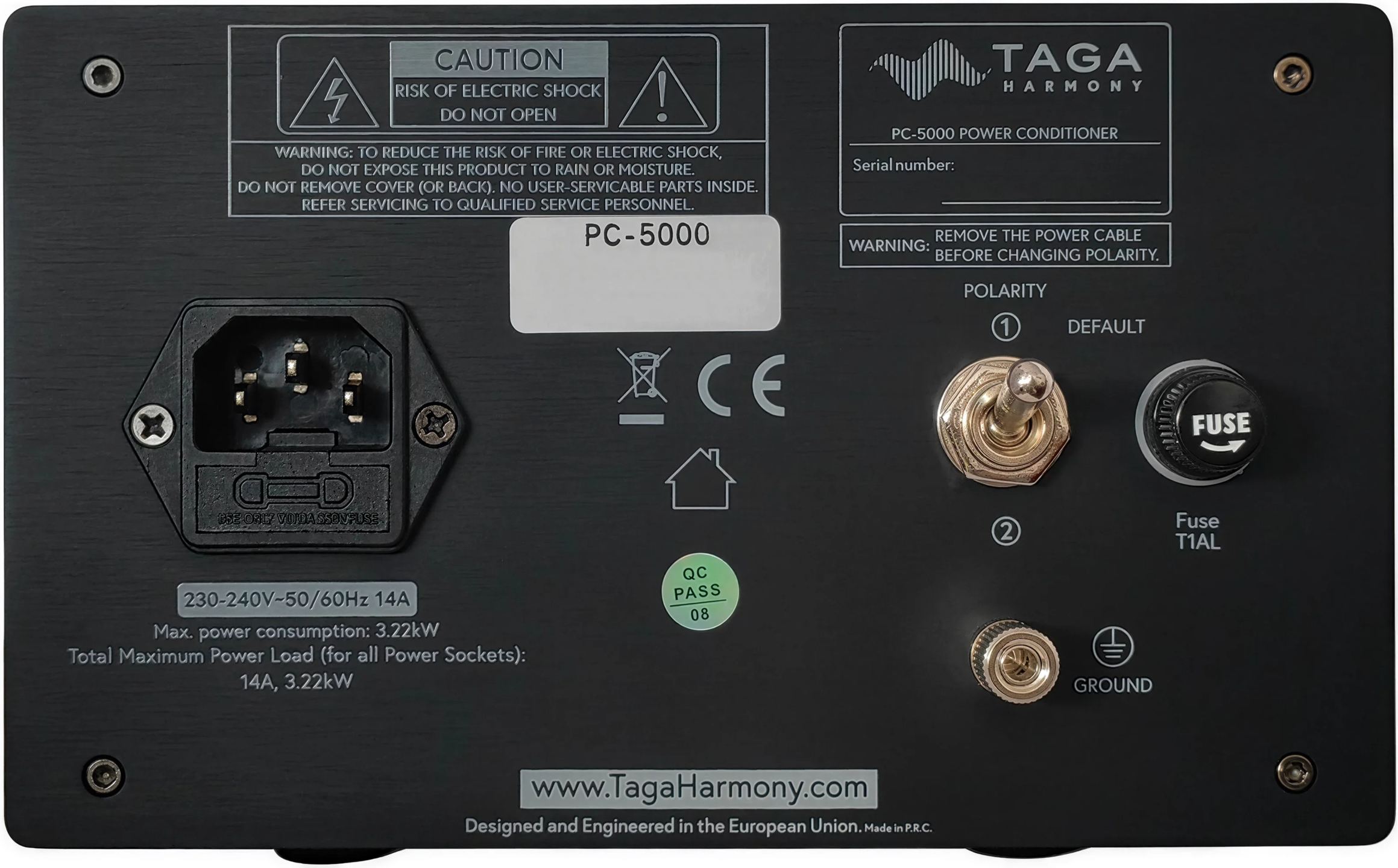
The phase detector indicates wiring errors. When phase and neutral are reversed in the wall outlet, a visual indicator lights up. The polarity switch allows you to instantly correct this inversion without handling the power cable. This feature is practical in older installations where electrical wiring may have inversions. Correct polarity ensures optimal operation of switch-mode power supplies and limits leakage currents.
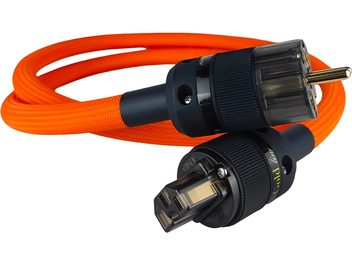
The IEC C14 input accepts a supplied removable Schuko–IEC C13 power cord. This standardized connector allows you to replace the original cable with an audiophile model if desired, offering an upgrade path according to personal preferences.
What’s new in the 2025 version
Compared to the original PC-5000, the 2025 model brings several technical refinements. The internal wiring now adopts 18AWG oxygen-free copper (AWM 1672 for the primary, AWM 1007 for the secondary), offering even better conductivity than the previous version.
The toroidal transformer now features an aluminum shielded cover absent from the initial model. This metallic shielding intercepts parasitic electromagnetic fields that could degrade the transformer’s efficiency. In a modern home environment saturated with Wi-Fi, Bluetooth, and mobile phone signals, this protection improves the transformer’s isolation capability.
The analog voltmeter gains a switchable backlight function, making it easier to read in setups where ambient lighting is low. This addition addresses users who place their conditioner in closed cabinets or dim spaces.
The mass drops from 7.5 kg to 6.5 kg despite the addition of aluminum shielding, suggesting optimization of the internal structure and chassis. External dimensions remain identical: 12 cm high, 18 cm wide, and 38 cm deep with feet. The total maximum load remains set at 14 A or 3450 W.
Documentation
Technical Specifications
Outlet configuration and power distribution
- Outlet type: Schuko
- Configuration: 8 outlets in total
- 4 switched outlets
- 4 unswitched outlets
- Organized into 4 groups of 2 outlets with individualized filtering
- Group I (switched): 3 A max – digital accessories
- Group II (switched): 1 A max – audio sources
- Group III (unswitched): 5 A max – preamplifiers and accessories
- Group IV (unswitched): 5 A max – amplifiers
- Total maximum load: 14 A, 3450 W
Noise filtering and reduction
- Noise filtering: -10 dB to 55 dB (2 – 100 MHz)
- Custom filtering by equipment type for each outlet group
- Oxygen-free copper inductors for each outlet group
- High-quality class X capacitors for optimal filtering
- 200 W toroidal transformer to isolate audio sources from line noise
- Shielded aluminum cover to protect the transformer from electromagnetic interference
Electrical protection
- Protection against surges, spikes, and overloads across all outputs
- Maximum surge current: 4500 A [8 / 20 µs, single]
- Maximum peak voltage: 3000 V [10 mA]
- Maximum clamping voltage: 775 V [8 / 20 µs]
- Maximum energy: 140 J [10 / 1000 µs]
Components and construction
- Internal wiring in oxygen-free copper for optimal conductivity
- Oxygen-free copper inductors for each outlet group
- High-quality class X capacitors
- 200 W toroidal transformer with shielded aluminum cover
Power supply
- Voltage and frequency: 230 V 50 / 60 Hz
- Power consumption
- Less than 0.1 W with no device connected
- Additional 0.2 W with backlight enabled
- Removable Schuko–IEC C13 power cord with IEC C14 inlet, compatible with premium audiophile cables
Physical characteristics
- Dimensions: 12 H x 18 W x 38 D cm (with feet)
- Weight: 6.5 kg
Additional features
- Analog voltmeter with backlight to monitor mains stability
- Phase detector and polarity switch for easy correction of wiring errors
- Convenient interface with voltage monitoring, phase detection, and backlighting
General information
The 8-outlet power conditioner combines two essential functions to optimize the performance of your audio and video setup.
Advanced, customized filtering of electrical noise: Home and professional networks are exposed to electromagnetic interference from connected devices (refrigerators, air conditioners, computers, etc.) or from external sources. These disturbances, known as noise, can affect audio and video quality and reduce the lifespan of your equipment’s internal circuits. The conditioner acts as a buffer between the wall outlet and your devices, improving the performance and longevity of connected components.
Protection against surges and overloads: Protects all outputs against surges, spikes, and electrical overloads, ensuring the safety of your equipment.
Highlights: customized filtering for each type of audio and video equipment, isolation of audio sources via toroidal transformer, comprehensive protection against surges, spikes, and overloads, maximum conductivity thanks to oxygen-free copper wiring.
Frequently asked questions
Why split the outlets into groups with different maximum currents?
Audio sources (CD players, DACs) typically consume 50 to 100 W, hence the 1 A limit for their group. Amplifiers can exceed 1000 W on peaks, requiring 5 A available. This segmentation prevents an amplifier from monopolizing the conditioner’s capacity to the detriment of other devices. It also allows filtering to be optimized: a group dedicated to sources can receive very aggressive filtering via the isolation transformer without risking limiting the dynamic current required by an amplifier.
Does the isolation transformer on Group II degrade sound dynamics?
No, the 200 W toroidal transformer is rated well above the needs of audio sources. A CD player or streamer rarely consumes more than 30 W in operation. This ample headroom ensures the transformer never saturates, even during transient peaks. The galvanic isolation it provides eliminates common-mode noise present on neutral and earth, often responsible for a sonic veil or perceptible background noise in sensitive systems.
What kinds of noise does the PC-5000 (2025) actually filter?
The conditioner mainly targets differential-mode and common-mode noise in the 2–100 MHz band. These disturbances come from switch-mode power supplies (computers, chargers, LEDs), electric motors (refrigerators, air conditioners), dimmers, and wireless devices. Class X capacitors absorb fast transients while copper inductors block noise frequencies. The toroidal transformer on Group II adds complete suppression of common-mode noise for audio sources.
Is it necessary to strictly adhere to the outlet group assignments?
While recommended, some pragmatism is possible. A DAC can operate on Group I or II depending on its consumption. A 50 W bookshelf amplifier could make do with Group III. However, following the assignments optimizes performance: placing a powerful amplifier on Group IV preserves full current capacity and appropriate filtering, while sources on Group II benefit from the transformer’s galvanic isolation. The switched outlets (Groups I and II) allow you to turn accessories and sources off from the main switch, reducing standby consumption.
Does the PC-5000 (2025) provide effective lightning protection?
The conditioner offers primary protection against surges induced by lightning—that is, disturbances propagating through the power grid following a distant strike. With a surge current handling of 4500 A and 140 J of absorbed energy, it stops the current spikes resulting from an indirect lightning strike in the neighborhood. However, a direct strike to the building exceeds these values. For maximum protection in areas exposed to severe storms, adding a compliant surge arrester at the main electrical panel is recommended. The PC-5000 then becomes the second line of defense, filtering residual noise.
How should I interpret the voltmeter and phase detector indications?
The voltmeter displays mains voltage, normally between 220 V and 240 V in Europe. Occasional variations of ±10 V are normal depending on time of day and grid load. A consistently low voltage (below 215 V) or high (above 245 V) indicates an installation issue requiring an electrician’s intervention. The phase detector lights up when phase and neutral are reversed in the wall outlet. This inversion, while not immediately dangerous, can increase leakage currents and audible noise. The polarity switch next to it electronically corrects this anomaly, restoring the correct polarity for all connected devices.
Does oxygen-free copper wiring provide an audible benefit?
Oxygen-free copper (OFC) has higher conductivity than standard electrolytic copper and resists corrosion better over time. In a power conditioner where currents can reach 14 A, wiring resistance directly affects losses and heating. OFC wiring minimizes voltage drop between input and outputs, preserving the regulation of connected devices’ power supplies. On mid-resolution systems, the difference remains imperceptible. In high-fidelity setups with quality sources and amplification, this optimization contributes to overall transparency by eliminating a potential source of electrical signal degradation.
What is the PC-5000 (2025)’s daily power consumption?
With no device connected, the conditioner consumes less than 0.1 W, mainly to power the voltmeter. Activating the backlight adds 0.2 W. Even with this function permanently on, annual consumption does not exceed 3 kWh, or less than 50 euro cents. This energy efficiency comes from the absence of active components: filtering relies solely on passive elements (inductors, capacitors) that do not consume power. The toroidal transformer itself only consumes power when supplying current to connected devices, with efficiency exceeding 95%.
- Eco-contribution of €1.10 included in the sale price.