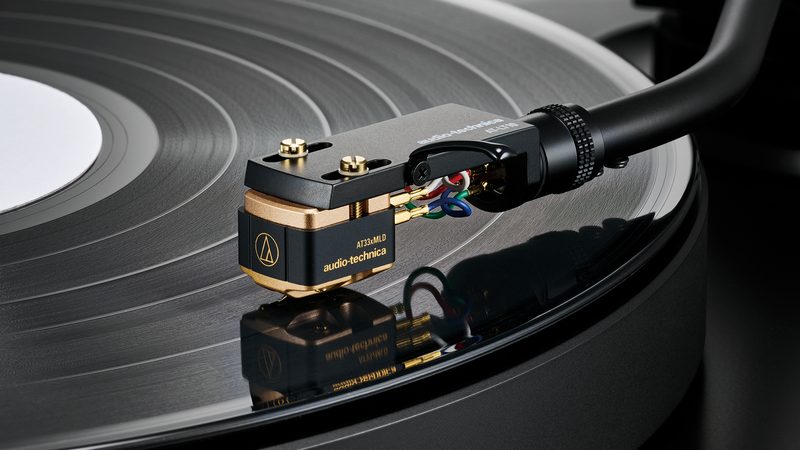
Audio Technica AT33xMONO/II
Overview
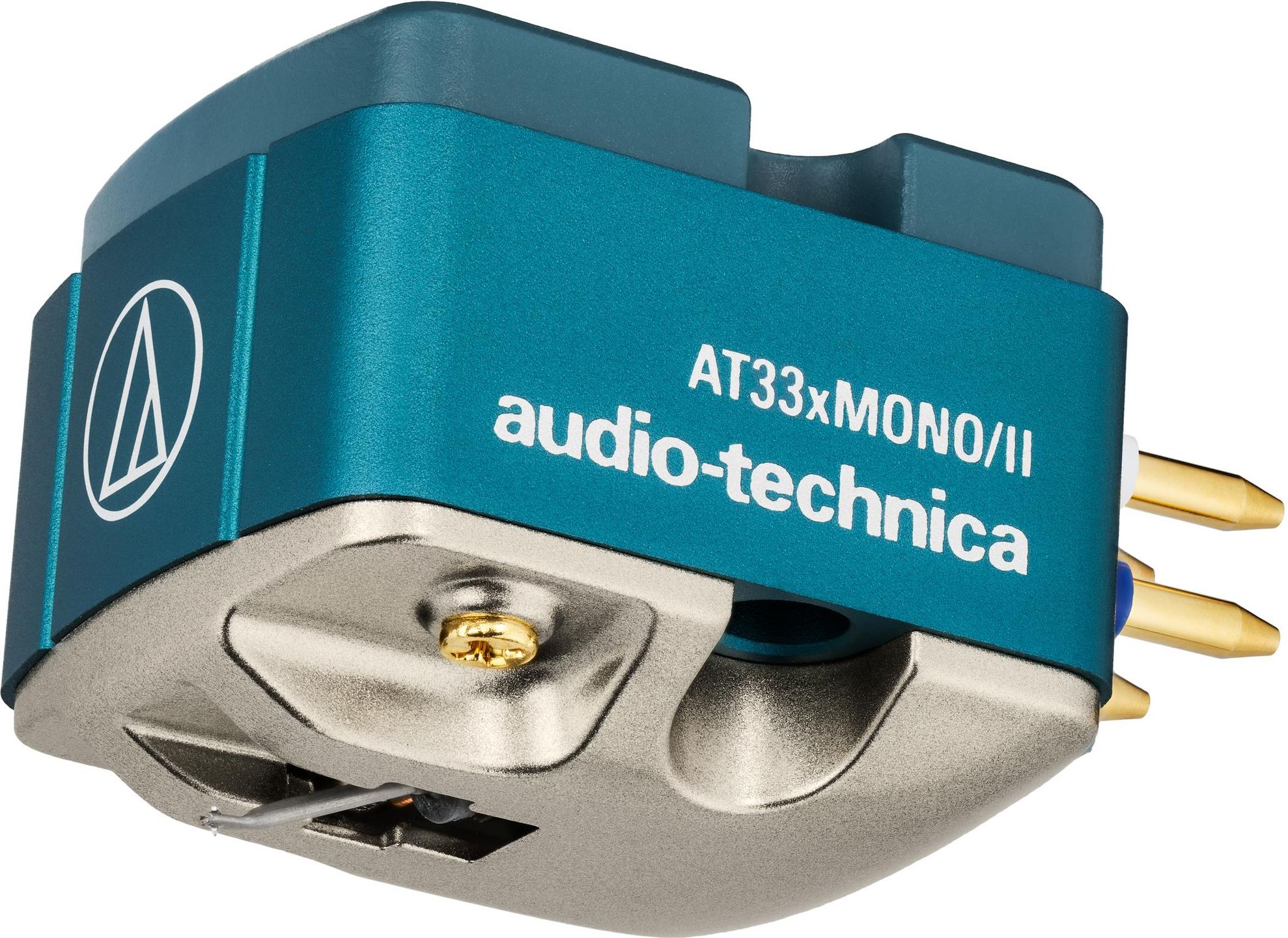
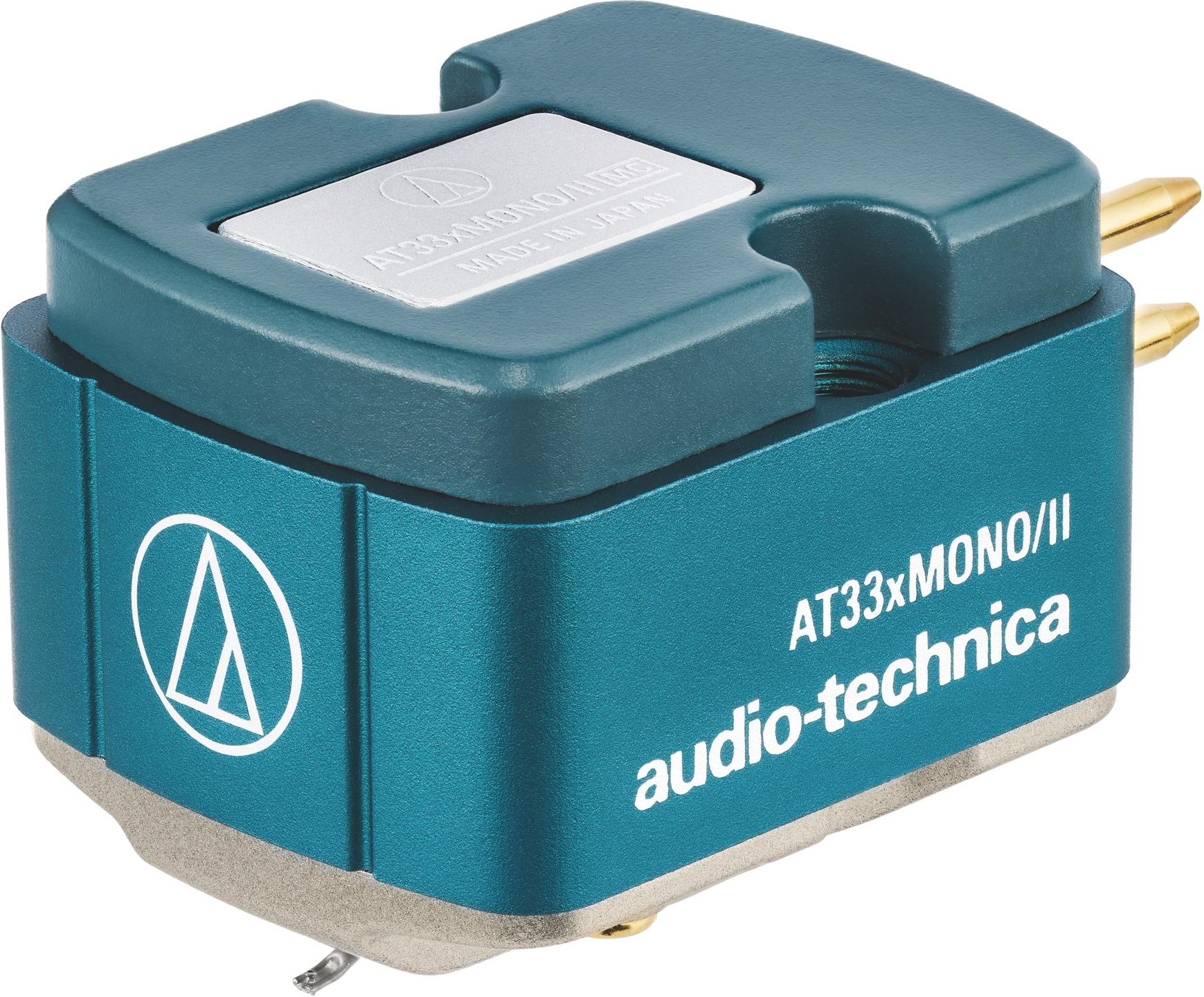
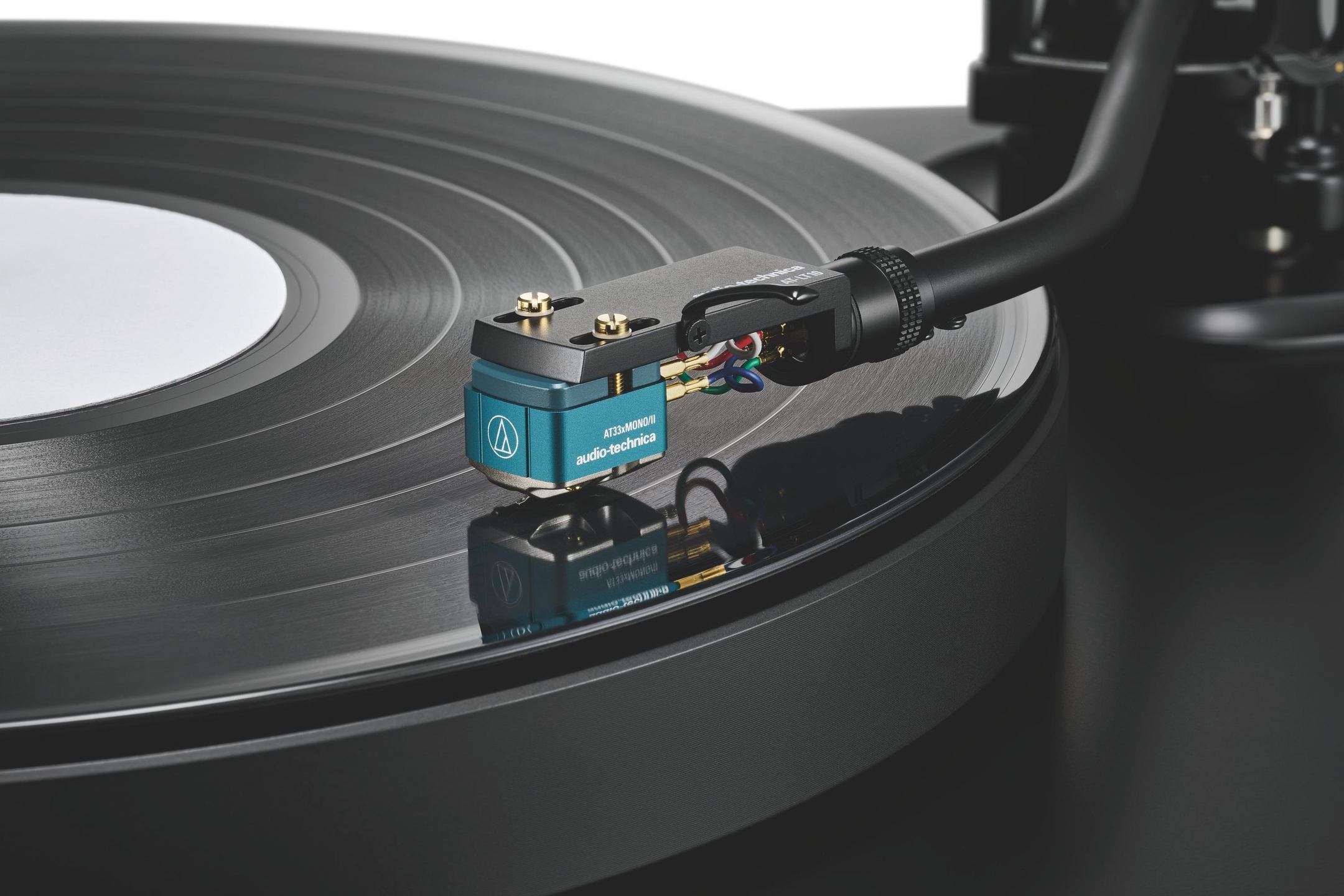
The AT33xMONO/II represents the culmination of over sixty years of expertise in phono cartridge design, integrating for the first time a samarium-cobalt magnet into an Audio-Technica mono cartridge. This dual moving-coil cartridge combines cutting-edge materials with a reimagined acoustic architecture to deliver a particularly warm and stable reproduction of classic mono recordings.
An innovative hybrid construction to tame resonances
The AT33xMONO/II heralds a new construction approach at Audio-Technica with its hybrid body combining die-cast zinc, aluminum, and high-rigidity polymer. The zinc, particularly dense and rigid, forms the structural base and ensures effective suppression of resonances in the mid and low registers. This tri-material structure enables optimal dispersion of parasitic vibrations across the entire chassis.
The duralumin tube cantilever tapers toward the tip to improve transient response. This material, stiffer than standard aluminum, offers an ideal balance between lightness and mechanical strength. Internal damping uses Hanenite synthetic rubber, a Japanese compound with a rebound coefficient below 10%. Positioned inside the housing and at the pivot support, it absorbs vibrational energy without returning it, eliminating unwanted coloration while preserving signal dynamics.
The distinctive choice of samarium-cobalt
The key differentiator of the AT33xMONO/II lies in its magnetic system using a samarium-cobalt (SmCo) magnet paired with a pure iron yoke. This combination, unique within the AT33x range, differs from the neodymium-permendur system of the MONO/I version through its specific sonic characteristics.
Samarium-cobalt magnets offer superior resistance to demagnetization and exceptional thermal stability, retaining their magnetic properties over very long periods. The pairing with a pure iron yoke provides progressive magnetic saturation that contributes to this cartridge’s warm sonic signature. This architecture generates a homogeneous magnetic field in the air gap, ensuring a linear conversion of mechanical motion into electrical signal.
“True Mono” architecture and PCOCC technology
The electrical generator employs a dual moving-coil configuration aligned horizontally, parallel to the record surface. This “True Mono” layout ensures that only the lateral groove modulations—containing the entirety of the mono signal—are converted into an electrical signal.
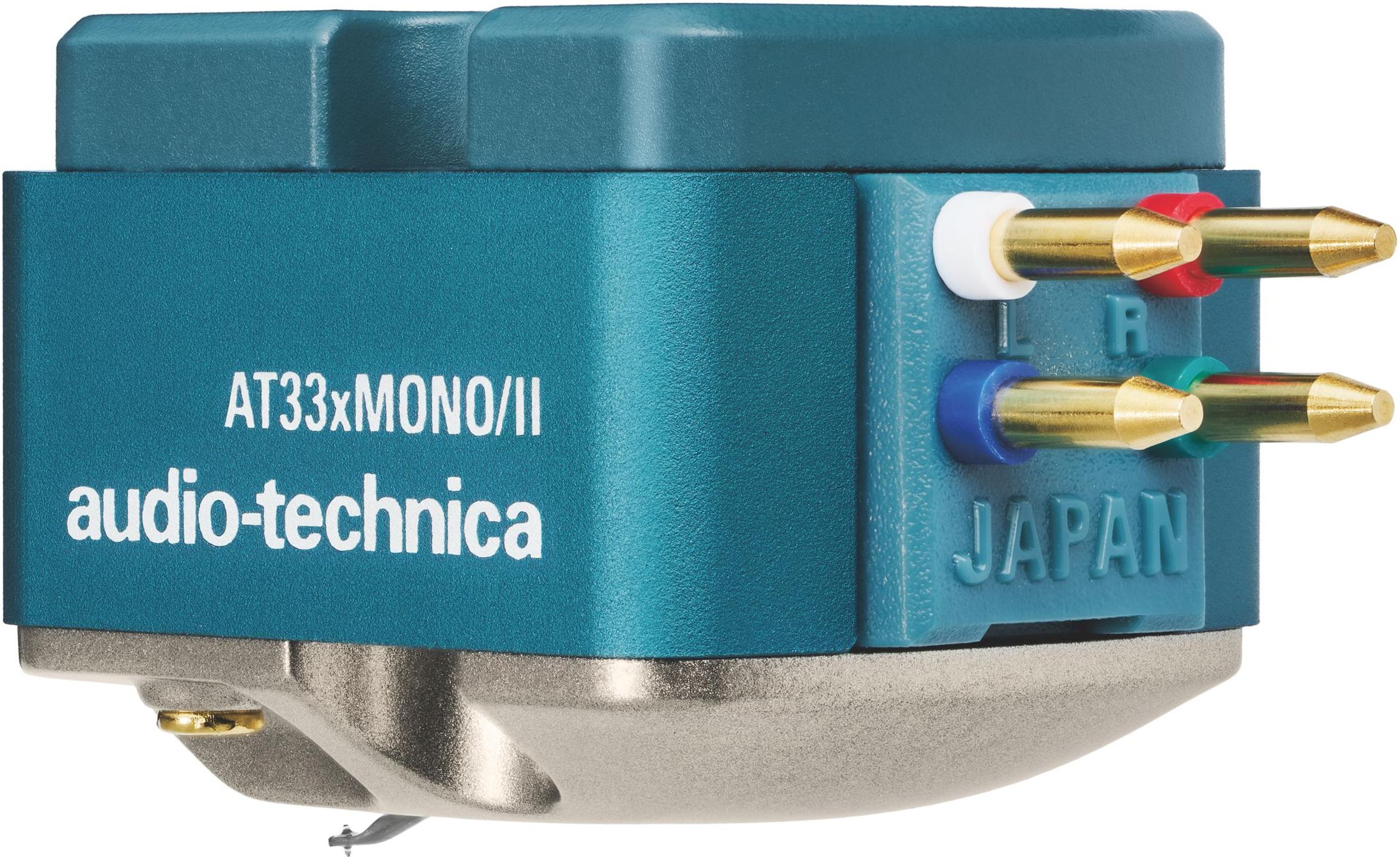
The coils use PCOCC (Pure Copper by Ohno Continuous Casting) wire, a technology developed by Professor Atsumi Ohno. This process yields a single-crystal conductor up to 200 meters long, eliminating the grain boundaries of conventional copper that generate micro-distortions. The dual-coil configuration provides four output terminals with bifilar windings, allowing use with any standard stereo phono preamplifier without ground loop issues.
Optimized geometry for the mono groove
The 0.65 mil (16.5 microns) nude conical diamond is the optimal choice for mono microgroove records. This spherical geometry ensures uniform contact with the groove walls, regardless of cutting-angle variations between pressings from different eras.
The horizontal compliance of 14 × 10⁻⁶ cm/dyne (static) allows the diamond to faithfully follow lateral undulations. Vertical compliance is deliberately limited to minimize pickup of surface noise, which is primarily vertical. The 20-degree stylus rake angle corresponds to the cutting standards of mono records from the 1950s–1960s.
Installation and compatibility
The reduced-compliance suspension mechanism broadens compatibility with various tonearms, particularly those of medium to high mass. At 10.2 grams and with a tracking force of 2.5 grams (range 2.3–2.7 g), the cartridge fits the majority of setups.
Integrated M2.6 threaded inserts simplify installation, eliminating the hassles of traditional loose nuts. The kit includes six screws in three lengths (8, 10, and 13 mm) to fit all headshells on the market.
Documentation
French
Technical Specifications
Electrical Specifications
- Transducer type: dual moving-coil (MC True Mono)
- Frequency response: 20 Hz – 20000 Hz
- Output voltage: 0.37 mV (1 kHz, 5 cm/s, horizontal signal)
- Horizontal/vertical separation: 25 dB (1 kHz)
- Channel balance: 1.0 dB (1 kHz)
- Coil impedance: 10 Ω (1 kHz)
- DC resistance: 10 Ω
- Recommended load impedance: ≥ 100 Ω (with MC phono preamplifier)
- Coil inductance: 27 µH (1 kHz)
Mechanical Specifications
- Tracking force: 2.3 – 2.7 g (2.5 g standard)
- Static compliance: 14 × 10⁻⁶ cm/dyne
- Dynamic compliance: 6 × 10⁻⁶ cm/dyne (100 Hz)
- Diamond: nude spherical, 0.65 mil radius
- Cantilever: rigid duralumin tube
- Vertical tracking angle: 20°
- Threaded inserts: M2.6 × 2
Dimensions and Weight
- Weight: 10.2 g
- Dimensions (H × W × D): 16.1 × 16.6 × 26.1 mm
Box Contents
- Non-magnetic screwdriver
- Cleaning brush
- Washers: 2 pieces
- M2.6 screws: 6 pieces (8 mm, 10 mm, 13 mm)
- Protective cap
Frequently Asked Questions
Can this cartridge damage my stereo records if I use it by mistake?
No, the AT33xMONO/II has sufficient vertical compliance to navigate safely in stereo grooves. However, it will only reproduce a mono signal (sum of left and right channels) without stereo separation. It’s still best to reserve it for mono records to fully benefit from its qualities.
What is the difference between the AT33xMONO/II and the AT33xMONO/I model?
The main difference lies in the magnetic system: the MONO/II uses a samarium-cobalt magnet with a pure iron yoke, offering a warmer and more stable presentation, while the MONO/I employs a neodymium magnet with a permendur yoke for a more analytical and dynamic rendering. The choice depends on your sonic preferences and the type of mono recordings in your collection.
Can I use this cartridge with my standard MM phono preamp?
No. With an output voltage of 0.37 mV, this MC cartridge requires a dedicated MC phono preamplifier or the addition of an MC step-up transformer between the cartridge and your MM preamp. Insufficient gain would result in a signal level that is too low and a degraded signal-to-noise ratio.
Is this cartridge suitable for 78 rpm records?
No, the AT33xMONO/II is designed exclusively for 33⅓ and 45 rpm microgroove records. Shellac 78 rpm records require a different stylus size (generally 2.5 to 3 mil) and should not be played with this cartridge to avoid mutual damage.
- Eco-contribution included in the sale price.
- GTIN / EAN: 4961310164065