

Gold Note TUBE-1012 black



Overview
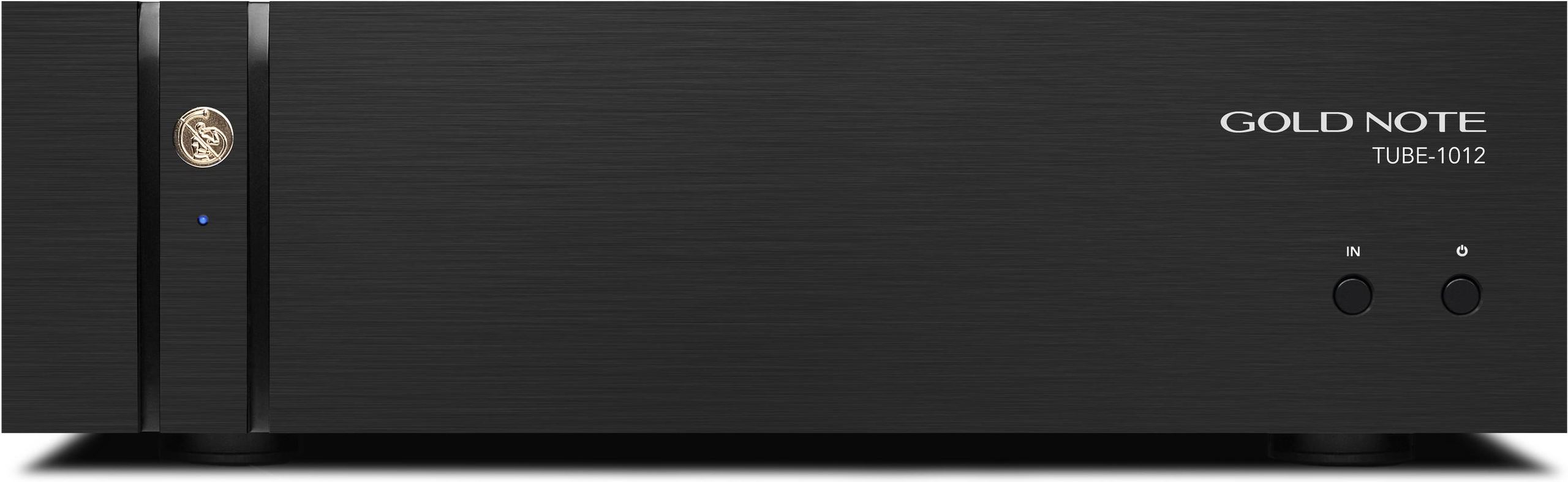
The Gold Note TUBE-1012 is a tube output stage designed to transform the sonic character of a hi-fi system. Unlike a conventional amplifier, this module is placed between an audio source and an amplifier, adding the tube sound signature to solid-state electronics. With its 12 Soviet 6n1p tubes running in class A and its proprietary Totem-Pole design, the TUBE-1012 aims to combine the precision of transistors with the warmth of valves.
A modular approach to sound coloration
The TUBE-1012 fits into Gold Note’s modular philosophy, allowing a hi-fi system to be upgraded progressively. Its position in the audio chain is strategic: it comes after the sources (CD player, DAC, phono preamp) and before the power amplification stage.
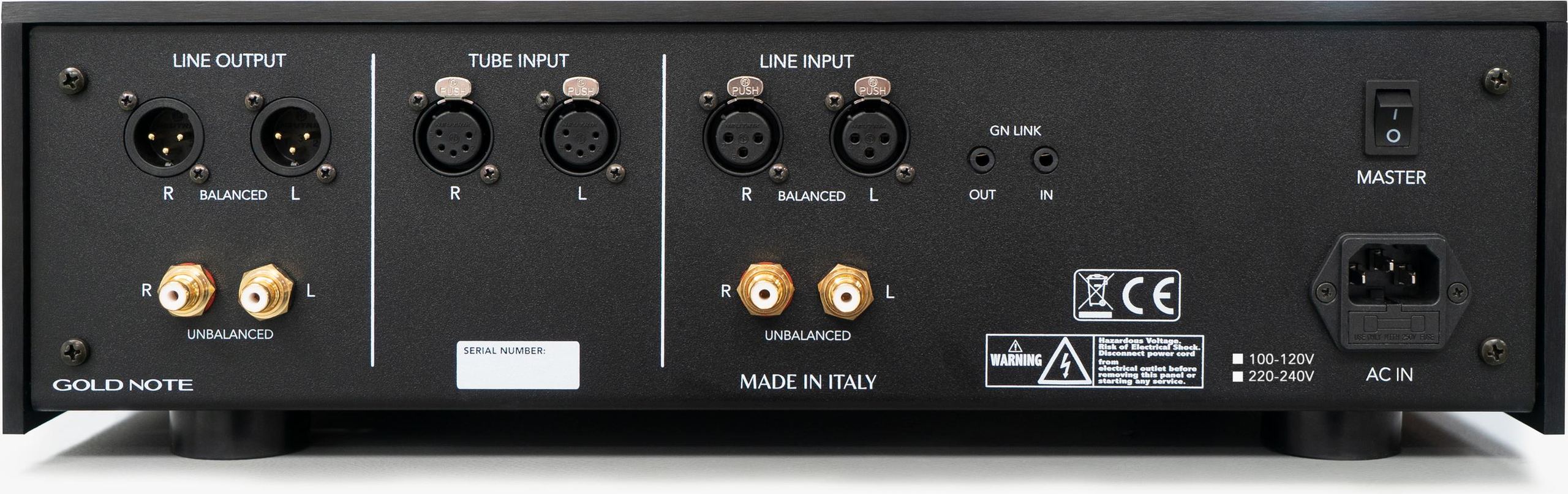
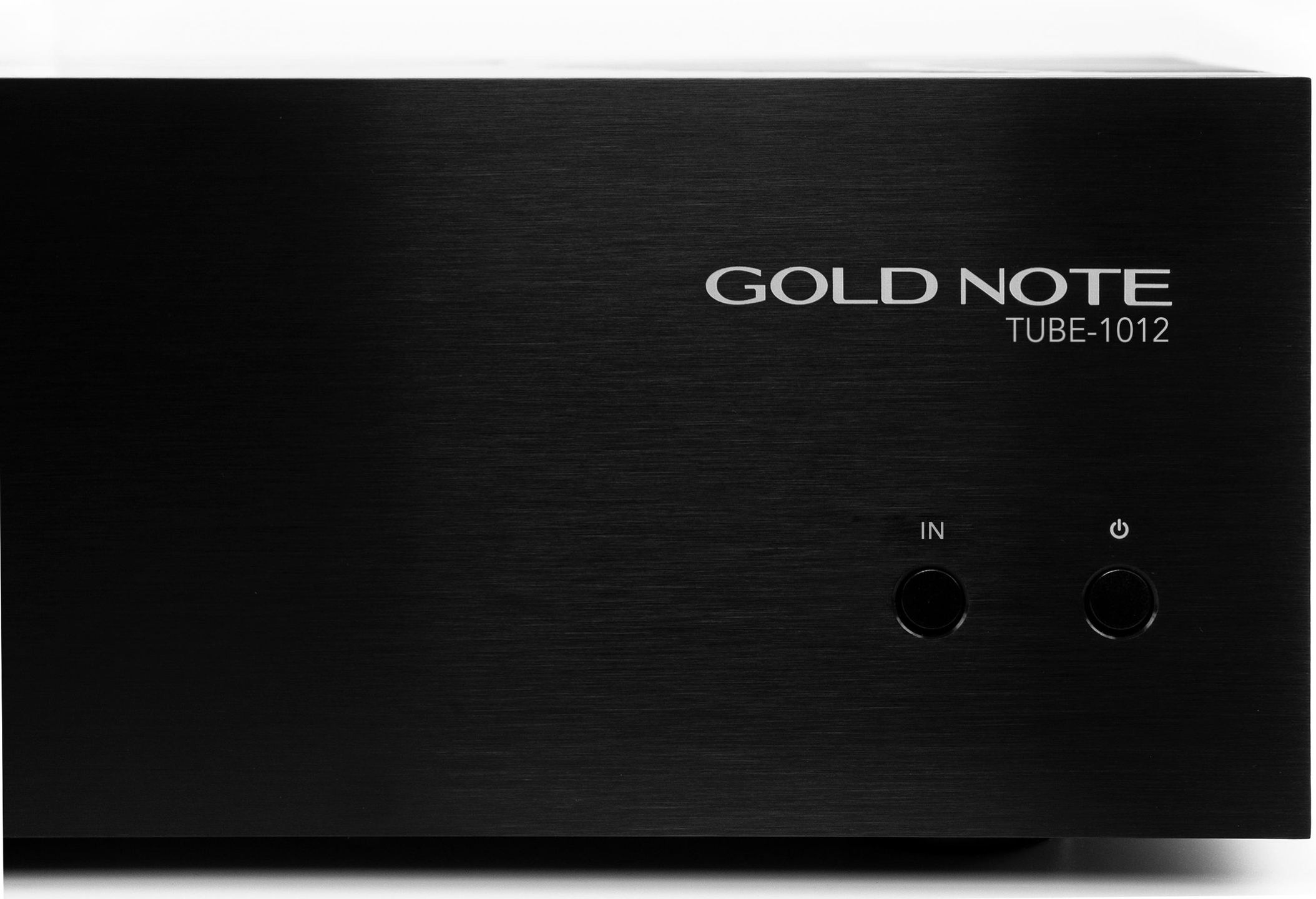
The unit can accommodate up to two sources simultaneously thanks to three distinct types of inputs. The TUBE input, which uses a 5-pin XLR connector, is specifically dedicated to Gold Note sources. The LINE inputs (available in unbalanced RCA and balanced XLR) ensure compatibility with all other brands. The front-panel input selector makes switching between sources straightforward.
With a measured gain of only 2 dB, the TUBE-1012 does not impose aggressive amplification but focuses on the qualitative transformation of the signal. Maximum input levels reach 12 Vrms on XLR and 6 V on RCA, while the outputs can deliver up to 16 V on XLR and 8 V on RCA, ensuring comfortable dynamic headroom.

Totem-Pole design: stacking for better reproduction
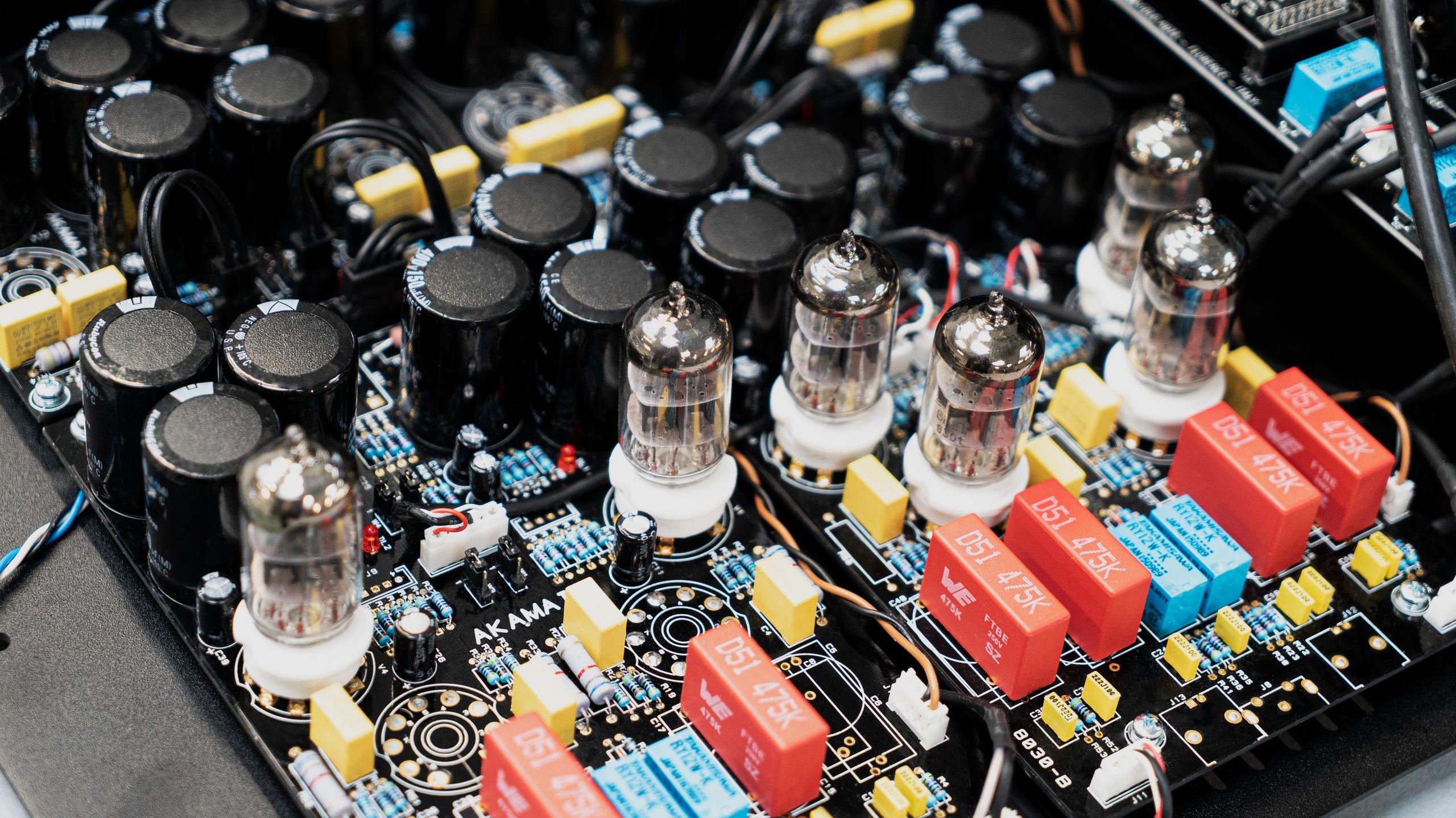
At the heart of the TUBE-1012 lies a proprietary Totem-Pole architecture, a topology that fundamentally differs from conventional push-pull designs. In this configuration, the tubes are stacked vertically rather than wired in parallel. Each 6n1p tube drives six independent audio stages, creating a distributed processing network intended to reduce distortion while extending bandwidth.
Output impedance remains below 600 Ω, a relatively low value for a tube stage, facilitating matching with different amplifiers. The minimum recommended load of 10 kΩ suits most modern preamplifiers and integrated amplifiers. The absence of coupling transformers at both input and output simplifies the signal path and removes certain potential sources of coloration or bandwidth limitation.
Gold Note specifies a total harmonic distortion of 0.0028% at 1 kHz, figures that are closer to solid-state electronics performance than to traditional tubes. The signal-to-noise ratio exceeds 100 dB, reflecting meticulous work on the power supply and shielding.
6n1p tubes: Soviet heritage and robustness
The choice of 6n1p tubes is no accident. These Soviet-made dual triodes stand out from classic Western tubes through their robust construction and specific electrical characteristics. Originally developed for military applications, they offer above-average longevity, with a service life of up to 5000 hours for military-grade versions.
Electrically, the 6n1p offers a moderate gain of around 30 to 35 and a relatively high plate impedance, making it closer to American 6BQ7A tubes than to 6922/E88CC, often mistakenly cited as direct equivalents. Their transconductance of around 4.35 mA/V contributes to their reputation for linearity and low distortion in hi-fi audio applications.
The 6n1p requires a heater current of 600 mA at 6.3 V, twice that of many comparable Western tubes. This higher consumption explains why the TUBE-1012 has a power draw of 80 W. The absence of power tubes in the design avoids bias adjustment issues, simplifying day-to-day use.
An electronic power supply regulated by tubes
The TUBE-1012’s power supply deserves special attention. Gold Note has opted for a super-linear tube-based regulator, an approach that is consistent with the product’s philosophy. Four choke filters complement the regulation system, absorbing fluctuations and interference from the mains. The three custom Gold Note transformers form the backbone of this power supply.
This approach results in a total weight of 16 kg for the unit, a significant portion of which comes from the transformers and chokes. The dimensions of 430 mm wide, 135 mm high, and 370 mm deep place the TUBE-1012 within the standard footprint of high-end hi-fi components.
Documentation
Technical specifications
Audio performance
- Maximum input level
- 12 Vrms on XLR
- 6 Vrms on RCA
- Maximum output level
- 16 Vrms on XLR
- 8 Vrms on RCA
- Output impedance: < 600 Ω
- Input impedance: 10 kΩ
- Recommended load: > 10 kΩ
- Total harmonic distortion + noise: 0.0028% at 1 kHz – 1.736 V
- Signal-to-noise ratio: > 100 dB at 1 kHz – 1.736 V
- Gain: 2 dB
Inputs and outputs
- 1 balanced stereo XLR input
- 1 unbalanced stereo RCA input
- 1 Tube input (5-pin XLR for Gold Note sources only)
Tubes and design
- Tube type: 6n1p x 12
- Design: Totem-Pole output stage
- Transformers: no coupling transformer on input/output
Power supply
- Power consumption: 80 W
- Mains voltage: 100–120 V or 220–240 V, 50 / 60 Hz
- Super-linear electronic tube regulator with 4 inductance filters
Dimensions and weight
- Dimensions: 430 mm W x 135 mm H x 370 mm D
- Weight: 16 kg net, 21 kg packaged
Frequently Asked Questions
Can the TUBE-1012 be used with amplifiers from other brands than Gold Note?
Yes, the TUBE-1012 is compatible with any amplifier that accepts standard line-level inputs. RCA and XLR connections ensure compatibility with almost all amplifiers on the market. The output impedance below 600 Ω and the minimum recommended load of 10 kΩ conform to industry standards. Only the TUBE input (5-pin XLR) is specific to Gold Note sources.
Is regular adjustment or maintenance of the tubes required?
No, the TUBE-1012 does not require bias adjustment, unlike tube power amplifiers. The 6n1p tubes operate at fixed voltage and current levels set at the factory. Maintenance is limited to occasional dusting of the chassis. The lifetime of 6n1p tubes reaches 5000 hours for military-grade versions, which corresponds to several years of typical use. When replacement becomes necessary, you simply remove the old tubes and insert the new ones, with no adjustment required.
What sonic difference does it make compared to a fully solid-state system?
The TUBE-1012 introduces the harmonic signature of tubes, notably an enrichment in even-order harmonics that smooths transients and adds density to the midrange. The soundstage gains in three-dimensional depth. Timbres become more organic, particularly on voices and acoustic instruments. However, with its very low distortion measurements and high signal-to-noise ratio, the TUBE-1012 preserves the transparency and detail of the original system, avoiding the excessive coloration sometimes associated with older tube designs.
What is the difference between the TUBE-1012 and the TUBE-1006?
The TUBE-1012 uses 12 6n1p tubes, while the TUBE-1006 uses 6. This difference results in a more pronounced tube coloration on the 12-tube model, with more marked harmonic enrichment. The TUBE-1012 consumes 80 W with three custom transformers, compared with 50 W and two transformers for the TUBE-1006. The 12-tube model is also 5 kg heavier (16 kg vs. 11 kg). Both share the same connectivity and compatibility; the choice depends on the desired degree of coloration and installation constraints.
- Eco-contribution included in the sale price.
- Manufacturer reference: PF-MILLE-TUB-012-B