iFi Audio Zen Air Dac 2



Specifications and features


Overview
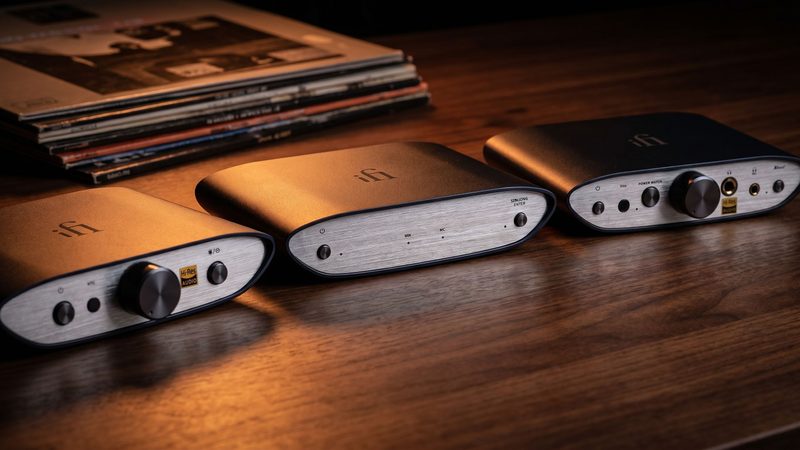
In 2022, the first Zen Air DAC had a simple mission: to offer the essentials of the Zen range in a polymer enclosure, without a balanced output, at the lowest possible price. The Zen Air DAC 2 changes direction. New Cirrus Logic chip, balanced 4.4 mm output, metal front panel, midnight blue finish, and dedicated power button: this second generation takes on most of the strengths that iFi Audio had until now reserved for the standard Zen range.
A new converter by Cirrus Logic
Since its beginnings, iFi Audio has equipped almost all of its converters with Burr Brown (Texas Instruments) chips. The Zen Air DAC 2 changes supplier and adopts a 32-bit Cirrus Logic DAC, which the brand markets under the name MasterHIFI. iFi Audio presents this choice as being motivated by a gain in clarity and dynamics.
The figures confirm this ambition. The signal-to-noise ratio and dynamic range both reach 118 dBA, compared with 113 dBA on the first model. Total harmonic distortion (THD+N) drops to 0.0011% on the 6.35 mm output and 0.0015% on the 4.4 mm output, whereas the original Zen Air DAC showed 0.04%. Conversion supports PCM up to 384 kHz and native DSD up to DSD256, without altering the stream (bit-perfect processing for DSD and DXD).
Frequency response extends from 20 Hz to 90 kHz (-3 dB), which goes far beyond the audible spectrum and ensures linear behavior across the entire useful band.
The 4.4 mm balanced output, at last
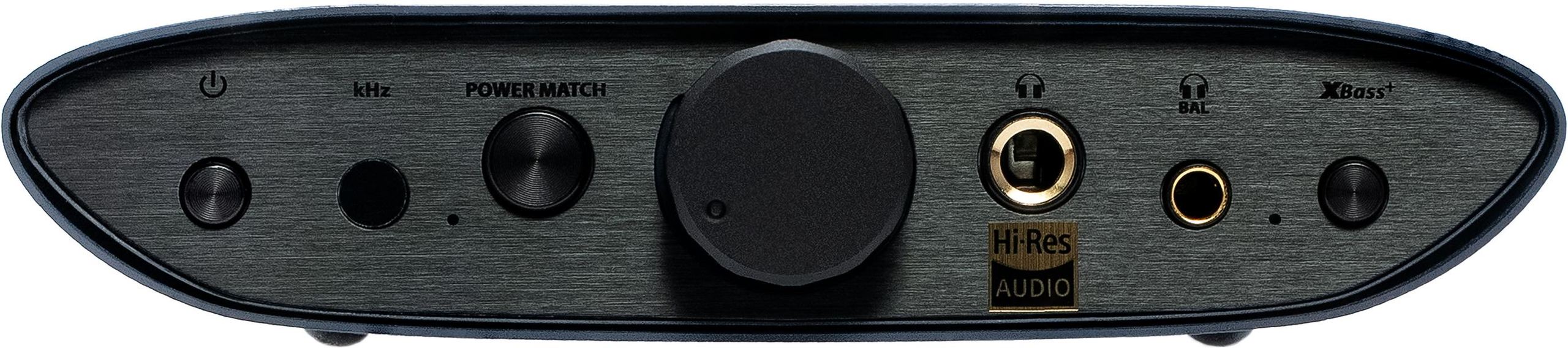
This was the most visible concession of the first Zen Air DAC compared with the Zen DAC V2 and Zen DAC 3: the lack of a balanced output. The Zen Air DAC 2 remedies this with a 4.4 mm Pentaconn jack on the front panel, alongside the unbalanced 6.35 mm jack.
The audio circuit is designed in a balanced topology, which reduces crosstalk and background noise compared with a conventional unbalanced design. Output impedance remains low: under 0.7 Ω on the 6.35 mm output (and 3.5 mm via adapter), under 1.4 Ω on the 4.4 mm output. These values ensure proper control even with IEMs sensitive to source impedance.
Three times more power than the previous model
iFi Audio claims up to 300% more power than the first Zen Air DAC. The calculation is based on peak values: 741 mW into 32 Ω for the Zen Air DAC 2 (balanced output), versus 280 mW into 32 Ω for the original model (single unbalanced output). In RMS values, the 4.4 mm output delivers at least 484 mW into 64 Ω, and the 6.35 mm output at least 286 mW into 32 Ω.
This increase in power comes largely from the addition of the balanced output, which inherently doubles the available output voltage. Planar magnetic headphones and high-impedance models will find a tangible advantage here: more current available for dynamic excursions, and firmer control of the driver.
PowerMatch (gain switch) remains present on the front panel. In the low position, the output is suited to highly sensitive IEMs to avoid hiss. In the high position, the gain increases for more demanding over-ear headphones.
XBass+ and analog volume control
XBass+ boosts low frequencies in the analog domain, after conversion. The advantage of this purely analog processing is that it alters neither the resolution nor the integrity of the source digital signal. The effect can be activated with a button on the front panel. It can be useful with open-back headphones or IEMs whose frequency response weakens in the bass, but it may be too pronounced with headphones already generous below 100 Hz.
Volume is controlled by an analog potentiometer on the front panel. Unlike digital volume adjustment, which reduces signal resolution when you lower the level, an analog potentiometer preserves the integrity of the converted stream.
Midnight blue finish and metal front panel
The first Zen Air DAC featured a fully light gray polymer enclosure (“Soft Ash”), which made it very light but gave it a somewhat austere look. The Zen Air DAC 2 opts for a midnight blue finish (“Midnight Blue”) with a textured diamond pattern on top of the enclosure, and a brushed metal front panel. Visually, the result is closer to the Zen DAC 3 than to its direct predecessor.
A dedicated power button appears on the front panel, on the left. It is an addition requested by users of the first model: it allows the device to be turned off without unplugging the USB cable. The kHz LED indicator, which displays the format of the received audio stream, remains present beside it.
Dimensions remain compact (158 × 100 × 35 mm) for a weight of 315 g, consistent with the presence of metal elements on the front panel.
Connectivity and compatibility
The USB-C input replaces the old USB Type-B connector. It is used for both audio data transfer and power supply (5 V, current above 1 A). The device works plug and play on PC and Mac, without a driver.
At the rear, a pair of stereo RCA outputs allows the Zen Air DAC 2 to be connected to an amplifier, a receiver, or active speakers. The line output voltage reaches 2 V nominal and 3.4 V peak, with variable gain. There is no fixed/variable switch as on the Zen DAC 3: the output level is always controlled by the potentiometer on the front panel.
The only input is USB. No optical S/PDIF, no coaxial, no Bluetooth. The device supports high-resolution streams from Apple Music, Tidal, Spotify, Qobuz, and other Hi-Res Audio-compatible services.
Technical specifications
Architecture and design
- Balanced audio circuitry
- Low-noise, low-distortion design
- Analog stages optimized for clean and natural reproduction
Digital / analog conversion
- 32-bit MasterHIFI DAC (Cirrus Logic)
- Hi-Res Audio compatible
- Supported formats:
- PCM up to 384 kHz
- DSD up to DSD256
Audio performance
- Headphone output power (RMS):
- ≥ 484 mW @ 64 Ω (4.4 mm balanced output)
- ≥ 286 mW @ 32 Ω (6.35 mm output)
- Line output voltage: 2 V nominal / 3.4 V max (variable gain)
- Headphone output impedance:
- < 0.7 Ω (3.5 mm / 6.35 mm)
- < 1.4 Ω (4.4 mm balanced)
- Signal-to-noise ratio (SNR): 118 dBA
- Dynamic range: 118 dBA
- Total harmonic distortion + noise (THD+N):
- ≤ 0.0011% (6.35 mm, 1.27 V @ 16 Ω)
- ≤ 0.0015% (4.4 mm, 2.4 V @ 32 Ω)
- Frequency response: 20 Hz – 90 kHz (-3 dB)
Integrated audio features
- PowerMatch: gain adjustment for demanding headphones
- XBass (analog): low-frequency enhancement, without digital degradation
- Improved dynamics and sonic presence
Connectivity
- USB-C input (audio + power)
- Headphone outputs:
- 6.35 mm jack (single-ended)
- 4.4 mm jack (balanced)
Compatibility
- PC and Mac (plug & play)
- Compatible with Hi-Res streaming services: Apple Music, Tidal, Qobuz, and others
Power supply and consumption
- Power supply: USB-C 5 V / > 1 A
- Power consumption:
- ~ 0.55 W (no signal)
- ~ 3.55 W (max signal)
Physical characteristics
- Dimensions: 158 x 100 x 35 mm
- Weight: 315 g
Frequently Asked Questions
Can the Zen Air DAC 2 connect to a smartphone?
Yes, via USB-C. On an iPhone equipped with a USB-C port or via a Lightning-to-USB-C adapter for older models, and with a direct connection on most Android smartphones. The phone must provide sufficient current (above 1 A) through its USB port, which is not guaranteed on all models.
Can it be used as a preamplifier with active speakers?
Yes. The RCA outputs at the rear deliver a line-level signal whose volume is controlled by the potentiometer on the front panel. Simply connect an RCA cable to the inputs of the active speakers or an integrated amplifier.
What is the practical difference between the 6.35 mm output and the 4.4 mm output?
The 4.4 mm output is balanced: it transmits the signal on separate conductors for the positive and negative phases, which reduces interference and crosstalk. It also provides more power (484 mW into 64 Ω RMS, versus 286 mW into 32 Ω for the 6.35 mm output). You need headphones fitted with a cable terminated in 4.4 mm Pentaconn to benefit from it.
What justifies the switch from Burr Brown to Cirrus Logic?
iFi Audio used Burr Brown chips throughout its range for more than a decade. The choice of a Cirrus Logic MasterHIFI DAC for the Zen Air DAC 2 is motivated, according to the brand, by a gain in clarity and dynamics. The published measurements (THD+N divided by a factor greater than 30, SNR up by 5 dB) confirm a notable technical improvement on paper.
- Eco-contribution of €3.10 included in the sale price.
- Manufacturer reference: IFI0051
- GTIN / EAN: 5061043053298