

Kanto SUB6 white



Overview
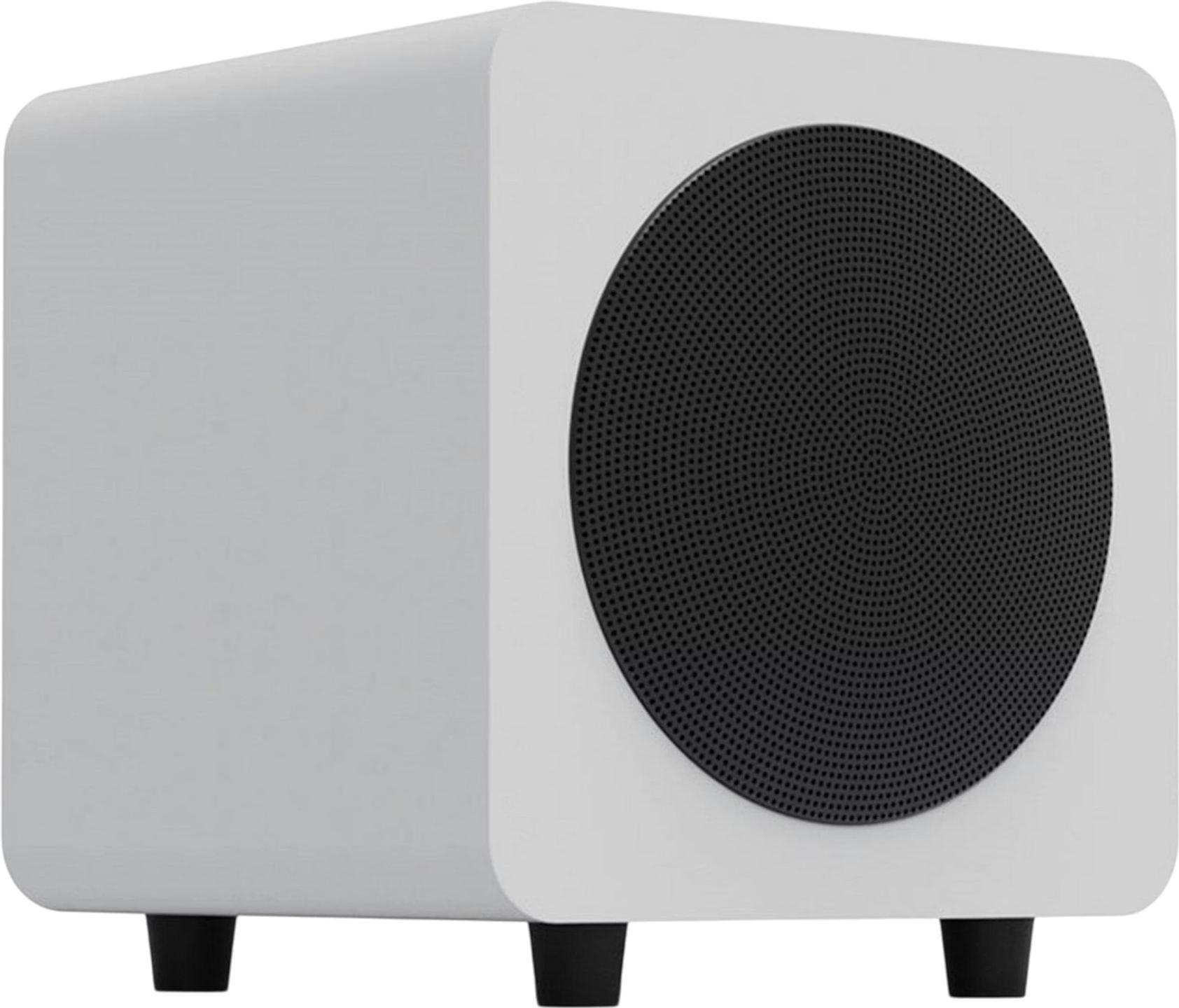
A 22 cm cube, 5 kg on the scale, and yet 100 watts RMS under the hood. Kanto’s SUB6 is a sealed active subwoofer that slips under a desk, at the foot of a shelf, or into a corner of the living room without demanding the slightest spatial compromise. Behind its compact format, it houses a 16.5 cm (6-inch) paper-cone driver and a Class D amplifier capable of delivering up to 200 watts peak.
A sealed enclosure for controlled bass
The SUB6 uses a sealed enclosure design, a choice that is far from trivial at this size. Unlike bass-reflex subwoofers whose port boosts low frequencies at the cost of a certain looseness, the sealed enclosure keeps the driver under constant control thanks to the internal air pressure of the cabinet. The result: fast, tight bass with little overhang. Transients are reproduced clearly, whether it’s a funk bass line or a kick drum hit.
This type of enclosure favors precision over sheer extension. The SUB6’s frequency response reaches down to 40 Hz, which covers the vast majority of music and movie content, but does not claim to reproduce the deepest infrabass. It is a deliberate compromise: bass quality is prioritized over quantity.
Design and materials
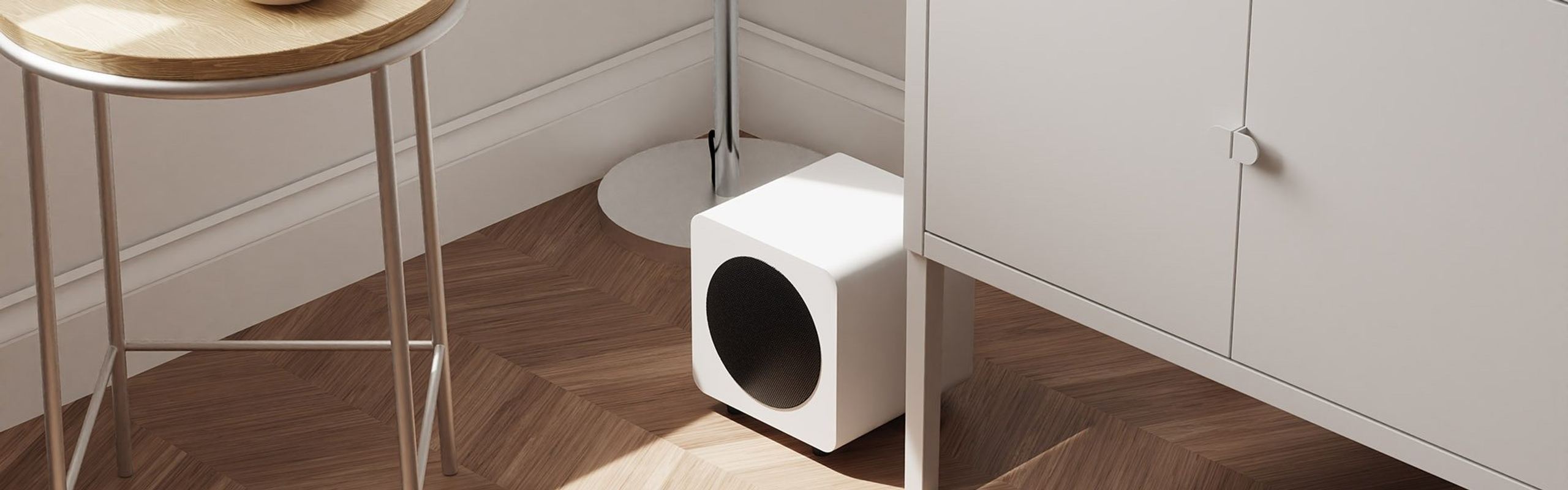
The cabinet is built from acoustic-grade MDF. This medium-density fiberboard offers a good compromise between rigidity and damping of unwanted vibrations, whereas molded plastic or wood that is too light would allow the subwoofer to resonate at certain frequencies. Four rubber feet decouple the subwoofer from the surface it rests on, which limits the transmission of vibrations to furniture and flooring.
The front-firing driver is protected by a metal grille designed to minimize sound diffraction. The design is understated, cubic, with no superfluous ornamentation. It blends discreetly into a work desk as well as a TV cabinet.
Controls and integration into an audio system
The rear panel concentrates three controls: a volume knob, a crossover frequency knob, and a two-position phase switch (0° and 180°).
The adjustable low-pass filter lets you set the frequency above which the SUB6 stops reproducing the signal (between 40 and 120 Hz). This setting is essential for matching the subwoofer to the main speakers without overlap or gaps in the spectrum. In practice, the crossover is adjusted according to the capability of the satellite speakers: with small desktop speakers using 7 to 10 cm drivers, a crossover around 80-100 Hz works well; with larger speakers, it can be set lower.
The phase switch compensates for timing differences between the subwoofer and the main speakers when placement does not allow optimal alignment. If the subwoofer is far from the speakers or if the amplifier inverts the signal phase, switching to 180° can restore bass coherence.
Connectivity is limited to a pair of stereo RCA inputs (line level, left and right). The SUB6 connects to the subwoofer output or pre-outs of an amplifier, a pair of active speakers, or a DAC with a dedicated output. An RCA cable is included in the box.
Auto standby and power consumption
A three-position selector (On / Auto / Standby) manages power-up. In Auto mode, the SUB6 activates as soon as it detects an audio signal and goes into standby after a period of inactivity. A practical detail that avoids having to access the rear panel every time you listen, especially if the subwoofer is installed under a piece of furniture.
Which speakers to pair it with
The SUB6 was designed to complement compact speakers in the Kanto range: the YU2, ORA, ORA4, YU4, and to a lesser extent the YU6 and REN. It works with any speaker that has a subwoofer output or line output, whether Kanto or not.
Its 6-inch driver and 100 W RMS power make it suited to nearfield setups or modest-sized rooms. In a large living room, Kanto’s SUB8 (8 inches, 120 W RMS) will take over with a broader foundation and a better ability to fill the room’s volume. The SUB6 performs best at short range, in an office or small living room, where its precise bass integrates naturally with the rest of the spectrum without dominating the reproduction.
Technical Specifications
Speaker
- Type: paper cone woofer
- Diameter: 6 inches (≈ 16.5 cm)
- Enclosure type: closed (sealed enclosure)
Amplification and Audio Performance
- Amplification: class D
- Peak power: 200 W
- RMS power: 100 W
- Frequency response: 40 Hz – 175 Hz
Connectivity and Controls
- Audio inputs: stereo RCA (line level L / R)
- Available controls:
- Crossover frequency
- Phase
Dimensions and Weight
- Dimensions (W x D x H): 22 x 22 x 24.1 cm
- Net weight: 5 kg
Box Contents
- Power cable
- RCA cable
- User manual
Key Features
- Fast, precise bass: closed design for excellent control and low distortion
- Ultra-compact form factor: ideal for small spaces, easy installation (desk, living room, apartment)
- Optimized integration: phase and crossover controls for precise adjustment to your system
- Balanced reproduction: deep, controlled bass without an overpowering effect
Frequently Asked Questions
Does the SUB6 have a wireless input (Bluetooth, Wi-Fi)?
No. The SUB6 connects only via RCA cable. It does not include a wireless receiver. If your audio source is Bluetooth, the signal must pass through a pair of active speakers equipped with a wired subwoofer output before reaching the subwoofer.
Can the SUB6 be placed on a desk without annoying vibrations?
The four rubber feet decouple the cabinet from the surface, which reduces the transmission of vibrations. On a light or glass desk, an anti-vibration pad (acoustic foam, for example) can further improve isolation. The moderate 5 kg weight avoids overloading a standard desktop.
Does the SUB6's crossover replace that of the main speakers?
The SUB6’s low-pass filter only cuts the signal sent to the subwoofer. It does not affect the main speakers, which continue to reproduce the entire spectrum. If your speakers have their own high-pass crossover setting, you can adjust it in addition to avoid overlap in the low-midrange.
What is the difference between the SUB6 and Kanto's SUB8?
The SUB8 features an 8-inch (20 cm) driver and a more powerful amplifier (120 W RMS / 250 W peak). Its frequency response reaches down to 35 Hz (versus 40 Hz for the SUB6), and its larger cabinet volume allows it to better fill medium to large rooms. The SUB6 remains the best choice when space is limited or for compact desktop speakers.
- Eco-contribution of €0.75 included in the sale price.
- GTIN / EAN: 800152723853