Grado Platinum 4
Overview
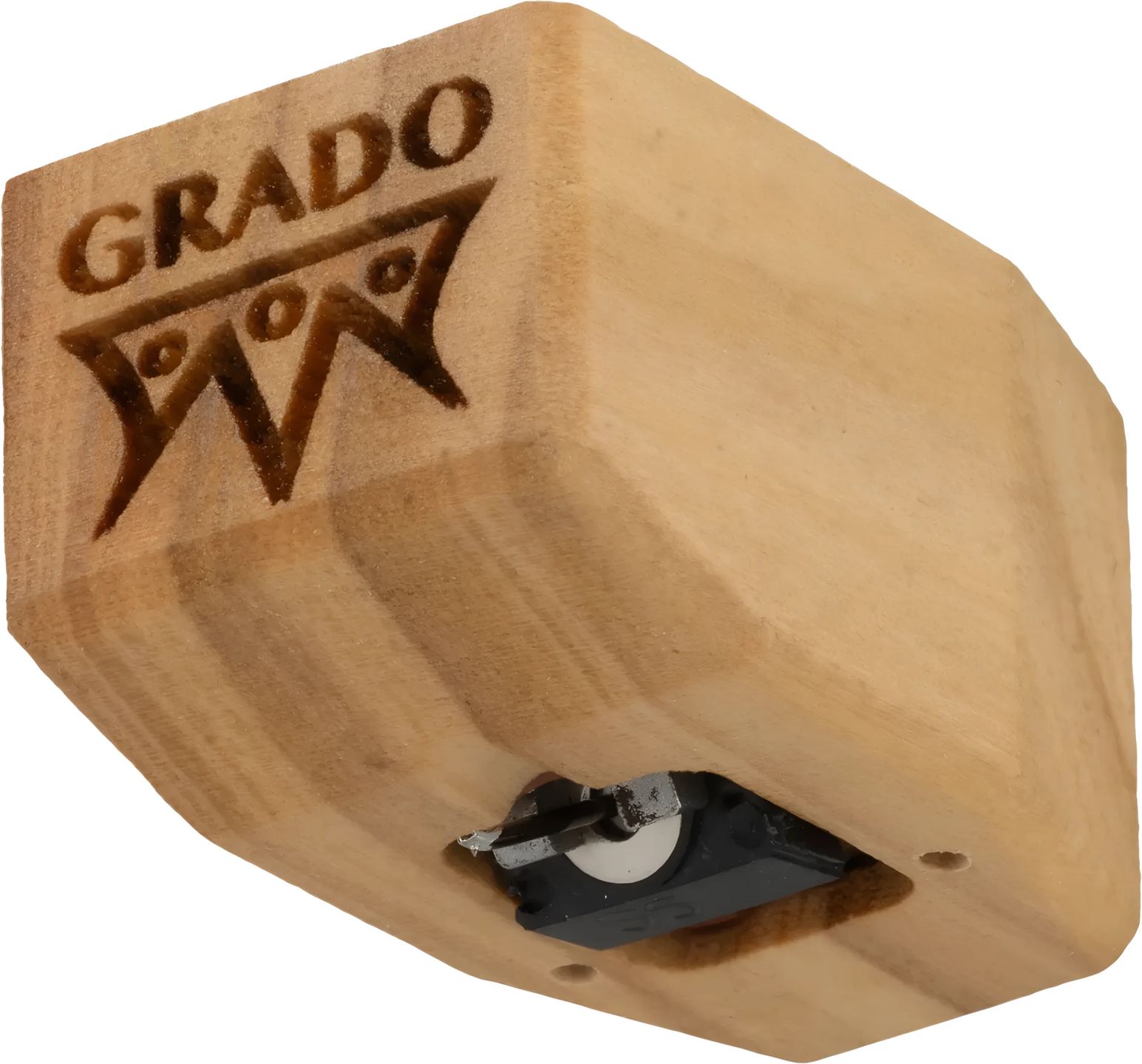
Second cartridge in the Timbre Series after the Opus4, the Platinum4 succeeds the Platinum3 with several notable developments: the body changes from Australian jarrah to Mediterranean olive wood, the internal wiring adopts 6N OCC copper (instead of the previously used UHPLC copper), and the chassis has been redesigned to make setup easier. Each unit is hand-assembled in the Grado Labs workshops in Brooklyn.
The Flux-Bridger principle, a third way between MM and MC
Grado cartridges are neither Moving Magnet nor Moving Coil. They are based on a Moving Iron principle patented by Joseph Grado under the name Flux-Bridger: a small moving piece of iron, attached to the cantilever, moves within the field of fixed magnets, while the coils remain stationary. The moving mass is reduced compared with a conventional MC cartridge, and the absence of coils on the moving assembly eliminates one source of fragility. The fixed coils retain their geometry over time, which contributes to signal stability over the life of the cartridge.
In practice, this design offers hybrid behavior: the liveliness and transient speed associated with MC cartridges, combined with robustness and longevity closer to MM cartridges. The Platinum4 inherits this Flux-Bridger generator in its most recent form, with four coils and a dual-magnet system.
An olive wood body designed for resonance control
The move from Australian jarrah (used on the Platinum3) to Mediterranean olive wood is one of the most visible changes in this generation. Grado uses the same olive wood for the Sonata4, one step above in the range, which brings the Platinum4 closer to its bigger sister mechanically.
The wood used for the body is not a purely aesthetic choice. Its density, fibrous structure, and damping properties influence how unwanted vibrations dissipate around the generator. Grado selects Mediterranean olive wood for its ability to limit undesirable resonances while preserving the cartridge’s tonal balance.
The shape of the chassis has been reworked compared with the previous generation. The Platinum3 was criticized for its wide, low body, which made the cantilever difficult to see when cueing onto the record and cleaning the stylus. The new Platinum4 profile improves cantilever visibility, a detail that simplifies alignment and reduces the risk of mishandling in daily use.

Stylus, cantilever, and groove tracking
The Platinum4 uses a bonded elliptical stylus mounted on an aluminum cantilever. The elliptical profile offers a wider contact surface with the groove walls than a spherical stylus, which improves tracking of the engraved information (and stereo separation) without requiring excessively high tracking force. The 20 µm/mN compliance, combined with a recommended tracking force between 1.6 and 1.9 g, makes the cartridge compatible with most medium-mass tonearms.
One point worth noting to place the Platinum4 within the Timbre range: the Sonata4, positioned just above it, uses a nude elliptical stylus (rather than a bonded one) on a specific aluminum cantilever. The difference between a bonded and nude stylus comes down to mounting precision and tip mass at the end of the cantilever. The nude stylus, attached without an intermediate shank, reduces moving mass and refines tracking. This is one of the criteria that separates the two models.
6N OCC copper wiring and cryogenic treatment
The Platinum4’s coil wire is made of 6N-purity OCC (Ohno Continuous Casting) copper, or 99.9999%. This casting process produces wire with very long continuous crystals, which limits grain boundaries and promotes conductivity. The Platinum3 used UHPLC copper (ultra-high purity long crystal), a slightly different specification. The move to 6N OCC copper aligns the Platinum4 with the standard now common across the entire Timbre Series.
Each cartridge undergoes cryogenic treatment after assembly. This process, which consists of exposing the components to very low temperatures, aims to stabilize the crystalline structure of the metals and reduce internal stresses. Internal damping completes the design to limit unwanted micro-vibrations within the generator.
Three versions to suit the phono stage
The Platinum4 is available in three versions: High Output (4.0 mV), Low Output (1.0 mV), and Mono.
The High Output version, with its 4.0 mV output voltage, connects directly to any MM phono input without additional amplification. The 55 mH inductance and 660-ohm internal resistance are typical of a high-output cartridge.
The Low Output version delivers 1.0 mV. This output level requires a phono preamp capable of providing sufficient gain (around 60 dB), but with an MM-type input load, between 10 and 47 kΩ. This point deserves attention: unlike a conventional MC cartridge loaded at a few tens or hundreds of ohms, the Platinum4 Low Output requires high input impedance despite its low output level. With only 6 mH of inductance and 70 ohms of internal resistance, this version offers electrical behavior more favorable to high-frequency reproduction.
The Mono version is intended for playback of mono records pressed before the stereo era, with purely lateral tracking motion.
Whichever version is chosen, the cartridge shows low sensitivity to capacitive loading, which simplifies the choice of interconnect cables between tonearm and preamplifier.
What you can expect when listening
Grado describes the Platinum4’s sound as balanced and controlled. The midrange is present, with body and texture. The highs remain smooth and natural, without aggressiveness. The bass is clear and well-defined, without being overpowering. Channel separation, specified at an average of 30 dB between 10 Hz and 30 kHz, contributes to a stable and well-defined soundstage. Frequency response extends from 10 Hz to 60 kHz.
The Grado sound character, on wood-bodied cartridges, tends toward a warm and colored tonality, with a preference for harmonic density rather than hyper-analytical detail. The Platinum4 fits within this line while bringing the benefits of 6N OCC copper and the new olive wood body.
Technical specifications
Key points
- High-end Moving Iron phono cartridge
- Mediterranean olive wood body
- Elliptical diamond mounted on an aluminum cantilever
- Available in High Output, Low Output, and Mono versions
- Extended frequency response up to 60 kHz
- Handcrafted by Grado Labs
Design and technologies
- Proprietary Moving Iron architecture developed by Joseph Grado, with low moving mass, for fast, precise, and natural reproduction while maintaining excellent harmonic richness
- Mediterranean olive wood body helping to limit unwanted resonances and contribute to the cartridge’s tonal balance
- New chassis shape improving cantilever visibility during setup
- Bonded elliptical diamond paired with an aluminum cantilever, ensuring precise groove tracking and balanced, detailed reproduction
- Internal wiring in ultra-high-purity 6N OCC copper
- Cryogenic treatment applied to each cartridge
- Internal damping designed to reduce resonances and preserve the integrity of the audio signal
Sound reproduction
- Balanced, fluid, and controlled listening
- Rich, lifelike midrange
- Smooth and natural highs
- Clear bass
- Stable soundstage with particularly refined channel separation
Type and materials
- Type: Moving Iron phono cartridge
- Body: Mediterranean olive wood
- Diamond: elliptical
- Cantilever: aluminum
- Available versions: High Output, Low Output, Mono
Electrical characteristics
- Output level
- High Output: 4.0 mV @ 5 CMV (45)
- Low Output: 1.0 mV @ 5 CMV (45)
- Inductance
- High Output: 55 mH
- Low Output: 6 mH
- Internal resistance
- High Output: 660 ohms
- Low Output: 70 ohms
- Recommended load: 10 kΩ to 47 kΩ
- Low sensitivity to capacitive load
Mechanical data
- Weight: 9.4 g
- Recommended tracking force: 1.6 to 1.9 g
- Compliance: 20 μm / mN
Audio performance
- Channel separation: 30 dB (average from 10 Hz to 30 kHz)
- Frequency response: 10 Hz – 60 kHz
Frequently asked questions
Is the Platinum4 compatible with my tonearm?
With a weight of 9.4 g, a compliance of 20 µm/mN, and a tracking force between 1.6 and 1.9 g, the Platinum4 is suitable for the vast majority of tonearms with متوسط effective mass, which covers most tonearms available on the market. Very light or very heavy tonearms may cause mechanical resonance issues.
Should I choose the High Output or Low Output version?
That depends on your phono preamp. If you have a standard MM input (gain around 40 dB), the High Output version (4.0 mV) is the direct choice. The Low Output version (1.0 mV) requires a preamp capable of providing about 60 dB of gain with an input impedance of 10 to 47 kΩ, which excludes most conventional MC inputs loaded at low impedance.
What is the main difference between the Platinum4 and the Sonata4?
The two cartridges share the same olive wood body, the same 6N OCC copper, and identical electrical characteristics. The difference lies in the stylus and cantilever: the Platinum4 uses a bonded elliptical stylus on a standard aluminum cantilever, while the Sonata4 uses a nude elliptical stylus on a specific aluminum cantilever, which reduces mass at the end of the stylus and refines tracking.
What has changed compared with the Platinum3?
Three main developments: the body changes from Australian jarrah to Mediterranean olive wood, the coil copper changes from UHPLC to 6N OCC, and the chassis has been redesigned to make the cantilever more visible during setup and cueing. Cryogenic treatment is now applied to each cartridge.
- Eco-contribution included in the sale price.