

Pro-Ject Phono Box S3 B black


Awards

Diapason d'Or
The number 1 in classical music and hi-fi. It is a benchmark in the field of classical music and hi-fi, as well as the distinction it awards to the best devices each year
Pro-Ject Phono Box S3 B: Balanced and Discrete Phono Preamplifier
Until recently, balanced connections were reserved for the RS range, the top of the Pro-Ject catalogue. With the Phono Box S3 B, the Austrian manufacturer brings this technology down into its S3 series, while adopting a new larger chassis, front-panel controls, and a fully discrete gain stage. The result is a compact MM/MC phono preamplifier, manufactured in Slovakia, that packs an unusually high number of features for its price range.
A Redesigned Steel and Aluminium Chassis
The Phono Box S3 B adopts a more substantial enclosure than the Phono Box S3 from which it derives. This new chassis combines a steel structure with aluminium panels and fully aluminium knobs. The steel provides mechanical rigidity, while the aluminium ensures electromagnetic shielding. The unit weighs 930 g (without the external power supply), with compact dimensions of 206 × 55 × 153 mm (164 mm including connectors). Two finishes are available: black or silver.
The power supply remains external (18 V / 500 mA DC), an approach that keeps the transformer away from the audio circuit. Power consumption during operation is 170 mA at 18 V, dropping below 0.5 W in standby. Users wishing to go further may consider the Pro-Ject Power Box S3 Phono, a filtered linear power supply compatible with this preamplifier.
The “B” for Balanced
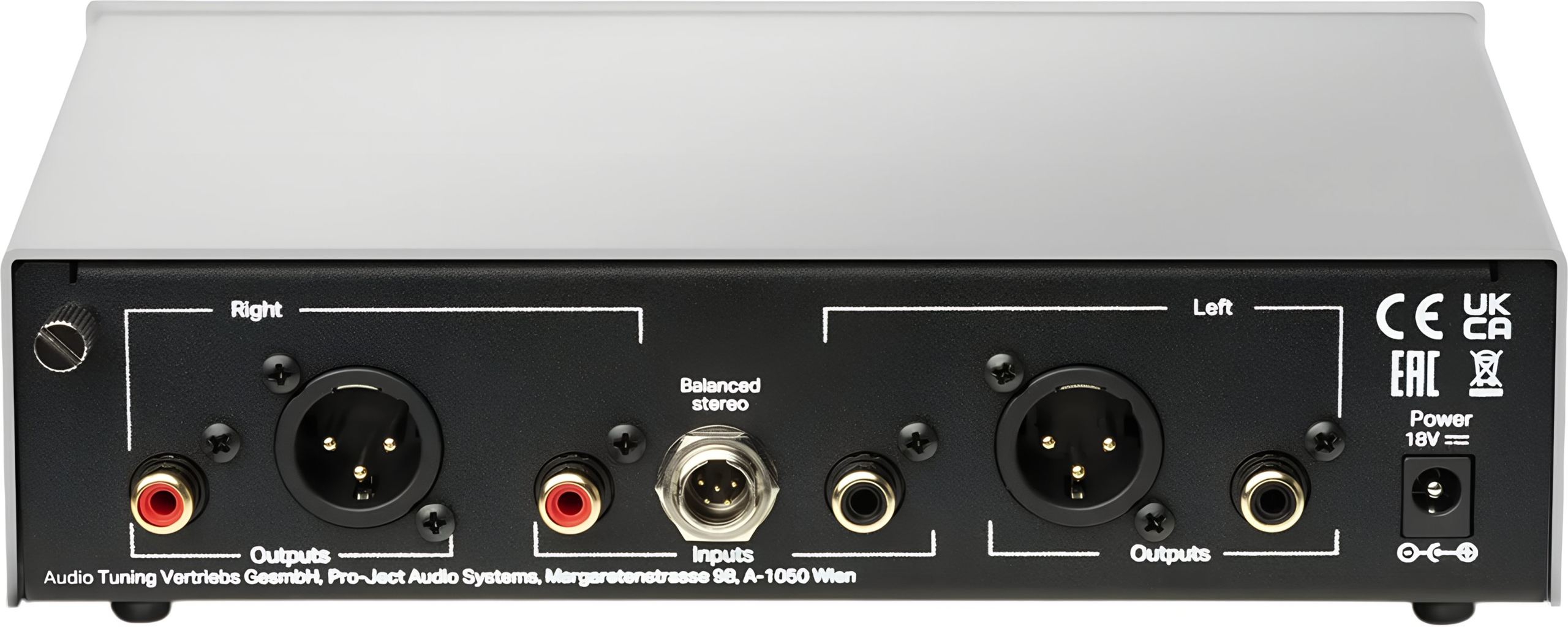
The “B” in the name stands for “balanced.” This is the most visible addition compared to the original Phono Box S3. The balanced input uses a 5-pin mini XLR connector (a compact format also found on Pro-Ject turntables in the B range, such as the X1 B and X2 B). The balanced outputs, meanwhile, use a pair of full-size standard XLR connectors.
The principle of a balanced connection is based on transmitting two identical signals in opposite phase (a “hot” signal and a “cold” signal). The receiving stage can then subtract the noise accumulated along the cable run, since that noise affects both conductors equally. In recording studios, this technique is the standard for microphones and long-distance connections.
One technical point is worth noting: moving coil (MC) cartridges are inherently balanced transducers, as their coils separate the ground conductors of each channel. Moving magnet (MM) cartridges, on the other hand, share a common ground between channels, which prevents the balanced connection from being fully exploited. To take full advantage of the mini XLR input, an MC cartridge is therefore required.
The asymmetrical RCA input remains available, and the Phono Box S3 B supports both MM and MC cartridges on this input. This is a preamplifier that can grow with the system: start with RCA and an MM cartridge, then switch to balanced with an MC cartridge when upgrading, without changing the phono preamplifier.
Discrete Gain Stage and Dual Mono Design
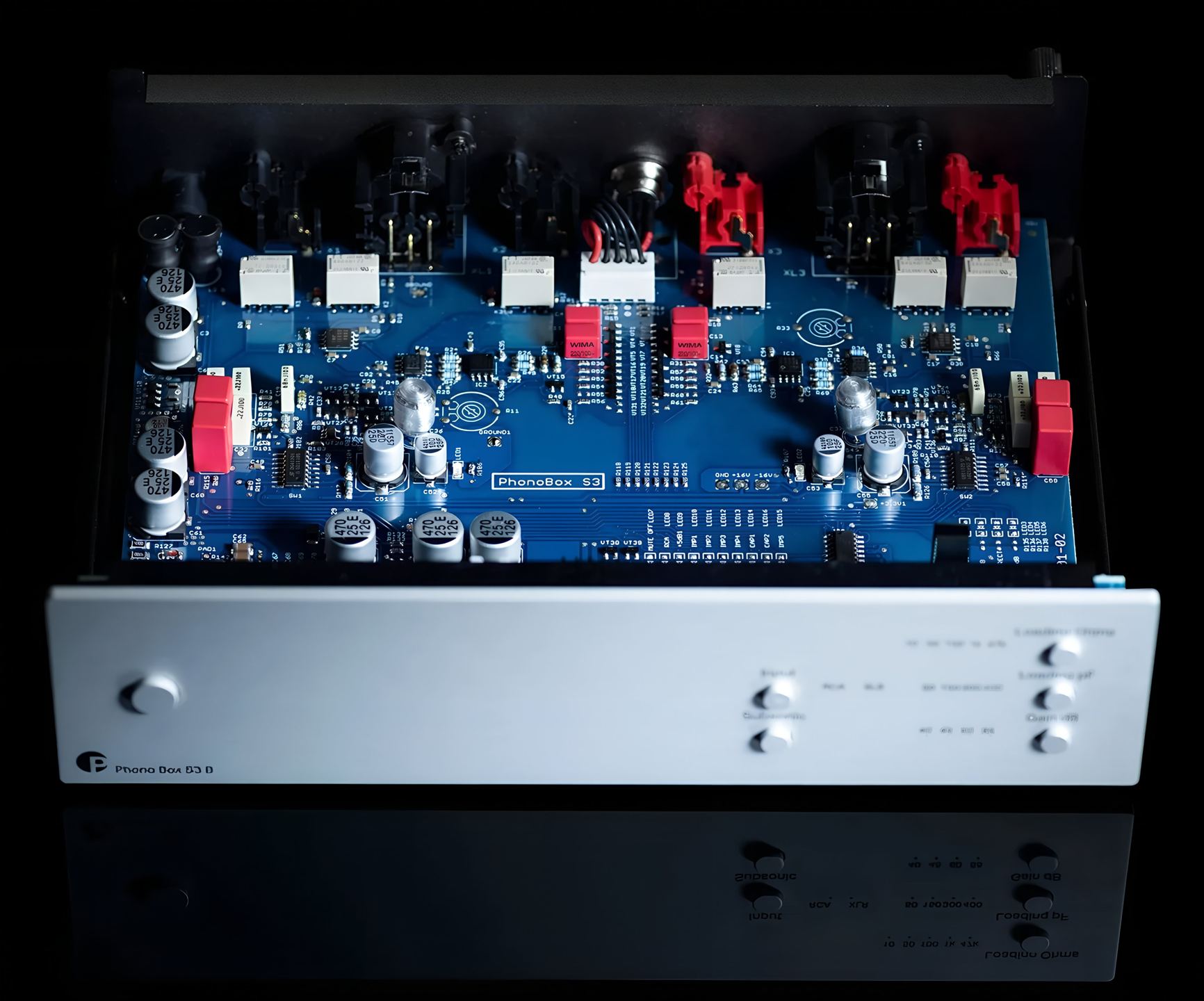
The gain stage of the Phono Box S3 B is built from individual components (resistors, capacitors, transistors), with no integrated circuits or operational amplifiers. This so-called “discrete” design is more expensive to implement and requires a longer development time than an op-amp-based circuit, but it gives the designer finer control over the circuit’s behaviour.
The design is dual mono: each channel has its own amplification stage. Combined with the balanced architecture, this topology doubles the number of amplification sections required (two signals per channel, two channels). The gain stage processes the + and − signals independently, then recombines them before sending them to the semi-passive RIAA equalisation stage. For the XLR outputs, a balancing stage regenerates a balanced output signal, with an additional gain of 6 dB. The RCA outputs, asymmetrical by nature, receive the signal directly from the RIAA stage.
Published measurements confirm very low distortion levels: below 0.001% THD at 1 kHz in MM configuration, and below 0.005% in MC. The signal-to-noise ratio reaches 103 dBV (110 dBV A-weighted) in MM at 40 dB gain, and 85 dBV (90 dBV A-weighted) in MC at 60 dB gain. RIAA curve accuracy is specified at ± 0.3 dB between 20 Hz and 20 kHz.
Front-Panel Controls: A Rare Convenience at This Level
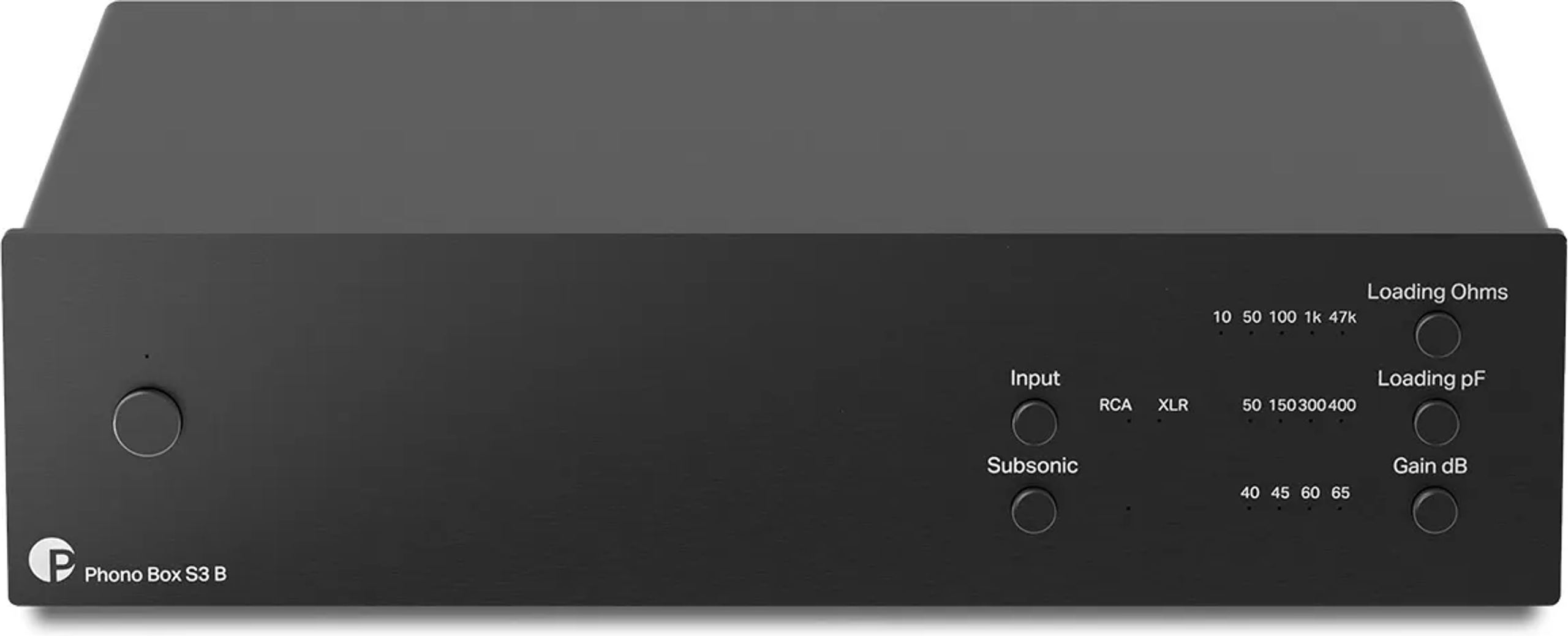
On most phono preamplifiers in this category, impedance, capacitance, and gain settings are adjusted via DIP micro-switches located on the underside of the unit or on the circuit board. This requires turning the unit over, sometimes opening it, and manipulating tiny switches blindly. The Phono Box S3 B breaks with this convention by placing all controls on the front panel, accessible via simple rotary knobs.
The loading options are extensive. Input impedance can be set to five values: 10, 50, 100, 1,000, and 47,000 ohms. Input capacitance offers four values: 50, 150, 300, and 400 pF. Gain is adjustable across four levels: 40, 45, 60, and 65 dB (with an additional 6 dB available via the XLR outputs). The low values (10 ohms for impedance, 50 pF for capacitance) allow compensation in challenging situations, such as the use of high-capacitance phono cables. A subsonic filter at 20 Hz with an 18 dB per octave slope completes the front panel. This filter attenuates infrasonic frequencies produced by record warps, tonearm resonances, or pressing defects, and relieves the downstream amplifier and speakers.
Compatibility and Integration
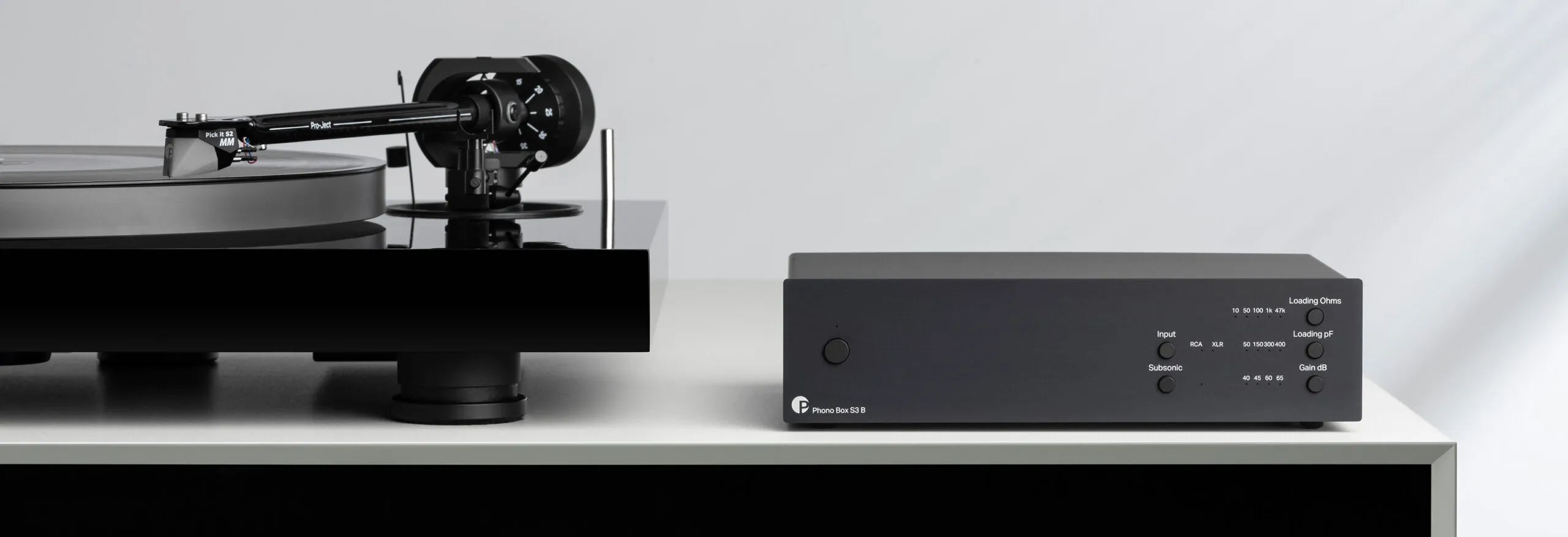
On the input side, the Phono Box S3 B pairs with Pro-Ject turntables in the “B” range (X1 B, X2 B, X8 Evolution B, among others) via the Connect it S cable with 5-pin mini XLR connectors, but it accepts any turntable with a standard RCA output. On the output side, the two pairs of connectors (RCA and XLR) allow integration into virtually any hi-fi system, whether an integrated amplifier with RCA inputs or a preamplifier with balanced inputs.
The gain range (40 to 65 dB, or up to 71 dB via XLR) covers the vast majority of cartridges on the market, from high-output MM to very low-output MC. The output level can be adjusted to match that of other sources in the system (CD player, network streamer), avoiding volume discrepancies when switching between sources.
Documentation
Technical Specifications
Design
- Fully balanced and discrete gain stage
- Dual mono architecture
- Amplification section built from individual components, without integrated circuits
- MM and MC cartridge compatible
- Semi-passive RIAA equalization
- Very low noise and very low distortion
- Steel and aluminum chassis with fully aluminum knobs, ensuring excellent rigidity and optimal isolation against interference
- Aluminum enclosure providing protection against interference
Balanced Design
- 5-pin mini XLR balanced input
- Balanced XLR outputs
- Fully balanced and discrete gain stage
- Balancing stage generating a balanced signal for XLR outputs
- RCA outputs fed directly by the RIAA equalization stage
Settings and Operation
- Easy adjustment of front panel settings
- Ability to connect two turntables simultaneously
- Independent settings memory for each input
Electrical Specifications
- Input impedance: 10, 50, 100, 1k, 47k ohms
- Input capacitance: 50, 150, 300, 400 pF
- Gain (+ 6 dB via XLR output): 40, 45, 60, 65 dB
- MM signal-to-noise ratio (40 dB): 103 dBV, 110 dBV A-weighted
- MC signal-to-noise ratio (60 dB): 85 dBV, 90 dBV A-weighted
- THD at 1 kHz: < 0.001% MM, < 0.005% MC
- THD (20 Hz - 20 kHz): < 0.008% MM, < 0.01% MC
- RIAA equalization curve accuracy: < 0.3 dB / 20 Hz - 20 kHz
- Subsonic filter: at 20 Hz with 18 dB/octave slope
Connectivity
- Inputs: 1 x 5-pin mini XLR, 1 x RCA pair
- Line output: 1 x RCA pair, 1 x XLR pair
Power Supply
- DC power supply: 18 V / 500 mA
- Consumption: 18 V / 170 mA DC, < 0.5 W in standby
Dimensions and Weight
- Dimensions: 206 x 55 x 153 mm (164 mm with connectors)
- Weight: 930 g without power supply
Frequently Asked Questions
Does the Phono Box S3 B work with an MM cartridge on the balanced input (mini XLR)?
Technically, the connection is possible, but MM cartridges are not balanced transducers due to their internal wiring (common ground between channels). The benefit of the balanced connection will therefore not be fully realised. For use with an MM cartridge, the RCA input is the most logical choice.
What is the difference from the Phono Box S3 (without the "B")?
The Phono Box S3 B adds balanced inputs and outputs (mini XLR and XLR), a larger steel and aluminium chassis, a fully balanced and discrete gain stage, and moves all controls to the front panel. The original model offered only RCA connections and settings via micro-switches.
Is the mini XLR cable included with the preamplifier?
No. The Connect it S cable (5-pin mini XLR to 5-pin mini XLR) is sold separately by Pro-Ject. For turntables fitted with a 5-pin DIN or RCA connector, Pro-Ject offers other cables in its True Balanced Connection range.
Can performance be improved with a higher-quality external power supply?
Yes. The Pro-Ject Power Box S3 Phono is a compatible filtered linear power supply that replaces the original power adapter. Third-party linear power supplies delivering 18 V DC can also be used, provided the connector and polarity are correct.
Is the subsonic filter enabled by default?
No. The filter is disabled at power-up and is engaged manually via the “Subsonic” button on the front panel. It is recommended to activate it if the turntable exhibits audible wow, if the records being played are warped, or if the speaker system is sensitive to very low frequencies.
Does the Phono Box S3 B have a mono mode?
No. The unit does not include a built-in mono selector. To play mono records with a stereo cartridge, mono summing will need to be performed downstream, at the preamplifier or amplifier level, if that unit provides this function.
- Eco-contribution included in the sale price.
- GTIN / EAN: 9120097829283