Cardas Clear Digital AES/EBU 1.5m
Overview
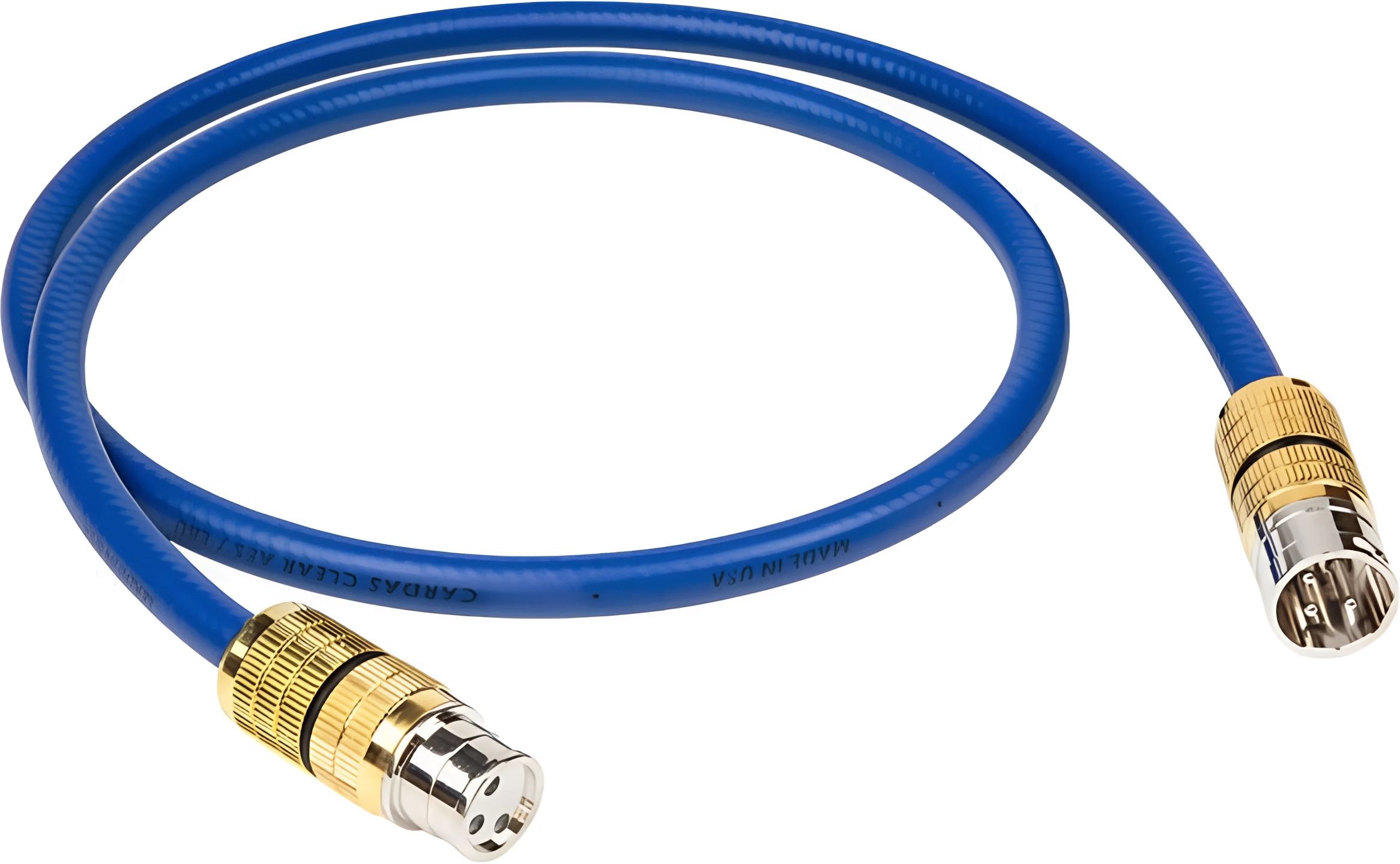
Connecting a transport or network player to a converter without altering the data stream: that is the role of an AES/EBU connection. Cardas handles this link with the same rigor as its most advanced analog cables. Clear Digital uses the Matched Propagation conductors developed by George Cardas and applies them to digital audio transmission, in a 1.5-meter length that suits the majority of home installations.
Geometry tuned to the golden ratio
The cable brings together three 25.5 AWG conductors in an equilateral triad. This perfectly symmetrical tri-axial structure directly supports the AES/EBU standard and its 110-ohm impedance. Each conductor is not a solid wire but a multilayer Litz bundle: Cardas assembles 82 strands of 99.9999% pure OFC copper, arranged in layers according to a so-called “cross-field” geometry that reduces inductance and resonance effects.
The detail of the gauges deserves an explanation. Rather than using identical strands, Cardas staggers their diameter according to the proportions of the golden ratio (about 1.618). Each strand therefore resonates at a slightly different frequency, which disperses resonances instead of concentrating them on a single one. The strands surround a Kevlar core that ensures uniform propagation, and receive an SPN coating, a thin transparent layer that slows copper oxidation.
Dielectrics and shielding against noise
Insulation matters just as much on a digital cable. Cardas extrudes an ultra-thin PTFE (Teflon) jacket around the conductors, complemented by antistatic LDPE air tubes and a PTFE tape that reinforces the connection. These low-loss materials let the signal flow without slowing it down, extending the Matched Propagation logic all the way to the signal envelope.
On the protection side, the cable combines two shields, a copper screen and a Mylar layer, against electromagnetic and radio interference. Over a 1.5-meter length that often runs near transformers and power supplies, this immunity keeps the signal readable by the converter. The trade-off of such a stack of materials is a cable that is stiffer than a simple standard connection, a point the outer jacket addresses.
Cold-assembled connectors and flexible jacket
The XLR connectors are hand-assembled in the Cardas workshop in Bandon, Oregon. The cable uses a method that not all manufacturers rely on: cold crimping. The junction between the conductor and the connector is made by mechanical pressure, without solder, which avoids adding heat likely to alter the conductive properties of copper. A flexible sleeve protects the connection area, where the cable undergoes the most stress in use.
The outer jacket in extruded TPR remains very flexible despite the richness of the internal construction. With a diameter of 9.01 mm, Clear Digital is easy to handle behind a cabinet, even in a tight space, and withstands repeated plugging without premature wear.
Where an AES/EBU connection fits
The AES/EBU standard, defined by the Audio Engineering Society and the European Broadcasting Union, transmits digital audio in balanced mode over XLR connectors, with a standardized impedance of 110 ohms. Balanced mode rejects part of the noise picked up along the path, an advantage on somewhat long connections or in an electrically noisy environment.
In practical terms, this cable connects a digital source, CD or SACD transport or network player, to a digital-to-analog converter equipped with an AES/EBU input. Most higher-end DACs and studio electronics offer this format. Strict compliance with 110 ohms matters: an impedance mismatch between the cable and the devices causes signal reflections, which result in increased jitter at the time of conversion. The geometry of Clear Digital is designed precisely for this value.
The subject of digital cables remains debated, and perceived differences vary depending on systems and listeners. Cardas’s argument, however, is based on measurable quantities: impedance matching, dielectric quality, and careful shielding. What remains is a fixed length of 1.5 meters, to be checked before purchase according to the actual distance between the two devices, bearing in mind that an AES/EBU connection does not tolerate being coiled with excess length well.
Technical Specifications
Cable Type
- Balanced digital audio connection
- Standard: AES / EBU (XLR 110 Ω)
Conductors
- Architecture: 3 × 25.5 AWG
- Ultra-pure copper: 99.9999% oxygen-free (OFC)
- Multilayer Litz structure: 82 strands of different gauges
- Central Kevlar core with homogeneous propagation
- SPN treatment (transparent protective layer)
Geometry
- Single-conductor coaxial “cross-field” structure
- Strand distribution according to the golden ratio principle (Golden Ratio)
- Reduction of inductance and resonance effects
Insulation
- Ultra-thin extruded PTFE (Teflon)
- Antistatic LDPE air tubes
- Reinforced connection with PTFE tape
Shielding
- Double shielding: copper, Mylar
- Purpose: maximum immunity to electromagnetic interference
Outer Jacket
- Ultra-flexible extruded TPR
- High flexibility and mechanical resistance
Dimensions
- Outer diameter: 9.01 mm
Connectors
- Neutrik connectors (XLR)
- Hand cold-crimped assembly
- Flexible protective sleeve on the cable / connector junction
- Purpose: preserve conductive properties without thermal degradation
Frequently Asked Questions
What is the difference between an AES/EBU connection and an S/PDIF coaxial connection?
Both carry a digital audio stream, but with distinct characteristics. AES/EBU is balanced, over XLR, with a 110-ohm impedance and a higher signal level. S/PDIF coaxial is unbalanced, over RCA or BNC, at 75 ohms. The balanced transmission of AES/EBU rejects common-mode noise better, an advantage on long connections or in a disturbed environment. The choice mainly depends on the inputs and outputs available on your devices.
Does Clear Digital handle high bitrates such as DSD or high-resolution PCM?
A passive cable imposes no format limit: it transmits whatever the source sends to it. The AES/EBU standard carries stereo PCM up to high resolutions, and DSD via DoP encapsulation (DSD over PCM). Actual capability therefore depends on the connected devices, not on the cable. Check the bitrates supported by your transport and your converter for the most demanding files.
Which devices have an AES/EBU socket?
This format comes from the professional and broadcast world, where it remains a standard. On the consumer side, it is found on high-end CD and SACD transports, many upper-range digital-to-analog converters, some network players, and reference clocks. More affordable devices often favor coaxial or optical. A three-pin XLR socket marked “digital” or “AES/EBU” confirms compatibility.
Can Clear Digital be used as a balanced analog interconnect cable?
No, it is better to stick to its intended use. An AES/EBU cable is calibrated for a 110-ohm impedance and for high digital frequencies. A balanced analog interconnect cable meets different electrical constraints. Swapping the two degrades transmission, due to impedance mismatch in the case of digital use. Each type of cable should keep to its function.
- Eco-contribution included in the sale price.