Astell&Kern AK-HC5

Specifications and features


Astell&Kern AK-HC5: portable USB-C audio converter
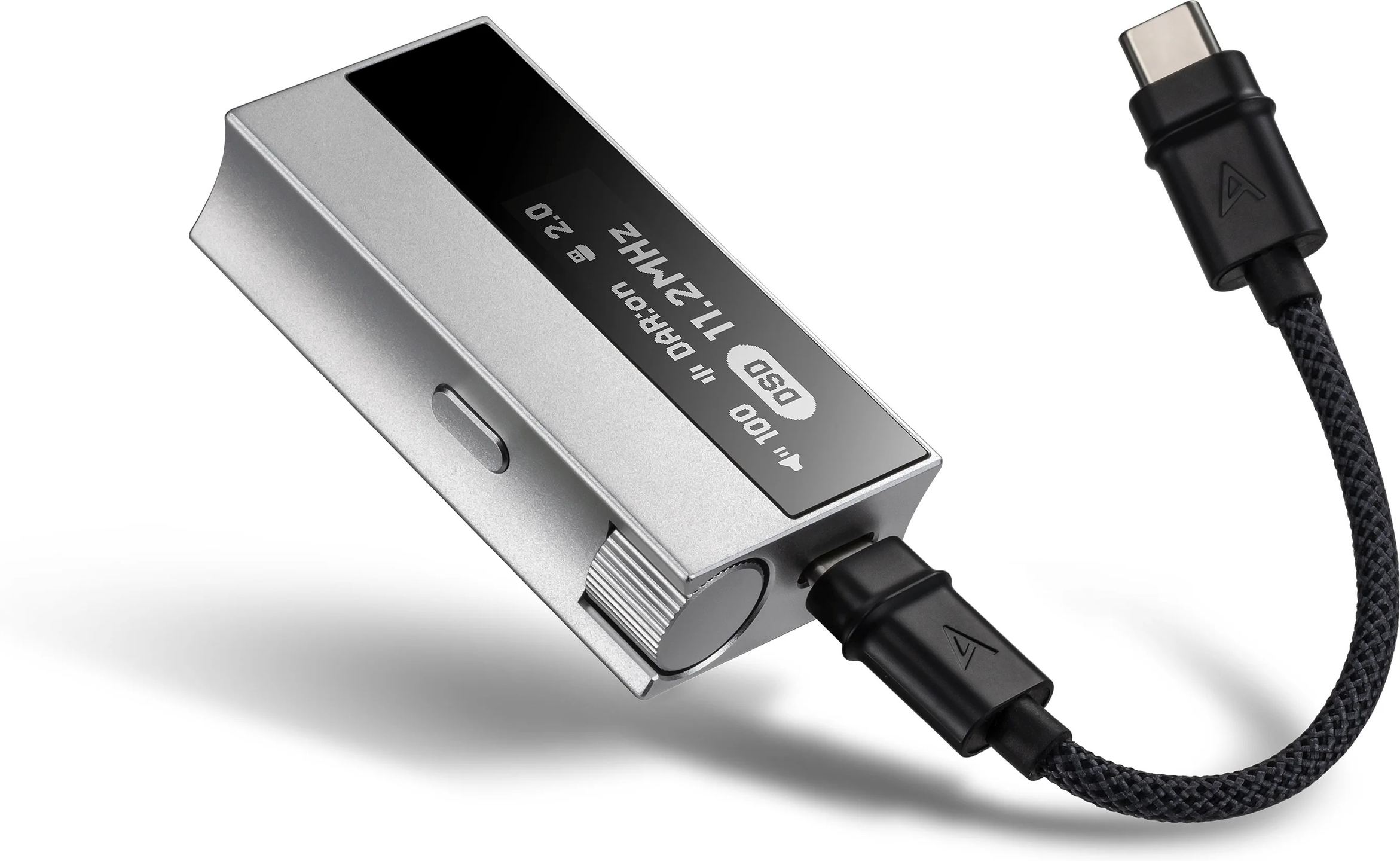
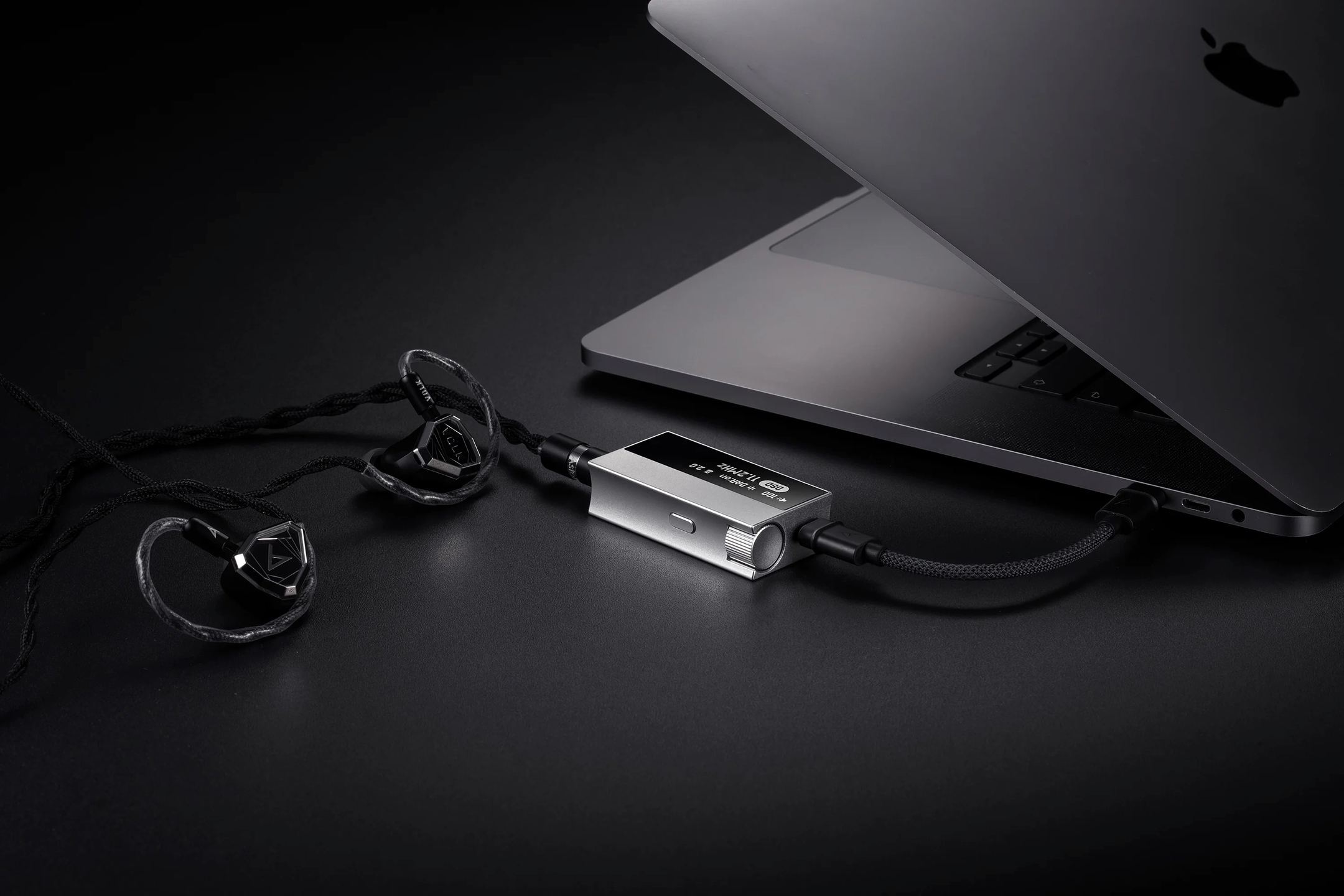
The AK4191EQ and AK4499EX chips, until now reserved for flagship Astell&Kern players such as the SP4000, are making their first appearance in a portable converter cable. The Korean manufacturer condenses its reference design into a 46-gram aluminum housing, featuring an OLED screen and a 150-step volume wheel. Connected via USB-C to a smartphone, computer, or console, this converter includes two headphone outputs: 3.5 mm single-ended and 4.4 mm balanced.
The SP4000’s chips in a converter cable
The AK-HC5 is the first portable USB converter to feature AKM’s AK4191EQ + AK4499EX combination, previously the preserve of Astell&Kern players at the very top of the catalog. The SP4000 uses four of each chip, while the HC5 includes one of each. The principle remains AKM’s approach since its new generation: separating digital processing (AK4191EQ) from analog conversion (AK4499EX) into two distinct components, which reduces interference between the two stages. The result on the HC5: PCM up to 32-bit/768 kHz and native DSD up to DSD512 (22.4 MHz).
An aluminum housing and OLED screen
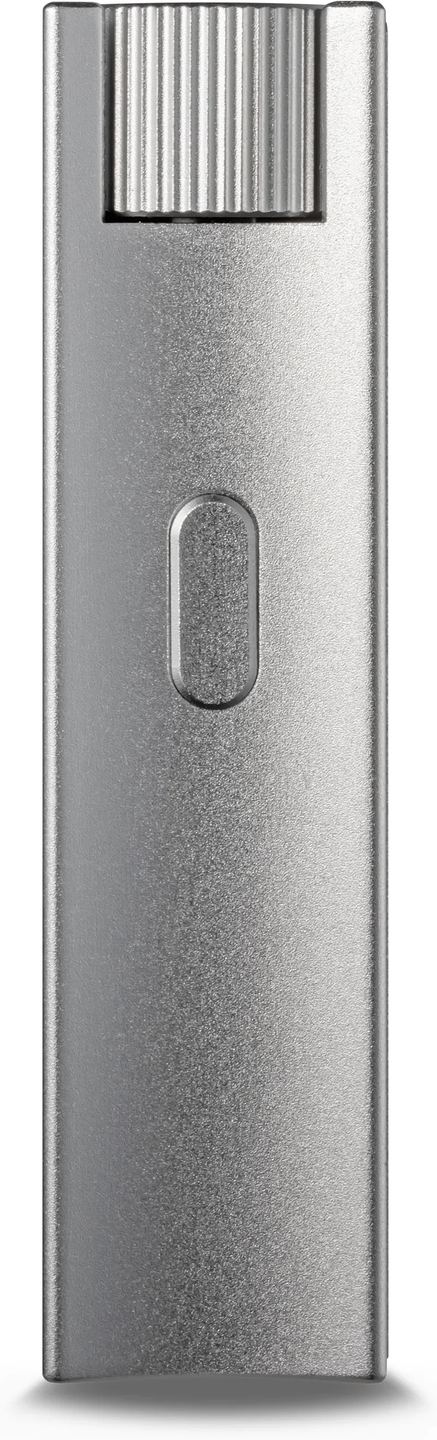
The machined aluminum body features a satin silver finish and weighs about 46 grams, with dimensions of 32 × 64.3 × 16 mm. It is bulkier than most compact USB converters on the market, and the AK-HC5 does not fit in the standard cases supplied with in-ear monitors, nor in MagSafe mounts for DACs. In return, it includes a 1.62-inch OLED screen, a 150-step volume wheel, and a side configuration button. The screen displays the volume, incoming signal format, active conversion filter, and DAR upsampling status. The wheel allows fine level adjustment, whereas most compact converters make do with two increment buttons. The single button is used to navigate the menu, which requires a few manipulations before becoming intuitive.
High Driving mode and dedicated amplification
Astell&Kern reprises here the High Driving mode introduced in the SP4000: a horizontal OPAMP layout that delivers more usable voltage to the headphone output than a conventional compact converter implementation. Output level reaches 2.5 Vrms single-ended on the 3.5 mm jack and 5 Vrms balanced on the 4.4 mm jack. Enough to comfortably drive the majority of in-ear monitors and dynamic headphones with medium or high sensitivity. The most current-hungry planar headphones, however, will still be better served by a dedicated headphone amplifier. To preserve signal purity against interference coming from the smartphone or source computer, the internal cable is double-shielded (tinned copper conductors followed by additional braided shielding) and the dedicated amplifier carefully manages its PSRR and CMRR power supply noise rejection ratios.
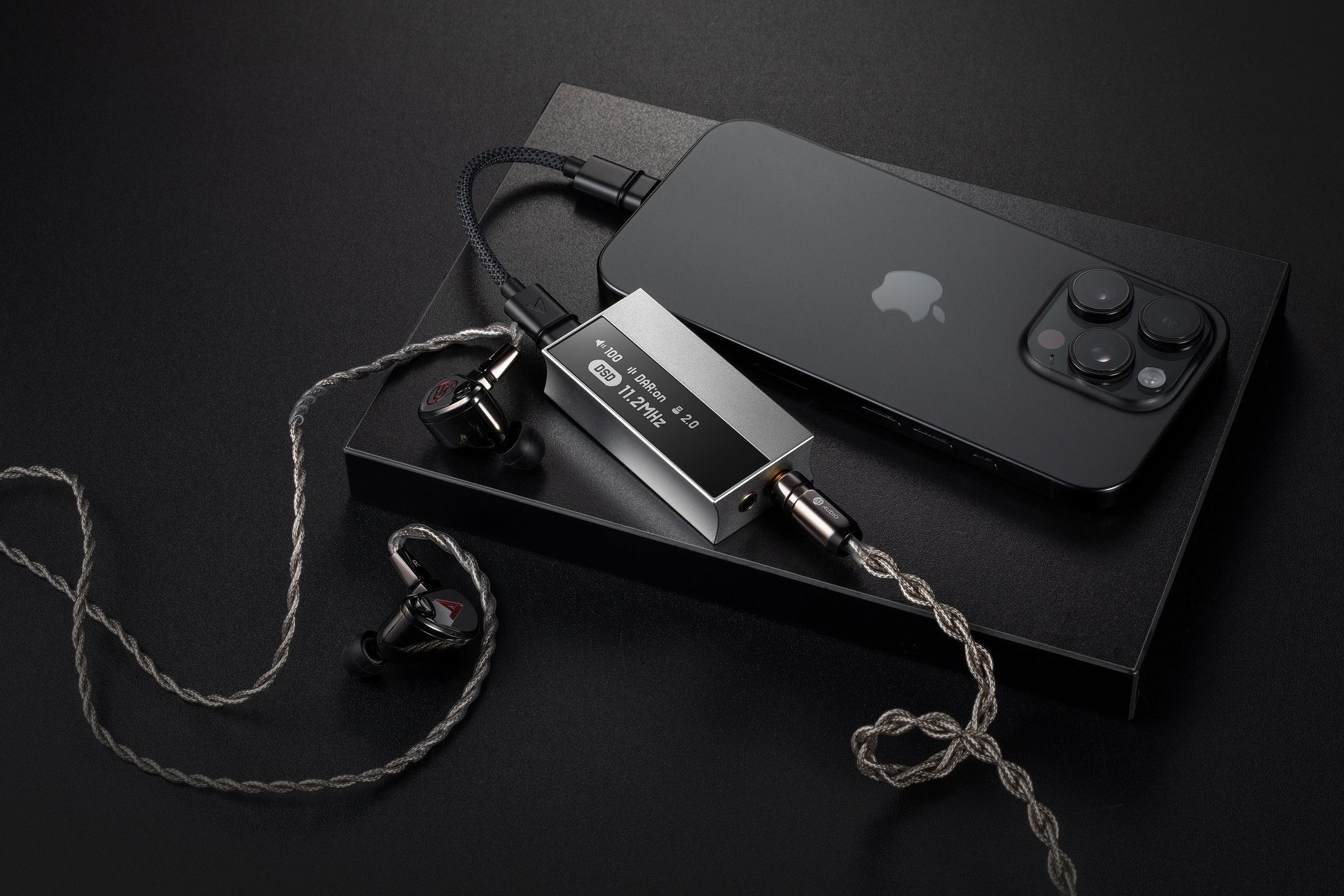
DAR upsampling and conversion filters
The Digital Audio Remaster (DAR) function uses processing derived from the brand’s own players. When activated, it reconstructs the incoming signal at a higher rate, either in PCM 384 kHz or DSD256, using a proprietary algorithm. The aim: to soften digital transitions and achieve a more analog-like rendering, especially with low-resolution files. The HC5 also offers six selectable conversion filters from the menu, previously limited to the brand’s players and desktop converters. Each filter slightly modifies time response and the timbre of transients, allowing the user to adjust the rendering according to the track or headphones used.
USB-C, dual output, and console compatibility
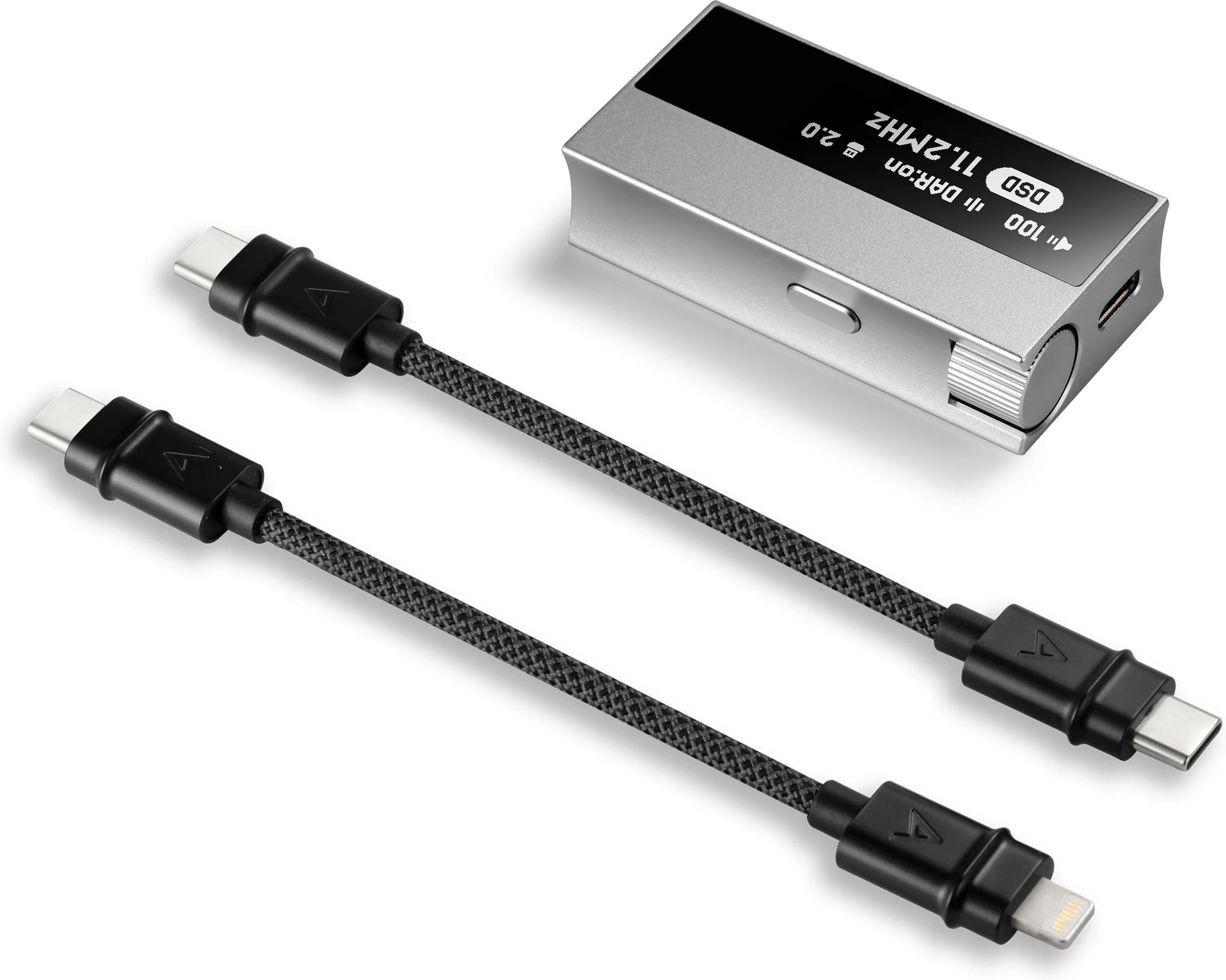
The single input is USB Type-C and supports both UAC 2.0 (smartphones, tablets, computers) and UAC 1.0 (PlayStation consoles, Nintendo Switch). Class selection is done directly from the HC5 menu, without a third-party app. Two headphone outputs sit side by side on the edge: the 3.5 mm single-ended jack for the majority of earphones and headphones on the market, and the 4.4 mm 5-pole balanced jack for high-end models supplied with a balanced cable. Output impedance remains low, at 0.5 ohm on 3.5 mm and 1.1 ohm on 4.4 mm, a sufficiently controlled threshold to drive sensitive multi-driver in-ear monitors without audible coloration. The manufacturer includes two cables in the box, one USB-C to USB-C and one USB-C to Lightning compatible with iPhones equipped with the Apple connector, as well as a Synt3 protective case. Like any battery-free USB converter, the HC5 draws its power from the source device: the OLED screen and active amplification place a greater demand on a smartphone’s battery life than Bluetooth playback.
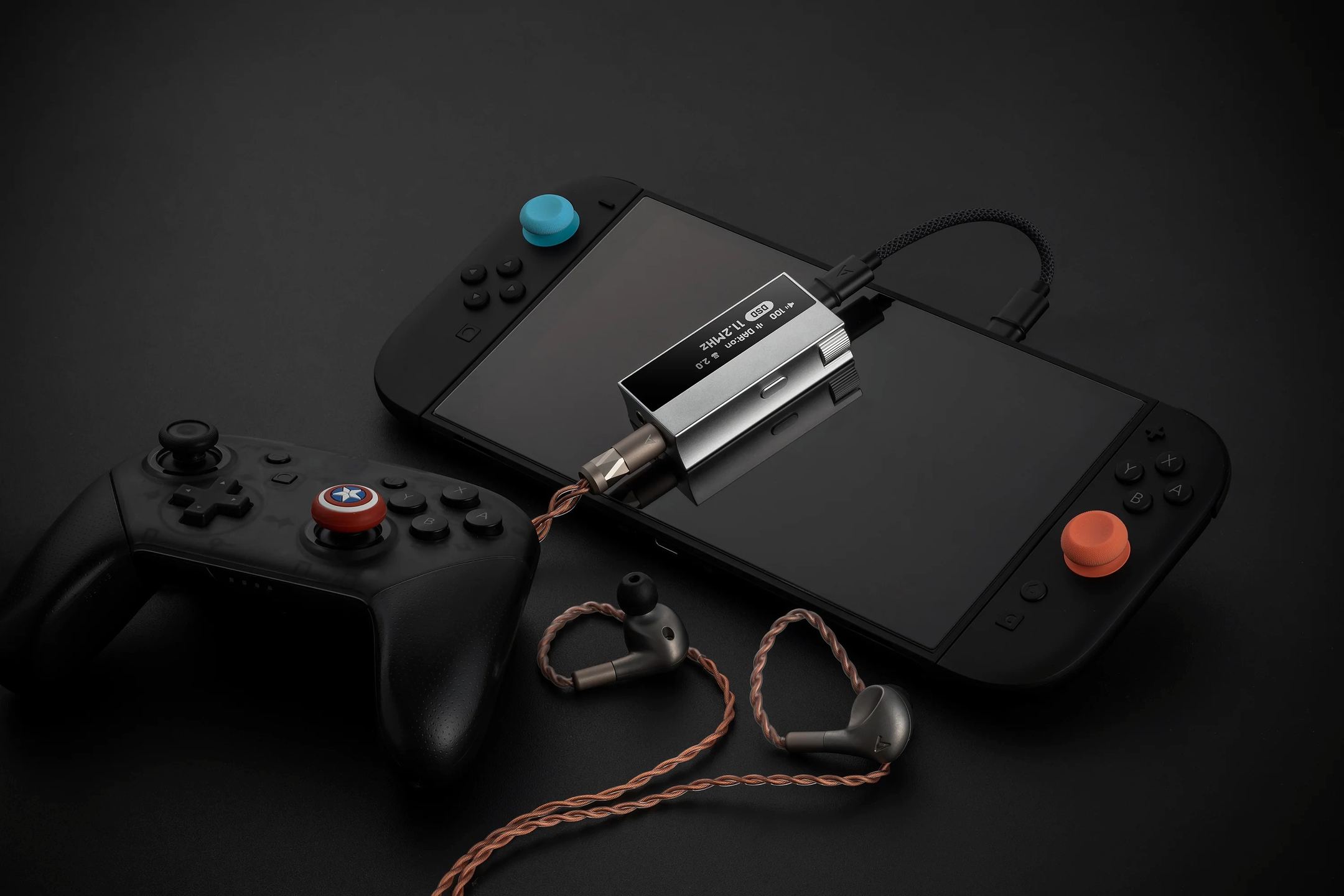
The HC5 compared with the HC4 and previous models
The HC5 extends a lineup expanded by addition rather than replacement: HC2 (Cirrus Logic), HC3 (ESS), HC4 (AKM AK4493S), and HC5 (AKM AK4191EQ + AK4499EX) coexist in the catalog. The technical leap between HC4 and HC5 remains clear, however. The HC4 used a single AK4493S chip from AKM’s previous generation, whereas the HC5 separates digital and analog into two high-end components. Output level rises from 2 Vrms to 2.5 Vrms single-ended, and from 3 Vrms to 5 Vrms balanced. The HC5 also introduces the OLED screen, the 150-step wheel, and the six conversion filters, elements absent from previous models. This hardware package comes at the cost of greater weight and bulk than previous models: the HC5 weighs 46 g, making it the heaviest in the HC series.
Technical Specifications
Overview
- Audiophile Hi-Fi DAC, satin silver finish
- First USB DAC cable equipped with AK4191EQ + AK4499EX chips, delivering a flagship-level sound signature with an exceptional level of detail and realism
- Astell&Kern audio philosophy and precision engineering in a compact format
Audio architecture
- Dual AKM AK4191EQ + AK4499EX DAC
- Native resolution 32-bit / 768 kHz and DSD512 at 22.4 MHz
- Digital Audio Remaster (DAR): audio upsampling to PCM 384 kHz or DSD256 for more natural playback, with increased clarity and depth
- Ultra-pure signal design: double noise-shielding of the cable and dedicated low-noise amplifier for pure sound, free from interference from any connected device
Amplification
- High Driving mode derived from the SP4000, delivering remarkable output power in a compact format
- Horizontal OPAMP layout providing much higher driving power than conventional portable USB DACs
- Rich dynamics, expansive soundstage, and powerful energy
Audio performance
- Frequency response
- ± 0.006 dB (20 Hz - 20 kHz), unbalanced and balanced
- ± 0.06 dB (20 Hz - 70 kHz), unbalanced and balanced
- Signal-to-noise ratio
- 121 dB at 1 kHz, unbalanced
- 125 dB at 1 kHz, balanced
- Crosstalk
- −139 dB at 1 kHz, unbalanced
- −141 dB at 1 kHz, balanced
- THD+N
- 0.0005% at 1 kHz, unbalanced
- 0.0004% at 1 kHz, balanced
- IMD SMPTE (800 Hz / 10 kHz, ratio 4:1)
- 0.0006% unbalanced
- 0.0005% balanced
- Output impedance
- 0.5 ohm on 3.5 mm unbalanced output
- 1.1 ohm on 4.4 mm balanced output
- Output level (no load)
- Unbalanced: 2.5 Vrms
- Balanced: 5 Vrms
Supported formats
- PCM: 8 kHz to 768 kHz (8 / 16 / 24 / 32 bits per sample)
- Native DSD
- DSD64 (1-bit, 2.8 MHz), stereo
- DSD128 (1-bit, 5.6 MHz), stereo
- DSD256 (1-bit, 11.2 MHz), stereo
- DSD512 (1-bit, 22.4 MHz), stereo
Connectivity
- Input: USB Type-C (compatible with UAC 1.0 and UAC 2.0)
- Headphone outputs
- 3.5 mm unbalanced
- 4.4 mm balanced (5 poles only)
- Broad compatibility: smartphones, computers, and consoles
Interface and control
- 1.62” OLED screen
- 150-step volume wheel for precise adjustment
- Clear display of playback information
Construction
- Aluminum body, satin silver finish
- Weight: approximately 46 g
- Dimensions (W × H × D): 32 mm × 64.3 mm × 16 mm
Box contents
- 1 Astell&Kern HC5 DAC and amplifier
- 1 USB-C to USB-C cable
- 1 USB-C to Apple Lightning cable
- 1 Synt3 protective case
- 1 quick start guide
- 1 warranty card
Frequently asked questions
Does the HC5 work with a PlayStation 5 or a Nintendo Switch?
Yes, the UAC 1.0 mode selectable from the HC5 menu enables compatibility with consoles that do not support the USB Audio 2.0 class. Once connected via USB-C to the PS5 or to the Switch dock, the HC5 handles audio output for games and voice chat.
Is there a built-in equalizer on the HC5?
No. The AK-HC5 offers neither an equalizer, nor mobile app management, nor a Bluetooth connection. Tone adjustment is done solely by choosing among the six AKM conversion filters and by enabling or disabling DAR upsampling.
Which cable is included to connect a recent iPhone via USB-C?
The USB-C to USB-C cable included in the box plugs directly into iPhones equipped with a USB-C port. The second cable provided, USB-C to Lightning, remains useful for earlier-generation iPhones still in use.
Can the HC5 drive high-end planar headphones?
With 5 Vrms on the 4.4 mm balanced output, the HC5 handles without difficulty the majority of portable-format planar headphones and most home headphones with متوسط sensitivity. The most power-hungry planars in terms of current (models with very low sensitivity, around 96 dB/mW or less) will benefit more from a home headphone amplifier.
What frequencies does the HC5 support in native DSD?
The HC5 plays DSD64, DSD128, DSD256, and DSD512 natively, up to 22.4 MHz. In PCM, it supports sampling rates from 8 kHz to 768 kHz, at resolutions of 8, 16, 24, and 32 bits per sample.
Does the HC5 use a lot of battery life on a smartphone?
The converter draws its power from the source device’s USB-C port, with no internal battery. Power consumption remains modest thanks to the AKM chips’ low-power mode, but an extended listening session with the OLED screen active will drain the phone’s battery more than Bluetooth playback.
What is the 150-step volume knob used for?
The wheel controls the HC5’s volume independently of the host system’s volume, with 150 increments versus the ten or twenty usually available on a smartphone. The very fine steps (the lower end of the range is deliberately progressive) make nighttime listening and precise adjustments on sensitive in-ear monitors easier.
- Eco-contribution of €0.08 included in the sale price.
- GTIN / EAN: 8800309900634