Klipsch Reference Premiere vs Heritage: what are the differences between the two ranges?
October 09, 2026
Contents
The question often comes up in the same terms: should you step up to Heritage, or stick with Reference Premiere and spend the difference on electronics? There is no universal answer, because the two ranges do not aim for the same compromise. One covers every channel in a multichannel setup at an affordable price. The other takes efficiency and directivity control to levels that even change your choice of amplifier.
→ Discover all Klipsch products
A horn for the treble, or a horn for each driver band
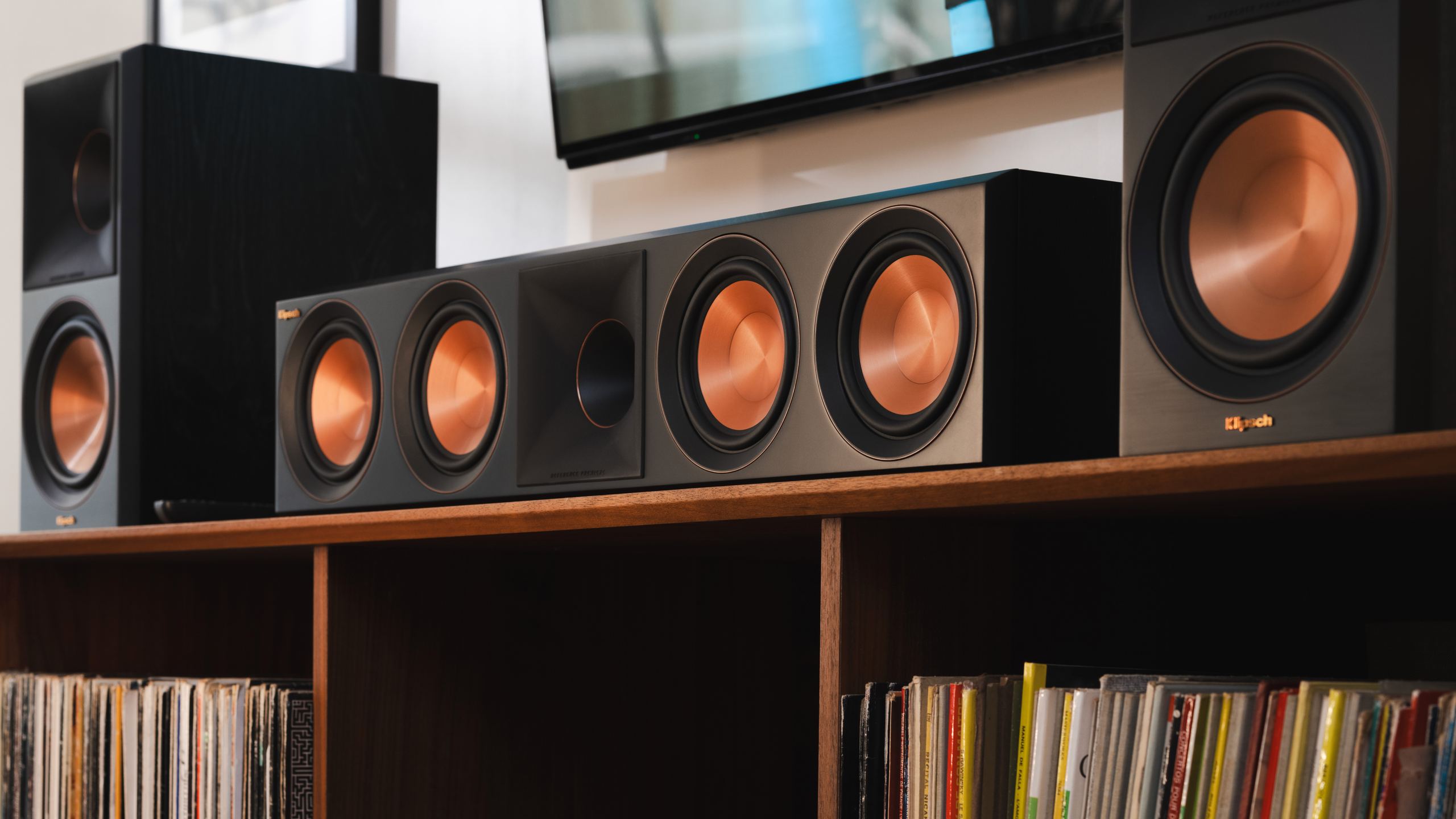
Reference Premiere is a two-way range. A 25 mm titanium-dome tweeter, mounted on a hybrid Tractrix horn with 90° × 90° coverage, takes over at around 1,500 Hz. Below that, one or more Cerametallic drivers radiate directly, in a bass-reflex enclosure with a rear Tractrix port. From bookshelf to floorstanding speakers, the principle remains the same: only the cone area increases, and some floorstanding models add an Atmos module on top.
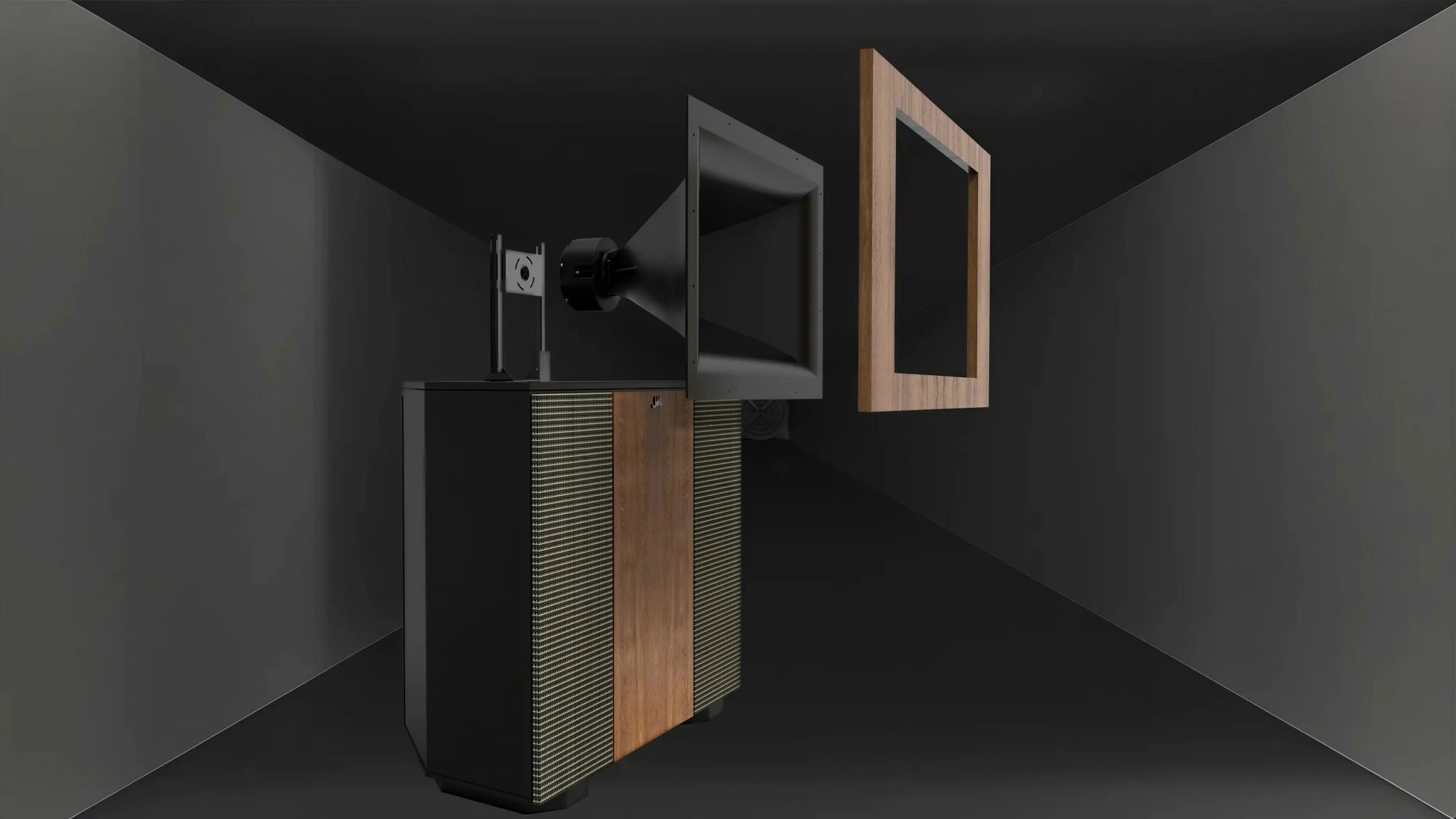
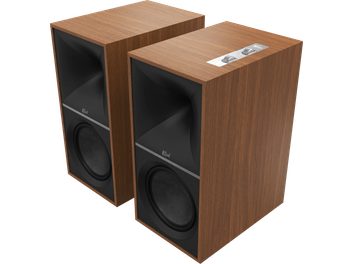
Heritage models are all three-way, and two of those three driver bands use a horn. On the Heresy IV, a compression driver with a 2.54 cm titanium diaphragm handles the treble above 4,500 Hz, a second driver with a 4.45 cm polyimide diaphragm handles the midrange from 850 Hz through a Tractrix horn, and a 30 cm woofer takes care of the rest. The Cornwall IV uses the same formula with a 38 cm woofer. La Scala and Klipschorn take the approach all the way: their woofer is also loaded by a folded horn.
This difference has a direct effect on sound radiation. A cone driver radiates broadly in the bass, then gradually concentrates its energy forward as the frequency rises. A horn, on the other hand, maintains roughly constant coverage across the entire band it handles. Extending the horn down to 850 Hz means controlling directivity across almost the entire range occupied by voices and solo instruments. On a two-way speaker with a high crossover frequency, the region where the woofer’s dispersion starts to narrow and the horn widens the angle again remains a transition to manage, and this is the compromise Reference Premiere accepts to keep its price down.
Efficiency changes the amplifier
The quoted figures are high on both sides: around 94 dB for a Reference Premiere bookshelf speaker, 98 dB for a floorstanding speaker from the same range, 99 dB for the Heresy IV and Forte IV, 102 dB for the Cornwall IV, and 103 dB for La Scala and Klipschorn. Klipsch measures in anechoic half-space, a method that slightly inflates the figures compared with a speaker on a stand in a room, but the gap between the two ranges remains valid: at the same volume, a Heritage requires several times less power.
In practice, a Reference Premiere works perfectly well with a standard home theater receiver. A Heritage opens the door to low-powered amplifiers, starting with integrated tube amplifiers delivering a few watts in Class A. There is a downside: at this level of efficiency, the background noise of average electronics becomes audible from the listening position, and even the slightest preamplifier hiss is noticeable.
Bass is not the Heritage selling point
On paper, the Heresy IV reaches down to 48 Hz (± 4 dB). A 16.5 cm Reference Premiere bookshelf speaker claims 44 Hz, and a floorstanding speaker from the same range goes down to 35 Hz. The smallest Heritage therefore does not reach as low as a speaker costing several times less.
The rest of the range partly addresses this without ever aiming for maximum extension. The Forte IV reaches 38 Hz thanks to a 30 cm woofer supported by a 38 cm passive radiator on the rear panel. The Cornwall IV goes down to 34 Hz with its 38 cm woofer in a bass-reflex enclosure, with a quoted maximum output of 119 dB. La Scala, despite selling for nearly €20,000, stops at 40 Hz (-4 dB): its 30 cm horn-loaded woofer, now combined with a port, prioritizes efficiency and power handling over deep-bass extension. Only the Klipschorn, with its 38 cm woofer in a corner-loaded folded horn, reaches 34 Hz.
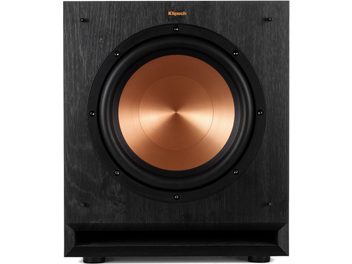
What you buy with a Heritage is the ability to produce high output without making the driver work hard, with distortion staying low as the volume rises. If the goal is to reach low frequencies, a subwoofer or a Reference Premiere floorstanding speaker costs much less.
Cabinet, materials and manufacturing
Reference Premiere speakers are made from MDF reinforced with internal bracing, covered in a wood-effect vinyl finish with a satin-painted baffle. The grilles are magnetic, and the dual aluminum binding posts support bi-wiring and bi-amping.
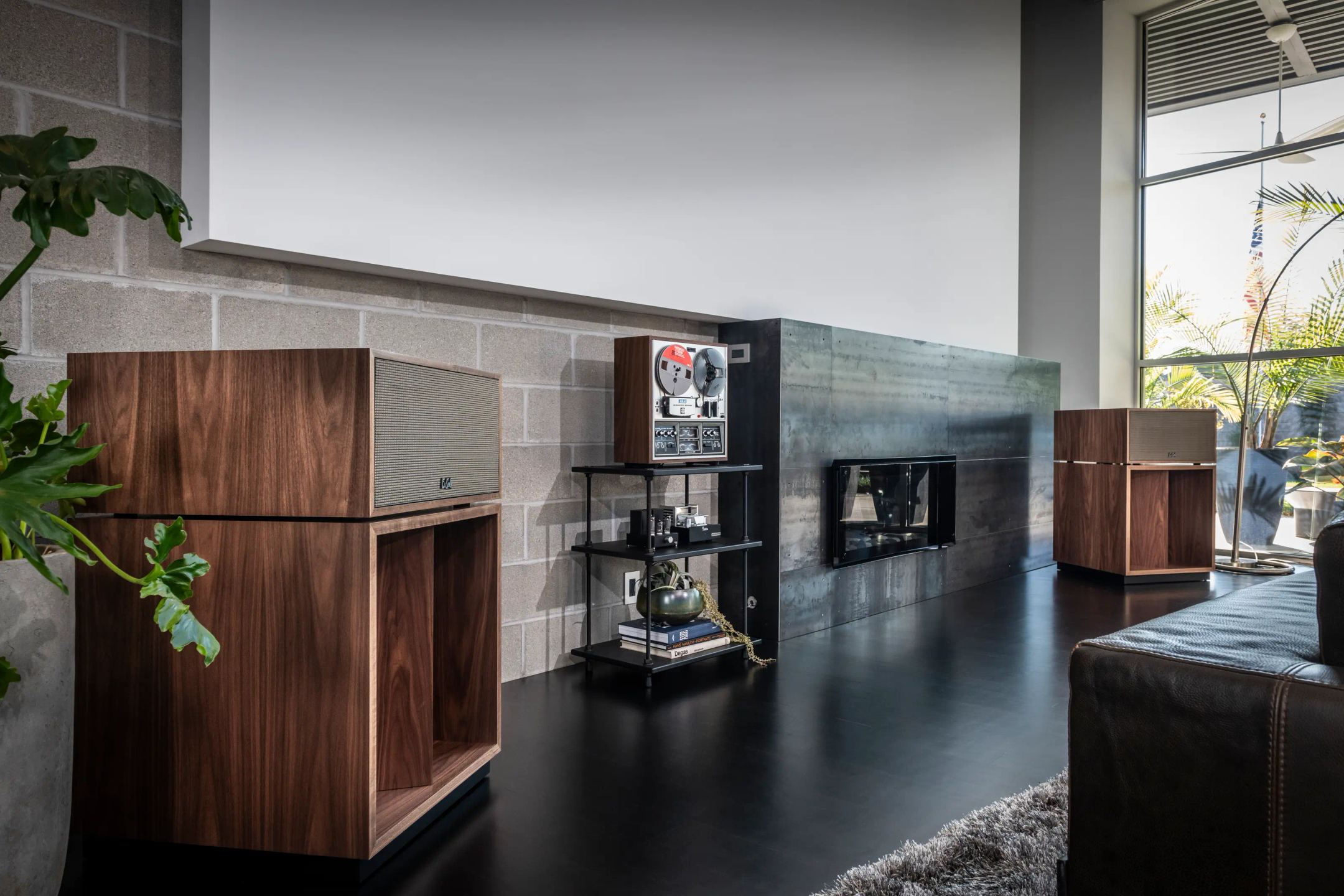
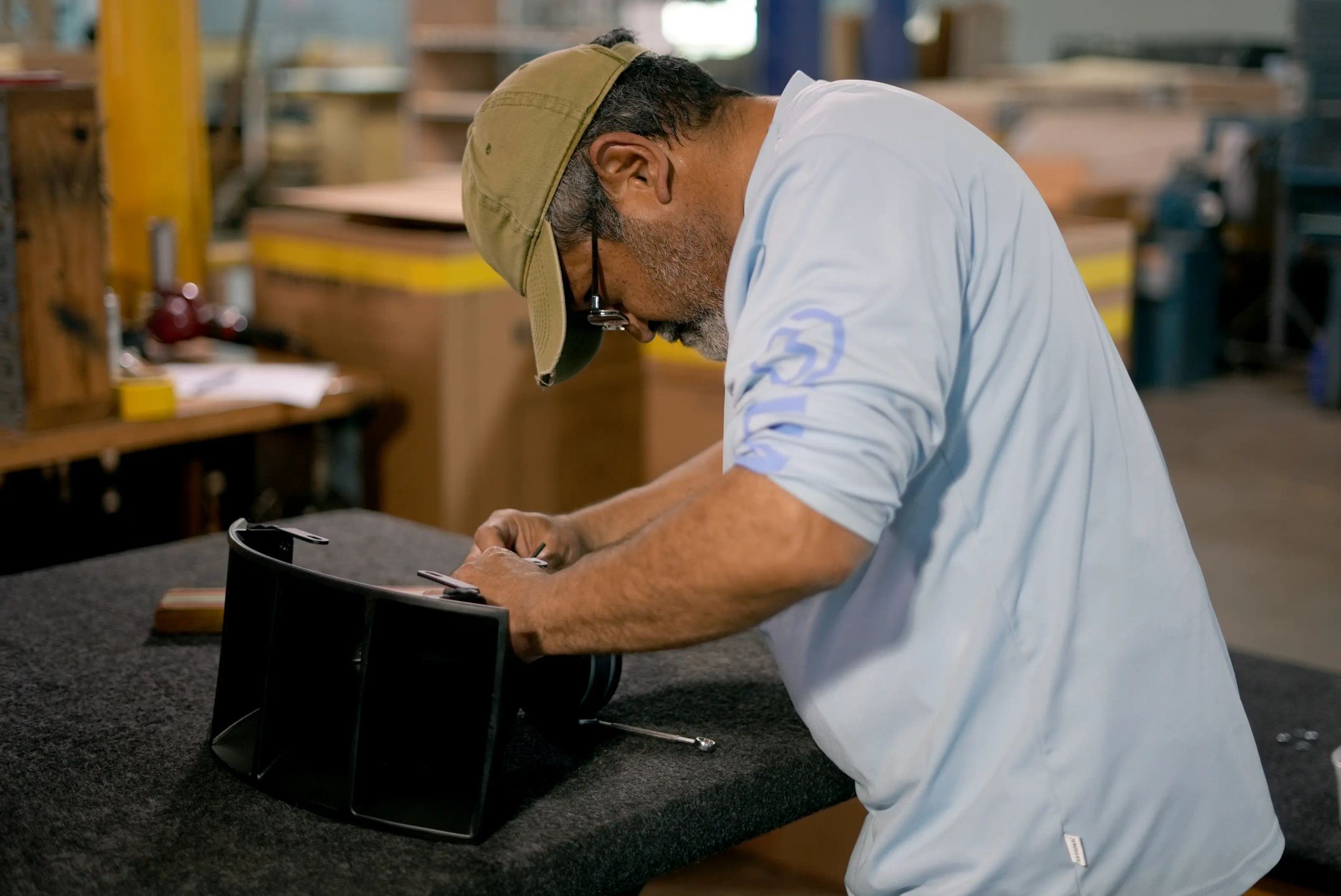
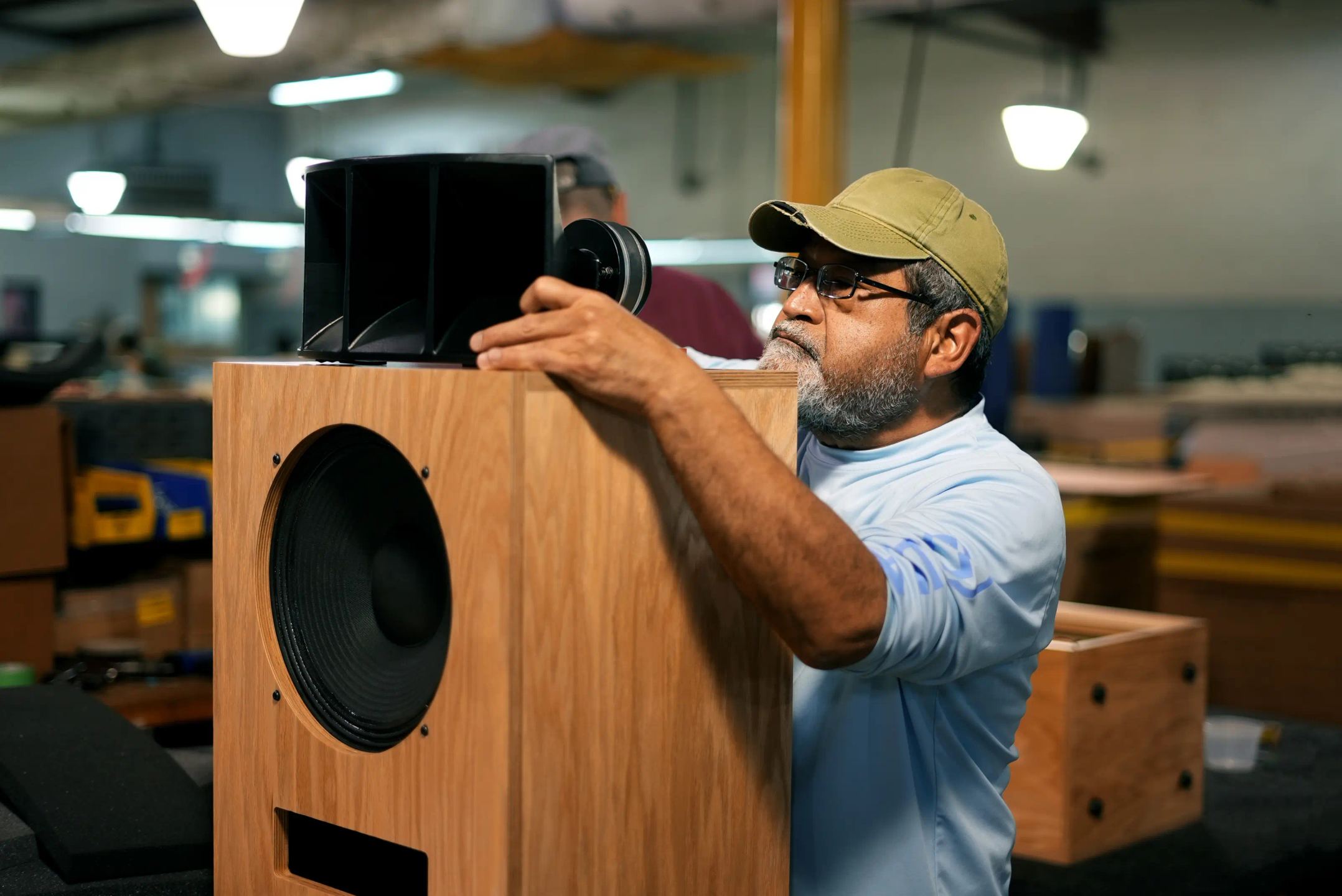
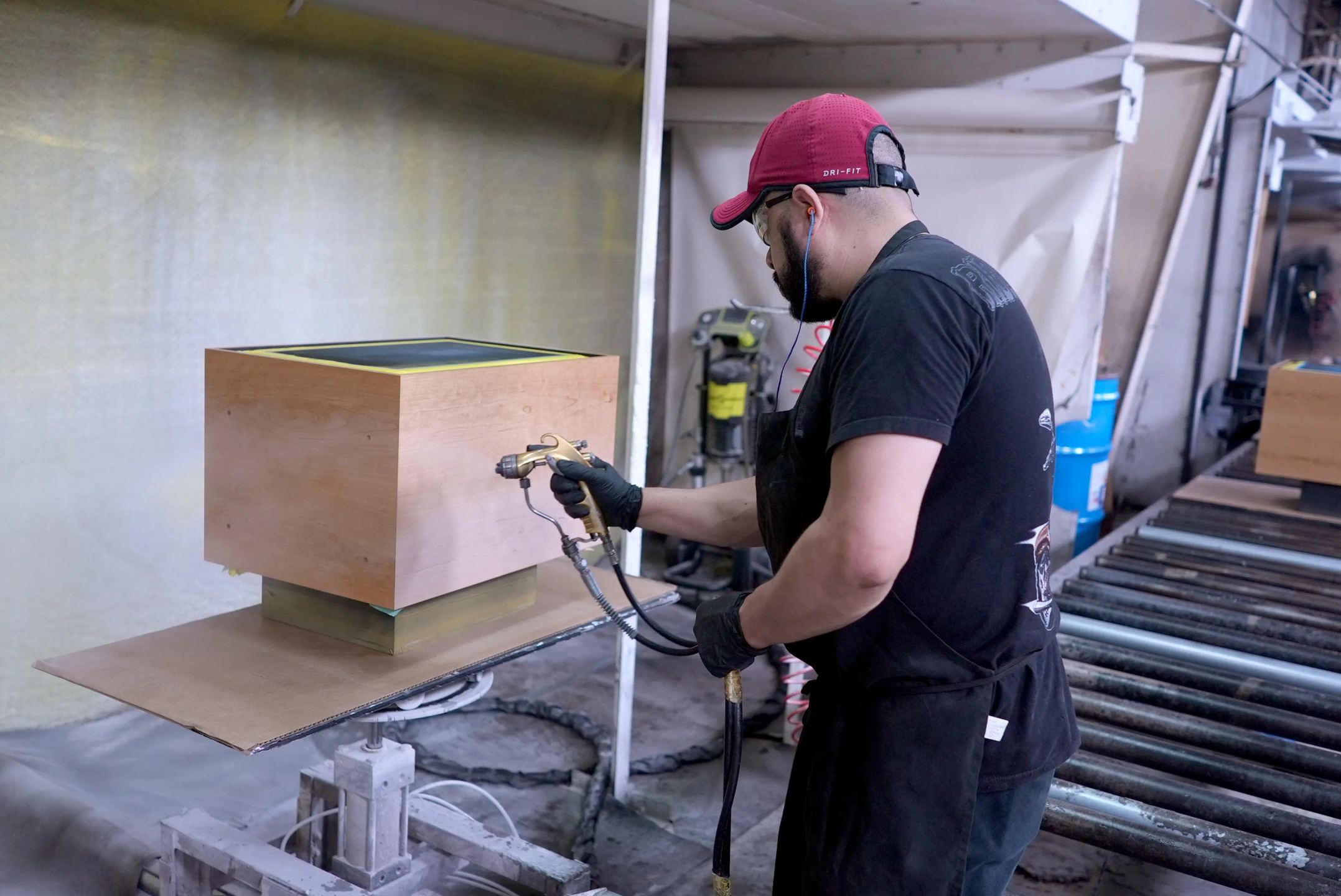
Heritage speakers feature real wood veneer, with sheets sliced in sequence and then bookmatched on either side of the joint, and they are assembled by hand in Hope, Arkansas, where production began in 1946. The Heresy IV’s internal wiring is AudioQuest Type 4 with Star-Quad geometry. Their weights reflect this: 20.4 kg for a Heresy IV, around 44 kg for a Cornwall IV, and 91 kg for a Klipschorn. They are as much pieces of furniture as speakers, and handling needs to be planned accordingly.
Multichannel remains Reference Premiere territory
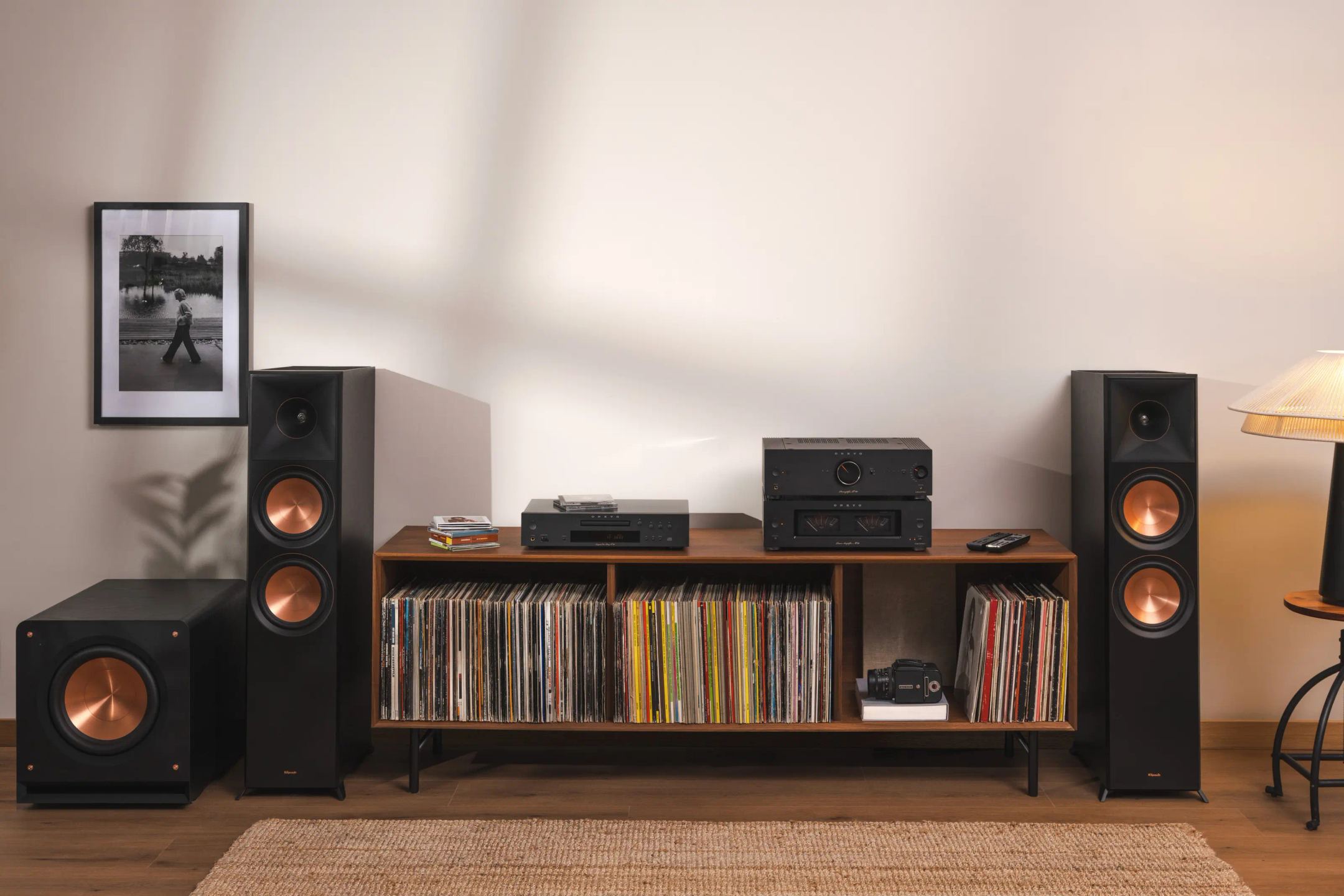
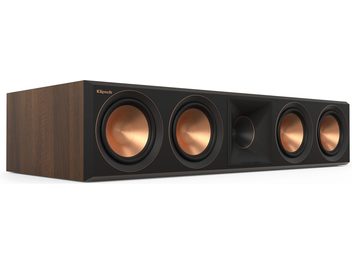
Reference Premiere covers every channel in a setup: floorstanding speakers, bookshelf speakers, center speakers, surround speakers, Atmos modules and subwoofers, all voiced around the same tweeter and the same Cerametallic cones. Floorstanding speakers with an integrated Atmos module take the approach as far as a terminal panel switchable between height and surround modes.
There is no center speaker or height module in the Heritage range. Building a complete multichannel system therefore means lining up several identical floorstanding speakers, with the space and budget that entails, or accepting a difference in tonal character between the front channels. For a dedicated cinema room, the choice is quickly settled. For mainly stereo listening with occasional cinema use, a pair of Heritage speakers supplemented by a subwoofer makes sense.
The room sets the rules
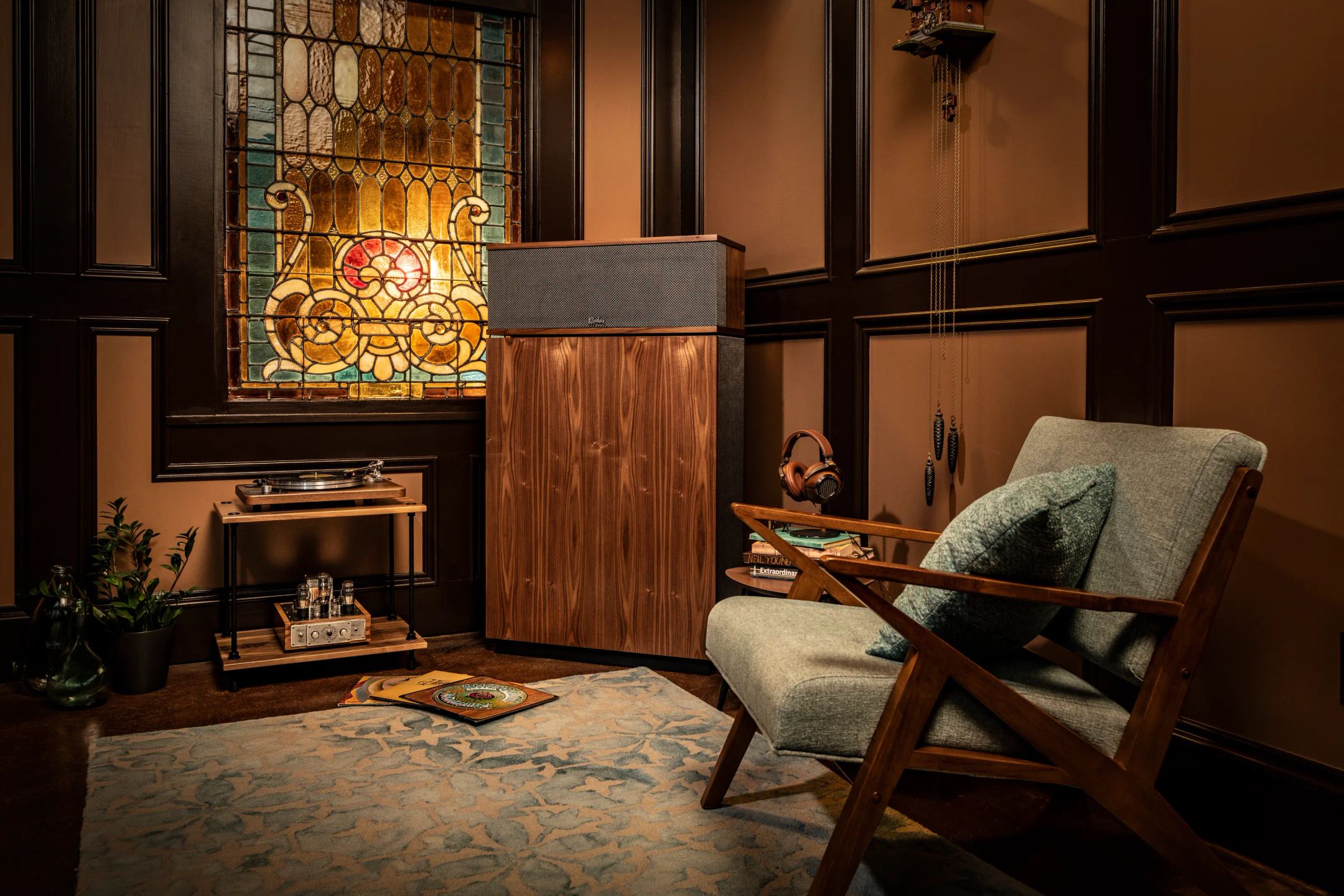
The Klipschorn is placed in corners: that has been its purpose since 1946. Since the AK6 generation, its bass horn has had an enclosed rear cabinet, so the walls no longer serve to complete the enclosure, but corner placement remains the position it was designed for. La Scala stands 134 cm tall and requires a comfortable listening distance. The Cornwall IV takes its name from its two preferred locations, the corner or the wall. The Heresy IV sits on its angled base, which tilts the acoustic axis upward toward a seated listener.
Reference Premiere speakers are more accommodating, with one caveat: their Tractrix port is on the rear panel, and placing them too close to the wall boosts the upper bass. In both cases, the horn axis must point toward your ears, otherwise the tonal balance shifts.
Two price scales
In Reference Premiere, a pair of bookshelf speakers costs around €700, a center speaker about the same, and a pair of floorstanding speakers with integrated Atmos modules between €1,990 and €2,580 depending on the finish. A complete 5.1.2 system remains in the same price bracket as a single pair of entry-level Heritage speakers.
In Heritage, the Heresy IV costs €4,990 per pair, the Forte IV €6,580, the Cornwall IV €8,990, the La Scala AL6 €19,998 and the Klipschorn AK7 €25,998, with the Jubilee at the top of the range. The two highest models support an optional external active crossover with digital processing, which bypasses the internal passive crossover, aligns timing and phase between driver bands, and requires separate amplification for each frequency band. This approach was first introduced on the Jubilee.
Both ranges are changing right now
The Heritage range was updated at the top end in March 2025 with the Klipschorn AK7 and La Scala AL6: a 3-inch midrange compression driver replacing the previous 2-inch unit, a modified Tractrix horn with a shortened throat, a wider-dispersion phase plug on the treble driver, ported horn-loaded bass on La Scala, a connection panel with passive and active inputs, and a new American Auburn finish. We detailed this development in an article on the new Klipschorn AK7 and La Scala AL6.
Reference Premiere, meanwhile, is moving to its third generation, announced on August 7, 2026 and expected in October. The catalog narrows to nine models, from floorstanding to effects speakers, and the tweeter receives a high-density axial Tractrix horn made from a revised BMC material, mounted flush with the baffle. The copper Cerametallic woofers remain the range’s signature.
Klipsch is also preparing a Reference Signature series, unveiled at CES 2026 and further detailed at CEDIA that same year, which will sit between Reference Premiere and Heritage, with a worldwide launch announced for winter 2026. We discussed it in our CES 2026 report. The currently considerable gap between the two families is therefore set to fill out.
Decide based on actual use
For a multichannel setup driven by a receiver, with effects channels and Dolby Atmos, Reference Premiere settles the question without debate: it is the only one of the two to offer the full selection, at a price that leaves room in the budget for electronics and a subwoofer.
For stereo listening in a living room, with a modestly powered amplifier and a desire for lively sound at moderate volume, the Heresy IV or Forte IV changes the character of the sound you get, provided you accept their bass limitations or add a subwoofer. The Cornwall IV needs a spacious room and rewards well-designed amplifiers. Beyond that, La Scala and Klipschorn are part of a dedicated-room project, with placement constraints, heavy handling and electronics chosen accordingly.
The deciding factor is not price but how many horn-loaded driver bands you want and how much space you are willing to give them. Both ranges are on display and available for listening in our Compiègne showroom: on this particular subject, half an hour of comparative listening is worth more than all the specification sheets.
Popular products
You may also like to read
 Which amplifier for Klipsch speakers: why power isn't the real questionComparisons and buying guides
 Klipsch Rebellion: the first bookshelf speaker in the Heritage rangeHi-fi and home cinema news
 Klipsch kO-R2: the second collaboration with Ojas unveiled in Milan, limited to 600 pairsHi-fi and home cinema news
 Klipsch at CES 2026: 80 years celebrated with horns, headphones and premium concept productsHi-fi and home cinema news
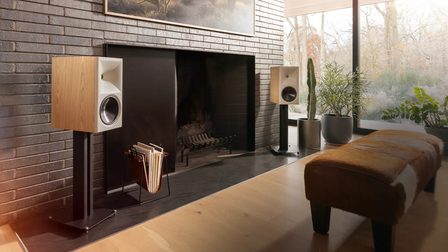 Klipsch Fives II, Sevens II and Nines II: the Klipsch–Onkyo collaboration unveiled at CESHi-fi and home cinema news
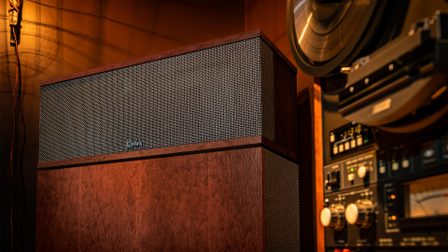 Klipsch renews its legends: discover the new Klipschorn AK7 and La Scala AL6Hi-fi and home cinema news