Simon
Does the job very well, the headphone jack is good.
Comment from 11 March 2024 — Experience from 29 January 2024
Automatically translated — Show original (French)
Fait très bien le job, la prise casque est bonne.
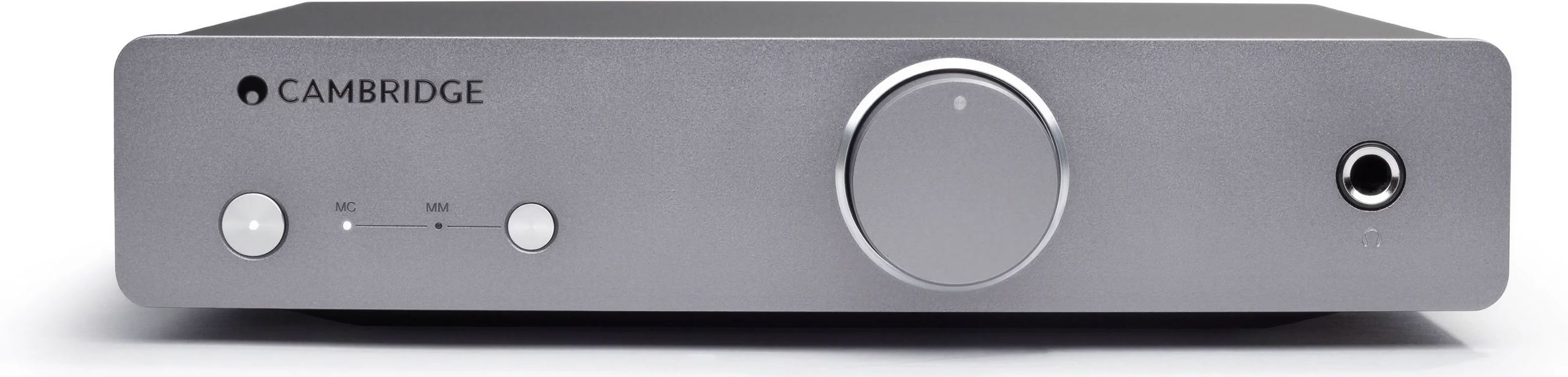

Launched alongside the Alva Solo in 2018, the Alva Duo is Cambridge Audio’s phono preamp for turntables fitted with a moving magnet or moving coil cartridge. This silver version uses the electronics of the original model, with no changes to the circuit design. The front-panel headphone amplifier, subsonic filter, and rear balance control are therefore all still present, in a compact metal chassis.
A turntable cartridge outputs only a signal of a few millivolts at best, and around one hundred times less for a moving coil. Without specific amplification and RIAA equalization correction, this signal remains unusable by a standard line input. The phono preamplifier handles this double task: boosting the level and applying the inverse correction to that engraved on the record. The Alva Duo sits at this exact point in the chain, between the turntable and the integrated amplifier or preamplifier in the system.
A front-panel switch toggles between the two operating modes. In moving magnet mode, gain reaches 39 dB and input impedance is set at 47 kΩ with a capacitance of 100 pF, standard values for the majority of MM cartridges on the market. Moving coil mode offers 60 dB of gain and an impedance of 100 Ω, which corresponds to a reasonable compromise for many medium-output MC cartridges. Very low-output MCs or those with more specific loading requirements may, however, reach the limits of this fixed, non-customizable setting.
A 6.35 mm connector occupies the front panel, accompanied by a slightly offset volume potentiometer. The built-in headphone amplifier lets you listen to your vinyl without turning on the main amplifier, which is useful during late-night sessions or when sharing a home. The potentiometer offers more noticeable resistance past the halfway point, acting as a safeguard against excessive listening levels.
The switch-mode power supply chosen by Cambridge Audio operates outside the audible band. This principle is intended to limit the mains hum often blamed on this type of gain stage. The components are surface-mounted (SMT technology), which shortens the traces and reduces the pickup of stray noise. The stated signal-to-noise ratio exceeds 90 dB in moving magnet mode and 70 dB in moving coil mode, values consistent with the intended use. Total harmonic distortion remains below 0.0025% in MM and rises to 0.20% in MC, a direct consequence of the much higher gain required to amplify the signal from a moving coil. Overload margin exceeds 30 dB, enough to handle the sharpest transients from a well-cut record without clipping.
A subsonic filter cuts very low frequencies, below the useful band. Stray vibrations from warped records or a vibration-prone environment are attenuated before reaching the speakers: low-frequency woofers are protected and the sound becomes more stable. At the rear, a balance potentiometer adjusts the balance between the two channels. This control is mainly used to compensate for a possible level imbalance between the left and right channels, which may come from the cartridge itself.
The chassis measures 48 × 215 × 159 mm and weighs 0.95 kg, a format that makes it easy to place on a shelf or next to a turntable. The new silver finish is added to the black and graphite gray versions already available. At the rear, the stereo RCA input accepts the turntable cables, accompanied by a ground terminal for connecting the tonearm ground wire. The RCA line output remains fixed in level: only the front-panel potentiometer affects the headphone output. The internal power supply supports mains voltages worldwide. Maximum power consumption is capped at 10 watts, and automatic standby activates after 20 minutes without a signal.
The fixed 100 Ω load impedance and the 60 dB gain are suitable for medium-output MC cartridges, generally in the range of about 0.3 to 0.7 mV. Very low-output MC cartridges (below 0.2 mV) or those requiring a very different load will benefit less from this setting.
Not always. A dedicated external phono stage only provides an audible improvement if the phono input built into the amplifier is fairly modest in quality, which is often the case with multi-purpose amplifiers. A listening comparison remains the best judge.
Yes. The balance applies to the stereo signal upstream of both outputs, line and headphone. It remains especially useful for correcting a slight level imbalance between the two channels of a cartridge.
Yes, it acts continuously on the output signal. Its cutoff frequency is below the useful band: music listening is not affected, and the speakers are protected from unwanted very low frequencies.
It supports the useful impedance range for conventional hi-fi headphones. For very demanding models (very high impedance or very low sensitivity), a more powerful dedicated headphone amplifier may be preferable.
No, the RCA input remains strictly reserved for a turntable. The signal levels of a network player or CD player are much higher, and RIAA equalization only makes sense for a signal coming from a phono cartridge.
Yes. Its power consumption remains modest, and the automatic standby mode after 20 minutes of inactivity handles this aspect without any intervention. In practice, it switches to standby on its own when no signal arrives from the turntable.
Simon
Does the job very well, the headphone jack is good.
Comment from 11 March 2024 — Experience from 29 January 2024
Jacques
Very good phono preamp with remarkable sound quality.
Comment from 4 March 2023 — Experience from 18 February 2023