Dominique
Unboxed, great deal
Comment from 12 December 2025 — Experience from 13 June 2024
Automatically translated — Show original (French)
Déballé, belle opportunité
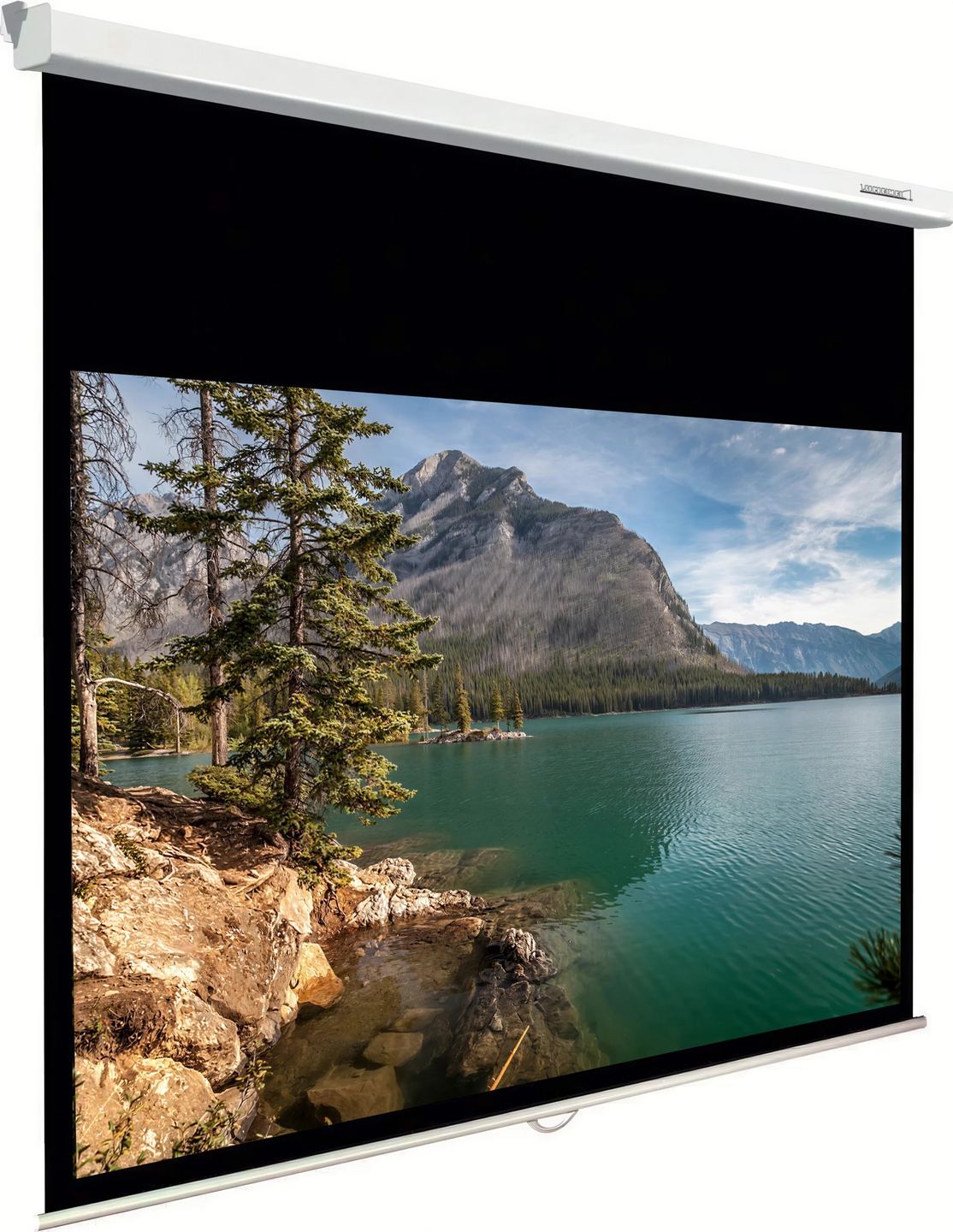
Unrolling a real screen instead of aiming at a painted wall clearly changes the result of a video projector. Lumene’s Plazza HD 200 C meets this need without complication: a manual screen 203 centimeters wide, a discreet white casing, and a locking system that requires no electrical power. The 16:9 format and generous image width make it well suited to films and series, in a living room as well as in a dedicated room.
The projection surface is a matte white screen, Lumene’s in-house HD screen material. Its structure layers several materials: a reflective face, two PVC thicknesses, and a fiberglass layer that ensures mechanical stability. The gain is 1.0, meaning the screen reflects the projector’s light without amplifying or reducing it. This choice preserves neutral colors and limits hot spots in the center of the image, that visible flaw when an overly reflective screen concentrates the light.
The viewing angle reaches 160 degrees. A viewer seated on the side of the sofa therefore sees an image close to the one perceived from the central axis, without a marked drop in brightness. Black borders frame the image: 50 millimeters on the sides, 60 millimeters at the bottom. They enhance perceived contrast: the eye reads the blacks in a scene better when they meet a dark frame. The back of the screen is black and opaque, allowing installation in front of a window without outside light passing through the surface.
Three treatments protect the screen over time. The first, anti-yellowing, preserves the whiteness of the surface, on which color accuracy depends. Then comes the anti-dust treatment, useful for a screen that is often rolled up and unrolled and would otherwise end up getting dirty. Finally, the anti-warp treatment addresses the weak point of roll-up screens: the screen can slightly ripple over time and with temperature variations, and this treatment limits the phenomenon.
The casing measures 225 centimeters in length with a section of 8 by 8 centimeters. This slimness matters at installation time: the housing remains discreet on the ceiling as well as high on a wall, and does not impose a bulky volume in a living space. Lumene makes it in white lacquered steel, with a slightly sparkled finish that sets it apart from the usual smooth housings. Inside, a sturdy spring retracts the screen and is designed for good mechanism longevity.
Unrolling is done by hand. An automatic locking system holds the screen in the desired position, without remote control or electrical connection. To raise the screen, a slight pull releases the catch and the spring returns the screen into the casing. This operation has a trade-off: unlike a motorized screen, each session begins and ends with a manual action, and spring-assisted retraction is fairly brisk. In its manual range, Lumene reserves damped retraction for the Capitol HD model.
The screen lowers with a 500-millimeter extra drop, the upper black strip located between the casing and the start of the image. This reserve adjusts the image height: it lowers the projected area to align it with viewers’ eye level, or to compensate for a casing installed very high. The automatic locking also allows intermediate positions if the full diagonal is not needed. The screen weighs 10.5 kilograms bare.
The Plazza HD 200 C can be installed in three ways: wall-mounted, ceiling-mounted, or suspended. Installation does not use quick clips; it requires screwing the brackets in place, an operation that is simple in principle but best done by two people when the screen is being fitted to the ceiling, given its weight and length. Once installed, the screen provides an image 203 centimeters wide by 115 high, for a diagonal of 234 centimeters, about 92 inches.
On the projector side, the screen accepts standard-throw or long-throw models, as well as short-throw projectors. Ultra-short-throw projectors, however, are not suitable. Placed just below the screen, this type of projector lights the surface at a very shallow angle: the slightest flatness defect in a roll-up screen then creates visible distortion. These projectors require a perfectly tensioned surface and often dedicated optical treatment, absent from the Plazza HD 200 C.
The 16:9 format matches the framing of recent films, series, and streaming content. The Plazza HD range exists in several widths; the 200 C version occupies a middle position, equally comfortable in an average-sized living room or in a small dedicated room.
For an image 203 centimeters wide, a viewing distance of 2.5 to 3.5 meters suits the majority of installations. Below that, viewers perceive the image structure with the less defined projectors. Farther away, the image loses presence. The usual rule is to aim for between one and one and a half times the width of the screen. Seat height and projector position also matter in the final adjustment.
Yes. The commercial name of the screen refers to its generation at Lumene, not to a resolution limit. A white matte projection screen has no intrinsic definition of its own: it reproduces what the projector sends. The sharpness of a 4K image depends on the projector, the optics, and the source, not on the screen. The 1.0 gain and matte surface of the Plazza HD 200 C are suitable for HD projectors as well as 4K models.
Nothing prevents it, and the anti-dust and anti-yellowing treatments help the screen age properly. The anti-warp treatment limits rippling without eliminating it completely: a screen left tensioned for a very long time may show slight marking. For occasional use, rolling the screen back up between sessions protects it from dust and direct light. For daily use in a dedicated room, leaving it in place remains a reasonable option.
A light dusting is enough in most cases, using a soft, dry cloth passed over it without pressing. In case of a mark, a barely damp microfiber cloth, followed by immediate drying, avoids halos. Solvents, alcohol, and abrasive products should be avoided: they attack the surface treatments and the reflective layer. It is better to deal with dirt quickly than to rub at a set-in stain.
The casing should be installed high enough so that the bottom of the image reaches eye level once the screen is unrolled. The 500-millimeter extra drop provides some leeway: the upper black strip lowers the image without requiring the casing to be placed too low. In practice, seat height, image size, and projector angle are taken into account. Marking out with a pencil before drilling, by simulating the image position, avoids unpleasant surprises.
The 200 C designates the 16:9 version, the format of current films and series. Lumene also offers the Plazza HD range in 4:3 format, identified by the letter V instead of C, for presentation use or older content. Both versions share the same screen material and the same type of casing. The choice of format depends on the projected content: 16:9 remains the most consistent for home cinema and television use.
Dominique
Unboxed, great deal
Comment from 12 December 2025 — Experience from 13 June 2024
Abdeslam
Perfect, I recommend it.
Comment from 8 June 2020 — Experience from 18 May 2020