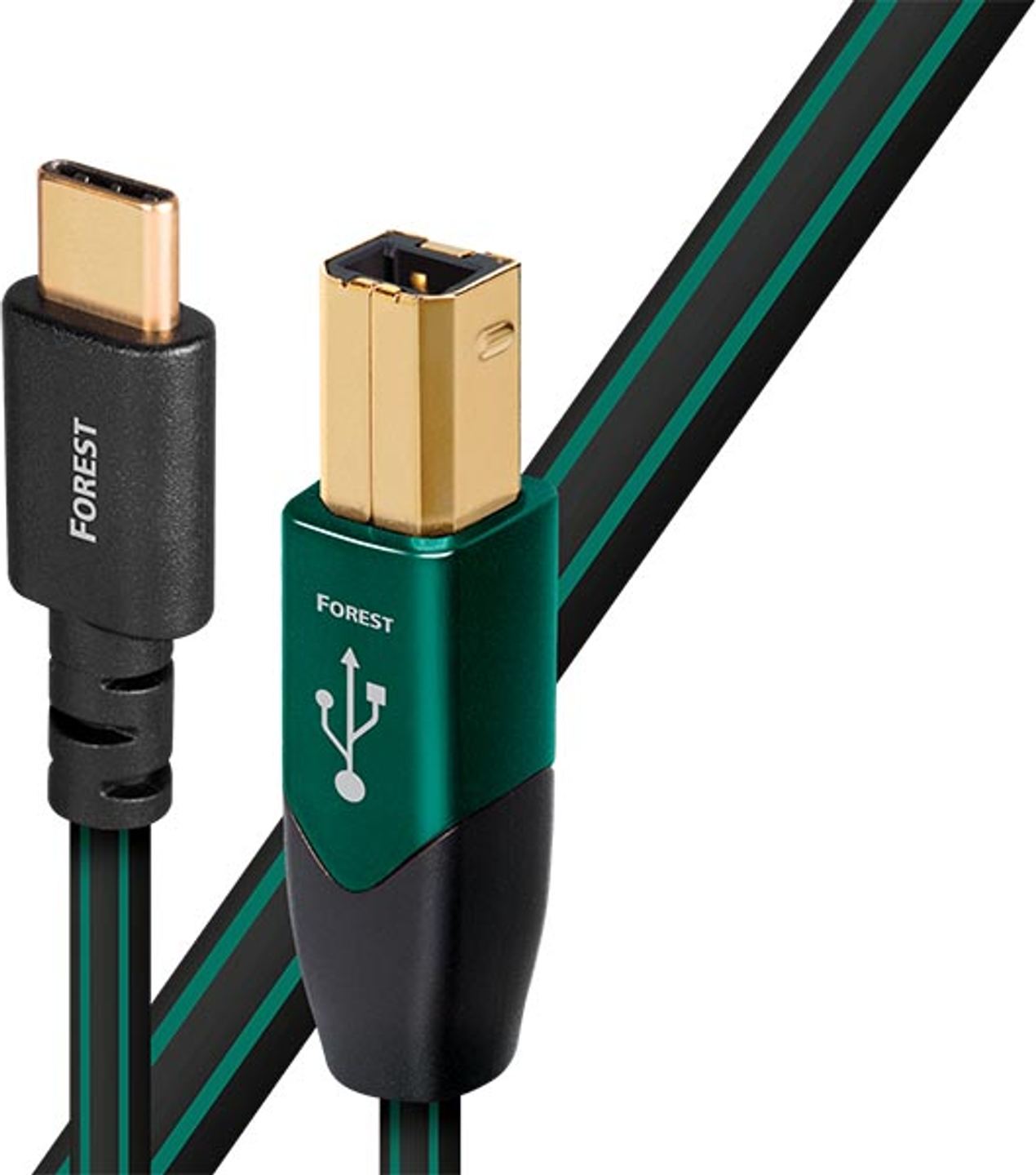
Audioquest Forest USB B to C 0.75m
Overview
An audio USB cable that stands apart from the generic cords supplied with devices, without reaching the price levels of high-end models. This Forest sits on the second rung of the AudioQuest range, just above the Pearl, and incorporates technologies developed by the Californian manufacturer for its more expensive cables, in a version optimized for value for money.
Semi-solid conductors with silver-plated surface
What makes this cable special is its Long-Grain Copper (LGC) conductors coated with a thin layer of silver accounting for 0.5% of the composition. High-frequency USB signals travel almost exclusively along the surface of the conductor: AudioQuest leverages this physical phenomenon to deliver transmission quality close to that of a full-silver cable, without incurring the cost. This semi-solid concentric approach also limits interactions between strands, a source of dynamic distortion and jitter in conventional multi-strand cables.
The choice of LGC copper is no accident. This material has fewer imperfections than standard OFC copper, resulting in higher conductivity and reduced distortion. AudioQuest uses this same copper in several of its more expensive analog cables.
Insulation and geometry stabilized by nitrogen-injected foam
The Hard-Cell Foam insulation surrounding the conductors differs from conventional materials in one fundamental respect: it is injected with nitrogen to create air pockets. Since nitrogen, like air, does not absorb energy, it also does not release any to or from the conductor, which reduces distortion. The rigidity of this foam maintains a stable conductor geometry along the entire length of the cable, ensuring constant impedance.
Conventional insulating materials store part of the electrical energy before releasing it, creating a form of temporal distortion. AudioQuest’s approach aims to minimize this phenomenon, which is often overlooked in digital cables.
Shielding that also protects the ground
The Metal-Layer Noise-Dissipation system goes beyond simple 100% shielding. Traditional shielding systems absorb and then drain noise and RF energy to the component’s ground, modulating and distorting the reference ground plane, which causes signal distortion. The Noise-Dissipation system “shields the shield,” absorbing and reflecting most of this unwanted energy before it reaches the layer connected to ground.
This protection is particularly relevant in the electromagnetically polluted environment of a computer or an audio system with multiple digital devices. RF interference picked up by an unshielded cable can affect the converter’s ground reference, degrading conversion quality even if the binary data is transmitted intact.
Directionality and installation
The Forest connectors carry arrows indicating the recommended direction of connection. All stretched metal strands or conductors have a non-symmetrical, therefore directional, grain structure. AudioQuest controls the resulting RF impedance variation so that noise is drained away from the areas where it would cause distortion.
This orientation is determined by listening tests on each batch of conductors, a process that may be surprising but which the manufacturer has followed for decades. The arrows indicate not only the direction that optimizes the metal’s directionality, but also the asymmetrical attachment of the shielding and ground to optimize overall system performance. In practice, the USB-C end is connected to the source side (computer, tablet, compatible smartphone) and the USB-B end to the receiver side (DAC, amplifier with USB input).
Applications and compatibility
The USB-B to USB-C termination meets a specific need: connecting mobile devices or recent computers to DACs and amplifiers equipped with the still-very-common square USB-B input. The USB-C connector is found on many recent devices: MacBook, Chromebook, iPad, Pixel, Galaxy. This cable therefore allows you to use the digital audio output of these devices with an external converter.
The Forest carries data up to 480 Mbps in high-speed USB 2.0, a rate more than sufficient for high-resolution audio including the most demanding formats. Isolating noise and jitter in the digital audio path between DAC and computer is critical for audio performance. The connection between computers and DACs is one of the most delicate applications in high-end audio.
Technical specifications
Connectivity and performance
- Compatibility: USB 3.0
- Supported USB version: USB 2.0 High Speed
- Data rate: up to 480 Mbit/s
- Supply voltage: 5 V
- Power delivery: not supported
Construction and materials
- Conductors: 0.5% pure silver
- Jacket: PVC with black and green stripes
- Insulation: hard-cell foam injected with nitrogen
- Shielding: 100%
Advanced technologies
0.5% concentric semi-solid silver conductors
- Significant reduction of strand-interaction-related distortion
- Reduction of jitter
- Optimal propagation of high-frequency signals thanks to the silver surface
- Performance close to a 100% silver cable at a lower cost
- Ideal for high-performance USB audio/video
Metal-layer noise dissipation
- 100% shielding for maximum protection
- Effective reduction of radio-frequency (RF) interference
- Protection of the ground reference to limit signal distortion
- System that absorbs and reflects parasitic energy before it reaches sensitive layers
Nitrogen-injected hard-cell foam insulation
- Maintains precise geometry of the signal pairs
- Nitrogen reduces energy absorption and release, minimizing distortion
- Rigid material ensuring impedance stability along the entire length of the cable
Direction-controlled conductors
- Takes into account the directional structure of the metal grains
- Optimized orientation to drain RF noise away from sensitive areas
- Directional markings on the connectors for correct installation
- Essential contribution to the overall noise dissipation system
Frequently Asked Questions
Is this cable suitable for charging a device?
The Forest carries the standard 5V USB power but does not support the Power Delivery protocol. It can provide basic power to a USB-powered portable DAC, but is not designed as a fast-charging cable for smartphones or tablets.
Can I use this cable with an iPhone 15 or later to a USB-B DAC?
Compatibility depends on the DAC. Some converters require drivers or specific USB Audio Class support. Most recent DACs compatible with USB Audio Class 2.0 will work, but it is advisable to check the DAC’s specifications regarding iOS/iPadOS compatibility.
What’s the difference compared with the Cinnamon model above it in the range?
The Cinnamon uses conductors with 1.25% silver versus 0.5% for the Forest. It also features a braided jacket instead of PVC. Moving up to the Cinnamon brings a more noticeable improvement in detail retrieval and in the width and depth of the soundstage.
What length should I choose?
AudioQuest offers this model in 0.75 m and 1.5 m. For USB digital audio, shorter lengths are generally preferable to minimize the risk of interference. Choose the shortest length compatible with your setup.
Is the Forest compatible with high-resolution audio formats (24-bit/192 kHz, DSD)?
Yes. The 480 Mbps high-speed USB 2.0 bandwidth comfortably exceeds the needs of high-resolution audio, including native DSD. Transmission quality will then depend on the capabilities of the receiving DAC.
- Eco-contribution included in the sale price.
- Manufacturer reference: USBFOR20.75CB
- GTIN / EAN: 92592009899