Christian
Perfect for my Dolby Atmos speakers
Comment from December 01, 2025 — Experience from September 13, 2025
Automatically translated — Show original (French)
Parfait pour mes enceintes Dolby Atmos
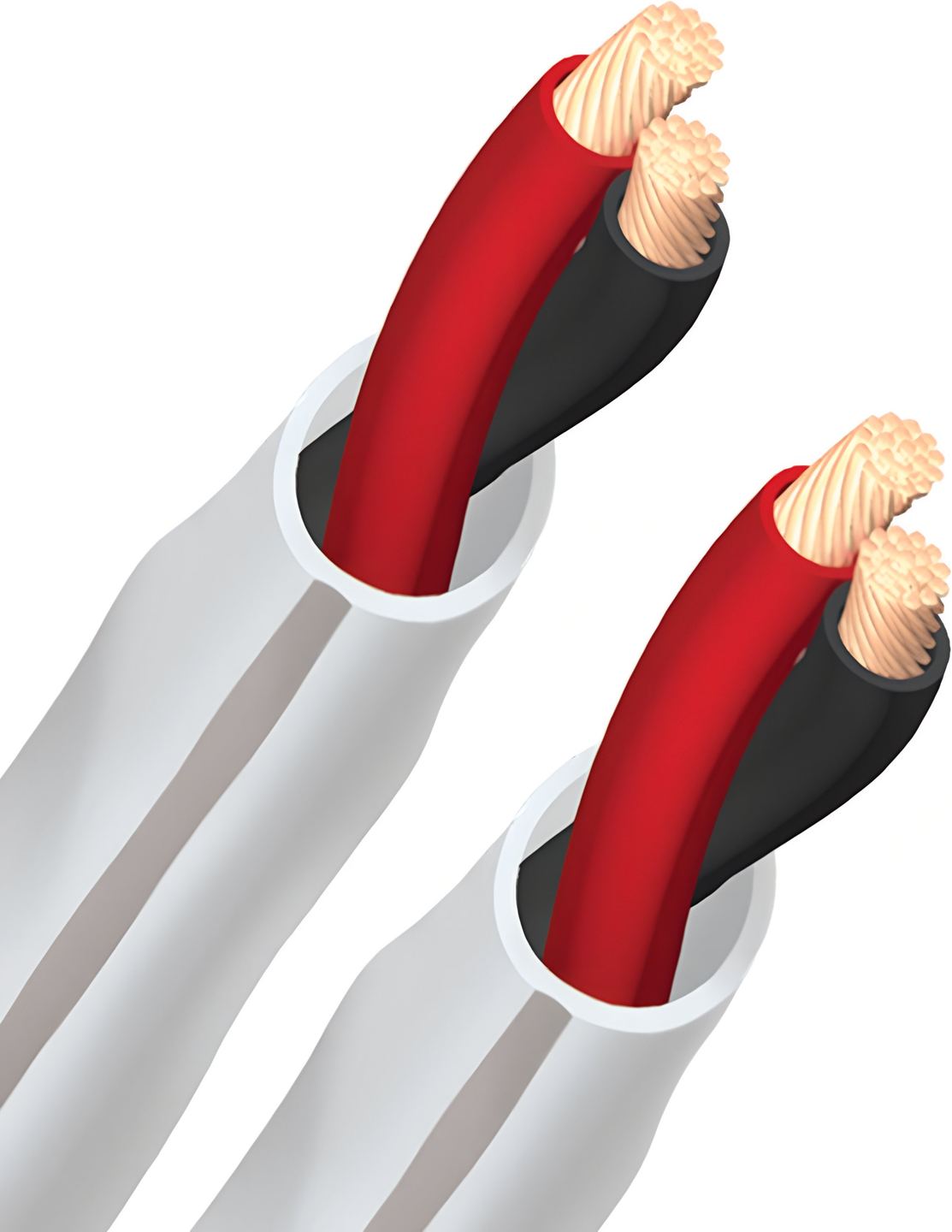
The AudioQuest SLiP-DB 14/2 makes in-wall speaker cable installation easier thanks to a design that’s as smart as it is efficient. Sold by the meter, this cable combines the American manufacturer’s acoustic expertise with a structure engineered for smooth routing through walls, conduits, and tight spaces.
With dual CL3/FT4 certification, the SLiP-DB 14/2 is also designed for direct burial, meeting the strictest standards for residential or commercial installation. Its flexibility, durability, and transmission quality make it an ideal solution for integration projects that refuse to compromise on sound performance.
The SLiP-DB 14/2 features a semi-solid concentric conductor architecture made from Long-Grain Copper (LGC). This AudioQuest technology uses elongated copper grains instead of the standard granular structure, significantly reducing the number of grain boundaries. In a traditional stranded cable, each strand constantly shifts position, creating electrical and magnetic interactions that generate distortion. The semi-solid concentric construction keeps the strands in fixed positions, eliminating these unwanted interactions.
The 2 × 2.08 mm² cross-section provides optimal conductance for most speakers, from compact bookshelf models to high-power floorstanders. Each conductor’s 19 strands are precisely and tightly arranged, ensuring uniform signal transfer. This concentric layout delivers the benefits of a solid conductor while retaining the flexibility needed for installation.
The EasySLiP Minimalist outer jacket is the major innovation of this series. AudioQuest has developed a PVC material with a friction coefficient significantly lower than standard cables and even previous FLX models. This ultra-slick surface makes pulling the cable through conduits, partitions, and ducts a smooth operation, even over long and complex runs.
The sequential metric marking, visible from 0.3 to 152.4 meters, counts down from the outside of the spool. This clever approach allows installers to instantly know the remaining length without calculations, optimizing material management and reducing waste. The white markings on the jacket also make identification and polarity connection easier.
The SLiP-DB 14/2’s low-inductance spiral geometry minimizes loss of sonic focus, a common issue over long distances. Parasitic inductance, which makes sound blurry and less defined, is greatly reduced thanks to this helical conductor arrangement. This feature allows the cable to maintain its performance over significant lengths, up to the maximum limit of 152 meters.
LGC copper contains fewer oxides, impurities, and grain boundaries than standard OFHC copper. These properties result in smoother, clearer transmission, especially noticeable in the midrange and treble. The semi-solid construction eliminates micro-vibrations between strands that can color the signal, preserving the naturalness and precision of the musical message.
Dual CL3/FT4 certification allows installation in the walls of residential and commercial buildings in compliance with national electrical codes. The CL3 standard ensures fire resistance and the absence of toxic gas emissions in case of fire. FT4 certification attests to resistance against vertical flame spread.
The direct burial capability sets the SLiP-DB apart from standard models. This feature allows underground installation without additional protective conduit, opening up possibilities for outdoor setups and runs between buildings. The PVC jacket resists moisture, temperature fluctuations, and the mechanical stresses of soil.
All SLiP-DB 14/2 conductors are tested for RF noise directionality. This attention to detail, a hallmark of AudioQuest, optimizes signal flow for maximum performance. While subtle, this orientation contributes to overall system clarity, especially noticeable in complex installations with many electronic sources.
The concentric construction also acts as a natural shield, reducing sensitivity to electromagnetic interference from nearby equipment. This property is especially valuable in modern setups where speaker cables run alongside electrical networks, LED lighting, and Wi-Fi systems.
The SLiP-DB features an even slicker jacket than FLX models, making installation even easier. It also adds direct burial certification, allowing underground installation without extra protection. The internal construction remains similar, with the same semi-solid concentric LGC conductors.
Measure the actual route, taking into account required paths, obstacles, and bends. Add 10% as a safety margin for connections and unforeseen issues. The cable’s metric marking makes management easy: the decreasing numbers indicate the remaining length on the spool.
AudioQuest tests the directionality of all its conductors to optimize RF noise behavior. While the impact is subtle, it’s recommended to follow the indicated direction for optimal performance, especially in high-end hi-fi installations.
The 2 × 2.08 mm² cross-section easily supports amplifiers of several hundred watts, even over long distances. For very high-power applications (over 500W) or runs longer than 50 meters, consider the SLiP-DB 12/2 model with a larger cross-section.
This two-conductor model does not allow direct bi-wiring. For this application, choose the SLiP-DB 14/4 with four conductors, or use two separate runs of SLiP-DB 14/2—one for bass, one for mid/high frequencies.
The jacket meets CL3/FT4 standards, which require fire and high-temperature resistance. It withstands typical building temperature variations without degradation. However, avoid direct contact with intense heat sources such as heating ducts.
Christian
Perfect for my Dolby Atmos speakers
Comment from December 01, 2025 — Experience from September 13, 2025
Raoul
Extremely twisted, otherwise fine for the price range
Comment from July 26, 2025 — Experience from May 01, 2025
Daniel
Very happy with my purchase combined with an X-A160EVO power amplifier from the same brand. My only comment concerns the function selection button, which is not always very practical on the device, but this is largely compensated for and improved by using the remote control.
Comment from January 31, 2025 — Experience from September 26, 2024