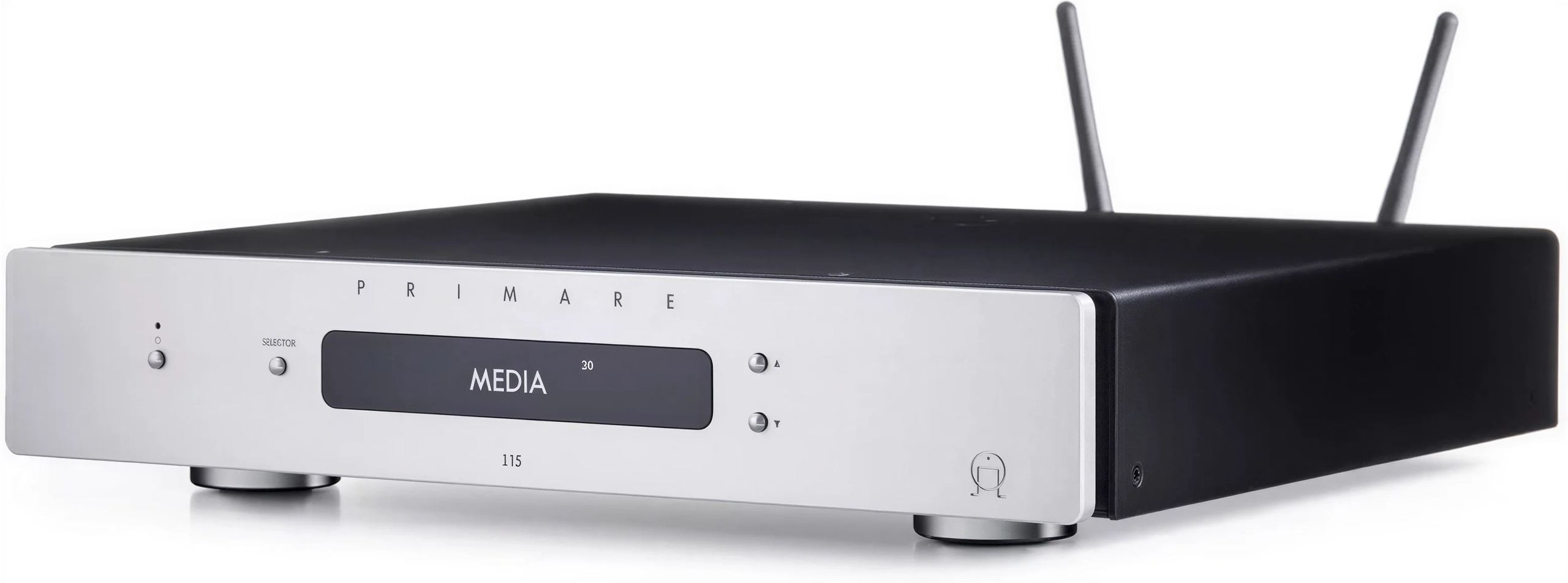
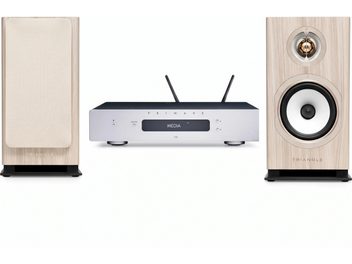
Primare I15 Prisma MK2: a compact network integrated amplifier
When a fire destroyed a Japanese AKM foundry in late 2020, the entire audio industry began looking for replacement DACs. Primare took the opportunity to fit an ESS DAC instead, without changing anything else on its smallest network integrated amplifier. The result is a compact enclosure combining amplification, digital conversion and network playback, fitting where a full-width component would not.
A Hypex module instead of the in-house UFPD
The larger integrated amplifiers in the range, the I25 and I35, feature the in-house Class D module, the UFPD 2, produced in small batches. For the I15 Prisma MK2, the manufacturer chose a mass-produced Hypex UcD102 module. The logic is simple: this large-scale production lowers costs while retaining the brand’s sonic character.
Class D is switching amplification. It generates little heat and consumes little power, less than 25 watts in operation, and its heat sink is fitted directly onto the module board, as close as possible to the speaker terminals. The signal path remains short.
In terms of power, the I15 Prisma MK2 delivers 2 × 60 watts into 8 ohms and 2 × 100 watts into 4 ohms. The fact that power increases as impedance drops indicates a good current reserve, enough to drive most speakers despite its compact size. The switching power supply feeding the module was chosen to respond quickly to current demands, with stable voltage and capacitive reserve for peaks.
ESS conversion and digital inputs
The chip handling digital conversion is an ESS ES9028Q2M DAC, a 32-bit stereo model. It replaced the AKM component in the first version, without changing the other specifications or performance. It handles PCM files up to 384 kHz and DSD up to 256 (11.2 MHz), covering the main high-resolution formats on the market.
Digital inputs include three optical Toslink sockets, one optical input on a 3.5 mm mini-jack and one RCA coaxial input, all limited to 192 kHz. The rear USB-B port accepts a computer and supports up to 384 kHz. A front USB-A port reads a USB drive or hard drive up to 192 kHz and DSD 128. A coaxial digital output completes the package: it mirrors the signal from a digital source, or converts an analog source to either 48 or 96 kHz.
Prisma, networking and streaming
The entire network section is based on Prisma, Primare’s connectivity and control platform. It manages playback from local storage as well as online services, via wired or Wi-Fi connection, along with multiroom operation between several Prisma devices.
The most open access point is built-in Chromecast: through the Google Home app, it provides access to hundreds of services, with quality depending solely on what each service offers, up to 24-bit/96 kHz with Tidal HiFi or Qobuz. AirPlay 2 streams from an Apple device up to CD quality, Spotify Connect reaches 320 kbit/s, and Bluetooth, with compression, is useful for occasional listening. The I15 Prisma MK2 is also Roon Ready certified for those who manage their library with Roon.
The Prisma app serves as a complete remote control: input selection, playback, volume adjustment, artist or album searches in stored files, information about the current track, playlists. Two Ethernet ports are fitted on the rear, allowing the unit to act as a network switch for connecting another wired component, while Wi-Fi operates on both the 2.4 and 5 GHz bands.
Integrating into an existing system
In analog mode, the I15 Prisma MK2 accepts one source through an RCA line-level input and another through a 3.5 mm mini-jack. There is no built-in phono preamp: a turntable therefore requires an external preamp or a model with one built in.
The RCA preamp output enables two uses. It feeds an active subwoofer, whose own low-pass filter then handles the crossover, since this output remains full-range. It can also drive a separate power amplifier should you later wish to separate preamplification and amplification.
Each input can be adjusted independently. When set to fixed gain, it lets the signal pass through the preamplification stage without level adjustment: this is home theater bypass mode. The front left and right channels of a multichannel system then pass through the I15 Prisma MK2, while the audio-video processor retains control of the overall volume. You can also rename and hide unused inputs, enable automatic source detection, and connect the unit to a home automation system via the RS-232 port and 12-volt trigger.
A compact enclosure with Swedish design
The format is the first thing that sets the I15 Prisma MK2 apart. Its enclosure is only 350 mm wide, compared with around 430 mm for a full-width component, and measures 73 mm high, 329 mm deep and weighs 6.4 kg. This reduced footprint opens up locations inaccessible to conventional electronics.
On the front panel, the OLED display is the same as that of the larger I35; sourced from the automotive industry, it is built to last and remains easy to read, with brightness adjustment and display sleep mode. Input selection is handled by relays rather than the usual CMOS switches, for better channel isolation and less noise, while volume control relies on a balanced-mode circuit selected for channel balance and low-level performance, where many small integrated amplifiers lose definition.
Power consumption remains low: less than 25 watts during listening, less than 0.5 watt in Eco standby mode, with the other standby mode retaining automatic wake-up on signal. The I15 Prisma MK2 is available in black and in a light, silver titanium finish, as on this version. Based in Limhamn near Malmö, Primare cultivates the Scandinavian spirit of “lagom”: neither too much nor too little, each element in its right measure.