Apollon
Incredible sound, super value for money!
Comment from April 20, 2026 — Experience from March 05, 2026
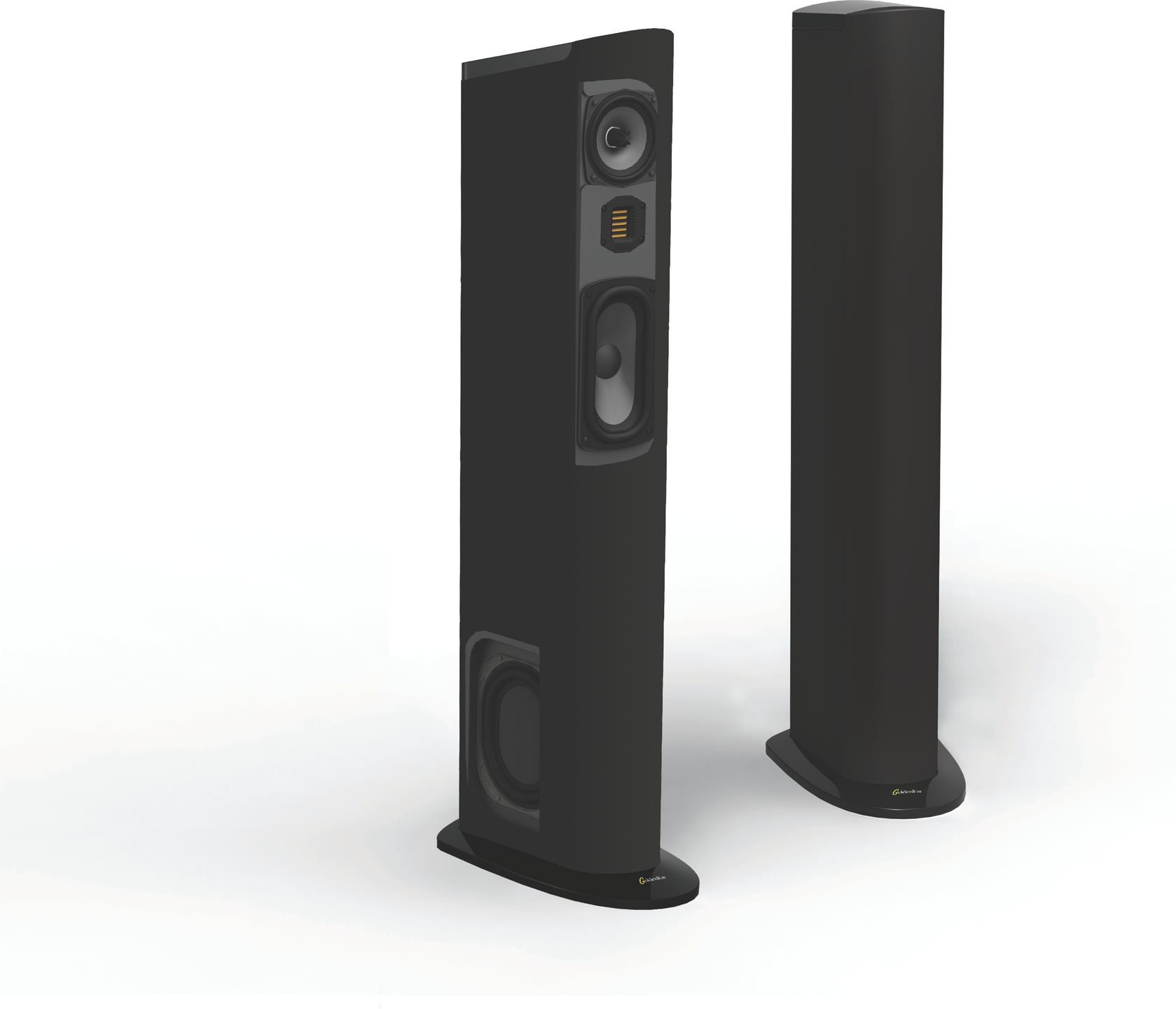
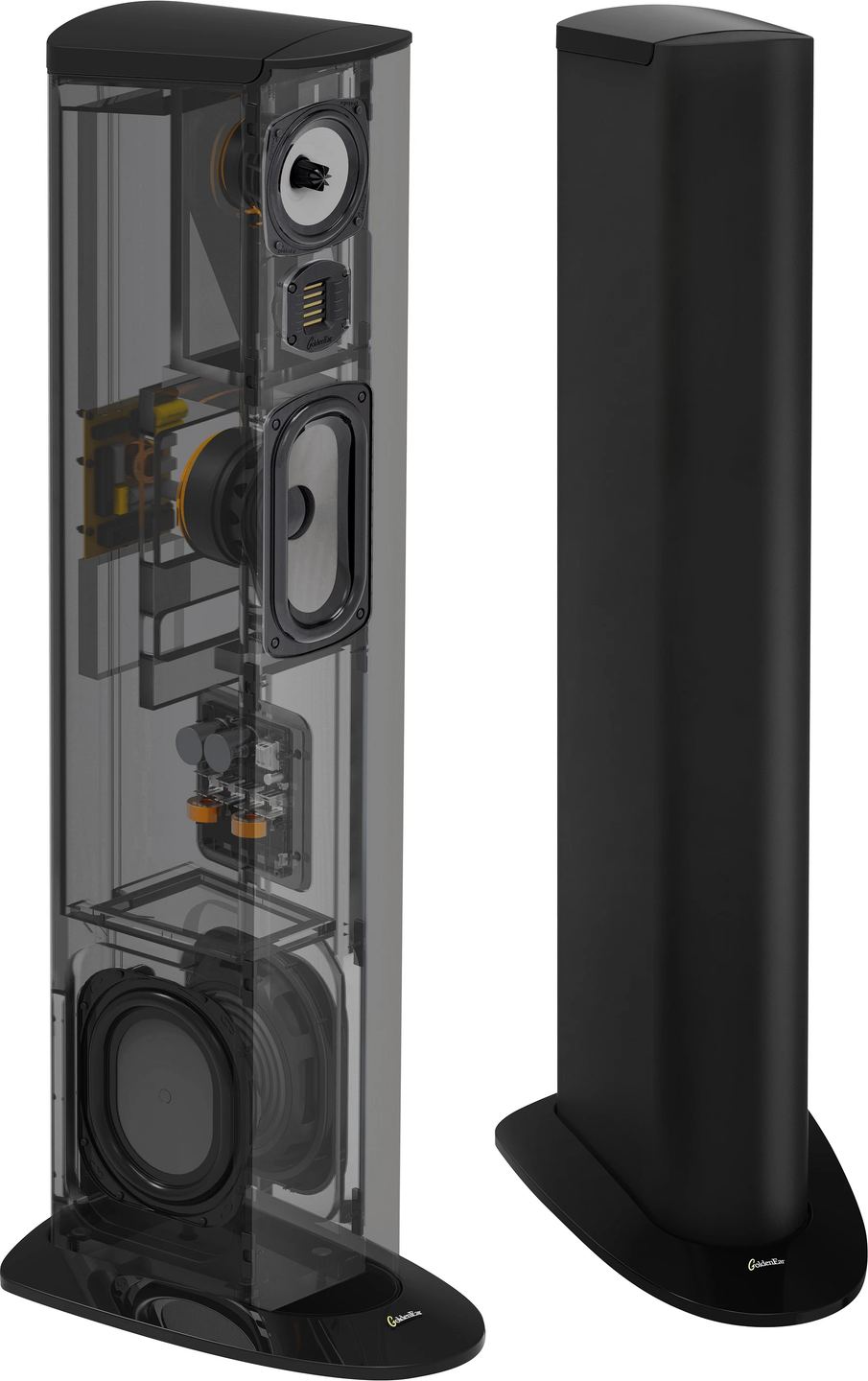

The GoldenEar Triton Three+ are floorstanding speakers that combine a passive high-mid section with an integrated subwoofer powered by an 800-watt amplifier. This hybrid configuration, developed from several decades of acoustic experience, positions these speakers between traditional loudspeakers and active systems.
This third generation incorporates technologies developed for the Triton One. Every component has been revised: a new polypropylene cone for the mid-bass, modified surround, reinforced voice coil, and a redesigned crossover featuring polypropylene capacitors. The DSP processor managing the bass section has been reprogrammed to improve linearity and extension in the low frequencies.
The Triton Three+ adopt a particularly sophisticated three-way configuration. The HVFR (High-Velocity Folded Ribbon) tweeter sits at the center of the front panel, vertically flanked by the 10 cm mid-bass driver and the 12.7 × 22.8 cm rectangular active woofer. This vertical arrangement optimizes temporal coherence and minimizes interference between drivers.
The MDF cabinet features a distinctive trapezoidal shape—133 mm wide at the front, widening towards the rear—which serves several acoustic purposes. This geometry eliminates internal standing waves while reducing diffraction at the edges. The rearward tilt of the front panel temporally aligns the acoustic centers of the different drivers while directing sound toward the typical listening position. An acoustically transparent sock covers the entire cabinet except for the glossy black lacquered top cap, which slopes gently toward the back.
The two planar passive radiators, 15 × 20 cm, mounted on the sides near the floor, operate in opposite phase. This “inertially balanced” configuration cancels out unwanted vibrations that might otherwise be transmitted to the cabinet. Strategically positioned to exploit floor coupling, these radiators significantly extend the response in the lowest bass while increasing the overall output of the low-frequency section.
The black lacquered MDF base, essential for the stability of this slender 1118 mm tall column, must be assembled using the four supplied bolts. GoldenEar provides both decoupling spikes for hard floors and rubber tips for wood or tile, allowing you to adapt the mechanical interface to your flooring type.
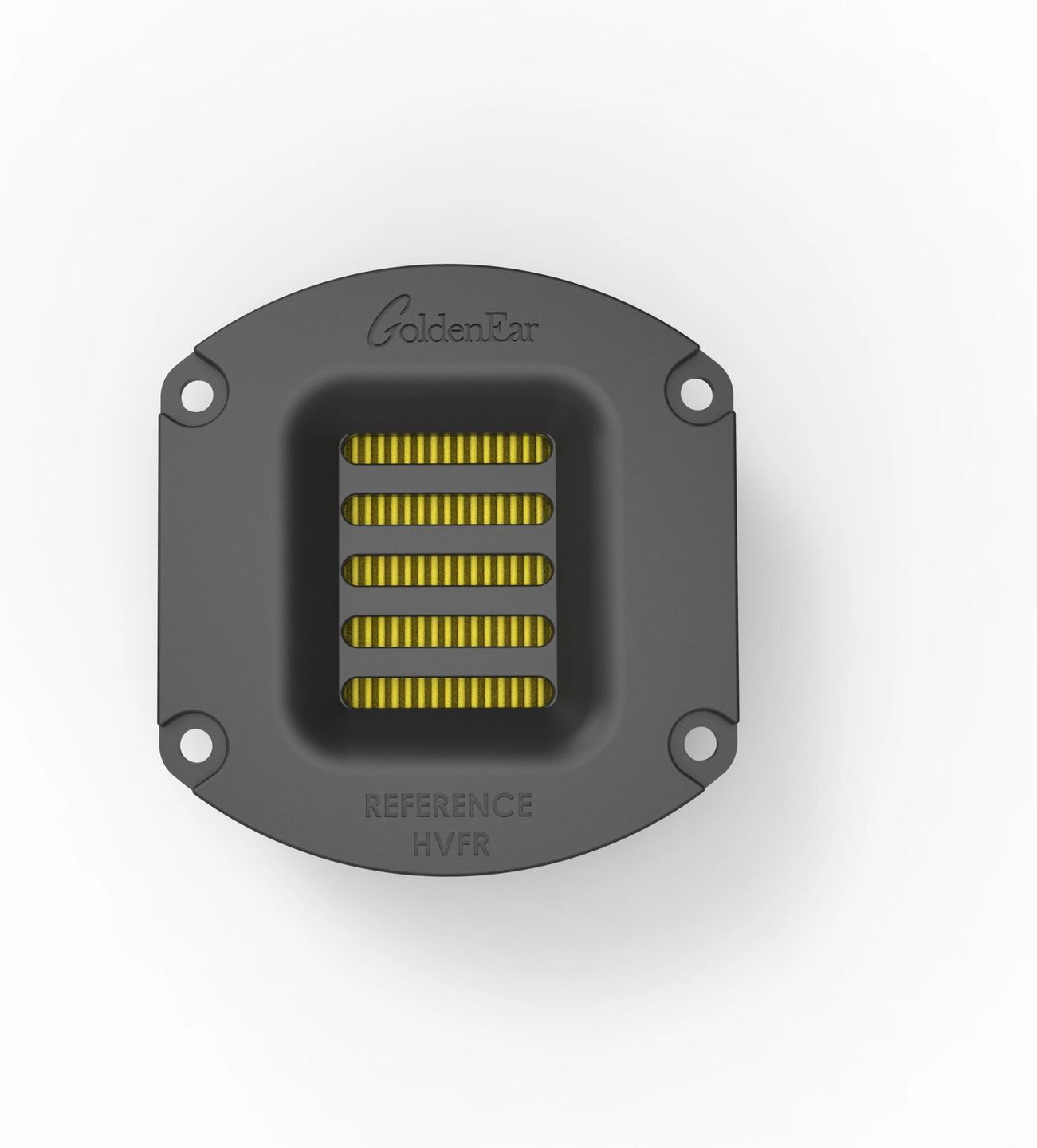
The high-velocity folded ribbon tweeter represents GoldenEar’s interpretation of the air motion transformer developed by Oskar Heil in the 1970s. Unlike conventional dome tweeters that move air by piston action, the HVFR compresses and expands air accordion-style thanks to its pleated Kapton high-temperature film diaphragm.
This ultra-lightweight conductive membrane, folded about twenty times on itself, sits within the intense magnetic field generated by high-power neodymium magnets. When the audio signal passes through the membrane, it contracts and expands laterally, expelling and drawing in air at a velocity greater than that of the diaphragm itself. This multiplication of air speed, combined with the extended radiating surface of the unfolded diaphragm, enables a frequency response extending up to 35 kHz.
Horizontal dispersion approaches 180 degrees, creating a particularly wide and stable soundstage. Conversely, vertical dispersion remains more controlled—a sought-after feature in multichannel home theater to minimize ceiling and floor reflections. However, this directivity requires precise positioning: the tweeter axis, located about one meter from the floor, should ideally align with ear height in the listening position.
The 10 cm mid-bass driver features GoldenEar’s exclusive MVPP (Multi-Vaned Phase Plug) waveguide. This device, composed of multiple radial vents molded into the chassis, controls the propagation of waves emitted from the rear of the cone. By managing these internal reflections, the MVPP extends the driver’s frequency response while maintaining minimal distortion up to the crossover frequencies.
The cone adopts a specifically calculated profile and uses a proprietary polypropylene formulation developed at the Arnprior research center. This combination ensures rigidity and lightness, allowing for rapid acceleration without modal deformation within the useful bandwidth. The high-density magnetic system, inherited from the Triton One.R, generates an especially intense field in the gap, ensuring precise control of the high-temperature aluminum voice coil.
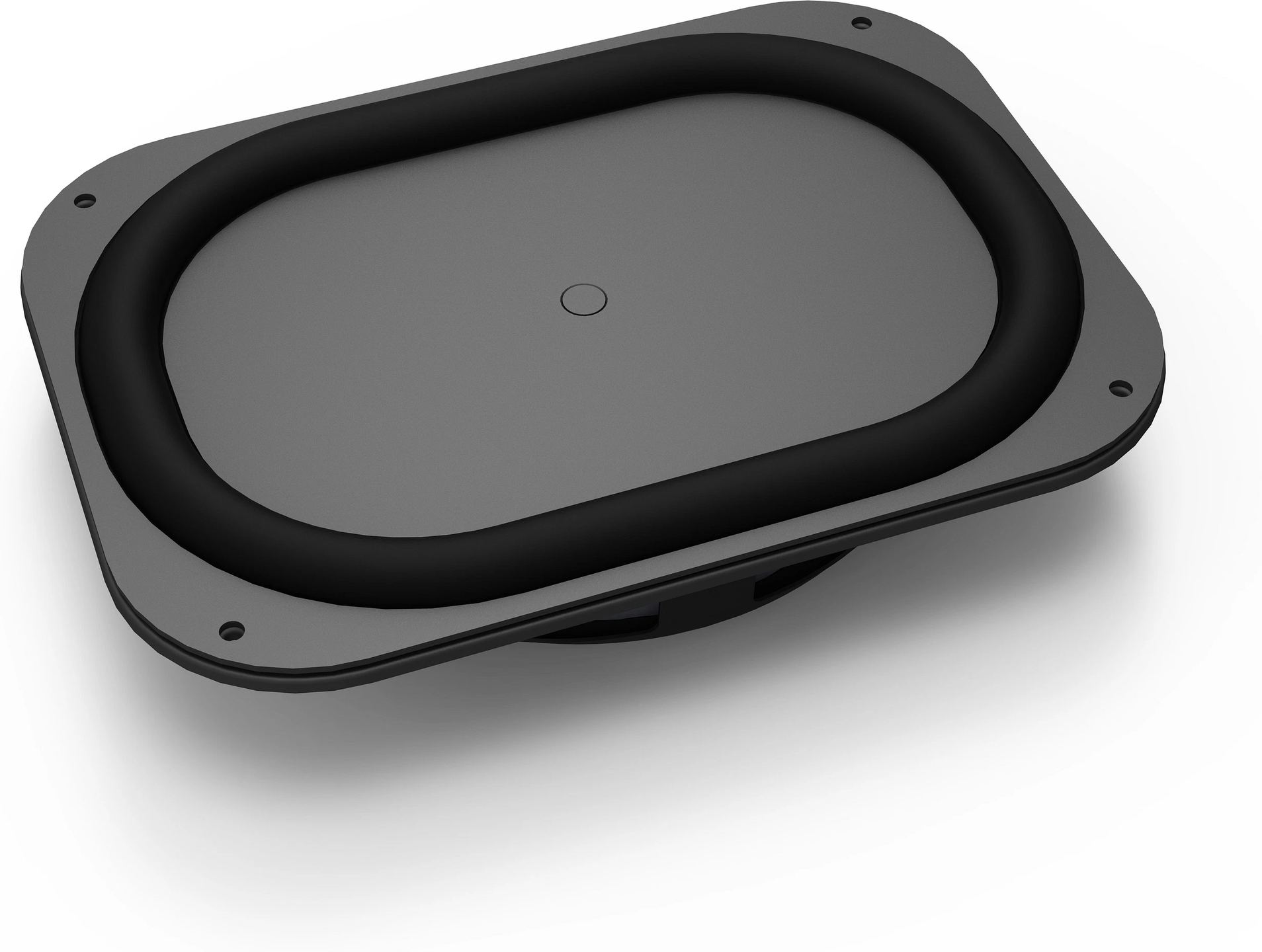
The 12.7 × 22.8 cm rectangular active woofer utilizes a “quadratic” geometry optimizing the surface-to-excursion ratio. Its composite diaphragm combines fiberglass and Nomex to provide both rigidity and internal damping. The exceptionally long linear excursion, enabled by a sophisticated progressive suspension, allows for high sound pressure levels without dynamic compression. The 38 mm diameter voice coil, wound on a high-temperature aluminum former, efficiently dissipates heat even during extended fortissimo passages.
The 800-watt ForceField digital Class D amplifier integrated into each speaker powers only the bass section. This considerable power, coupled with 56-bit DSP processing at 192 kHz, allows total control over frequency and phase response in the bass register. The processor analyzes the incoming signal in real time and applies psychoacoustic corrections to extend the perception of bass below the system’s physical cutoff frequency.
The rear panel features, in addition to the IEC power socket, an RCA input for receiving the LFE signal from a home theater processor. This flexibility allows the Triton Three+ to be used both in pure stereo and multichannel configurations. The subwoofer level potentiometer allows precise tonal balance adjustment according to room acoustics and personal preferences.
Thermal management of the amplifier is achieved by natural convection via the integrated heatsink. The absence of a fan ensures perfectly silent operation, an essential criterion for a speaker intended for high-fidelity home systems. Protection circuits continuously monitor temperature, current, and voltage to prevent any damage in case of overload.
The evolution from the original 2012 Triton Three illustrates GoldenEar’s philosophy of continuous improvement. While the external dimensions and general configuration remain identical, the internal modifications radically transform performance. The new polypropylene mid-bass cone replaces the previous formulation, delivering increased definition in the vocal range. The more supple and better-damped butyl surround extends the response downward while reducing unwanted resonances.
The passive crossover, completely redesigned with a balanced topology inherited from the Triton One, minimizes parasitic capacitance in the circuits. Polypropylene capacitors replace lower-quality electrolytic components, improving transparency and temporal stability. This phase-linear filtering architecture preserves the temporal relationships between drivers, a key criterion for precise stereo imaging.
The complete reprogramming of the DSP is probably the most significant improvement. The new algorithms, developed during the design of the Triton One, optimize the interface between the active woofer and the passive radiators. The result: greater extension into the sub-bass, better power handling, and more seamless integration with the rest of the spectrum.
The speakers deliver satisfying performance right out of the box, but the drivers and passive components benefit from a stabilization period of about 100 hours of use. During this phase, the suspensions gradually loosen, the bass gains depth and definition, while the mid-high subtly refines.
GoldenEar recommends a range of 15 to 400 watts per channel. The 90 dB sensitivity allows the use of modest amplifiers, even low-power single-ended triode tube amps. However, a quality amplifier of 50 to 150 watts will optimize mid-bass control and overall dynamics, with the integrated subwoofer handling the power needs in the bass.
The rear potentiometer allows fine adjustment according to room acoustics. Start at the midpoint (12 o’clock), then adjust in small increments while listening to familiar recordings. In reverberant rooms or placements near walls, a reduction may be necessary. Large rooms or positions far from walls will benefit from a slight increase.
The side radiators require a minimum clearance of 30 cm from side walls to function properly. Placement too close to side walls can create unwanted resonances and compromise tonal balance. The recommended spacing between speakers ranges from 2 to 3 meters, depending on room width and listening distance.
The Triton Three+ are perfectly suited for rooms up to about 35 m². Beyond that, or for SPL levels regularly exceeding 100 dB, the Triton One or One.R offer better power handling thanks to their multiple midrange drivers and additional woofers. The single midrange driver of the Three+ may reach its dynamic compression limits during complex orchestral passages at very high volume.
The Class D amplifier operates silently without a fan; only a discreet blue LED indicates power-on. Heat dissipation by natural convection keeps the temperature moderate even after several hours of intensive listening. No background noise, hiss, or hum is perceptible during normal operation.
Apollon
Incredible sound, super value for money!
Comment from April 20, 2026 — Experience from March 05, 2026
Pedro
It is a marvel, one of the best I’ve heard. And I’ve been listening to music for 60 years.
Comment from April 02, 2026 — Experience from February 19, 2026
Jean Luc
In my opinion, first of all the quality of the American speaker is definitely there. Second, the sound quality really delivers. And finally, treble and mids: no need to turn up the volume, they’re present right from the start with an Atoll IN80 Signature 2x80 watts amp paired with a BlueSound Node N130. And as for the bass, it really goes very low. For me, the sound quality at this price is exceptional; I don’t think any other speaker brand really stands out in comparison.
Comment from February 05, 2026 — Experience from January 25, 2026