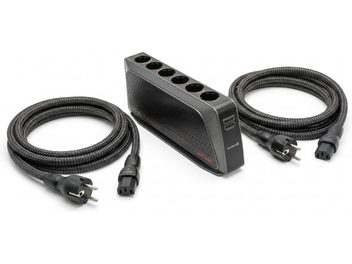
The Audioquest Niagara 3000 is a power conditioner designed to optimize the performance of audio and video systems. This sophisticated device offers a comprehensive solution to eliminate electrical disturbances and provide clean, stable power to your equipment.
A Power Conditioner with Multiple Talents
The Niagara 3000 stands out for its versatility and advanced capabilities. Equipped with a total of 7 outlets, it features 2 high-current outputs for power-hungry amplifiers and 5 linear-filtered outputs for audio and video sources. This configuration allows you to power an entire hi-fi or home theater setup with optimized current.
Audioquest’s patented noise-dissipation system effectively eliminates interference across a wide frequency range, from 20 kHz to 1 GHz, with a reduction of over 24 dB. The linear filtering dynamically adapts to line impedance and load, ensuring optimal performance under all conditions.
Cutting-Edge Technology for Music
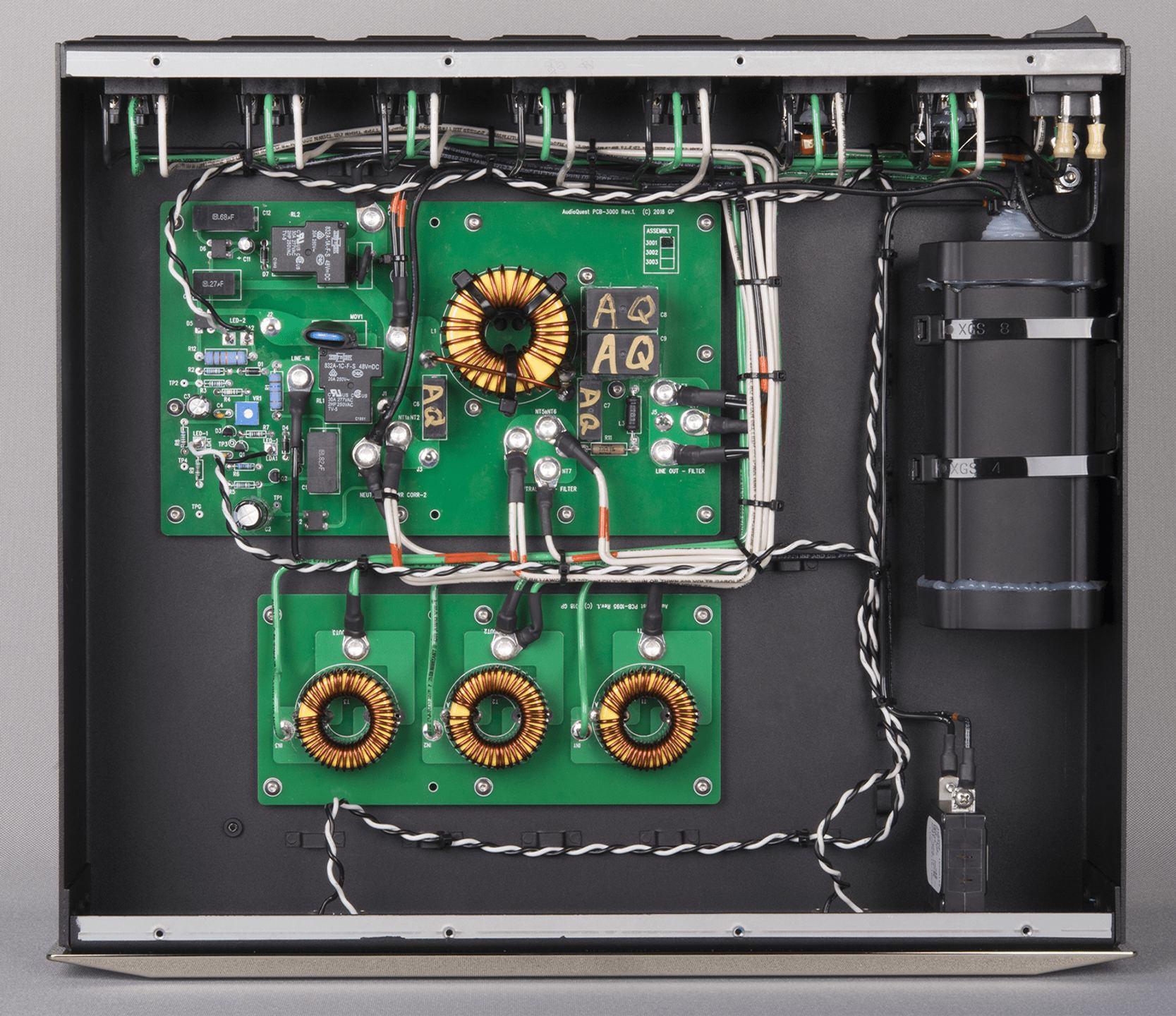
At the heart of the Niagara 3000 is a unique transient power correction circuit. Capable of delivering an instantaneous current peak of over 55 amps, it powers the most demanding amplifiers without signal compression. This power reserve ensures preserved dynamics and intact transients, essential for faithful musical reproduction.
The components used reflect the meticulous attention to design: capacitors developed in collaboration with NASA, beryllium-plated copper wiring with silver finish, and high-tension contact points. Every detail has been carefully considered to optimize conductivity and minimize losses.
Comprehensive Protection for Your Equipment
Beyond its filtering capabilities, the Niagara 3000 offers advanced surge protection. Its non-sacrificial system can handle spikes up to 6000V/3000A without damage, ensuring extended longevity for your devices. An automatic shutdown circuit cuts power in case of abnormally high voltage, resuming operation once conditions normalize.
This enhanced safety is complemented by robust construction: a steel chassis, oversized components, and optimized thermal dissipation. The Niagara 3000 is built to operate reliably for many years.
Easy Integration into Your Setup
Despite its extensive capabilities, the Niagara 3000 remains compact with dimensions of 445 x 88 x 386 mm. It can easily fit into a cabinet or rack, thanks to the included 2U mounting brackets. Its weight of 11.3 kg reflects its solid construction without making it difficult to handle.
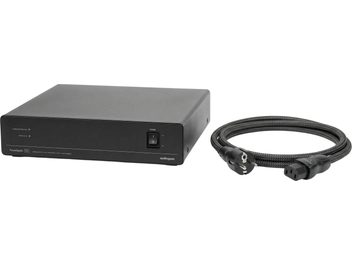
The connectivity is designed to adapt to various installation types. The IEC C14 power input allows you to use the power cable of your choice. Audioquest logically recommends its own NRG or Storm series cables for optimal performance, but the Niagara 3000 is compatible with any quality cord.
Audible Benefits Across the Spectrum
Using the Niagara 3000 results in noticeable improvements across the entire sound spectrum. In the bass, there is greater definition and impact, with sharper transients and better articulation. The midrange gains naturalness and presence, revealing more micro-details and nuances.
In the treble, high-frequency noise filtering delivers a more open and precise soundstage, free from harshness or artificial brightness. The soundstage expands and gains depth, with better separation of sound layers and more precise localization of instruments.
Beyond purely sonic aspects, the Niagara 3000 helps reduce listening fatigue during long sessions. By eliminating background noise and subtle distortions, it enables a more relaxed and immersive listening experience.
Noise attenuation: greater than 24 dB over 21 octaves from 20 kHz to 1 GHz
Surge Protection
Non-sacrificial protection, withstands repeated surge tests of 6,000 V, 3,000 A
Automatic shutdown on overvoltage at 140 V AC in less than 0.25 seconds
Automatic reset once voltage returns to normal levels
Noise Filtering
Linear noise attenuation in transverse mode greater than 24 dB from 3 kHz to 1 GHz
Line impedance dynamically linearized according to frequency
Load of 10 to 50 Ω depending on system current
Power Outlets
7 outlets divided into 3 isolated groups:
2 high-current outlets for variable current equipment (amplifiers)
2 linear filtered outlets (outlets 3 and 4)
3 linear filtered outlets (outlets 5 to 7)
General Specifications
Power consumption: typically less than 0.25 A at 120 V AC
Dimensions (W × H × D): 44.5 × 9.7 × 38.6 cm
Weight: 13.1 kg
2U rack-mountable (brackets included)
Frequently Asked Questions
Is the Niagara 3000 compatible with all types of audio and video equipment?
+
Yes, the Niagara 3000 is designed to work with a wide range of devices. Its high-current outlets are suitable for powerful amplifiers, while the filtered outlets are ideal for sources, preamplifiers, and video devices.
What is the difference between the Niagara 3000 and higher-end models in the range?
+
The Niagara 3000 offers most of the technologies found in the high-end models in a more compact and affordable format. It has fewer outlets and a slightly lower current reserve but remains highly effective for the majority of systems.
Is it necessary to use specific power cables with the Niagara 3000?
+
While Audioquest recommends its own cables for optimal performance, the Niagara 3000 will work with any quality power cable. Using shielded, low-impedance cables will, however, help maximize its filtering capabilities.
Does the Niagara 3000 generate heat during operation?
+
The Niagara 3000 generates slight heat during operation, mainly due to its active filtering circuits. However, this heat is moderate and not an issue in a properly ventilated setup.
Can the Niagara 3000 be connected to another power conditioner?
+
It is generally not recommended to cascade multiple power conditioners, as this can reduce their effectiveness. The Niagara 3000 is designed to be connected directly to a wall outlet for optimal performance.
User reviews
Philippe
Hello to the entire team, After a short break-in period, which isn't entirely finished yet, you can feel a change from the very first notes, especially in the higher spectrum. The mids and highs are more open, more realistic. The bass is tighter. The soundstage is wider. It's less muffled. A very good product, and on top of that, it's beautiful. Sure, it's an investment, but it ensures the entire system is protected and operates under the best conditions.
Comment from January 08, 2025 — Experience from December 28, 2024
Automatically translated — Show original (French)
Bonjour à toute l'équipe.. Après un petit rodage pas tout à fait terminé d'ailleurs, on ressent, des les premières notes un changement surtout sur le haut du spectre. Les médiums et les aigus sont plus aérés, plus réalistes. Les graves sont plus tendus. La scène sonore est plus large. C'est moins étouffé. Très bon produit et en plus il est beau.. Certes c'est budget mais cela mais en sécurité tout l'ensemble du système et on est sur qu'il fonctionne dans les meilleurs conditions.
Christian
Niagara set up after changing and testing the power cables.. 1st step: Significant improvement in sound quality by replacing the original cables of a SW JL Audio Fathom 212v2, a Zappiti Reference player, and an Anthem AVM90 processor with Tornado high current and source cables (more impactful bass, richer harmonics, clearer and less "muddy" sound). Very surprised by the result. I did not notice any improvement regarding the Arcam and Anthem amplification blocks between low-cost Supra LoRad cables and a Tornado. Same for a SW Velodyne DD12+. So, I used the cheaper cables (Supra). 2nd step: Added 2 Niagara 3000 distributing the setup (except the SWs which were too far) on 2 different circuits. This further improved the final output: more finesse and smoothness in the highs, better intelligibility of instruments (more depth and width).. Overall, it exceeded my expectations in improving the sound quality of my setup. Note that I also connected a projector and a TV to one of the Niagaras. It is difficult for me to note a significant difference in the video signal output. The comparative tests were conducted on 3 ranges of Audioquest cables (Blizzard, Thunder, and Tornado; the Tornado being superior to the others) and then on the Niagara 3000 mainly on Stereo music in Hi-Res files played in multichannel stereo and a bit of movie and concert excerpts.
Comment from June 04, 2024 — Experience from May 24, 2024
Automatically translated — Show original (French)
Niagara mis en place après avoir changé et testé les câbles d'alimentation.. 1ère étape : Amélioration importante de la qualité de son en remplaçant les câbles d'origine d'un SW JL Audio Fathom 212v2, d'un lecteur Zappiti Référence et d'un processeur Anthem AVM90 par des câbles Tornado courant élevé et source (basses plus percutantes, plus grande richesse des harmoniques, son plus net et moins "brouillon"). Très surpris du résultat. Je n'ai pas noté d'amélioration concernant les blocs d'amplification Arcam et Anthem entre des câbles Supra LoRad de coût modique et un Tornado. Idem pour un SW Velodyne DD12+ J'ai donc mis les câbles les moins chers (Supra). 2ème étape : ajout de 2 Niagara 3000 répartissant l'installation (sauf les SW trop éloignés) sur 2 circuits différents. Cela améliore encore un peu le rendu final : plus de finesse et de douceur dans les aigus, meilleure intelligibilité des instruments (plus de profondeur et plus de largeur).. Le tout a amélioré au-delà de mes attentes le rendu sonore de mon installation. A noter que j'ai branché également un projecteur et un TV sur un des Niagara. Il m'est difficile de noter une différence significative sur le signal vidéo émis. Les tests comparatifs se sont effectués sur 3 gammes de câbles Audioquest (Blizzard, Thunder et Tornado ; le Tornado étant supérieur aux autres) puis sur les Niagara 3000 essentiellement sur de la musique Stéréo en fichiers Hi-Res diffusée en stéréo multicanal et un peu d'extraits de films et concerts.
Eco-contribution included in the sale price.
Manufacturer reference: NIAGARA3000EU
GTIN / EAN: 92592098008
Thank you for choosing us
To better understand our visitors, measure marketing effectiveness and personalise ads, we and our partners use cookies and mobile advertising identifiers on your device. This data makes it possible to display personalised and non-personalised ads and measure their performance. Some cookies, which are technically necessary, are exempt from consent. You can accept those that require your consent, refuse them by clicking "Refuse", or customise your choices via the settings screen.
To find out how Google uses the data collected once you have given your consent, see Google’s Business Data Responsibility site.
You can change or withdraw your consent at any time via the "Consent and cookies" link. Your choices will apply on our site for 12 months.