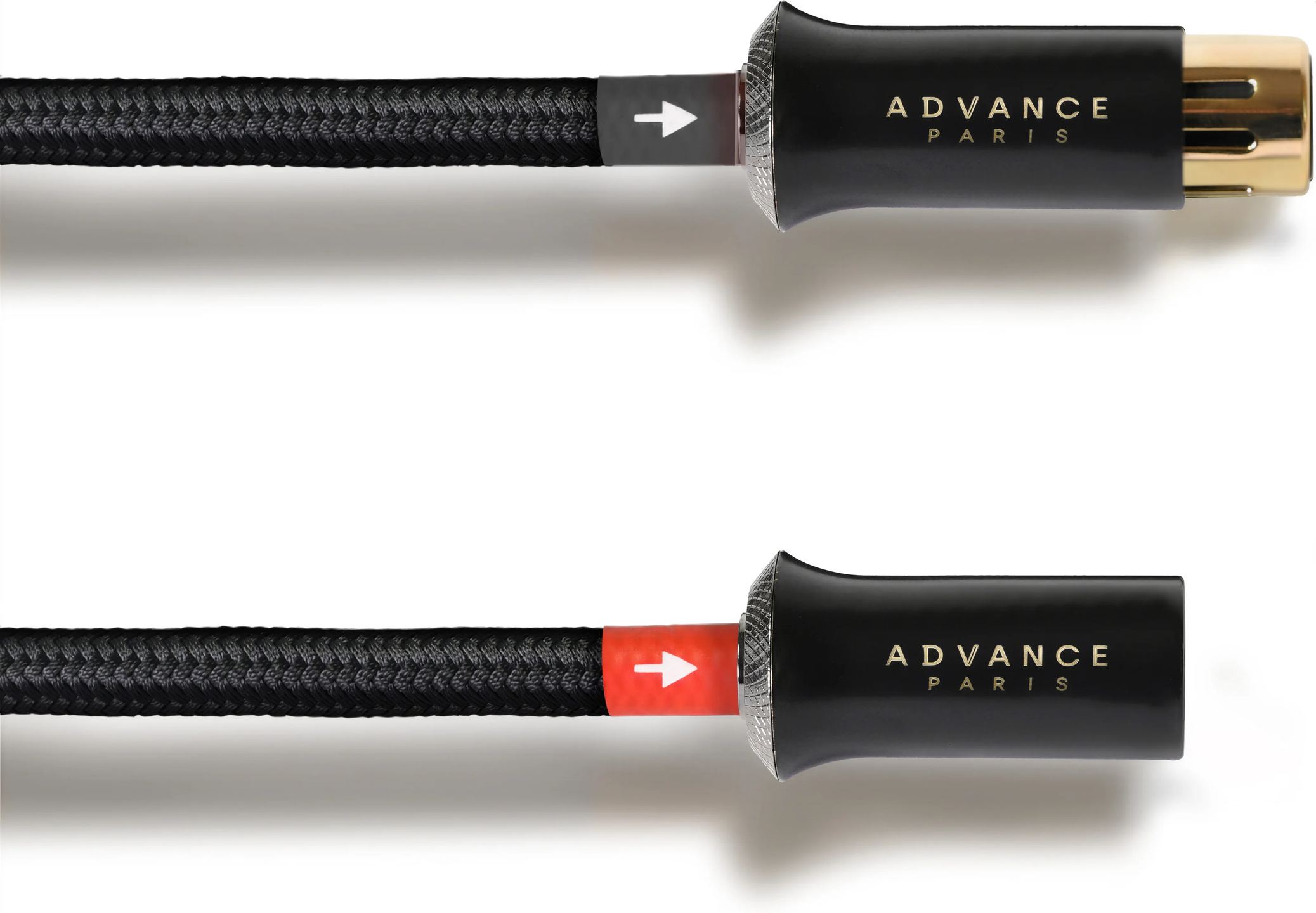
The Advance Paris LINK XLR cable is a shielded analog audio cable designed to ensure stable, high-quality signal transmission. It can be used to connect amplifiers, CD players, turntables, or preamplifiers. This balanced cable is part of the LINK range developed by Advance Paris. It is made with OCC copper and features shielding to minimize interference. This model is offered at a price point that is highly competitive in the audio market.
OCC Technology: Crystal-Clear Purity for Superior Sound
At the heart of the LINK XLR cable is OCC (Ohno Continuous Cast) copper, a material of exceptional purity reaching 99.9999% (6N). This unique casting technology, developed by Professor Ohno, creates long monocrystalline copper crystals that minimize the junctions between crystals, which are the main sources of audio signal degradation.
Unlike conventional copper, which has numerous crystalline junctions acting as micro-obstacles to signal flow, OCC copper offers an almost unobstructed path. This optimized crystalline structure allows for faithful signal transmission, preserving micro-details, instrument texture, and the ambiance of recordings.
This conductor quality translates into better transient definition (attack and decay of notes), more natural timbre reproduction, and preservation of dynamics, even in the most complex passages. For acoustic recordings in particular, this transparency allows for a better perception of soundstage and instrument placement.
Technical Design and Meticulous Manufacturing
The LINK XLR cable has an external diameter of 6.5 mm, offering an optimal balance between flexibility and robustness. Its outer sheath, made of black woven nylon mesh, not only provides a premium look but also excellent resistance to daily wear and repeated handling.
High-performance shielding is a crucial element of its design. In a modern home environment saturated with electromagnetic waves (Wi-Fi, Bluetooth, mobile phones), this shielding acts as an effective barrier against EMI (electromagnetic) and RFI (radio frequency) interference. This protection ensures that only the musical signal passes through the conductor, free from unwanted noise pollution.
The high-quality metal XLR connectors complete this technical architecture. Beyond their refined appearance, they guarantee optimal and durable contact with your equipment. Their robust construction ensures a comfortable grip and precise insertion, preventing false contacts that could compromise sound quality.
The characteristic impedance of 50 ohms has been specifically chosen to optimize compatibility with high-end audio equipment using balanced XLR connections, ensuring stable and consistent signal transmission across the entire audible frequency range.
The Advantage of Balanced XLR Connection
The XLR format (eXternal Line Return) is the benchmark for professional and high-end audiophile audio connections. Unlike unbalanced RCA connections, the XLR link uses three conductors: one for the positive signal (hot), one for the negative signal (cold), and one for ground.
This balanced configuration offers several key advantages. First, it doubles the signal amplitude, naturally improving the signal-to-noise ratio. Second, it provides superior immunity to external interference: any noise picked up affects both conductors identically and is automatically canceled out when the signal is differentiated at the receiving end.
For audiophile setups where the distance between devices can be significant, or in electrically “noisy” environments, the balanced topology of the LINK XLR is a major asset for preserving the integrity of the musical signal. It also helps eliminate ground loop issues, a common source of hum in complex systems.
Practical Applications and Recommended Setups
The LINK XLR cable fits into a variety of audiophile and professional configurations. It excels particularly in the following connections:
- Between a preamplifier and a power amplifier, preserving all the finesse of the preamplified signal
- Between a high-end digital source (DAC) and an integrated amplifier equipped with XLR inputs
- To connect a turntable with balanced preamplification to a preamplifier or amplifier
- In a recording studio, to link microphones, preamps, and mixing consoles
- For multi-amplified setups using active crossovers
Available in two lengths (0.5m and 1.5m), the LINK XLR adapts to different configurations. The short version (0.5m) is ideal for stacked or side-by-side equipment, minimizing signal path length. The longer version (1.5m) offers more flexibility for setups where devices are separated, while remaining within a reasonable length to avoid signal loss.