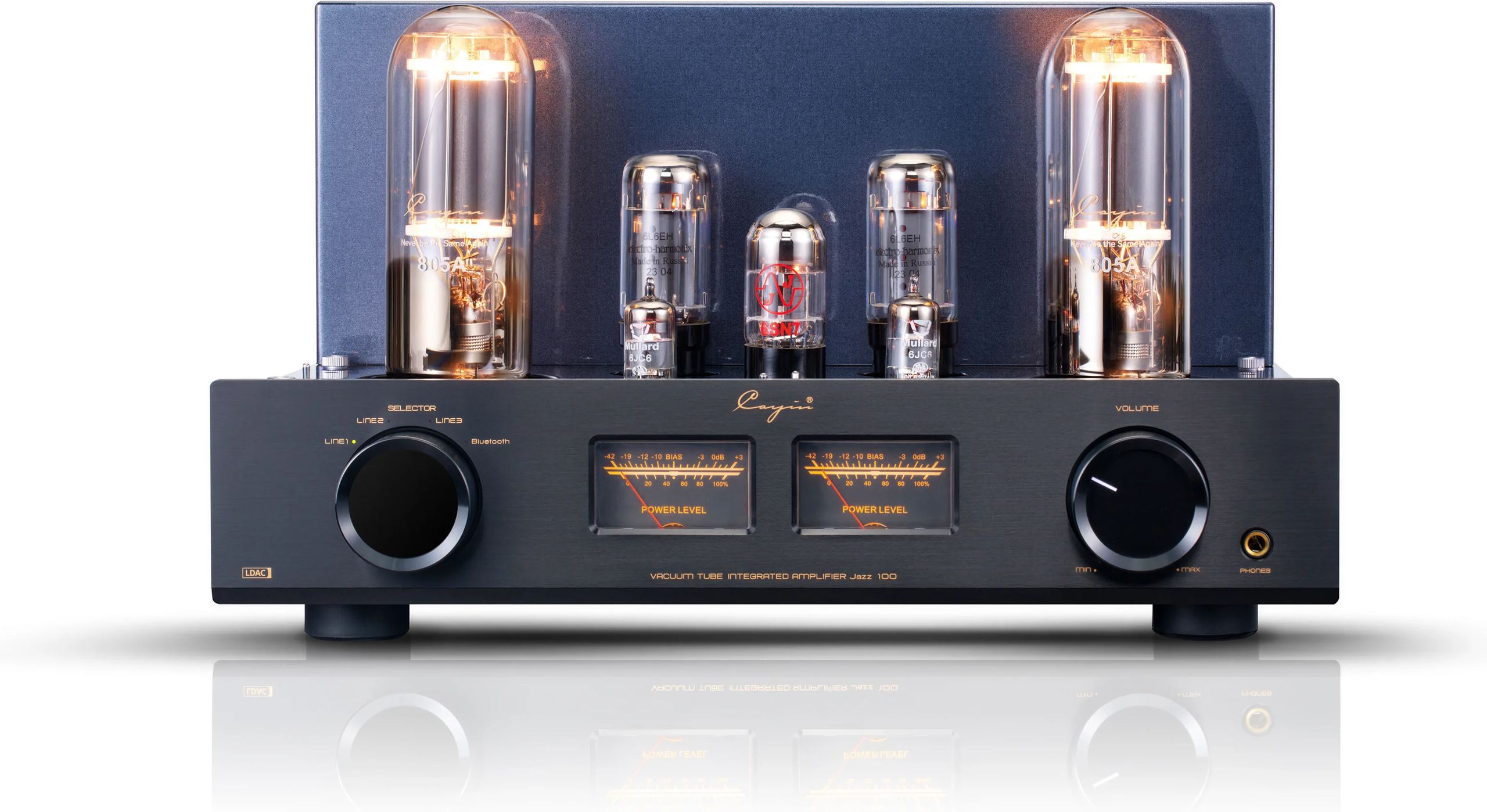
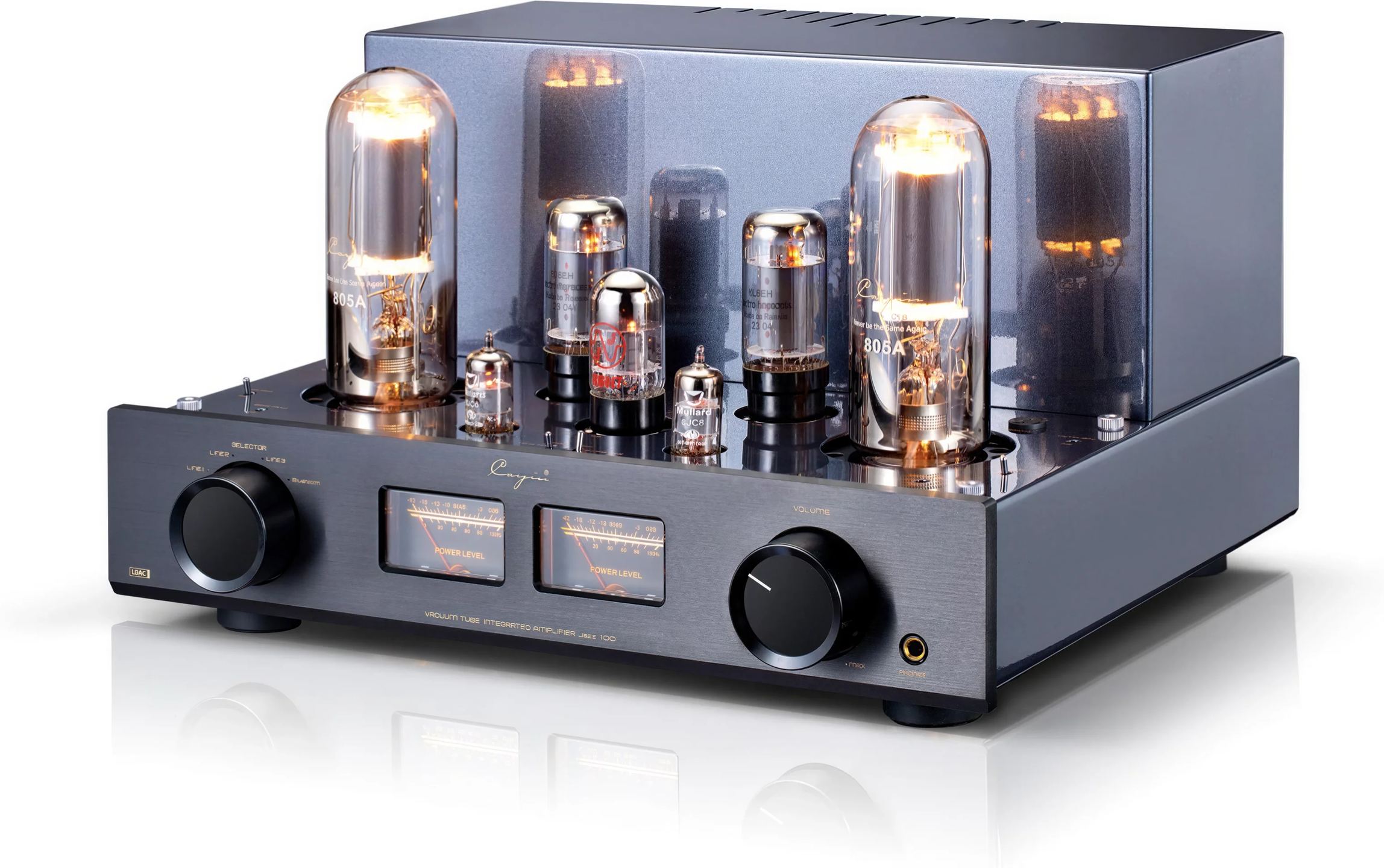
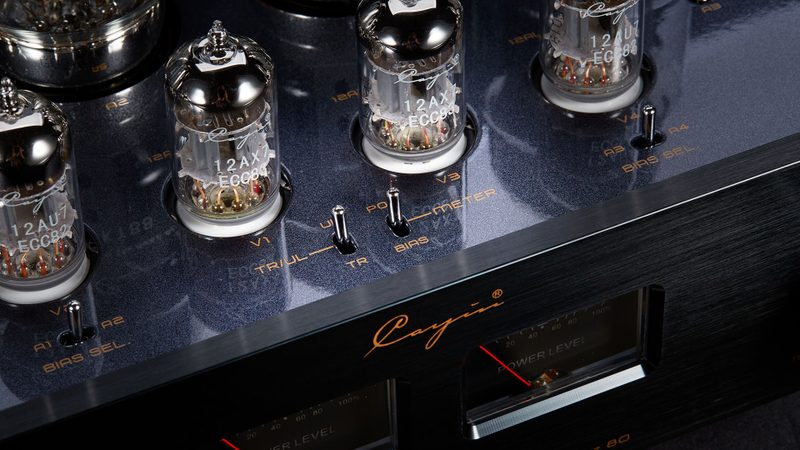
The Cayin Jazz 100 is a tube amplifier featuring a single-ended triode configuration, using 805A tubes to deliver 35 watts per channel in class A. It combines classic topology with meticulous design, aiming to reproduce the warmth and finesse characteristic of tube circuits. Its connectivity, notably including high-definition Bluetooth, allows for seamless integration into modern audio systems while preserving the qualities sought after by analog listening enthusiasts.
Exceptional Build Quality in Service of Sound
The Cayin Jazz 100 impresses at first glance with its imposing silhouette and refined design. Available in matte black or silver finish, its solid metal chassis houses rigorously selected components and meticulous internal wiring. This robustness translates into a substantial weight of 35 kilograms, reflecting the quality of the transformers and internal components.
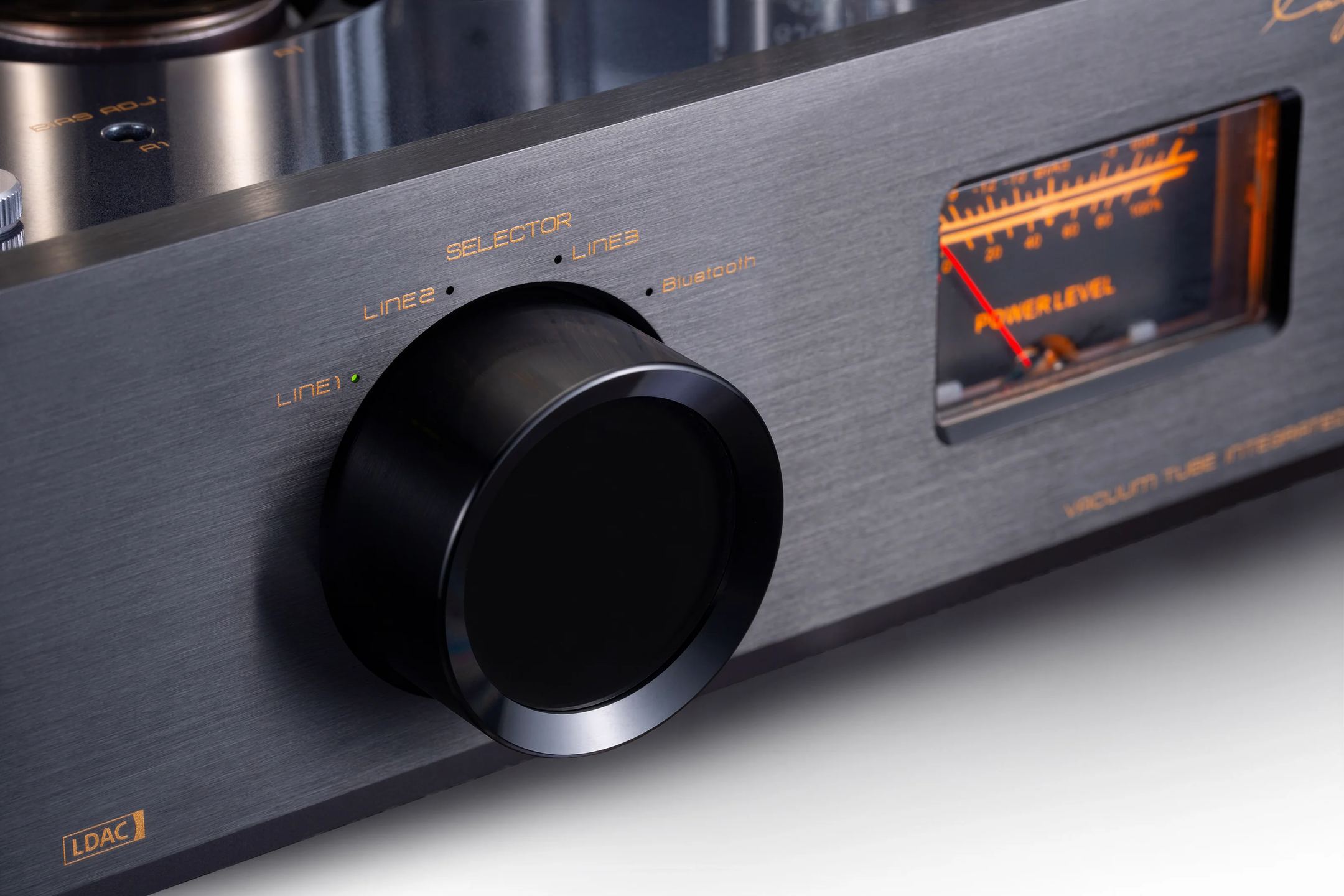
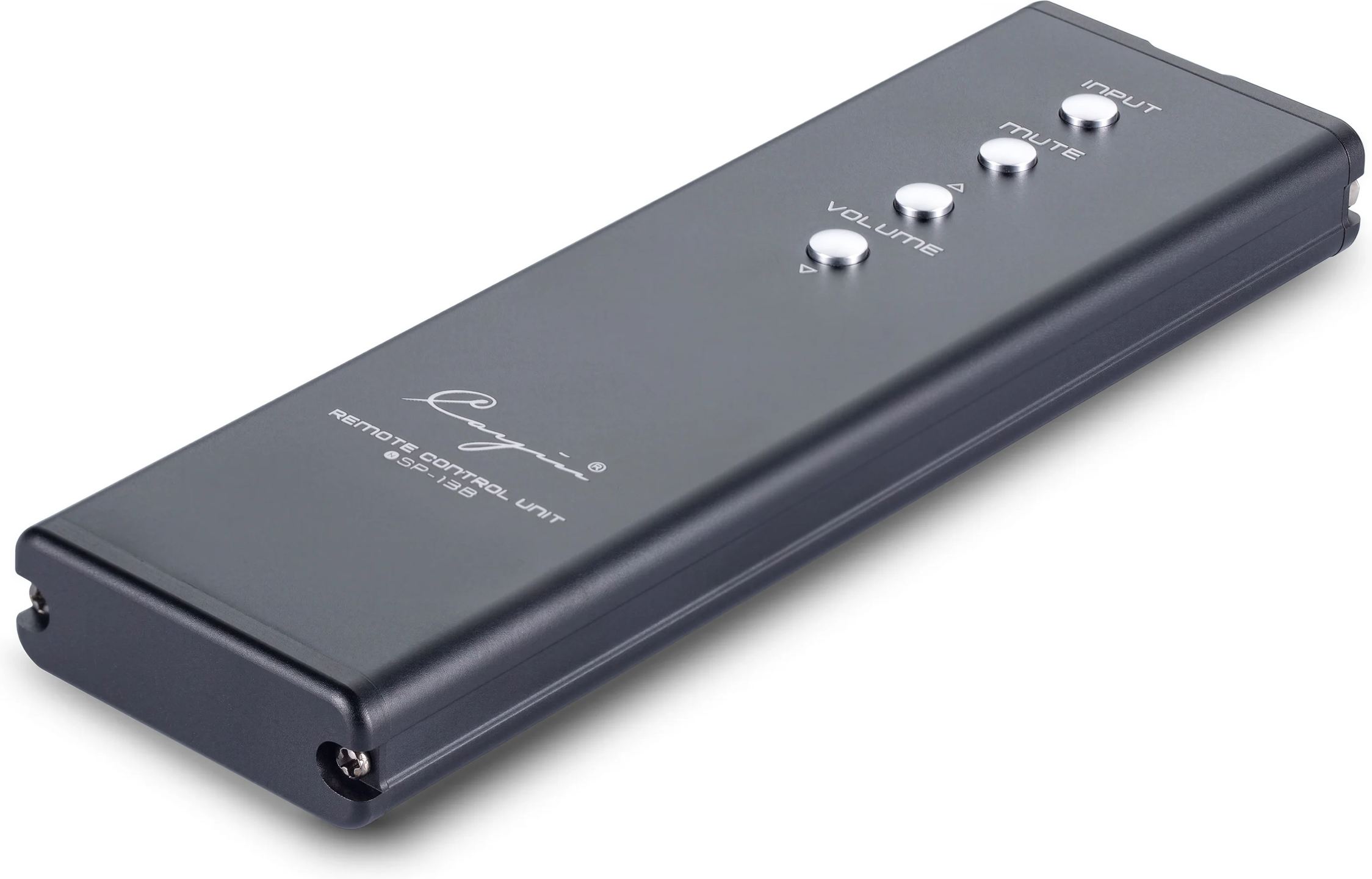
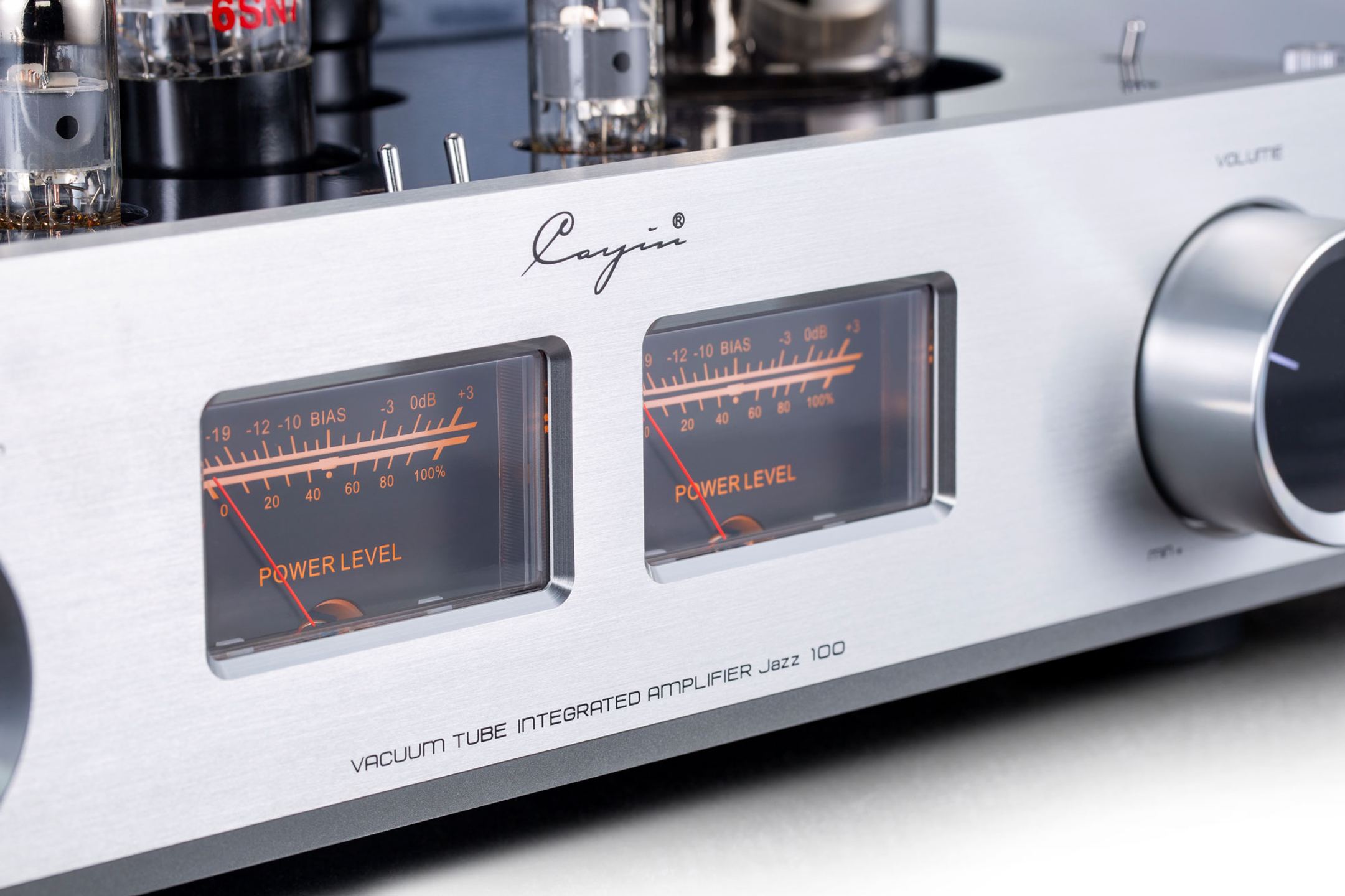
The front panel features two elegant needle VU meters that serve a dual purpose: they indicate real-time output power and act as measurement tools when adjusting tube bias. This attention to detail is also evident in the particularly sturdy infrared remote control, which allows you to control volume, source selection, and the mute function remotely.
The internal layout reveals a carefully symmetrical design, where each component is positioned to minimize interference and optimize the audio signal path. The output transformers, crucial elements in a tube amplifier, have been specifically developed for the Jazz 100 to ensure optimal stability, even with speakers of variable or complex impedance.
Single-Ended Triode Architecture: The Quintessence of Analog Sound
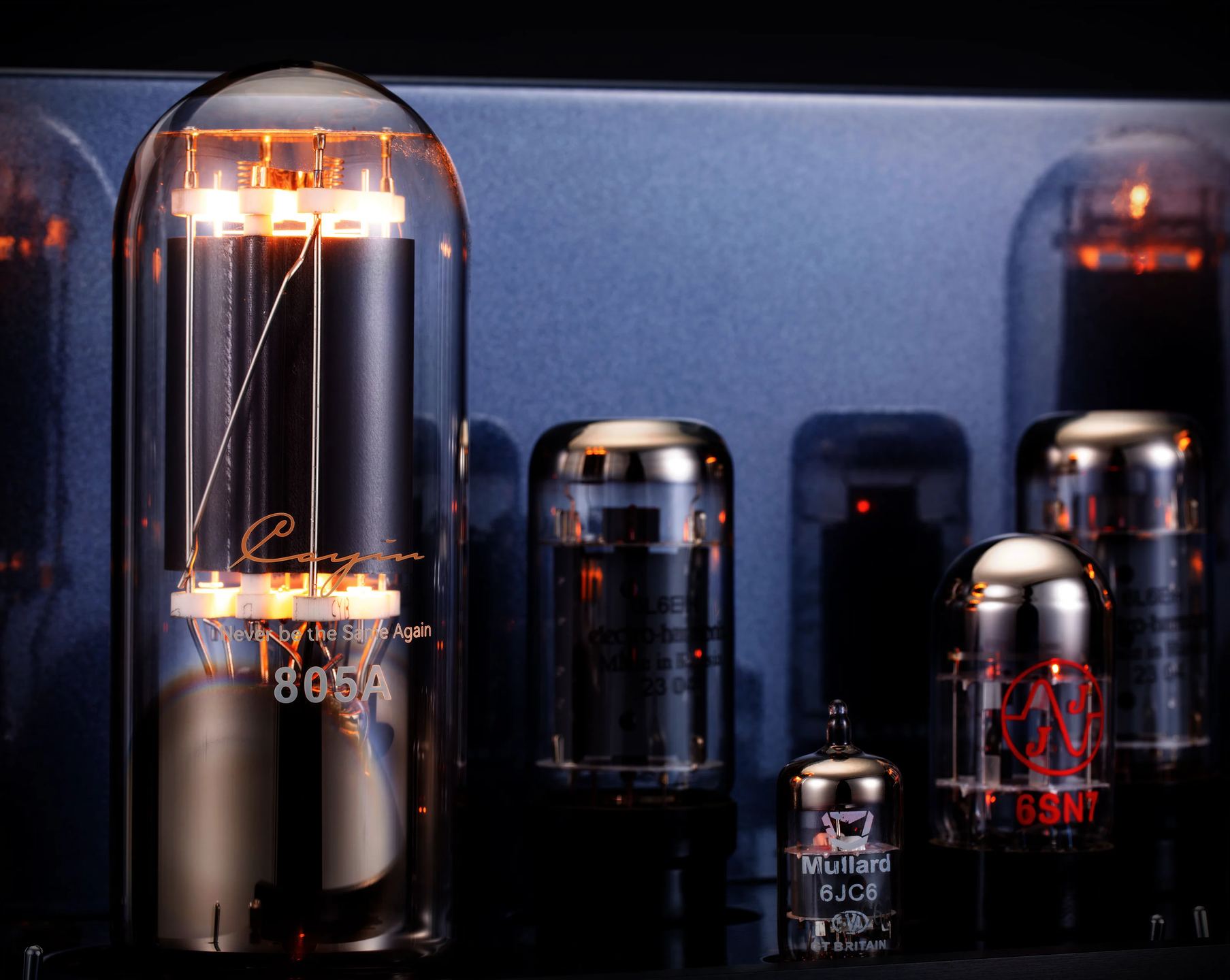
At the heart of the Jazz 100 lies a single-ended triode architecture using 805A tubes, a configuration prized by audiophiles for its transparency and musicality. Unlike the more common push-pull setups, this approach processes the entire signal through a single power tube per channel, thus avoiding crossover distortion and preserving the harmonic integrity of the music.
What truly sets the Jazz 100 apart from its competitors is its ability to deliver a substantial 35 watts RMS per channel (up to 46 watts at higher distortion) despite using a single-ended configuration. This technical feat, rare in this category of amplifiers, allows it to efficiently drive a wide range of speakers, including those with moderate sensitivity.
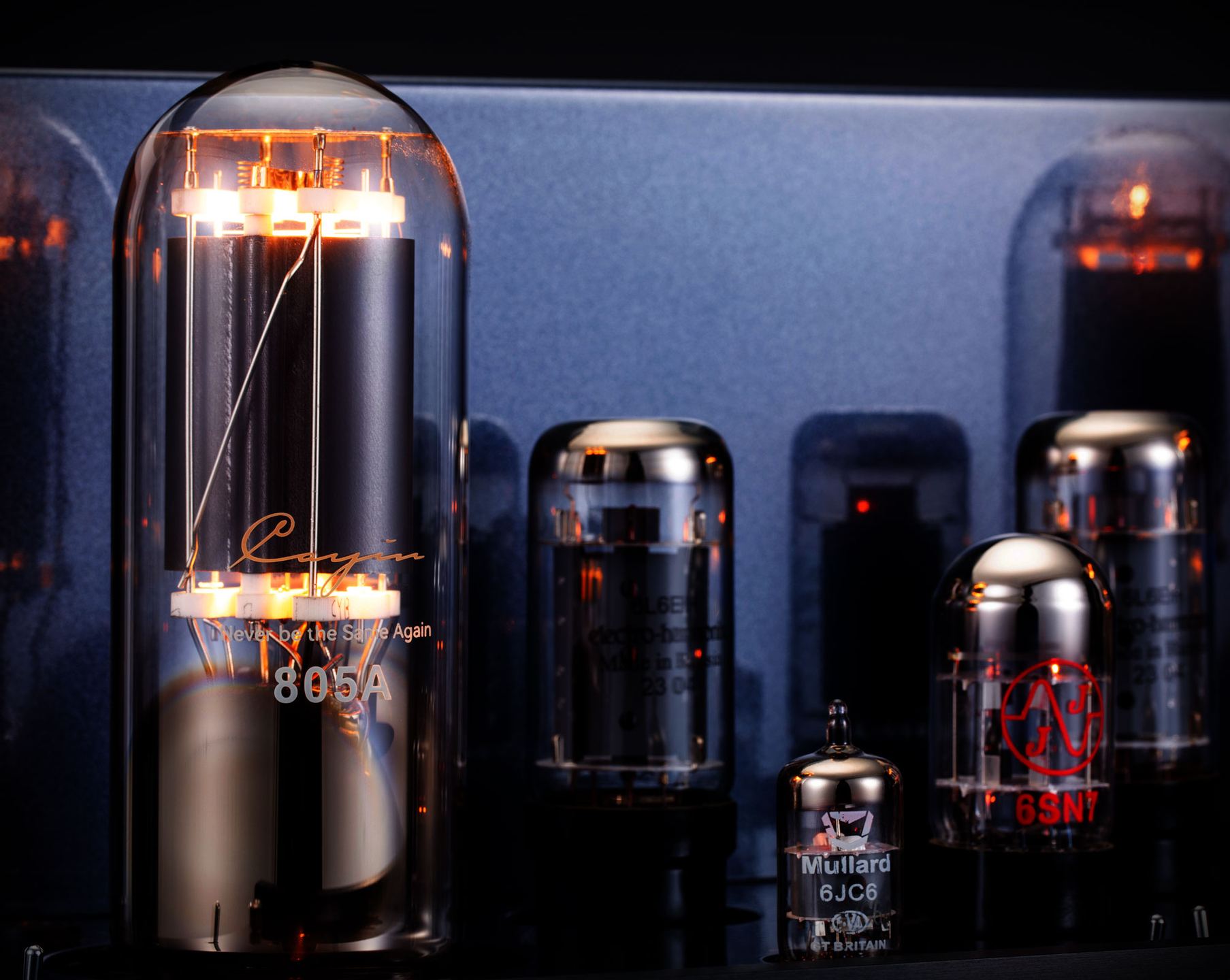
The complete amplification chain includes 6JC6 tubes for the input stage, a 6SN7 for preamplification, 6L6s as drivers, and finally the imposing 805A tubes for the power stage. The latter are directly heated triodes, renowned for their ability to reproduce instrumental timbres with striking naturalness and incomparable harmonic richness.
Sound Performance and Adaptability
The Jazz 100 stands out for its remarkable audio performance, with an extended frequency response from 12 Hz to 33 kHz (-3 dB) and total harmonic distortion kept to just 0.2% at moderate power. These technical characteristics translate into sound reproduction that is both precise and warm, where every musical nuance is preserved.
Adaptability to different speakers is a major asset of this amplifier. Its dedicated output terminals for 4 and 8 ohm impedances allow for optimal matching with virtually any type of speaker. This flexibility is enhanced by the ability to adjust the level of negative feedback: in the low position, the sound gains openness and expressiveness, while in the high position, it becomes more controlled and precise.
For headphone listening enthusiasts, the Jazz 100 features a dedicated front-panel output powered by a specific transformer. Compatible with headphones ranging from 16 to 300 ohms impedance, this section inherits the sonic qualities of the main amplification and offers a high-level personal listening experience.
Modern Connectivity and Versatile Use
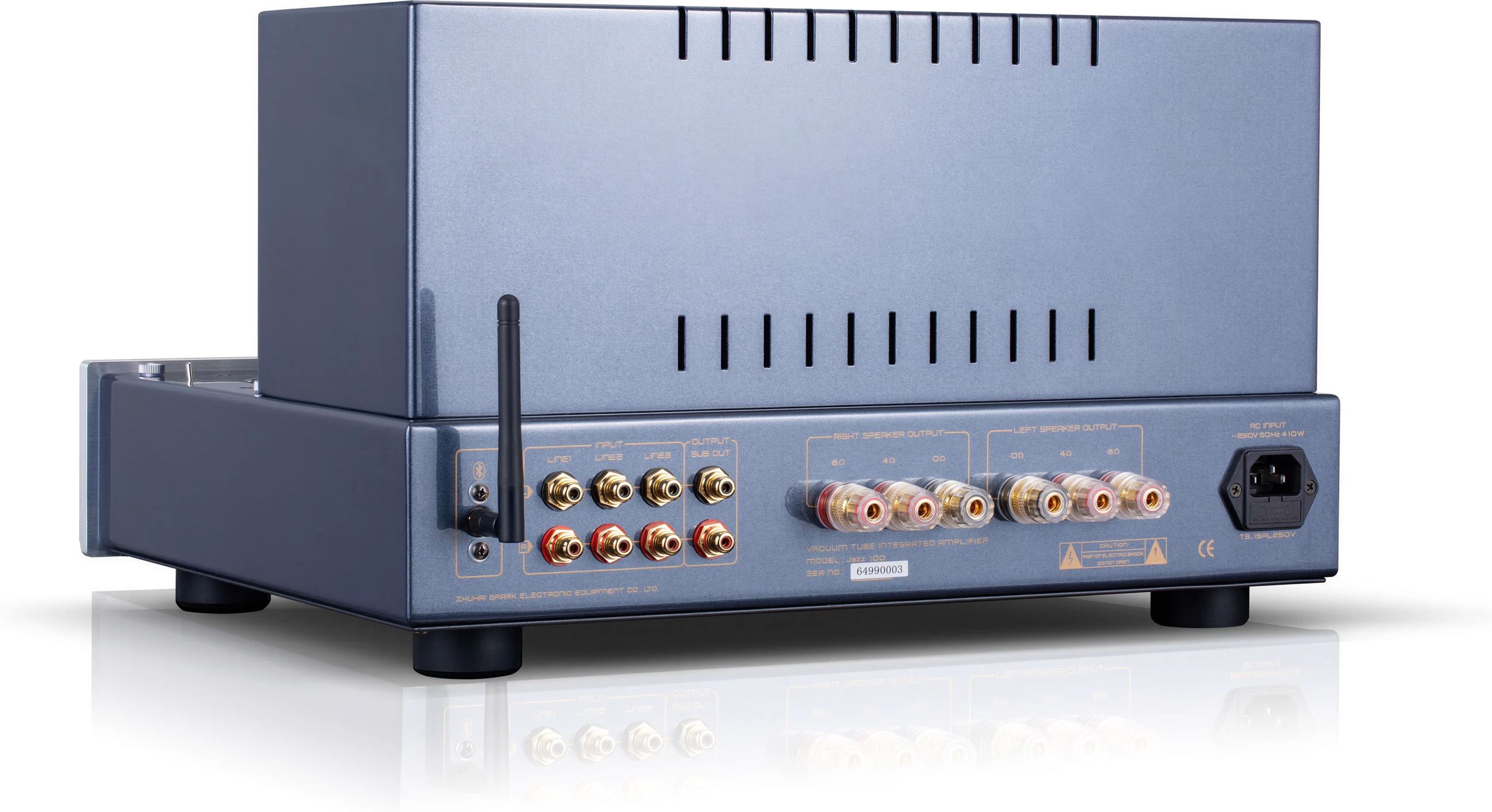
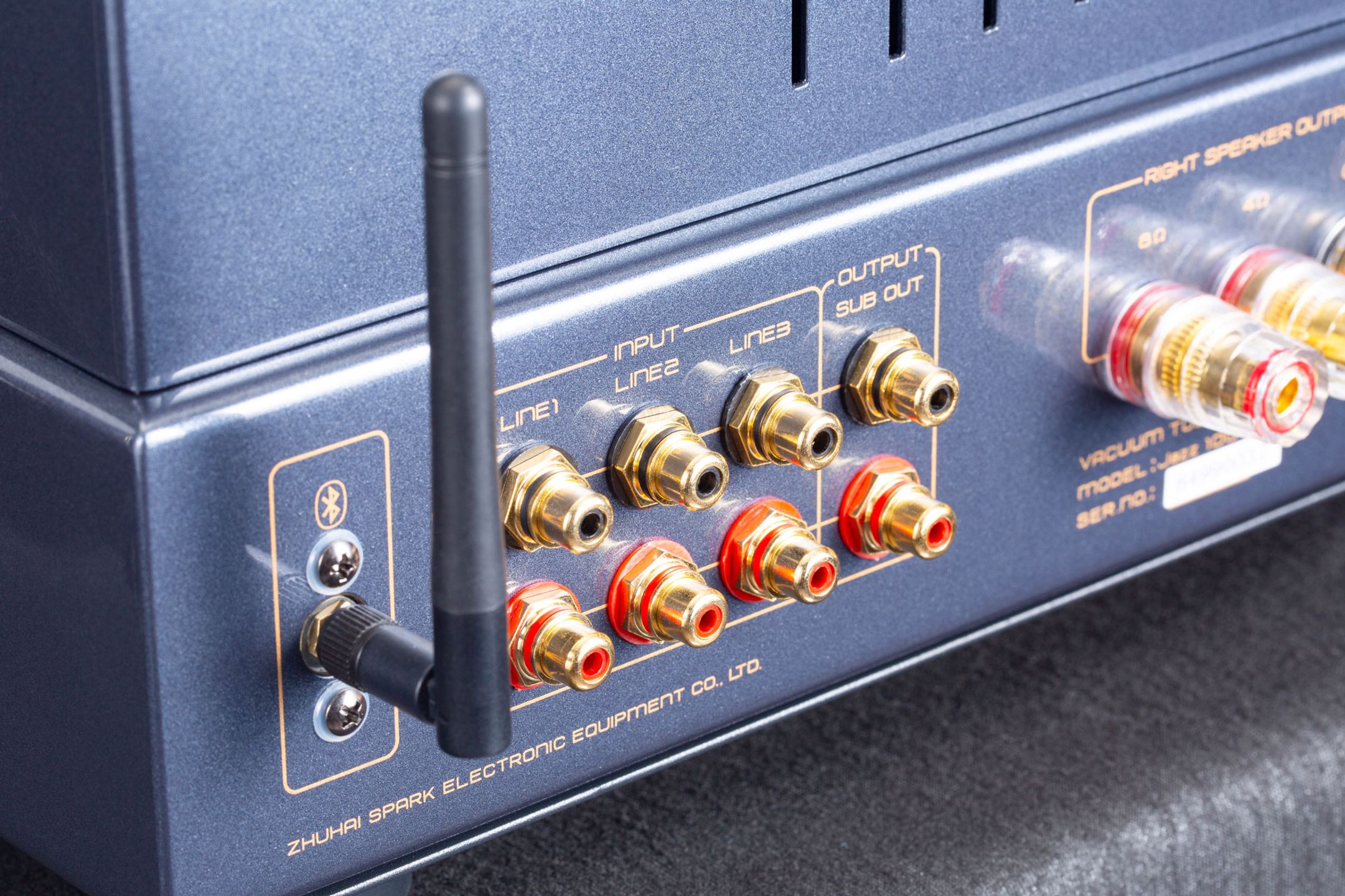
The Jazz 100 adapts perfectly to modern sources thanks to its extensive connectivity. Its three RCA line inputs allow you to connect traditional analog sources such as CD players, phono preamps, or external DACs.
The integration of a Bluetooth 5.0 receiver is a notable advancement for a tube amplifier of this caliber. Compatible with high-resolution codecs like LDAC, aptX HD, and aptX Low Latency, this feature allows wireless music streaming from a smartphone or tablet without significantly compromising sound quality. The built-in ESS SABRE ES9018K2M digital-to-analog converter ensures precise conversion of digital signals received via Bluetooth.
This versatility is also reflected in the ability to use the Jazz 100 in different configurations: as the main integrated amplifier in an audiophile system, as a power amplifier by bypassing the preamplification stage, or as a preamplifier to drive external power blocks.
Sound Customization and Tube Rolling
One of the most appreciated features of tube amplifiers is the ability to modify their sonic signature by replacing certain tubes with compatible models. The Jazz 100 excels in this area by allowing the 6L6 driver tubes to be replaced with various alternatives such as EL34, 6CA7, 5881, 6550, KT88, or KT90.
Each type of tube brings its own distinctive sonic coloration: EL34s tend toward a warmer sound with rich midrange, while KT88s offer increased dynamics and more extended extremes. This flexibility allows users to precisely tailor the amplifier’s sonic signature to their personal preferences, system, or the musical genre being played.
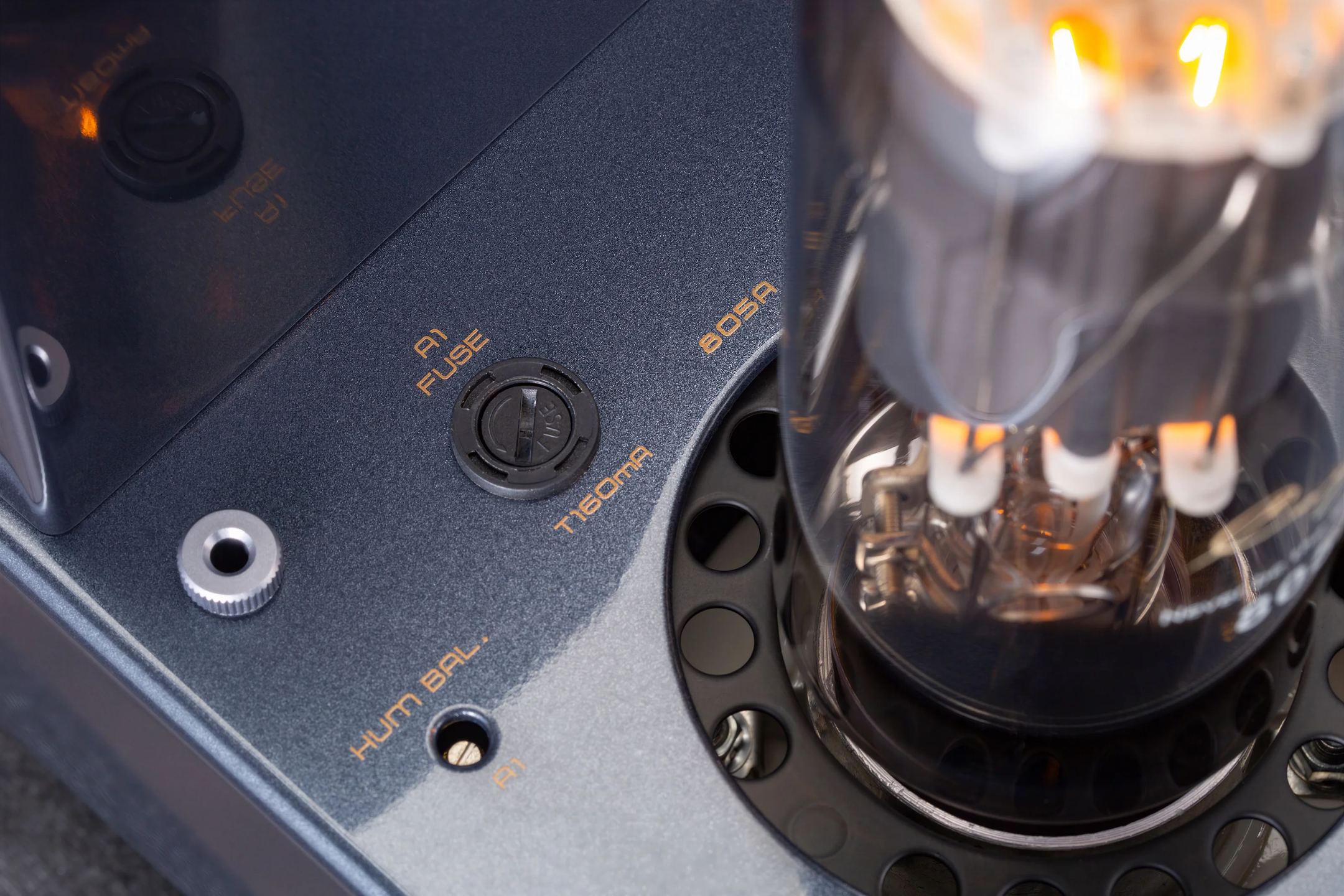
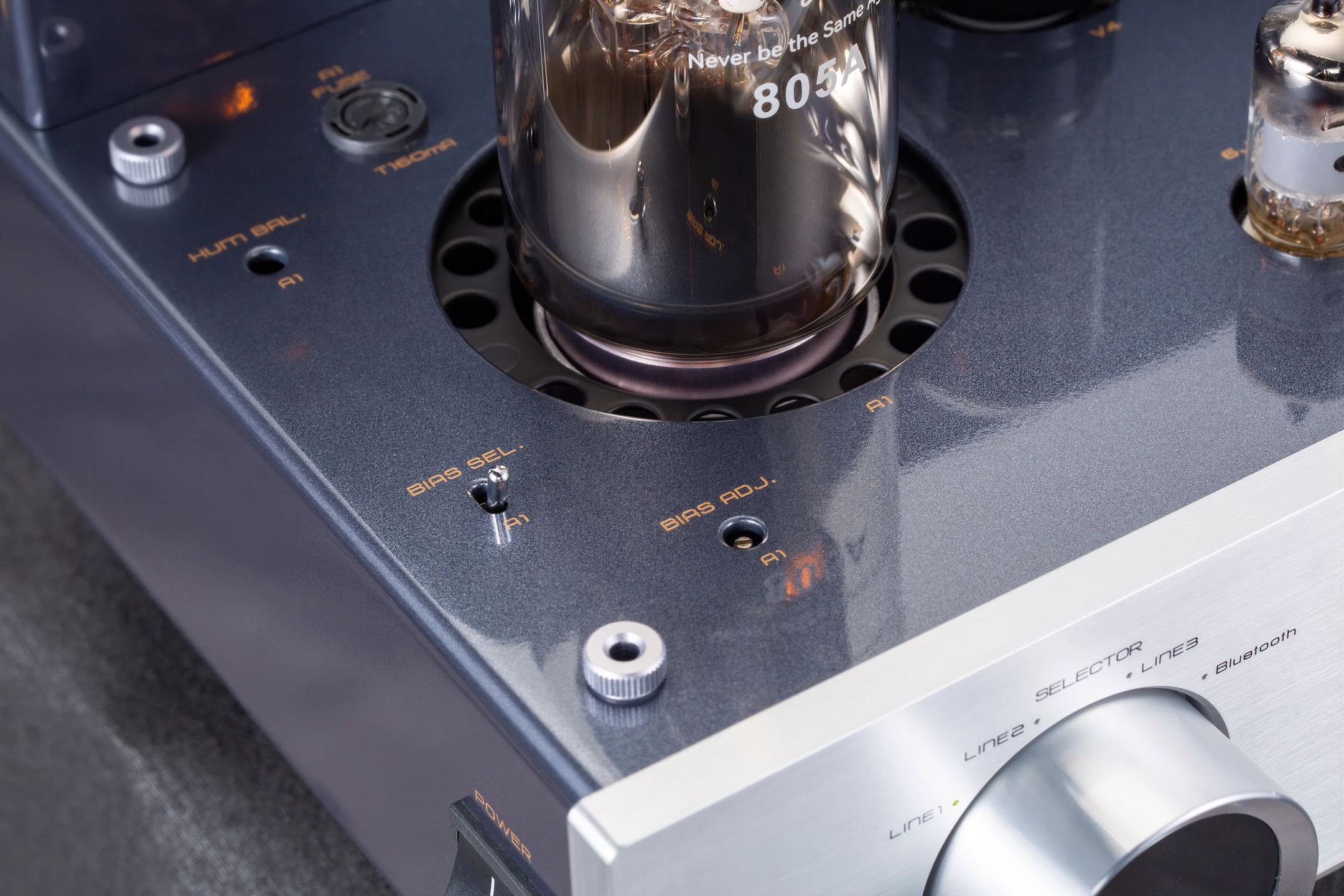
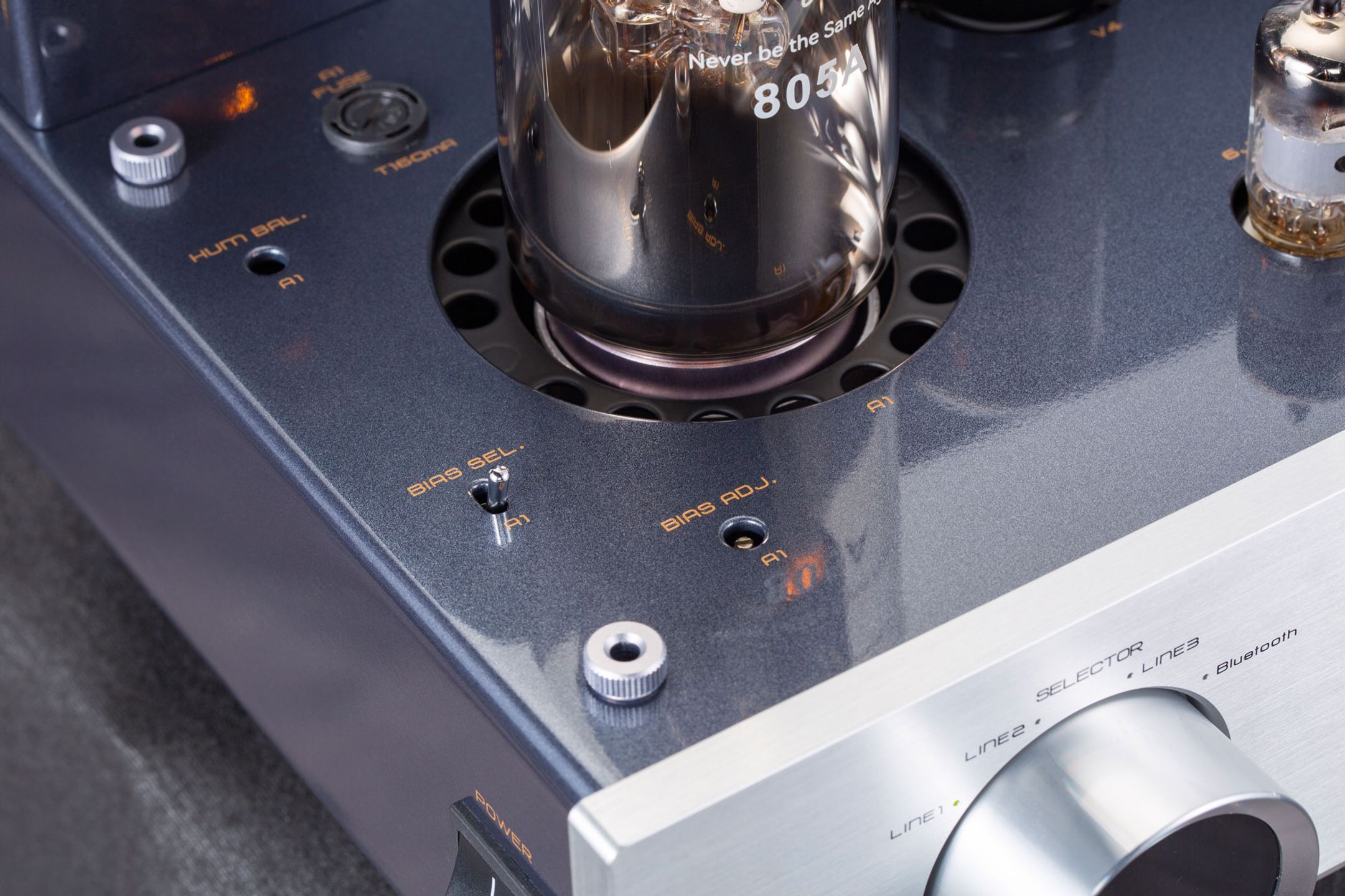
Beyond tube rolling, the Jazz 100 offers several settings to fine-tune its sound. The hum balancer minimizes background noise inherent to directly heated tubes, while manual bias adjustment via accessible trimmers allows for optimal operation and longevity of the power tubes.
Evolution Compared to the Jazz 80
The Jazz 100 represents a significant evolution compared to its predecessor, the Jazz 80. The fundamental difference lies in the amplification architecture: where the Jazz 80 used KT88 pentodes in a push-pull configuration, the Jazz 100 adopts 805A triodes in single-ended mode, an approach generally considered purer by audio purists.
This shift to 805A triodes gives the Jazz 100 a distinct sonic signature, characterized by increased transparency and more faithful reproduction of natural harmonics. The output power remains comparable between the two models, but the Jazz 100’s sound quality reaches a higher level, particularly in timbre reproduction and soundstage coherence.
Improvements also extend to the digital section, with an updated Bluetooth receiver and integrated DAC, as well as mechanical design, with optimized transformers and refined internal wiring. These developments make the Jazz 100 not just a simple update, but a complete reinterpretation of the high-end integrated tube amplifier concept.
Technical Specifications
Amplification
Output power:
2 × 35 W RMS (THD < 3%)
2 × 46 W (THD < 9%)
Audio performance:
Frequency response: 12 Hz – 33 kHz (–3 dB)
Total harmonic distortion: 0.2% at 1 W / 1 kHz (at 90% of rated power)
Signal-to-noise ratio: 90 dB (A-weighted)
Input sensitivity: 320 mV
Input impedance: 100 kΩ
Tube Configuration
Power tubes: 2 × 805A (triodes – Psvane)
Driver tubes: 2 × 6L6 (replaceable with EL34, KT88, etc.)
Preamplification: 1 × 6SN7
Input amplification: 2 × 6JC6
Features
Front panel analog VU meters (power indication)
Manually adjustable bias via trimmer (integrated measurement needle)
Hum balancer to minimize background noise
Adjustable negative feedback level (for a more controlled or open sound)
Robust IR remote control: source selection, volume, mute
6L6 tubes can be replaced (compatible with EL34, KT88, etc.)
Construction and Design
Solid metal chassis, matte black or silver finish
Symmetrical design and meticulous internal wiring
Custom output transformers for stable load, even with demanding speakers
Connectivity
Speaker outputs: dedicated 4 Ω and 8 Ω terminals
Headphone output: front jack (compatible with 16–300 Ω)
Analog inputs:
3 × RCA (LINE 1, LINE 2, LINE 3)
1 × Bluetooth (version 5.0)
Bluetooth Section
Version: Bluetooth 5.0
Chipset: Qualcomm QCC5125
Integrated DAC: ESS SABRE ES9018K2M
Supported codecs:
UAT (Ultra Audio Transmission)
LDAC, aptX HD, aptX, aptX Low Latency
AAC, SBC
Effective range: ≤ 10 m
Device name: Cayin HD BT
Dimensions and Weight
Dimensions (W × D × H): 420 × 389 × 248 mm
Net weight: 35 kg
Power consumption: 410 W
Frequently Asked Questions
What is the sonic difference between a single-ended triode configuration and the more common push-pull configuration?
+
The Jazz 100’s single-ended triode configuration processes the entire audio signal through a single power tube per channel, thus avoiding the crossover distortion present in push-pull setups. This approach better preserves the natural harmonics of the music, offering more faithful reproduction of instrumental timbres and increased soundstage coherence. In return, it generally delivers less power and exhibits higher harmonic distortion, but of a musical nature (mainly even harmonics).
What alternative tubes can be used to modify the sonic signature?
+
The 6L6 driver tubes can be replaced with several compatible alternatives, each bringing its own sonic coloration: EL34/6CA7 offer richer, warmer mids, ideal for jazz and vocals; KT88/6550 deliver deeper bass and more extended highs, suited to orchestral music; 5881s provide an intermediate balance with slightly recessed mids. Replacement should always be done with matched pairs to maintain stereo balance.
How does bias adjustment work and how often should it be performed?
+
Bias adjustment is done via accessible trimmers on the top of the chassis, using the VU meters as indicators. A switch allows you to toggle the VU meters from “power” mode to “bias” mode. The operation consists of gently turning the trimmers until the needle reaches the marked area on the dial. This adjustment is recommended during initial setup, after tube replacement, and periodically every 3 to 6 months to compensate for natural tube wear.
How does the Bluetooth section compare to a wired connection in terms of quality?
+
The Jazz 100’s Bluetooth section uses high-quality components, including a Qualcomm QCC5125 receiver and an ESS SABRE ES9018K2M DAC. With high-resolution codecs like LDAC (up to 990 kbps) or aptX HD, the sound quality comes very close to a wired connection, especially for compressed files. However, for listening to high-resolution files or vinyl, the analog connection via RCA inputs remains preferable to extract the last nuances that the Jazz 100 is capable of reproducing.
Is it possible to use the Jazz 100 solely as a preamplifier?
+
Although the Jazz 100 is designed as an integrated amplifier, it is possible to use it as a preamplifier by connecting external power blocks to its subwoofer outputs. This setup allows you to benefit from the unique sonic coloration of its tube preamplification stages while leveraging the power of external amplifiers to drive particularly demanding speakers or to create a multi-amplification system. However, note that this use does not fully take advantage of the Jazz 100’s high-quality output transformers.
User reviews
Michel
Bought to replace an Onkyo P304/M504 set, my only “constraint” was that this amp had to be able to handle my famously power-hungry DITTON 44s. I’d been warned that Class A and tubes were a whole different story. I can confirm it: whether at low or very low volume, or a bit louder (while respecting the break-in period for the unit and the tubes), you can feel this amp just cruising, having a blast. I caught myself turning around, rediscovering these speakers I love so much, thinking, “wow, they can do that.” This amp is refined and delicate in the upper range, and it can go very deep (The Sound of Silence by Geoff Castellucci still gives me goosebumps just thinking about it, so well did this amp, paired with my DITTONs, reproduce the whole piece). Thanks to the team for the advice—I have absolutely no regrets about my purchase, and every day I rediscover my tracks and my speakers, which I’ve become an even bigger fan of since this new pairing.
Comment from November 06, 2025 — Experience from October 15, 2025
Automatically translated — Show original (French)
Venu remplacer un ensemble Onkyo P304 M504, j'avais comme unique "contrainte" que cet ampli arrive à tenir mes DITTON 44 réputées gourmandes. On m'avait prévenu que la classe A et le tube, c'était tout autre chose. Je confirme, que ce soit à faible voir très faible volume, ou à un volume un peu plus fort (tout en respectant le rodage de l'appareil et des tubes), on sent que cet ampli se balade, se régale. Je me suis surpris à me retourner, à redécouvrir ces enceintes que j'apprécie tant, et à me dire "mais elles sont capables de ça".
Cet ampli est fin et délicat dans le haut du spectre, et il est capable de descendre très bas (the sound of silence par Geoff Castelluci me donne encore la chair de poule rien que d'y repenser tellement cet ampli a su restituer avec mes DITTON l'ensemble de ce morceau).
Merci à l'équipe pour les conseils, je ne regrette aucunement mon achat, et je redécouvre chaque jour mes morceaux et mes enceintes, dont je suis devenu encore plus fan depuis ce nouveau mariage.
To better understand our visitors, measure marketing effectiveness and personalise ads, we and our partners use cookies and mobile advertising identifiers on your device. This data makes it possible to display personalised and non-personalised ads and measure their performance. Some cookies, which are technically necessary, are exempt from consent. You can accept those that require your consent, refuse them by clicking "Refuse", or customise your choices via the settings screen.
To find out how Google uses the data collected once you have given your consent, see Google’s Business Data Responsibility site.
You can change or withdraw your consent at any time via the "Consent and cookies" link. Your choices will apply on our site for 12 months.