Audioquest Rocket 88 DBS, high-end speaker cable
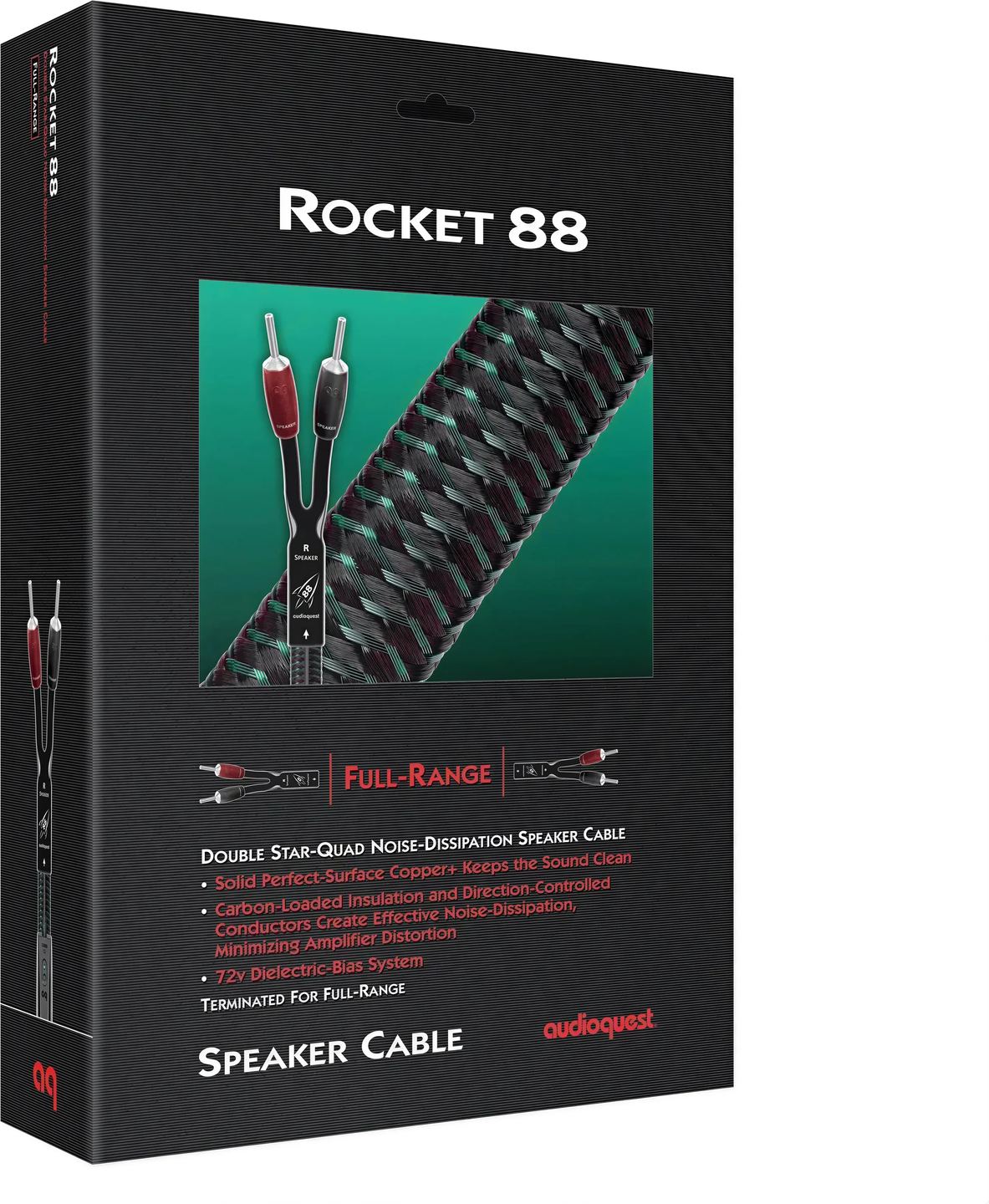
At the top of Audioquest’s Rocket series, the Rocket 88 DBS brings together the brand’s proprietary noise-reduction technologies in a pre-terminated, ready-to-connect speaker cable. High-purity solid copper conductors, Double Star-Quad geometry, and active 72-volt dielectric biasing: three approaches aimed at the same result—a silent background and detailed reproduction. Here is what lies beneath its braided jacket.
Solid PSC+ copper against distortion
All Rocket 88 conductors are solid, with no strands. This choice eliminates one of the main causes of distortion in a cable: electrical and magnetic interaction between multiple strands, which can result in confused or harsh sound. The metal used is Perfect-Surface Copper+ (PSC+), the purest copper in the Audioquest catalog, whose exceptionally smooth surface limits distortion linked to the metal’s grain boundaries.
The skin effect, which pushes the signal toward the conductor’s outer edge at high frequencies, is kept outside the audio band thanks to conductor cross-sections calibrated below the audible threshold. The air-filled foamed polyethylene insulation reduces energy absorption that can color the signal. Each internal conductor is also directionally oriented to reduce the pickup of radio-frequency noise, which explains the connection direction marked on the jacket.
Double Star-Quad geometry in practice
Eight solid conductors arranged in two crossed star-quads: it is this configuration, more than capacitance and inductance values alone, that shapes the cable’s sonic behavior. The crossover reduces signal time smear while preserving dynamics and the clarity of sonic layers.
This structure opens up a second possibility. When the two halves of the cable are separated at the speaker end, each star-quad retains its magnetic independence and the Rocket 88 becomes a genuine bi-wire set in a single cable. For owners of speakers with dual binding posts, this is a tangible advantage without having to double the number of cables.
The 72-volt DBS system in everyday use
The Dielectric-Bias System maintains a constant 72-volt charge on the cable insulation. Just as the Earth’s magnetic field aligns compass needles, this electrostatic field orients the insulation molecules in the same direction. The audible result: a quieter background from which details and dynamic contrasts emerge, often masked by unpolarized insulation.
The DBS is powered by a battery pack connected to the cable. A test button and LED allow the charge status to be checked from time to time, with the battery lasting several years. Since the charge is active from assembly onward, the Rocket 88 requires no break-in period before delivering its full potential.
Carbon-based noise dissipation
Around the conductors, alternating layers of metal and carbon-loaded synthetics form shielding that “shields the shielding,” in Audioquest’s words. The idea is to dissipate induced radio-frequency noise before it reaches the layer connected to ground, across a wide frequency range. This dissipation works in concert with DBS and PSC+ copper to lower the system’s noise floor.
Banana plugs or spades, how to terminate
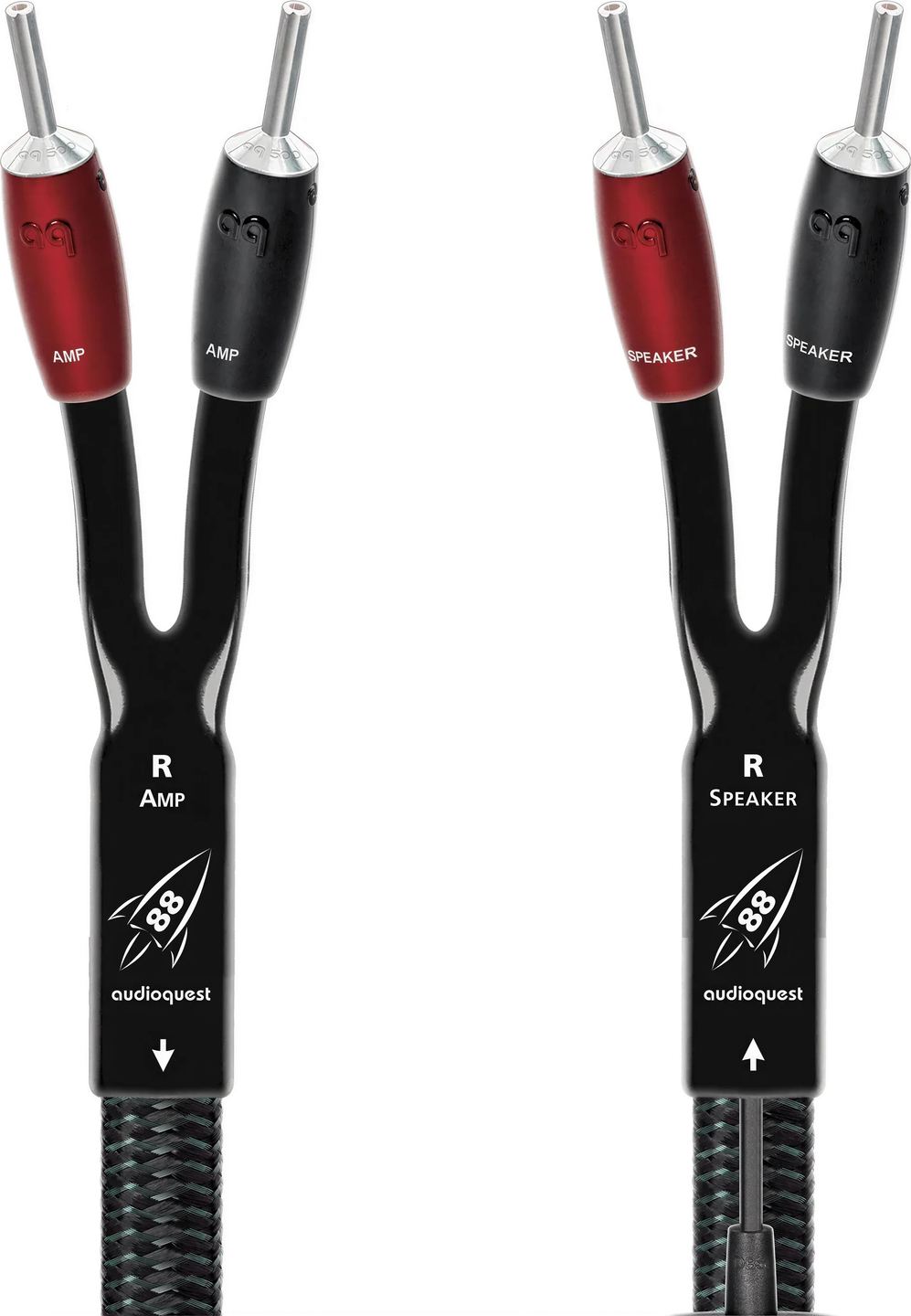
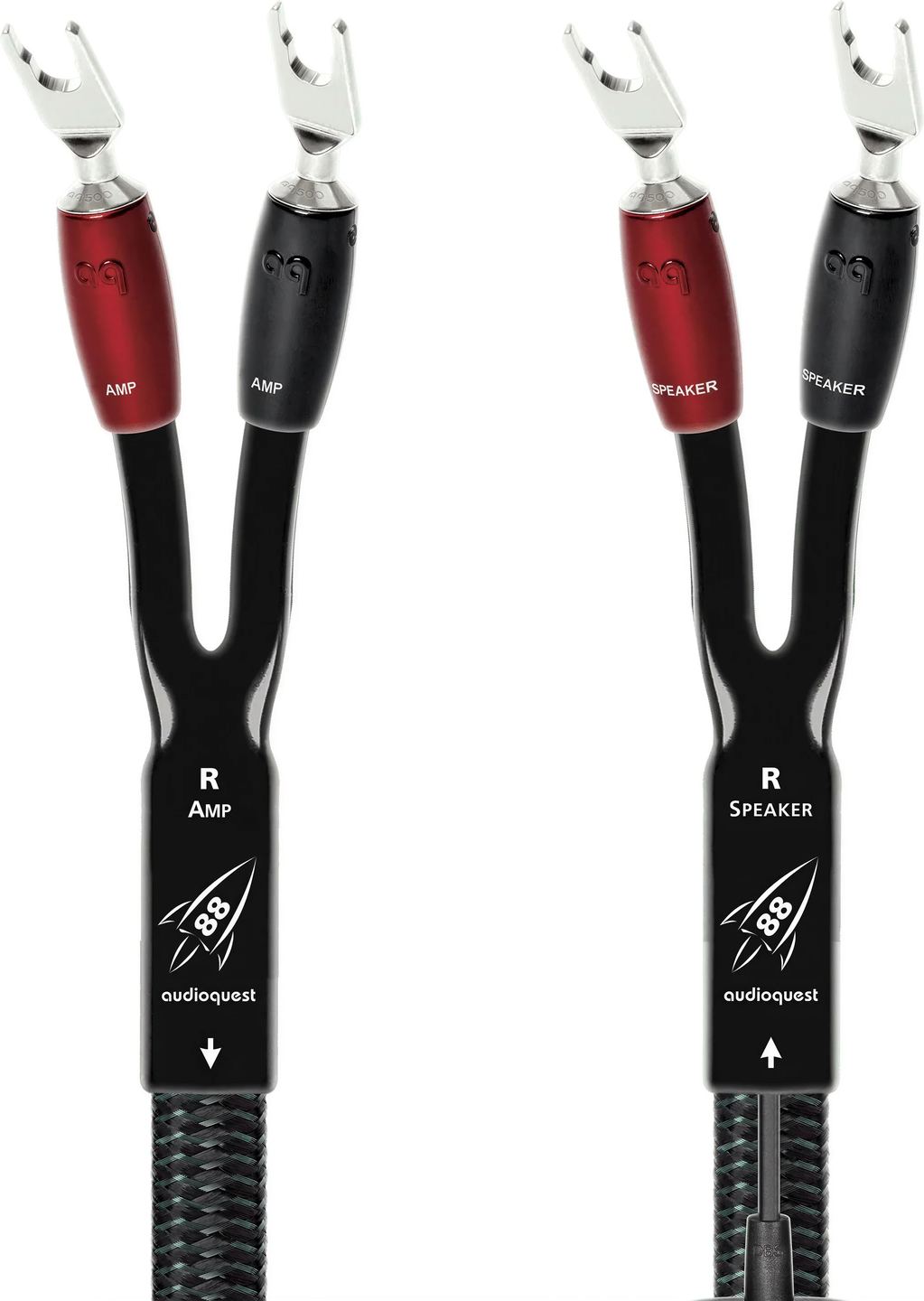
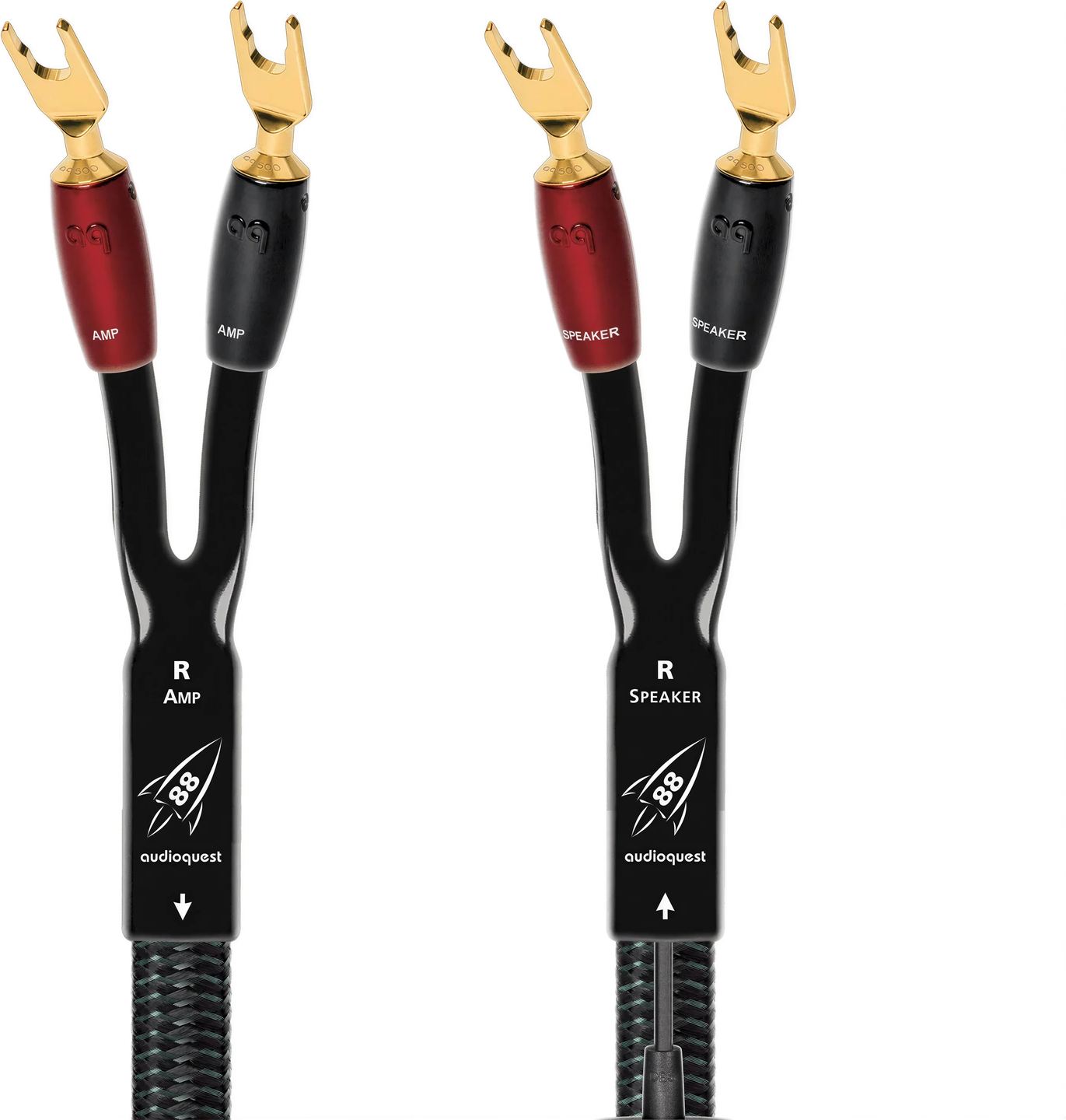
The cable is available with banana plugs or spade lugs, gold- or silver-plated depending on the version. Contact between the plug and conductor is made using the Cold-Weld process, a cold weld under controlled pressure that mechanically bonds conductor and connector without heat, preserving the integrity of the copper.
The choice between banana and spade plugs mainly depends on the amplifier’s binding posts. Insulated binding posts compliant with European standards, common on recent amplifiers, do not handle high-torque tightening on spade lugs well: banana plugs are therefore preferable, and sometimes mandatory. At the speaker end, spades regain the advantage when the binding post does not accept a fully inserted banana plug.