Cardas Clear Headphone 3m
Overview
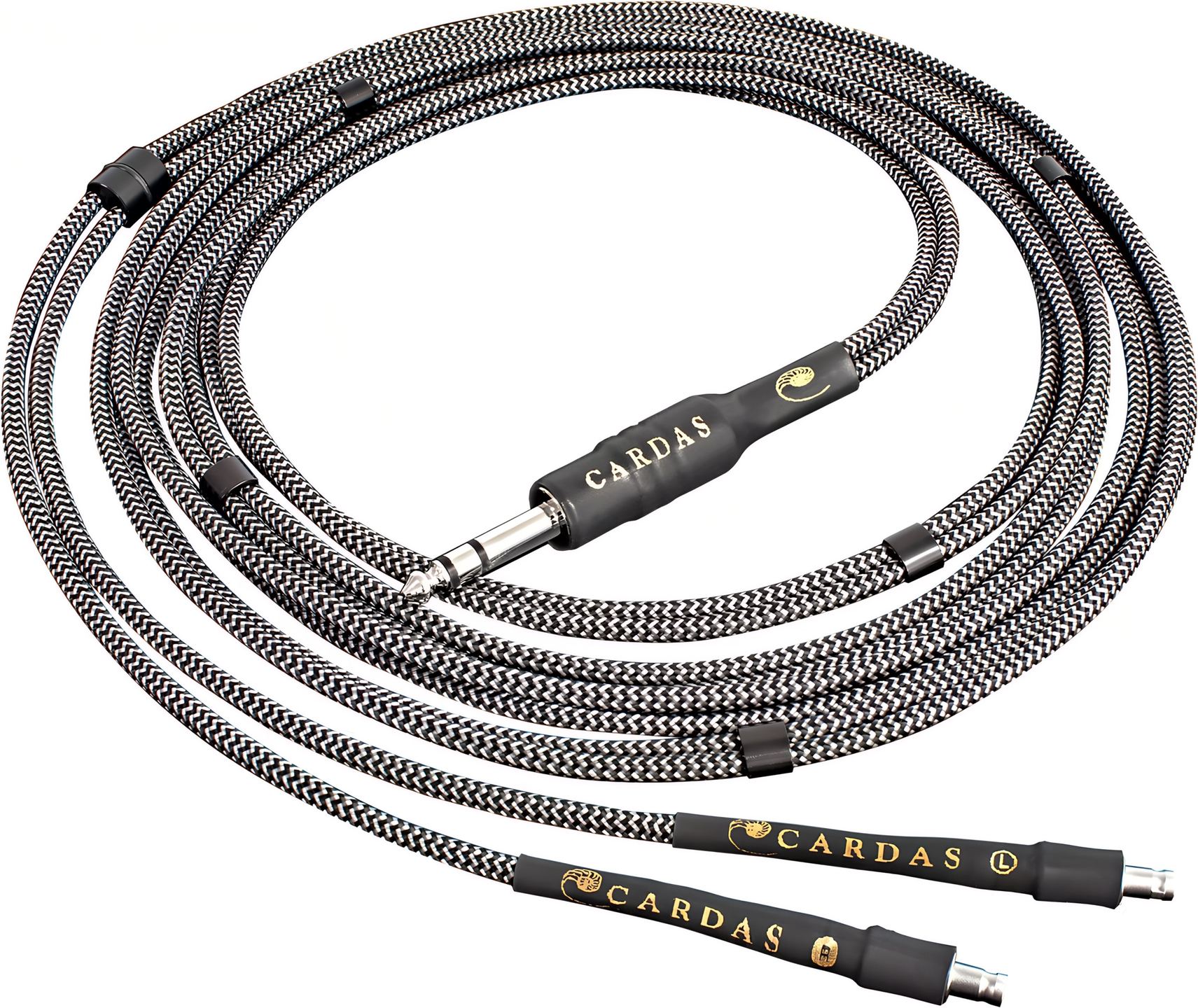
The Clear Headphone by Cardas is a replacement cable for hi-fi headphones. It uses patented Matched Propagation technology and features a miniaturized dual-mono construction. This model is designed to ensure a proper connection for high-end headphones.
Meticulous construction for maximum transparency
The Clear Headphone employs a fully dual-mono configuration, with two cables completely isolated from each other, one for each channel. This complete physical separation eliminates any crosstalk between channels and preserves the integrity of the headphone’s stereo separation.
The conductors use 99.9999% pure OFC (Oxygen Free Copper), produced to Cardas’s proprietary specifications. This Grade 1 copper undergoes a special manufacturing process that makes it particularly supple and ductile. Each conductor comprises eight strands of 26.5 AWG, for a total of 8×26.5 AWG per channel. The individual strands are sized according to the proportions of the golden ratio, the finest at the center and the thickest toward the outside.
The Litz construction coats each individual strand with a transparent insulating varnish (SPN - Single Polyurethane Nylon), preventing copper oxidation and eliminating interference between adjacent strands. Initially developed for high-frequency applications, this technique helps maintain the cable’s electrical characteristics over time.
A central Kevlar fiber core optimizes signal propagation while offering remarkable mechanical strength. The conductors are twisted into pairs using a patented Crossfield geometry, then surrounded by anti-static air tubes made of low-density polyethylene (LDPE). These tubes are held together by a carbon-impregnated PTFE tape that dissipates static charges.
Matched Propagation technology tailored for headphones
Developing the Clear Headphone took several years of research to adapt Matched Propagation technology to the dimensional constraints of a headphone cable. This technology addresses a fundamental problem identified at the dawn of telephony: the electrical signal propagates at a speed close to that of light in the conductor, but the surrounding dielectric responds about 30% more slowly.
This time offset causes a “smearing” of the signal, particularly audible on transients and fine details. Telephone companies used loading coils (Pupin coils) to compensate for this effect over long distances. Cardas’s solution is to control the conductor’s internal geometry to slow the signal’s propagation and align it with that of the dielectric, without additional components.
In the Clear Headphone, this synchronization is achieved by precisely controlling the winding angle and pitch of each layer of strands around the Kevlar core. The chosen dielectric materials—FEP (fluorinated ethylene propylene) and PTFE (polytetrafluoroethylene)—exhibit fast dissipation rates that minimize energy storage in the cable.
Sophisticated shielding and professional finish
An outer layer of PTFE air tubes, sized 1.618 times larger than the central tubes (again the golden ratio), keeps the composite shield at an optimal distance from the signal-carrying conductors. This shield combines 42 AWG tinned copper with magnet wire, providing effective protection against electromagnetic interference without adding parasitic capacitance.
The outer jacket in TPR (thermoplastic rubber) remains flexible even after years of use. Its special formulation resists skin oils and UV. A black-and-white nylon braided sleeve covers this jacket, adding extra mechanical protection while making the cable easy to identify visually.
The two mono conductors are held together by several black anodized aluminum pieces, laser-engraved with Cardas’s signature nautilus logo. A machined Delrin splitter can slide along the cable to accommodate different headphone sizes and user morphologies.
The final outer diameter of each conductor is 4.31 mm, a balance between flexibility and electrical performance. Despite this generous cross-section and reinforced shielding, the cable remains supple enough for comfortable everyday use.
Technical characteristics
Performance
- Suitable for both symmetrical and asymmetrical headphones.
- Dual-mono construction to separate channels and preserve signal purity.
- Neutral tonal balance, natural dynamics, and exceptional detail.
- Designed for high-end headphones such as the Sennheiser HD800.
Connectors and terminations
- Standard: Cardas 6.35 mm stereo jack and Sennheiser HD800 connector.
- Other terminations available on request: XLR, 4.4 mm, dual 3-pin, etc.
Design and construction
Conductors
- Kevlar core optimized for signal transmission.
- Oxygen-free copper (99.9999% purity) with transparent SPN (Litz) coating.
- Gauges calculated according to golden ratio proportions.
Geometry
- Twisted conductors in dual-mono pairs.
- Antistatic LDPE air tubes, bound with carbon-impregnated PTFE tape.
- Outer layer: PTFE air tubes 1.618 times larger than the center tubes.
- Shielding: 42 AWG tinned copper combined with magnet wire.
Insulation and jacket
- FEP tape-wrapped dielectric.
- Ultra-flexible extruded TPR jacket for flexibility and durability.
Technical specifications
- Gauge: 8 × 26.5 AWG.
- Outer diameter: 4.31 mm.
Key benefits
- Built to Cardas reference standards.
- True dual-mono configuration for optimal isolation.
- High flexibility despite reinforced shielding and ultra-pure conductors.
- Wide range of terminations to fit nearly all high-end headphones.
Frequently Asked Questions
Is the Clear Headphone cable compatible with balanced use?
Yes, the Clear Headphone’s dual-mono construction makes it perfectly suited for balanced connections. Since the two conductors are completely isolated from each other, they can carry the positive and negative signals of each channel without interaction. Simply order the cable with the appropriate balanced terminations (XLR, 4.4 mm, etc.).
What’s the difference between the Clear Headphone and the Clear Light/Clear Reflection headphone cables?
The Clear Headphone uses a true dual-mono architecture with two separate cables, like speaker cables, whereas the Clear Light and Clear Reflection models combine both channels within a single sleeve. The Clear also employs more sophisticated Matched Propagation conductors with a concentric geometry, versus a simpler two-conductor construction for the other models.
Does the Clear Headphone change the headphone’s sound signature?
According to Cardas, the cable aims for absolute neutrality thanks to Matched Propagation technology, which preserves the temporal integrity of the signal. Users generally report improved resolution, instrument separation, and soundstage depth, without a notable tonal shift. The cable instead reveals the headphone’s intrinsic capabilities.
- Eco-contribution included in the sale price.