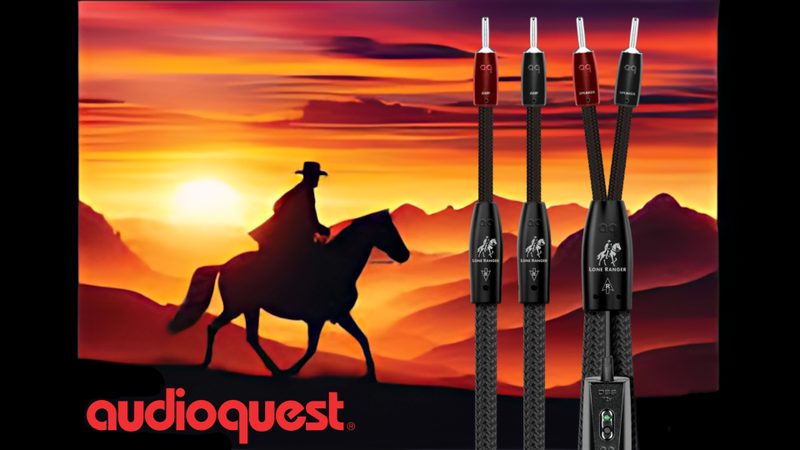
Audioquest Lone Ranger ZERO-Tech (2 x 2m) fork
Overview
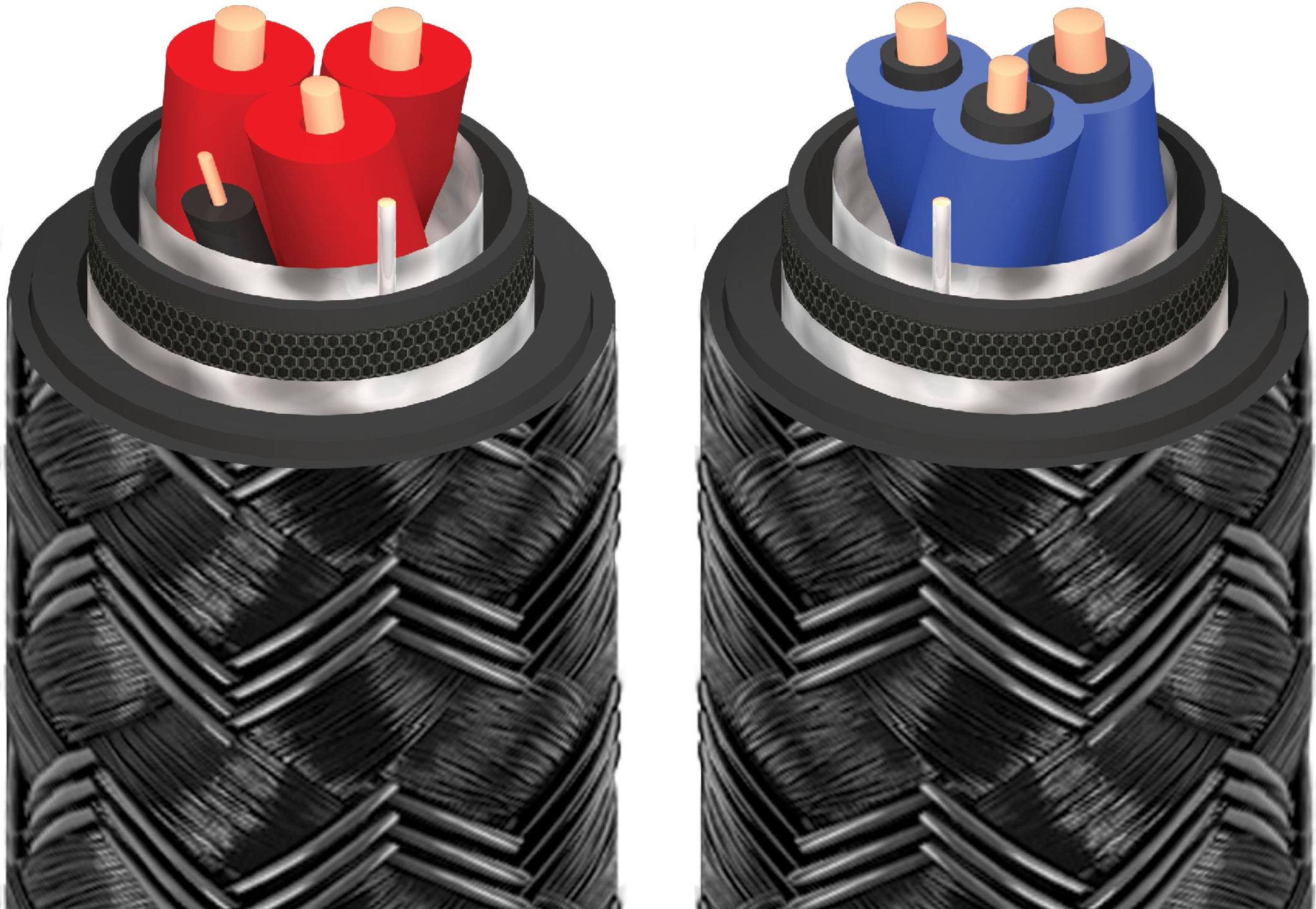
The Lone Ranger succeeds the Robin Hood model in AudioQuest’s Folk Hero series, positioned between entry-level cables and the Mythical Creatures range. Each polarity has a diameter of 11.6 mm, with a dual-housing construction separating the positive and negative conductors. The cable incorporates roughly one-third more PSC+ copper compared to previous models, in a design aimed at lowering impedance and optimizing frequency response.
ZERO-Tech technology at the heart of the design
The comprehensive method for eliminating characteristic impedance mismatches between a cable and the connected source and load components is for the cable to have no fixed characteristic impedance value. That is precisely what ZERO-Tech achieves. ZERO-Tech eliminates the electrostatic field between the cable’s high and low signal conductors, enabling linear dissipation of radio-frequency noise and uncompressed transients.
In a conventional cable, characteristic impedance creates a mismatch with the amplifier’s output impedance and the speaker’s load impedance. By removing any electrostatic interaction between the cable’s signal conductors, ZERO-Tech allows uncompressed current transfer. Transient current, crucial for musical dynamics, flows without restriction, and RF noise dissipation becomes linear across the entire frequency band.
Perfect-Surface Copper+ conductors
High-purity PSC+ copper conductors prevent strand-to-strand interaction, a major source of transient intermodulation distortion. Unlike multi-strand cables where magnetic and electrical interactions between strands generate distortions, the Lone Ranger’s solid conductors ensure more consistent signal transfer.
The Perfect-Surface technology applied to the copper minimizes surface imperfections and reduces grain boundaries in the metal’s crystalline structure. These grain boundaries are points of resistance and distortion in any metal conductor. By drastically reducing them, PSC+ copper offers increased clarity and a notable reduction in audible harshness in the high frequencies.
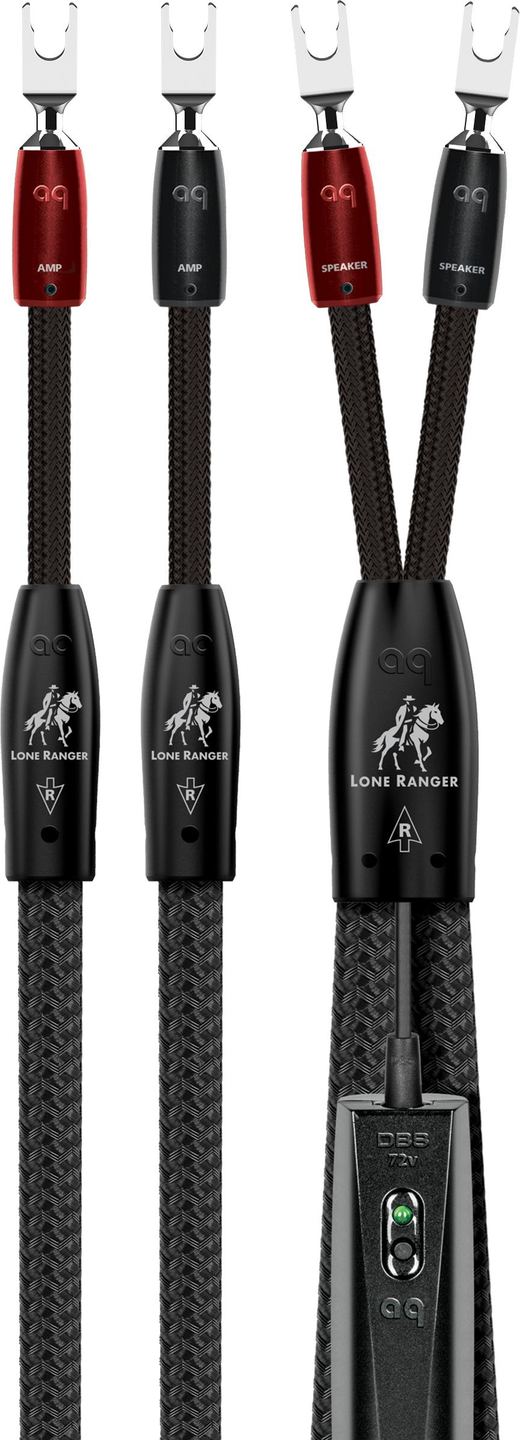
72 V DBS system with RF noise trap
The constant DC potential of AudioQuest’s 72 V Dielectric-Bias System polarizes the insulation, significantly reducing dielectric noise. A cable’s insulator acts like a capacitor: it stores energy as the signal passes, then releases it later in time and at other frequencies. This phenomenon creates a kind of temporal smearing that masks micro-details.
The DBS system also linearizes RF noise dissipation over a wide bandwidth. Powered by a battery housed in an external module attached to the cable, the system maintains a constant 72-volt charge that stabilizes dielectric properties. Unlike traditional cable break-in that requires weeks of use, DBS keeps this stabilization in place permanently.
Level 7 Noise-Dissipation
The Lone Ranger incorporates a particularly sophisticated noise-dissipation system. The cable uses a thicker carbon-loaded PVC in its construction, with an added graphene layer, and 4% silver-plated shield drain wires. This multilayer strategy targets the radio-frequency interference saturating our modern environment: cellular networks, WiFi, satellites, Bluetooth.
Direction-controlled conductors are designed to drain RF noise away from sensitive amplification circuits. Each conductor has a specific orientation, determined by listening tests during manufacturing, which optimizes noise evacuation toward the cable end where it will do the least harm. The 4% silver drain wires contribute significantly to the effective dissipation of high-frequency interference.
Physical construction and ergonomics
Slightly more compact than the Brave Heart with its 11.6 mm outer diameter versus 14.1 mm per polarity, the Lone Ranger adopts a construction that places the positive and negative conductors in separate round housings. This approach offers several advantages: easier handling, reduced magnetic interaction between polarities, and simpler installation even in complex setups.
A superior polypropylene insulator linearizes and broadens the noise-dissipation bandwidth. Polypropylene features a favorable dielectric constant and dimensional stability that minimizes distributed capacitance. If not controlled, this distributed capacitance creates smeared distortion in the upper spectrum.
The black-on-black braided nylon outer jacket protects the assembly while conveying a discreet aesthetic. There is no metal in the cable dressings or plug bodies, which would otherwise re-emit and capacitively couple RF noise back into the cable.
Cold-welded connectors
Cold-welded connections avoid introducing heat and distortion-causing materials such as solder. In a cold-welding process, bare copper parts are dipped in a bath of pure silver rather than tumbled in an inferior solution. This method creates a gas-tight connection that preserves signal integrity.
Connectors are available as banana plugs or spades, all in silver-plated red copper. The choice between bananas and spades often depends on the type of terminals on the amplifier and speakers. Terminals compliant with European standards can sometimes make it difficult to tighten spade lugs with high pressure, in which case bananas are the best choice.
Permanent Molecular Optimization (PMO)
By optimally and efficiently applying a high-frequency alternating signal far beyond what any audio system could deliver over any duration, transient intermodulation distortion and the cable break-in process are significantly reduced. This extreme treatment of dielectric materials, performed at the factory, permanently alters the insulator’s properties.
The result: the cable delivers its best performance from first use, without requiring weeks of break-in. Whereas some cables need hundreds of hours to reach their full potential, the Lone Ranger provides transparency and musicality immediately.
Comparison with Robin Hood
The Lone Ranger succeeds Robin Hood, a popular model in the Folk Hero series. The main improvements concern the amount of conducting metal, the optimized polypropylene insulation, and additional layers of noise dissipation. The Lone Ranger uses a thicker carbon-loaded PVC, an added graphene layer, and 4% silver shield drain wires, whereas Robin Hood used a less elaborate shielding strategy.
These evolutions translate into lower background noise, better definition in the bass, and more precise articulation of the midrange and treble. The Lone Ranger retains Robin Hood’s general approach—solid PSC+ conductors, ZERO-Tech, 72 V DBS—while refining every aspect of the design.
Technical Specifications
Main Specifications
- Connector configuration: 500 series silver spade fork
- Jacket: black-on-black braided nylon
- Conductors: Perfect-Surface+ solid copper (PSC+)
- Cross-section: 14 AWG (2.08 mm²)
- Geometry: ZERO-Tech (no characteristic impedance)
- RF dissipators: 4% solid silver conductors
- Bias system: 72V DBS with RF noise trap
- Noise dissipation: level 7 (graphene + carbon shielding)
- Connectors: silver-plated red copper, cold-welded
- Color: black
Technologies and Innovations
- ZERO-Tech (no characteristic impedance technology)
- Eliminates impedance mismatch effects between source and load
- Ensures current transmission without compression or distortion
- Perfect-Surface+ copper conductors (PSC+)
- Reduction of strand-interaction distortion
- Exceptional sonic clarity and smoothness
- 72V DBS dielectric-bias system with RF noise trap
- Biases the dielectric for optimal stability
- Reduces noise and stabilizes RF dissipation across a wide bandwidth
- Level 7 linear noise dissipation
- Graphene and carbon-based shielding
- ZERO-Tech technology and directional conductors
- Minimizes external RF noise
- 4% silver RF dissipators
- Improve high-frequency interference dissipation
- Efficiently drain noise away from sensitive circuits
- Permanent Molecular Optimization (PMO)
- Extreme material treatment
- Improves transparency and musicality from first use
- Directional design
- Conductors oriented for optimal RF noise drainage
Acoustic Performance
- Signal transmission without compression or distortion
- Tighter and better-controlled bass
- More articulate and detailed midrange
- More precise and extended treble
- Drastic reduction of high-frequency noise and distortion
- Exceptional transparency and musicality
Construction and Connectivity
- Cold-welded silver-plated red copper connectors
- Connection without heat or solder
- Avoids distortion and preserves signal purity
- Available in spade fork version
- Robust, flexible, and durable construction
- Black-on-black braided nylon jacket
- Bi-wiring compatible with the future BigFoot BASS cable (planned for 2026)
Compatibility
- Passive speakers: bookshelf, tower, surround
- Stereo or monoblock amplifiers
- Integrated amplifiers and AV amplifiers
- 2-channel Hi-Fi and home theater systems
Box Contents
- 1 AudioQuest Lone Ranger ZERO-Tech speaker cable
- Spade fork connectors
- AudioQuest documentation and warranty certificate
General Information
- Package dimensions (L × W × H): 30.5 × 38.7 × 7.6 cm
Frequently Asked Questions
What’s the difference between banana plugs and spade lugs for this cable?
Banana plugs offer quick insertion and removal, particularly suitable for amplifiers whose terminals don’t allow strong clamping. Spade lugs generally enable a tighter, more stable connection, but some terminals compliant with European standards make their use difficult. AudioQuest offers U-shaped spades that fit any type of terminal when there’s uncertainty.
Does the DBS system require a battery replacement?
The DBS module contains a battery that maintains the dielectric bias charge. This battery lasts several years under normal use. When replacement is necessary, AudioQuest provides spare batteries and instructions to perform the operation easily.
Can I use the Lone Ranger for bi-wiring right away?
A single Lone Ranger can power a bi-wireable speaker using jumpers between terminals. For optimal bi-wiring, you’ll need to wait for the BigFoot BASS cable to launch in early 2026. Pairing Lone Ranger on the highs with BigFoot on the lows will fully leverage compatible speakers. Using two Lone Ranger cables in parallel is not recommended due to possible high-frequency resonances.
Does PMO treatment make cable break-in unnecessary?
The factory-applied PMO treatment greatly reduces the typical break-in time. The cable reaches a high performance level right after installation. Some users nevertheless report subtle improvements after a few dozen hours, but these changes remain minor compared to what’s observed with untreated cables.
How do I determine the cable’s directionality for installation?
The Lone Ranger’s conductors are directional to optimize RF noise evacuation. Clearly marked arrows on the connectors indicate the installation direction: they point from the amplifier to the speakers. This orientation, determined by listening tests during each batch’s manufacture, ensures optimal interference dissipation.
Is the Lone Ranger suitable for tube amplifiers?
The Lone Ranger works perfectly with tube amplifiers. Its low impedance and ZERO-Tech design help the amplifier—tube or solid-state—transfer the signal to the speakers with less compression. Tube amps, often sensitive to load impedance, can particularly benefit from the cable’s no-characteristic-impedance approach.
- Eco-contribution included in the sale price.
- Manufacturer reference: LRANGER02SM
- GTIN / EAN: 92592199392