Sonoro Orchestra slim (Gen.2) Black (pack of 2)



Complementary product
Overview
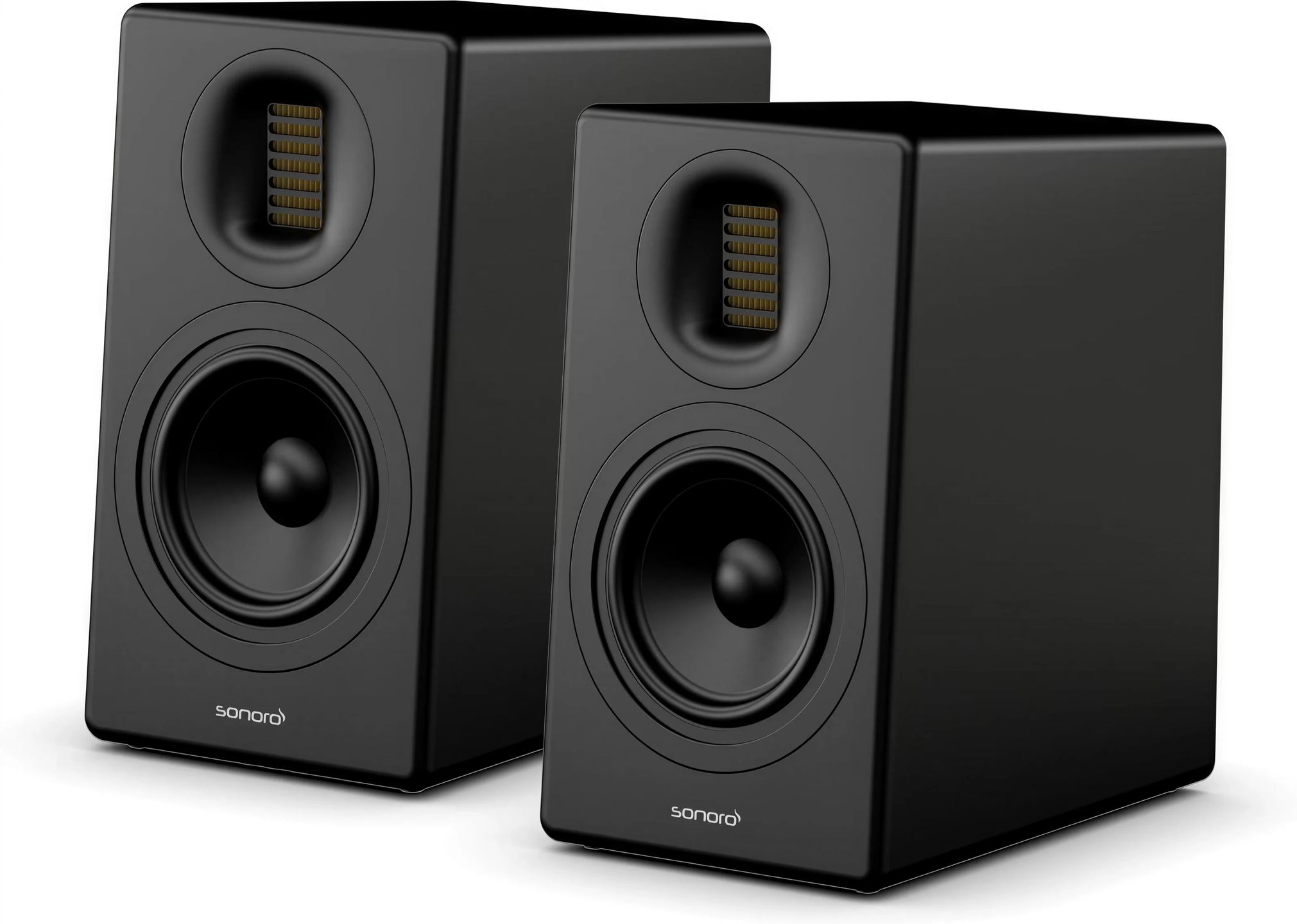
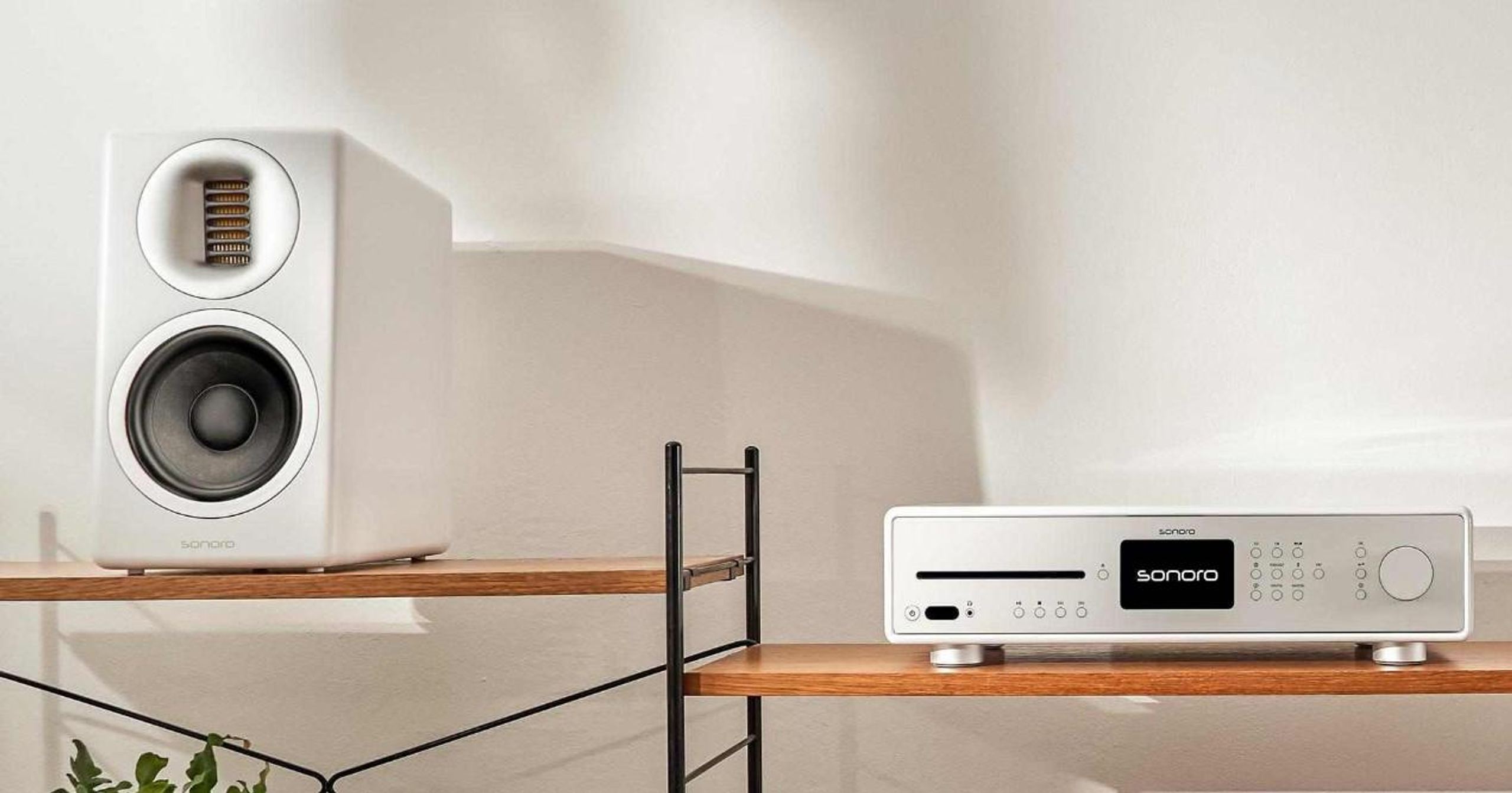
The second generation of the Orchestra Slim is an evolution of the previous model. It features a revised crossover and a mid-bass cone reinforced with Kevlar and bamboo, which impacts soundstage reproduction and register separation. Designed in Neuss, Germany, this two-way bass-reflex speaker with an AMT tweeter is suitable for rooms up to 30 m², while maintaining compact dimensions and a refined finish.
A composite cone that makes the difference
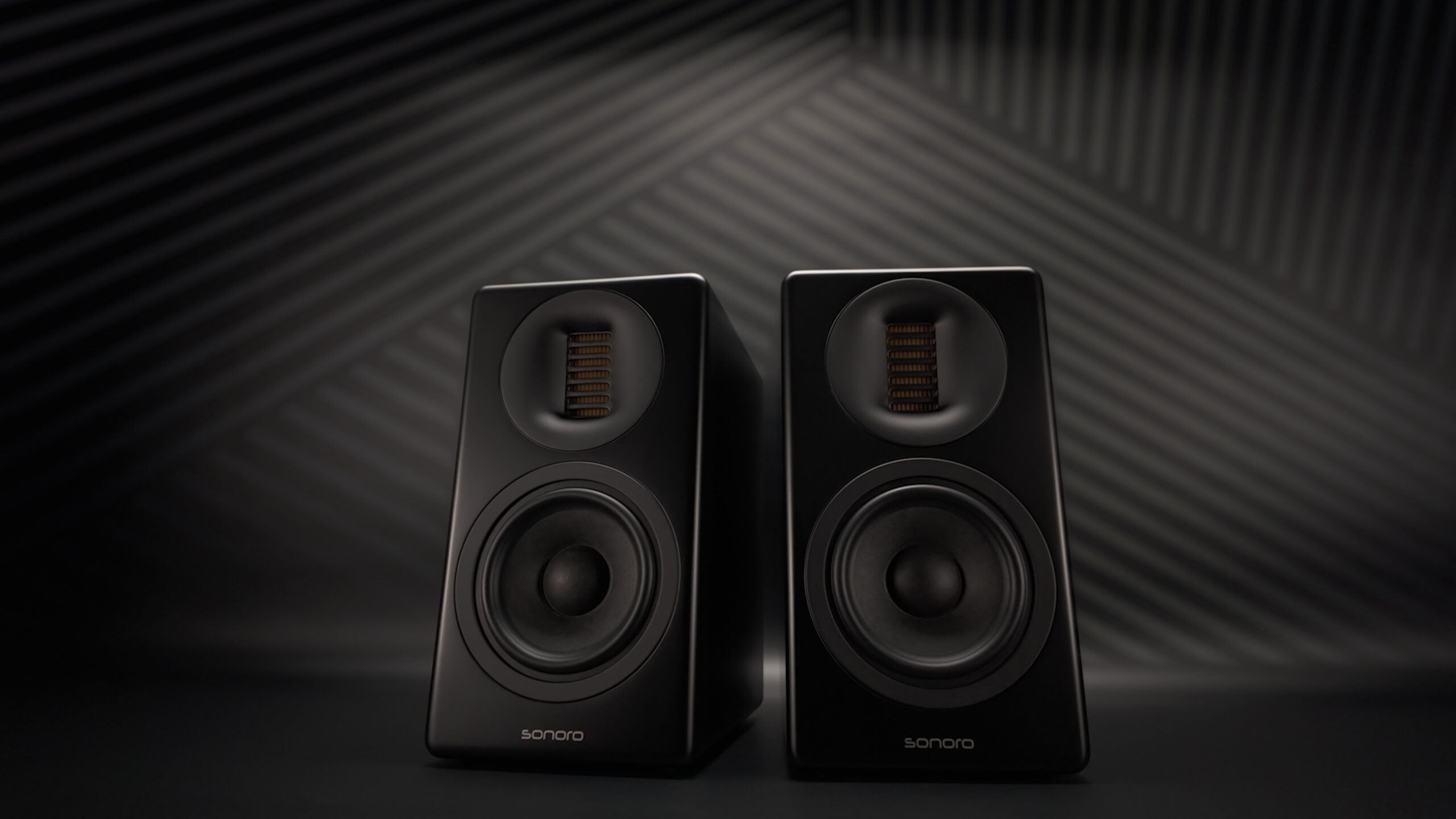
The Orchestra Slim Gen.2 mid-bass driver is based on an uncommon assembly. Its 5.25-inch (13.3 cm) cone combines paper, bamboo, and Kevlar fibers in a composite structure designed to optimize rigidity while limiting unwanted resonances. This combination is not just a cosmetic addition: Kevlar provides mechanical strength that minimizes deformation during fast movements, while bamboo contributes lightness, aiding speed. Paper, for its part, helps with internal damping and contributes to the driver’s tonal character.
This three-layer structure effectively reduces unwanted vibrations that can impair clarity, especially in the midrange where most human voices sit. The cone is mounted in a die-cast chassis, ensuring increased mechanical stability even under heavy load. The result is a midrange reproduction with greater definition and improved intelligibility of instrumental and vocal textures.
Compared to the first generation, this optimized cone offers a more linear frequency response in the lower spectrum. Frequency variations are attenuated, resulting in superior coherence between bass and mids. The transition to the AMT tweeter occurs at 2800 Hz, a crossover point chosen to prevent the mid-bass from operating in a region where its directivity degrades.
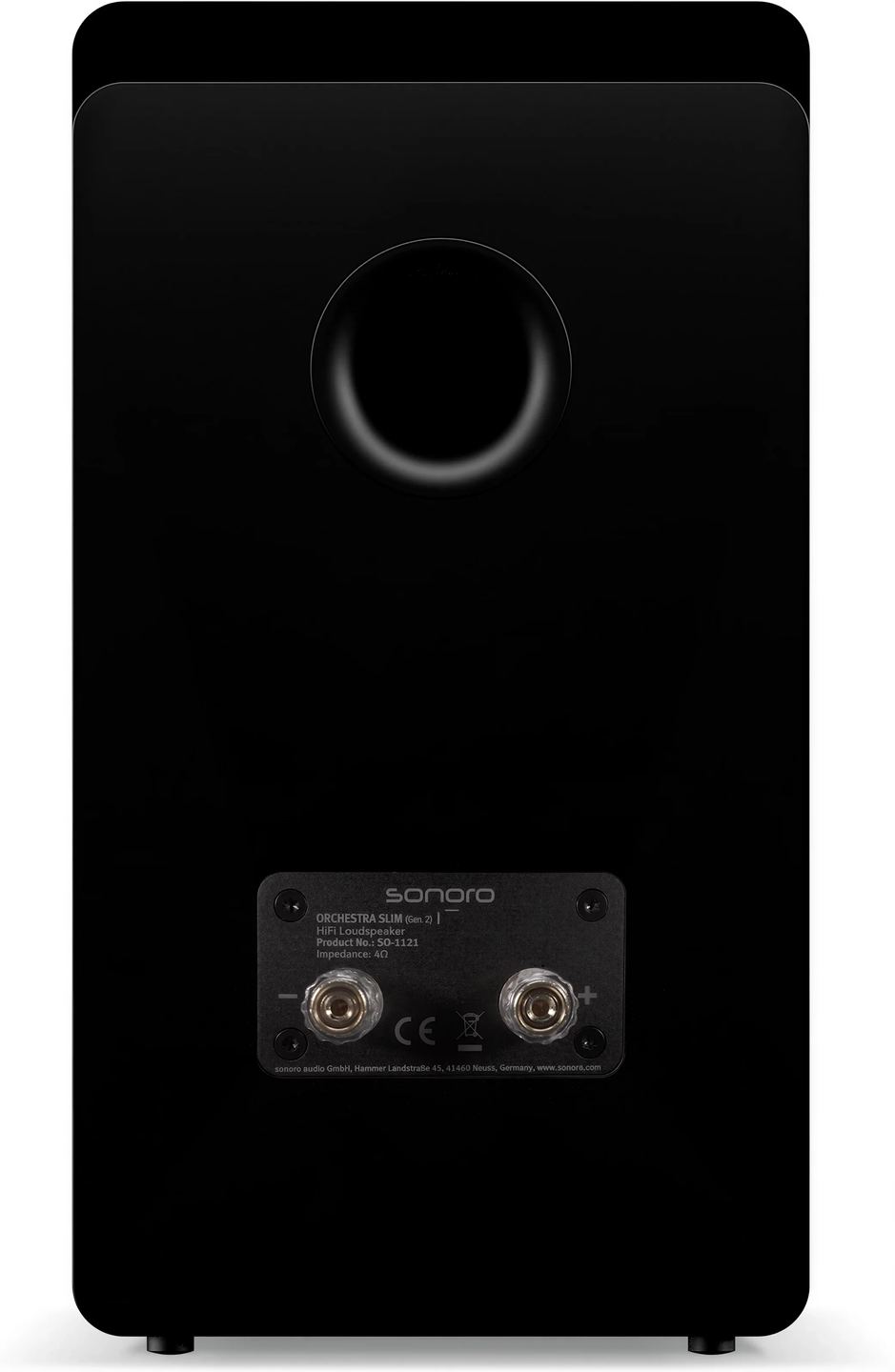
The rear tubular bass-reflex port extends bass response down to 45 Hz (-6 dB). A foam plug is provided to adjust the port’s impact depending on wall proximity. This is useful when speakers are placed near a wall, a situation that can excessively reinforce bass due to coupling. By partially blocking the port, this effect is reduced while maintaining satisfying low-frequency extension.
The AMT tweeter: a revisited legacy from the 1970s
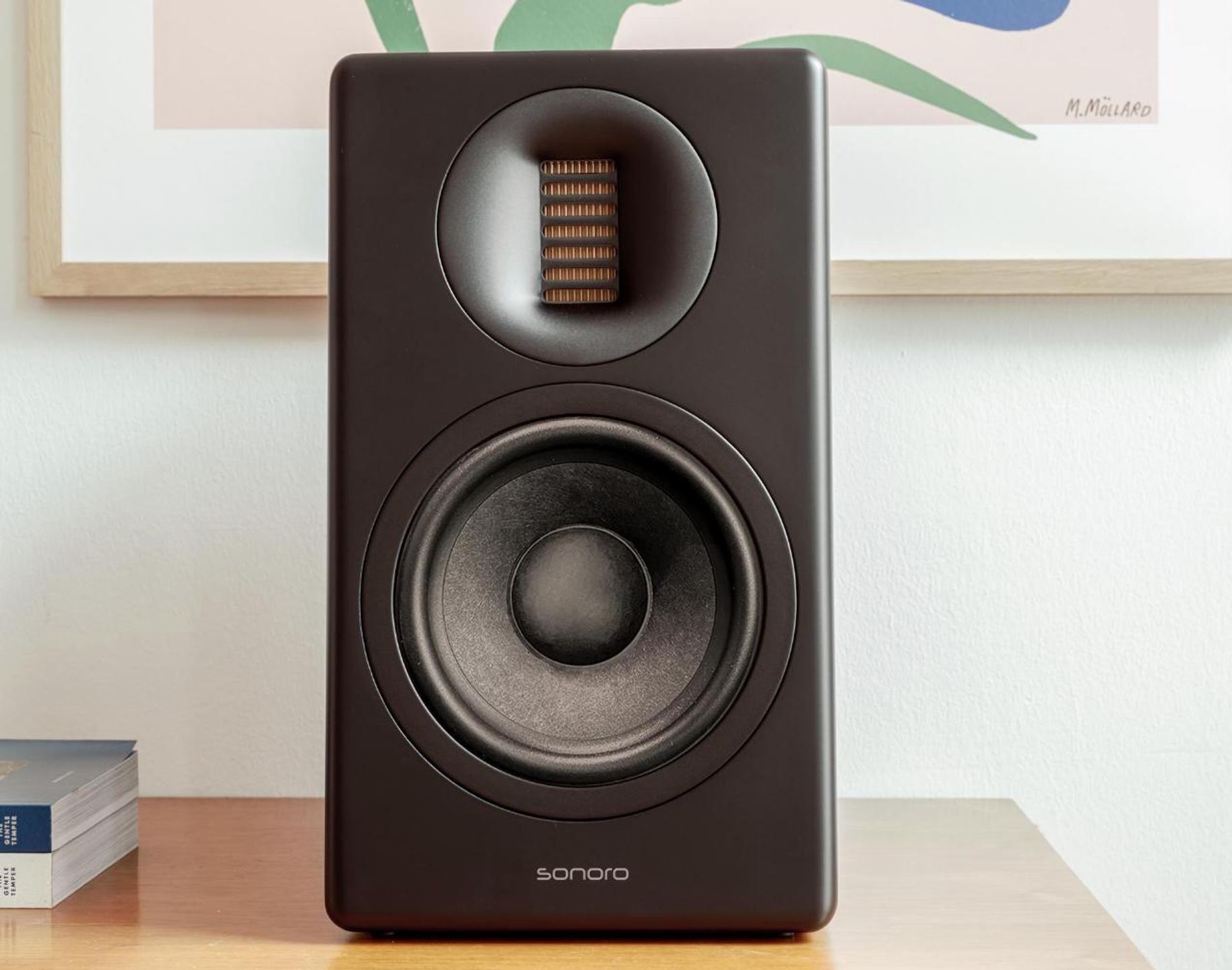
The Air Motion Transformer tweeter in the Orchestra Slim Gen.2 inherits a technology developed in the late 1970s by physicist Oskar Heil. Unlike conventional dome tweeters that operate with a front-to-back motion, the AMT uses a pleated diaphragm that behaves like a bellows. This diaphragm, made of polyester (PET) film, is traversed by an etched aluminum conductive trace. When an electrical signal passes through this trace, the diaphragm compresses and expands laterally, moving air through a pumping action.
The advantage of this design lies in the ratio between effective radiating surface and the transducer’s footprint. A 25 mm-wide AMT band offers a radiating surface comparable to that of a 200 mm dynamic cone. In the case of the Orchestra Slim Gen.2, the pleated diaphragm surface reaches approximately 85 cm². This large surface moves more air without requiring significant diaphragm excursion, which limits distortion and improves transient response.
The speed at which air is expelled by the diaphragm is about five times higher than the movement of the transducer itself, hence the name “air motion transformer.” This characteristic favors detailed high-frequency reproduction, with the ability to render rapid transients without smearing. The tweeter is integrated into a waveguide that controls dispersion and optimizes acoustic coupling with the environment. This guide contributes to a stable soundstage and wider coverage.
The tweeter’s motor uses a neodymium magnet, a material that offers high magnetic flux density in a compact volume. This configuration ensures high efficiency while keeping distortion levels low. Frequency extension reaches 32 kHz, well beyond the limit of human hearing, ensuring the useful bandwidth (up to 20 kHz) is reproduced without premature roll-off or attenuation.
A rethought crossover for greater coherence
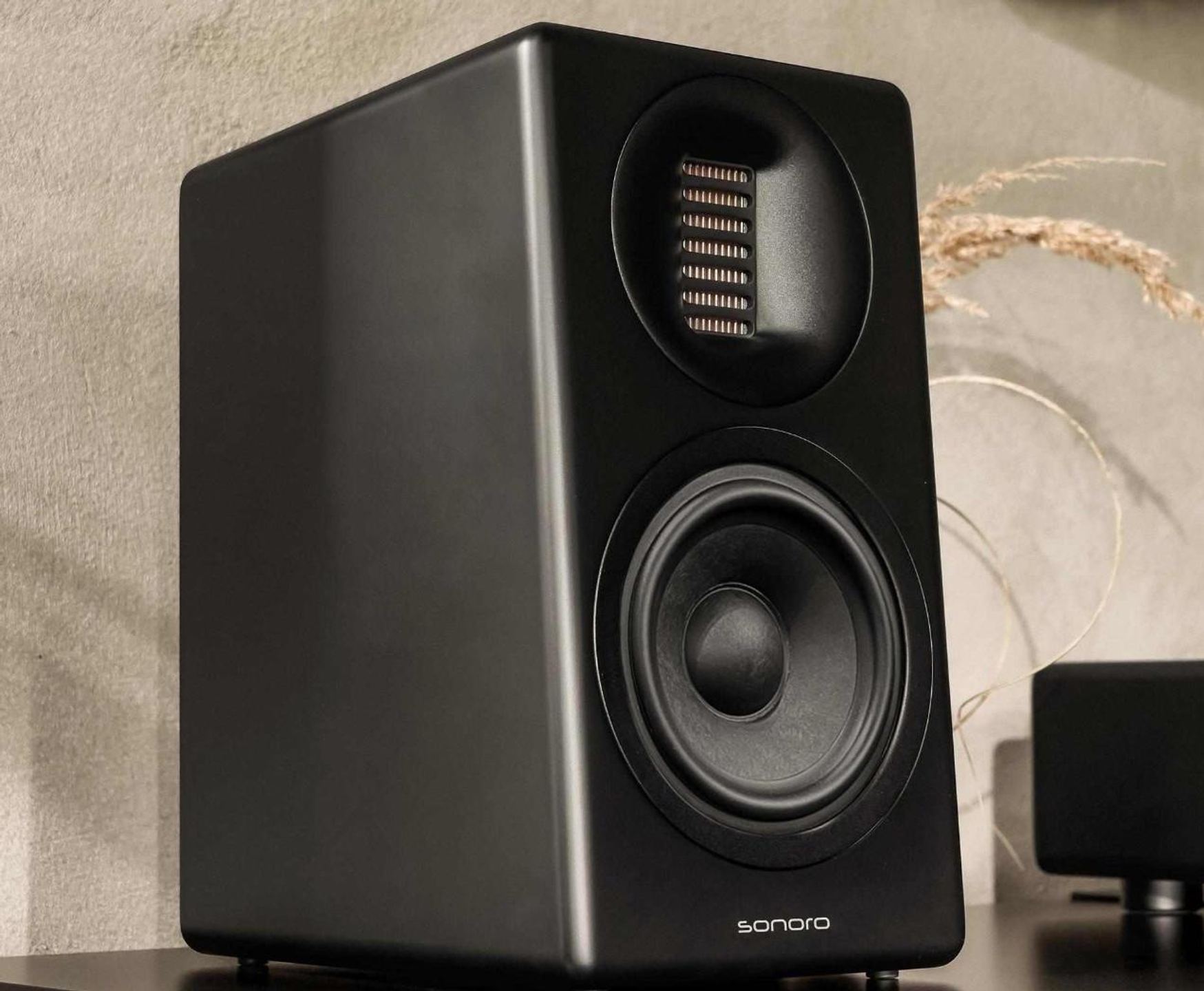
The main acoustic evolution in this second generation lies in the passive crossover that manages the transition between the mid-bass and the tweeter. This crossover determines how frequencies are divided between the two drivers. Careful design of this component is crucial for coherent phase response and to avoid dips or peaks in the overall response curve.
The new Orchestra Slim Gen.2 crossover refines the transition around the 2800 Hz cutoff. This optimization results in better tonal consistency between mids and highs, reducing temporal misalignments that can create audible artifacts, especially on voices. Vocal presence gains clarity and focus, making it easier to locate sound sources within the stereo field.
This crossover improvement also helps broaden the soundstage. The controlled dispersion of the AMT tweeter and the well-managed directivity of the mid-bass driver create an image that extends beyond the physical boundaries of the speakers. Instruments are more precisely placed, and depth increases. These qualities are particularly noticeable in acoustic recordings where spatialization plays a key role in conveying atmosphere.
The crossover components are selected for thermal stability and linearity. This attention to detail ensures acoustic characteristics remain stable even during high-level or extended listening sessions. High-quality binding posts ensure optimal signal transfer and accept large-gauge cables, making it easy to pair with a variety of amplifiers.
A natural match for Sonoro amplifiers
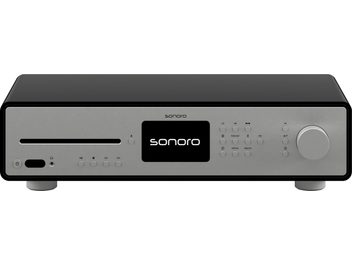
The Orchestra Slim Gen.2 has been specifically designed to pair with Maestro and Maestro Quantum amplifiers from Sonoro. These all-in-one units integrate network playback, a CD player, multiple inputs, and Class D amplification. The Maestro Quantum delivers 2 x 180 watts into 4 ohms, more than sufficient to harness the capabilities of the Orchestra Slim. This power enables comfortable listening levels in rooms up to 30 m² without straining the amplifier.
Visually, the match between the speakers and Maestro amplifiers is harmonious thanks to the identical finishes. Matte black and matte white with silver accents are found throughout the range, allowing you to build a system that’s aesthetically coherent. This visual continuity appeals to users who care about interior integration, avoiding stylistic clashes that can occur when mixing different brands.
Acoustically, the Maestro Quantum’s EQ presets are optimized for the Orchestra series speakers. The Dynamic Bass function, for example, adapts bass output according to listening volume, compensating for the ear’s variable sensitivity to low frequencies. This psychoacoustic correction maintains a satisfying tonal balance at all listening levels, from late-night low-volume sessions to more spirited listening.
Maestro amplifiers also offer extensive connectivity: FM/DAB tuner, phono input, HDMI ARC, streaming via AirPlay 2, Google Cast, Spotify Connect, Tidal Connect, Qobuz Connect, and Roon compatibility. This versatility makes the Maestro + Orchestra Slim Gen.2 pairing a complete system that meets most contemporary needs, from vinyl playback to high-resolution streaming.
Technical Specifications
Acoustic Transducers
- Woofer: 5.25-inch (13.3 cm) paper/bamboo composite driver reinforced with Kevlar, mounted in a die-cast chassis
- Tweeter: air motion transformer integrated into a waveguide
- Neodymium motor
- Diaphragm surface area of approximately 85 cm² (folded)
Electrical Specifications
- Recommended power: from 50 W
- Nominal impedance: 4 Ω
- Frequency response: 45 Hz – 32000 Hz (-6 dB)
- Sensitivity: 86 dB SPL (2.83 V RMS / 1 m)
- Crossover frequency: 2800 Hz
Enclosure Construction
- Cabinet made of high-density fiberboard with internal matrix for optimal rigidity and faithful reproduction
- Hand-sanded wooden housing with premium matte finish
Connectivity
- High-quality binding posts for optimal signal transfer
Design and Finishes
- Rounded corners and aluminum accents for an elegant aesthetic
- Flush-mounted drivers with no visible screws
- Compact dimensions for easy installation in any environment
Scope of Delivery
- 1 pair of ORCHESTRA Slim speakers (Gen. 2)
- User manual and safety instructions
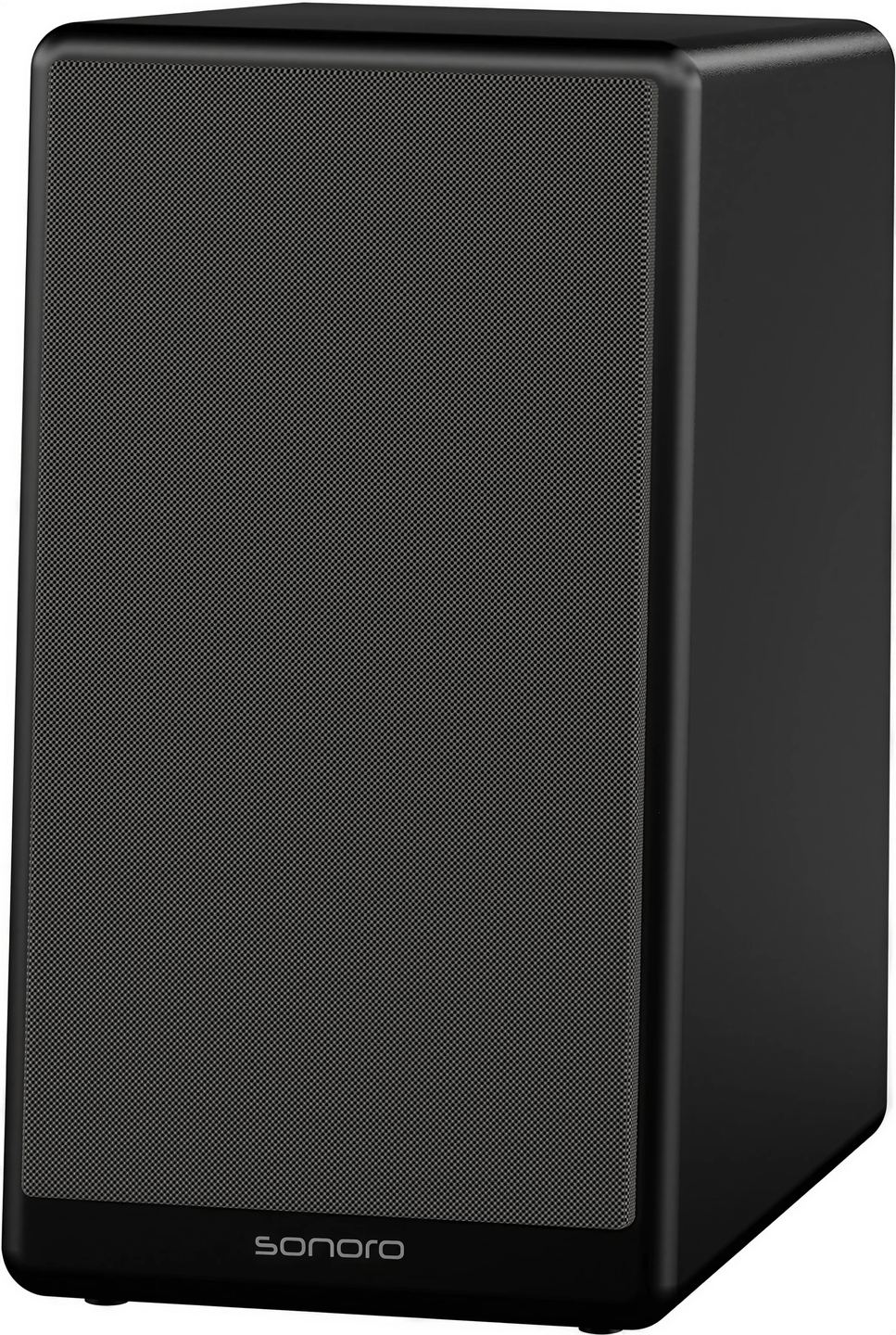
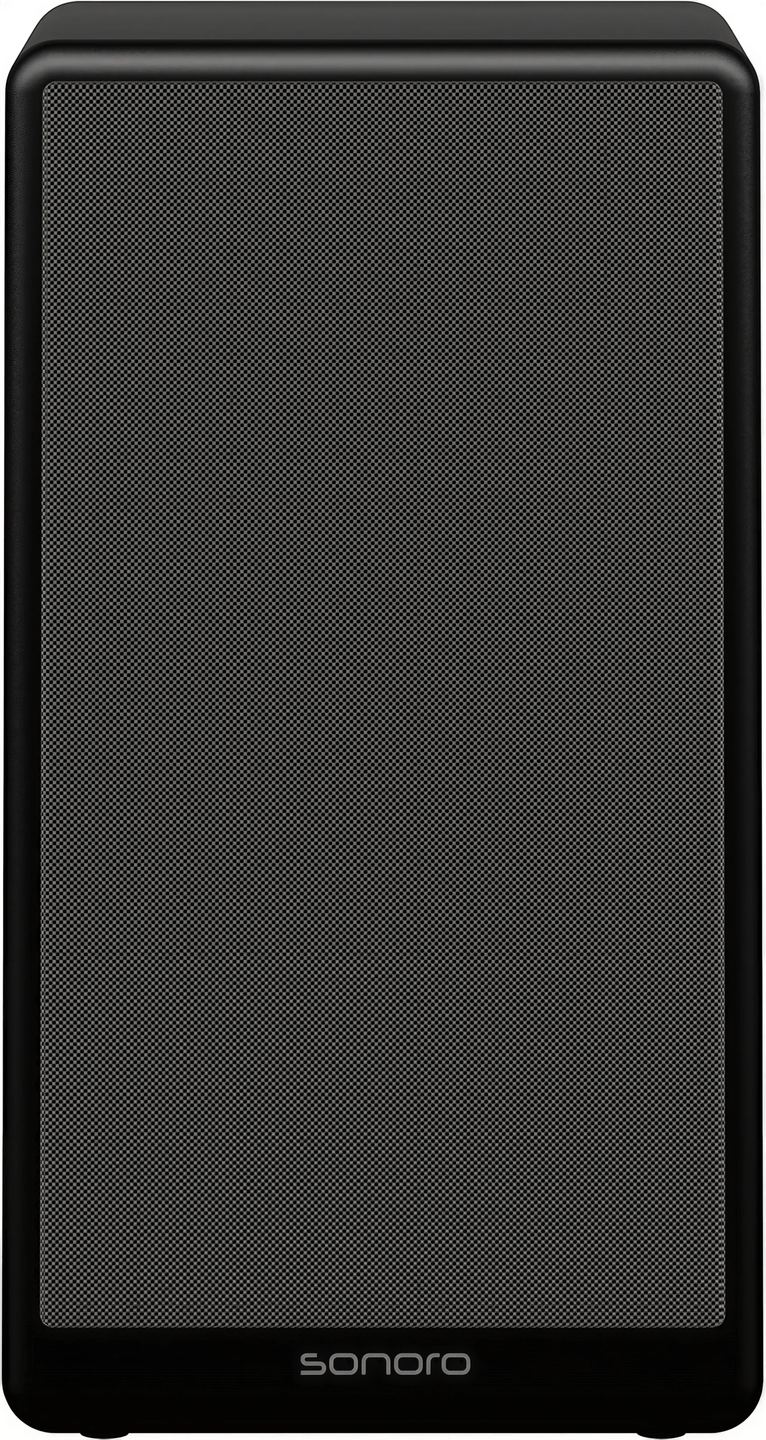
- Removable protective grilles
- Foam plug for bass-reflex port
General Information
- Designed and developed in Germany
Frequently asked questions
What is the minimum amplification required for the Orchestra Slim Gen.2?
The recommended power starts at 50 watts into 4 ohms. This is a minimum to achieve comfortable listening levels, but these speakers can easily handle more generous amplification. The Sonoro Maestro and Maestro Quantum amplifiers, with their 170 to 180 watts into 4 ohms, provide comfortable headroom that lets the speakers’ dynamic potential fully unfold in rooms up to 30 m².
How does Gen.2 differ from the first generation?
The main improvements concern the mid-bass cone and the crossover. The cone is reinforced with Kevlar and bamboo, enhancing rigidity and reducing frequency irregularities. The new passive crossover refines the transition between mids and highs, widening the soundstage and sharpening vocal focus. These changes yield better register separation, particularly noticeable in the lower range, and a subtle balance between dynamic impact and treble finesse.
Are the Orchestra Slim Gen.2 suitable for classical music?
The AMT tweeter offers frequency extension up to 32 kHz and fast transient response—qualities that favor acoustic instruments. The composite mid-bass cone limits unwanted resonances, preserving the clarity of instrumental textures. The 2800 Hz crossover ensures a smooth handoff between drivers, avoiding timing offsets that can undermine tonal coherence. These characteristics make these speakers a strong choice for classical recordings, where spatialization and natural timbre are crucial.
Is it necessary to use the magnetic grilles?
The magnetic grilles protect the drivers from impacts and dust, but their use is optional. Some listeners prefer to remove them for a more direct look at the drivers. Acoustically, the grilles’ impact on frequency response is minimal thanks to their permeable design. The high-quality fabric allows sound waves to pass without significant attenuation in the treble. The choice to keep or remove the grilles is therefore more about aesthetics than sound.
Can these speakers be used with an amplifier from another brand?
The Orchestra Slim Gen.2 are standard passive speakers that work with any amplifier capable of delivering at least 50 watts into 4 ohms. Although they were designed to pair with Sonoro’s Maestro amplifiers, there is nothing preventing you from connecting them to electronics from another brand. The binding posts accept large-gauge cables and ensure reliable signal transfer. The 4-ohm impedance does require checking that the chosen amplifier can comfortably handle this load.
What room size is recommended for these speakers?
The compact format and bass-reflex loading make the Orchestra Slim Gen.2 a good fit for living spaces up to 30 m². In such rooms, they deliver comfortable listening levels without needing outsized amplification. For larger spaces, the larger-format Orchestra or Orchestra Gen.2 models are better-suited alternatives. The 45 Hz extension allows reproduction of the fundamentals of most instruments, though a subwoofer can complement the setup for those seeking even deeper low-frequency extension.
- Eco-contribution included in the sale price.
- GTIN / EAN: 4260117330766