

Gold Note TUBE-1006 silver


Overview
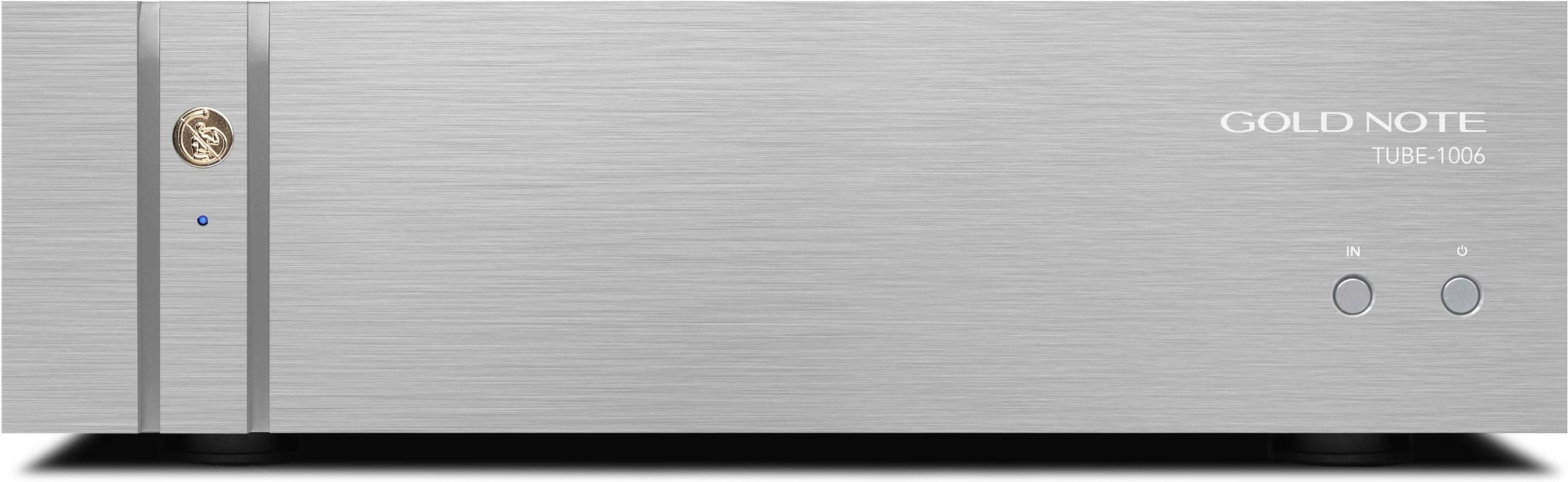
The Gold Note TUBE-1006 offers a distinctive approach: adding the sonic character of tubes to your solid-state electronics. This Class A six–6n1p-tube output stage is placed between your source and your amplifier, providing an alternative for those who seek tube warmth without giving up the control and precision of transistor circuits. Designed and manufactured in Florence by the Italian brand Gold Note, this module combines a proprietary Totem-Pole design, versatile connectivity, and a modest 50-watt power consumption.
An output stage designed for flexibility
The TUBE-1006 stands out through its function: it doesn’t replace a preamp or a power amp, but is inserted between your existing components. You can position it between a CD player, DAC, streamer, or phono preamp and your integrated amplifier. Another setup is to insert it between a preamp and a power amplifier. This versatility lets you integrate tube coloration into fully solid-state systems.
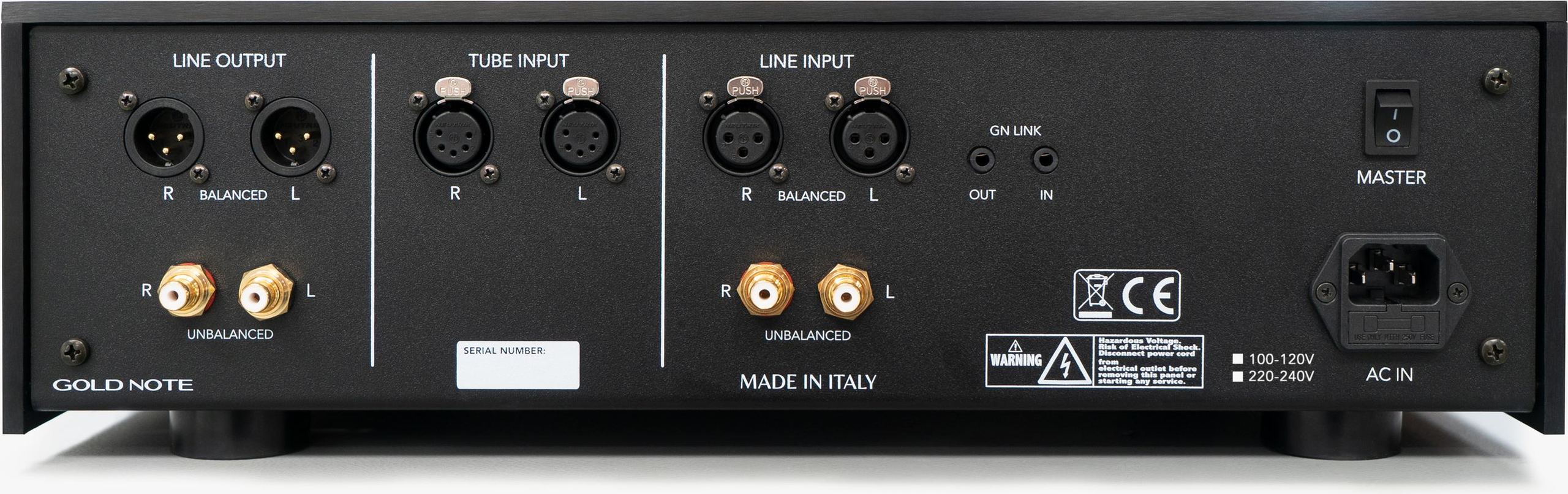
The rear panel provides three types of connections. The Tube input, via a 5-pin XLR connector, is reserved for compatible Gold Note sources (CD-1000, DS-1000, P-1000, PH-1000 phono preamp). This proprietary link handles both input and output simultaneously, simplifying cabling. The other two inputs, one balanced XLR and one unbalanced RCA, accept any external source. A front-panel selector lets you switch between these inputs; the power LED changes from blue (Tube Input) to green (Line Input). This design allows two sources to be connected at once, although only one can be active.
Gold Note has also provided a GN Link connection system enabling power on/off synchronization with other devices from the brand in a master/slave configuration. A dedicated Mute button completes the ergonomics.
Totem-Pole design and its six Russian tubes
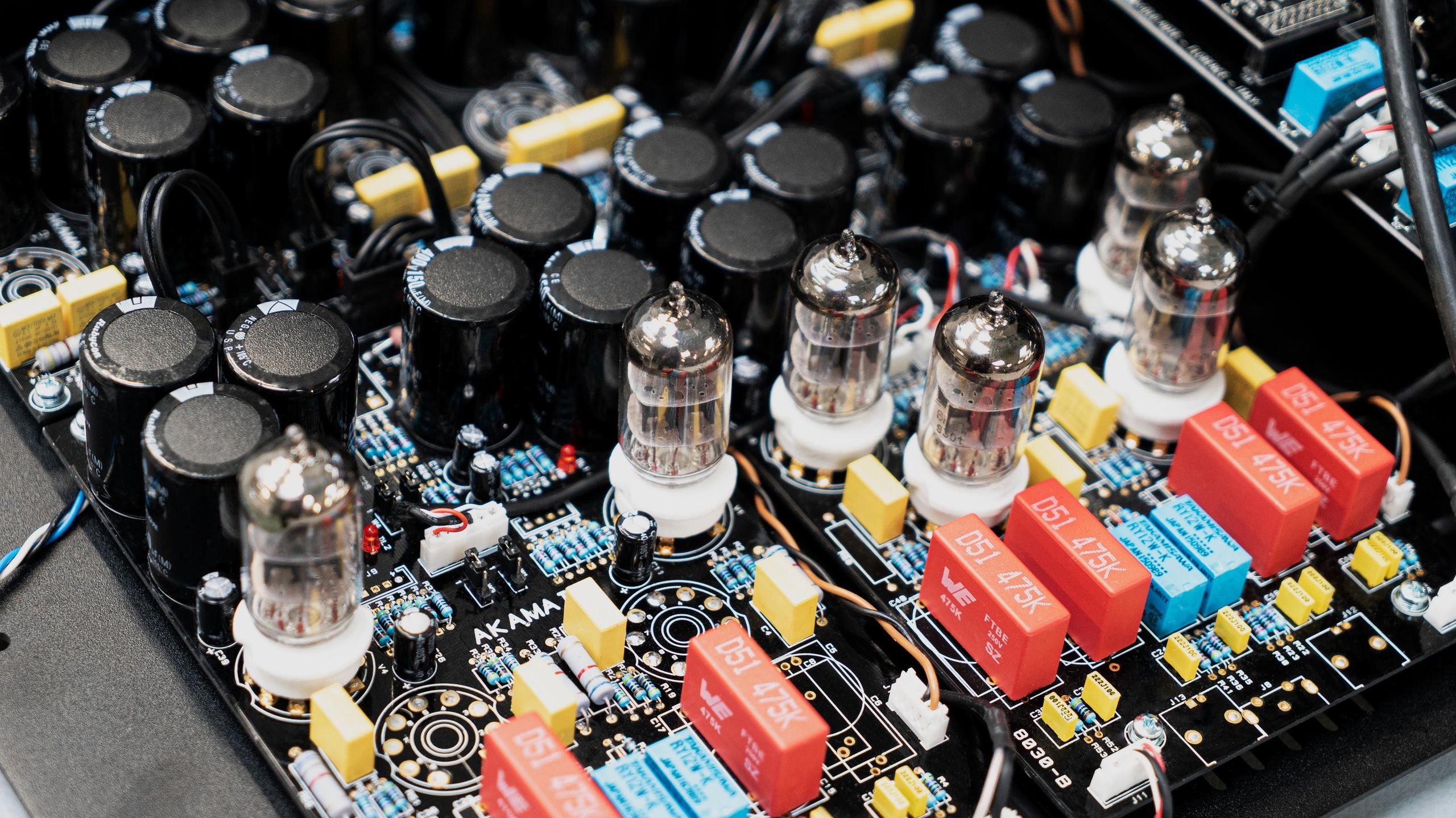
At the heart of the TUBE-1006 is a topology called Totem-Pole, a push-pull configuration where the stages are stacked. Unlike conventional designs, this configuration delivers six independent audio stages per tube, ensuring wide bandwidth and minimal distortion. Of the six 6n1p tubes in the unit, four are allocated to the audio signal path while two feed the drivers. The entire circuit operates in Class A, a class renowned for its linearity.
The brand emphasizes the absence of coupling transformers at the input and output, a technical choice that reduces potential coloration while preserving transparency. The power supply uses two custom Gold Note transformers arranged in a Dual Mono configuration, complemented by a third transformer dedicated to the service stage, isolated from the audio path. This separation limits interference and noise.
The 6n1p tubes are worth a closer look. Developed in the USSR, these miniature nine-pin dual triodes offer a moderate gain of around 35, very low distortion, and a lifespan of up to 5,000 hours in their ruggedized versions (6n1p-EV). Their cathode, larger than that of western 6DJ8/ECC88 tubes, gives them higher transient current capability and increased robustness. Their sonic signature, often described as warm and musical, contrasts with the more analytical character of many European tubes. The absence of power tubes in the TUBE-1006 reduces heat generation and eliminates the need for any bias adjustment, simplifying maintenance.
Measured performance and recommended load
The TUBE-1006’s technical specifications reflect meticulous engineering. Total harmonic distortion plus noise is just 0.0028% at 1 kHz for a 1.736 Vrms signal, a remarkably low figure. The signal-to-noise ratio exceeds 100 dB under the same conditions, ensuring a silent background. The added gain is 2 dB, a subtle change that preserves the balance of the system.
The output impedance of less than 600 Ω mates ideally with loads above 10 kΩ, compatible with most amplifiers and preamps on the market. Maximum input levels are 12 Vrms on XLR and 6 Vrms on RCA, while the outputs can deliver up to 16 Vrms on XLR and 8 Vrms on RCA. These generous values suit both modern high-output sources and more traditional setups.
Power consumption of 50 watts remains modest for a tube device, thanks to the absence of power tubes. This frugality makes it easier to integrate into systems where every watt counts, particularly in multiroom setups or smaller spaces.
When to choose the TUBE-1006 over the TUBE-1012
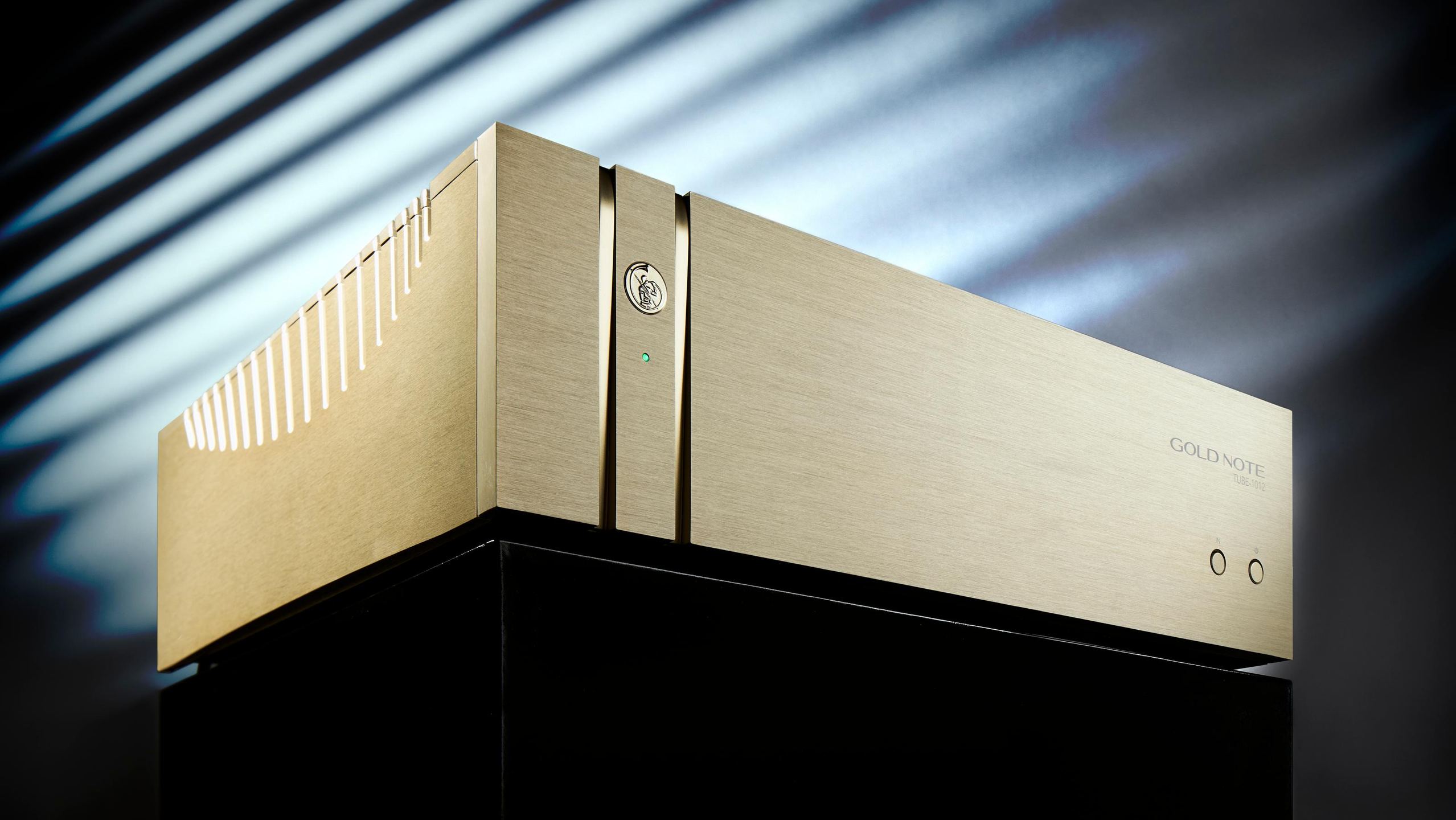
Gold Note offers two versions of this stage: the TUBE-1006 with six tubes and the TUBE-1012 with twelve. The higher-end model delivers more tube “quality,” according to the brand, with eight tubes devoted to the audio signal, four to the drivers, and a more sophisticated power supply incorporating a super-linear vacuum regulator with four inductive choke filters. Its power consumption rises to 80 watts and its weight to 16 kg.
The TUBE-1006 is the rational choice for those who want to experience tube sound without overhauling their system. Its moderate thermal and electrical footprint, its footprint identical to other components in the Series 10, and its more accessible price make it a coherent entry point. The TUBE-1012 is aimed at enthusiasts wishing to maximize the influence of tubes, at the cost of greater complexity and investment.
Broad compatibility beyond the Gold Note ecosystem
Although originally designed to enhance Gold Note sources via the proprietary Tube input, the TUBE-1006 connects easily to any brand thanks to its XLR and RCA line inputs. This openness significantly broadens integration possibilities. Owners of a Cambridge Audio DAC, a Marantz CD player, or an iFi streamer can thus add tube color with no constraints. Likewise, the unit pairs well with integrated amplifiers from Naim, Rega, Atoll, or any other manufacturer offering pre-in or standard line inputs.
This universality sets the TUBE-1006 apart from all-in-one solutions where tubes and electronics form an inseparable whole. Here, the addition is optional and reversible: simply remove it from the system to restore the original sound. This modularity appeals to those who enjoy experimenting with different configurations without investing in an entirely new system.
Documentation
Technical specifications
Audio performance
- Maximum input
- 12 Vrms on XLR
- 6 Vrms on RCA
- Maximum output
- 16 Vrms on XLR
- 8 Vrms on RCA
- Output impedance: < 600 Ω
- Recommended load: > 10 kΩ
- THD+N: 0.0028% at 1 kHz – 1.736 Vrms
- Signal-to-noise ratio: > 100 dB at 1 kHz – 1.736 Vrms
- Gain: 2 dB
Audio connections
- 1 balanced stereo XLR input
- 1 unbalanced stereo RCA input
- 1 Tube input (5-pin XLR for Gold Note sources only)
Tubes and transformers
- Tube type: 6n1p × 6
- Transformers: No coupling transformer on input/output
Power supply
- Power consumption: 50 W
- Power supply: 100-120 V or 220-240 V, 50 / 60 Hz
- 220 / 240 V fuse: 2 A fast-blow
- 100 / 120 V fuse: 3.15 A fast-blow
Dimensions and weight
- Dimensions: 430 mm (W) × 135 mm (H) × 370 mm (D)
- Weight: 13.3 kg net, 19 kg packaged
Frequently Asked Questions
Does the TUBE-1006 work only with Gold Note sources?
No. While it is designed to pair perfectly with the CD-1000 and DS-1000 players, P-1000 preamp, and PH-1000 phono preamp via the proprietary Tube input, it accepts any source thanks to its XLR and RCA line inputs. You can use it with third-party brands without limitation.
Can the TUBE-1006 be placed between a preamp and a power amplifier?
Absolutely. This is even one of the recommended configurations. You can insert it between a preamp and a power amp stage, or between a source and an integrated amplifier. This flexibility lets you integrate it into a variety of setups, depending on your system’s topology.
What sonic difference does the TUBE-1006 make compared with a fully solid-state system?
The TUBE-1006 adds the typical tube signature: warmth, texture, and a slight compression at the top of the spectrum that softens sometimes overly analytical digital sources. Timbres gain body, and the soundstage breathes more. The extent of this change depends on your existing components and on how sensitive you are to sonic differences.
- Eco-contribution included in the sale price.
- Manufacturer reference: PF-MILLE-TUB-006-S