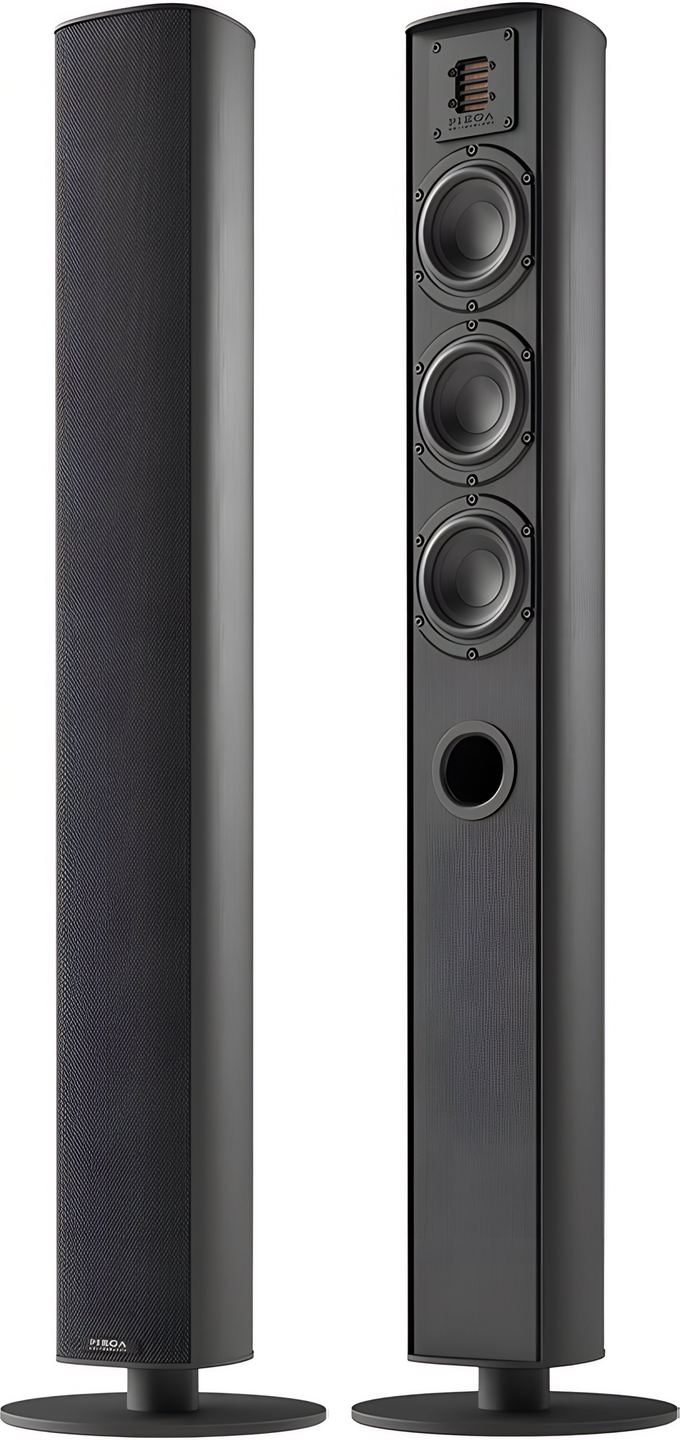
Five years after the TMicro series, Piega is renewing its entry-level range with the Ace series. The Ace 50 is the flagship model: a floorstanding speaker barely 14 cm wide, clad in aluminum and crowned with the AMT ribbon tweeter that built the Swiss brand’s reputation. Behind this slender silhouette lies a three-way system capable of competing with much bulkier speakers.
Aluminum, curves, and Swiss precision
Designer Stephan Hürlemann shaped the Ace 50 around a simple belief: it’s the music that should dress the room, not the speaker. The extruded aluminum cabinet adopts an oval profile just 14 cm wide and 16 cm deep, with no visible screws or sharp edges. This rounded shape is not just aesthetic: it more effectively absorbs internal reflections and eliminates standing waves that color the sound in traditional rectangular enclosures.
Choosing aluminum rather than traditional MDF allows the walls to be thinner while maintaining high rigidity. For the same external dimensions, the Ace 50 therefore offers a larger internal volume than a wooden speaker, which favors low-frequency extension. The circular 25 cm base, screwed onto a central pillar, slightly raises the column and emphasizes its slender profile.
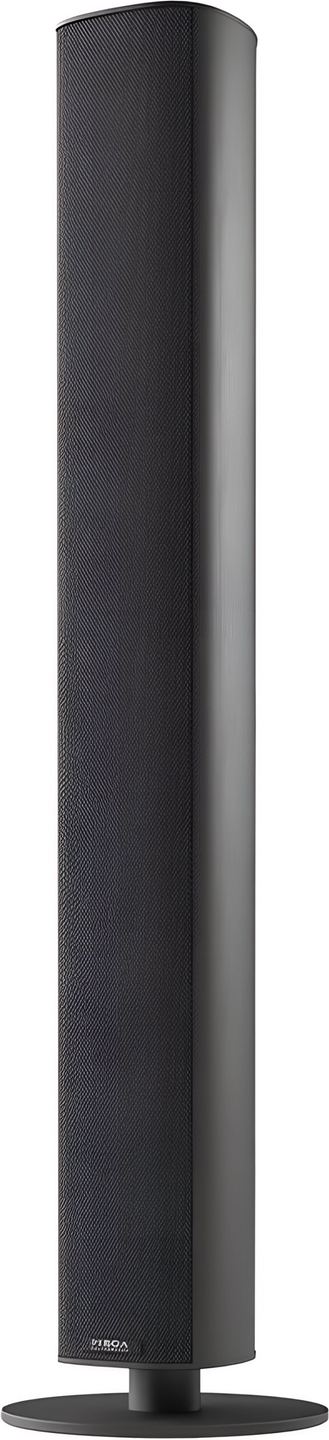
Three finishes are available in the range: natural aluminum (silver), black anodized aluminum, or glossy white lacquer. Each version comes with a matching fabric grille that blends harmoniously with the speaker’s rounded profile.
Three-way design in a compact footprint
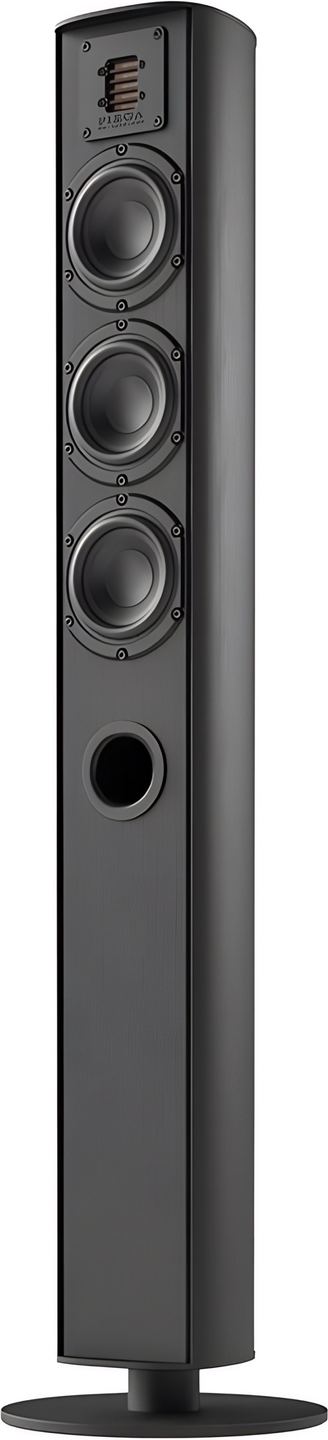
Despite its slim build, the Ace 50 is a three-way speaker — an architecture usually found in much larger floorstanders. Engineers Daniel Raimann and Roger Kessler completely redesigned all the drivers for this new generation.
The two 120 mm MDS-B woofers located at the bottom work in parallel in a bass-reflex volume with a front port. This layout allows for relatively close placement to walls without excessive bass boom. Piega claims almost double the acoustic output in the low frequencies compared with the TMicro 60, resulting in bass that is fuller and tighter.
The third 120 mm MDS driver, installed just below the tweeter, operates in a sealed chamber and handles the midrange up to around 4 kHz. This separation of duties allows each driver to operate in its optimal range, reducing distortion and improving vocal coherence.
The AMT-1 tweeter, Piega’s sonic signature
The name Piega comes from the Italian word for “fold,” a direct reference to the tweeter technology that has characterized the brand since its beginnings. The AMT-1 (Air Motion Transformer) uses a pleated 24 × 36 mm diaphragm combined with a high-purity neodymium magnetic motor.
Unlike dome tweeters, which move air in a piston-like fashion, the AMT compresses and expels air through the folding motion of its diaphragm. This mechanism delivers a fast transient response and particularly low distortion. The frequency response extends up to 40 kHz, making the Ace 50 compatible with high-resolution audio files.
The speaker’s narrow front baffle also contributes to the soundstage: by reducing parasitic reflections around the drivers, it allows the sound to detach naturally from the cabinet and project a wide stereo image, even when the speakers are placed close together.
Everyday listening and home integration
The Ace 50 can be driven by amplifiers delivering between 20 and 150 watts into 4 ohms. Its 90 dB/W/m sensitivity makes it relatively easy to drive: a mid-range integrated amplifier is sufficient to get the most out of it. It is suitable for medium-sized rooms — living rooms, offices, bedrooms — and can be used without a subwoofer in most setups.
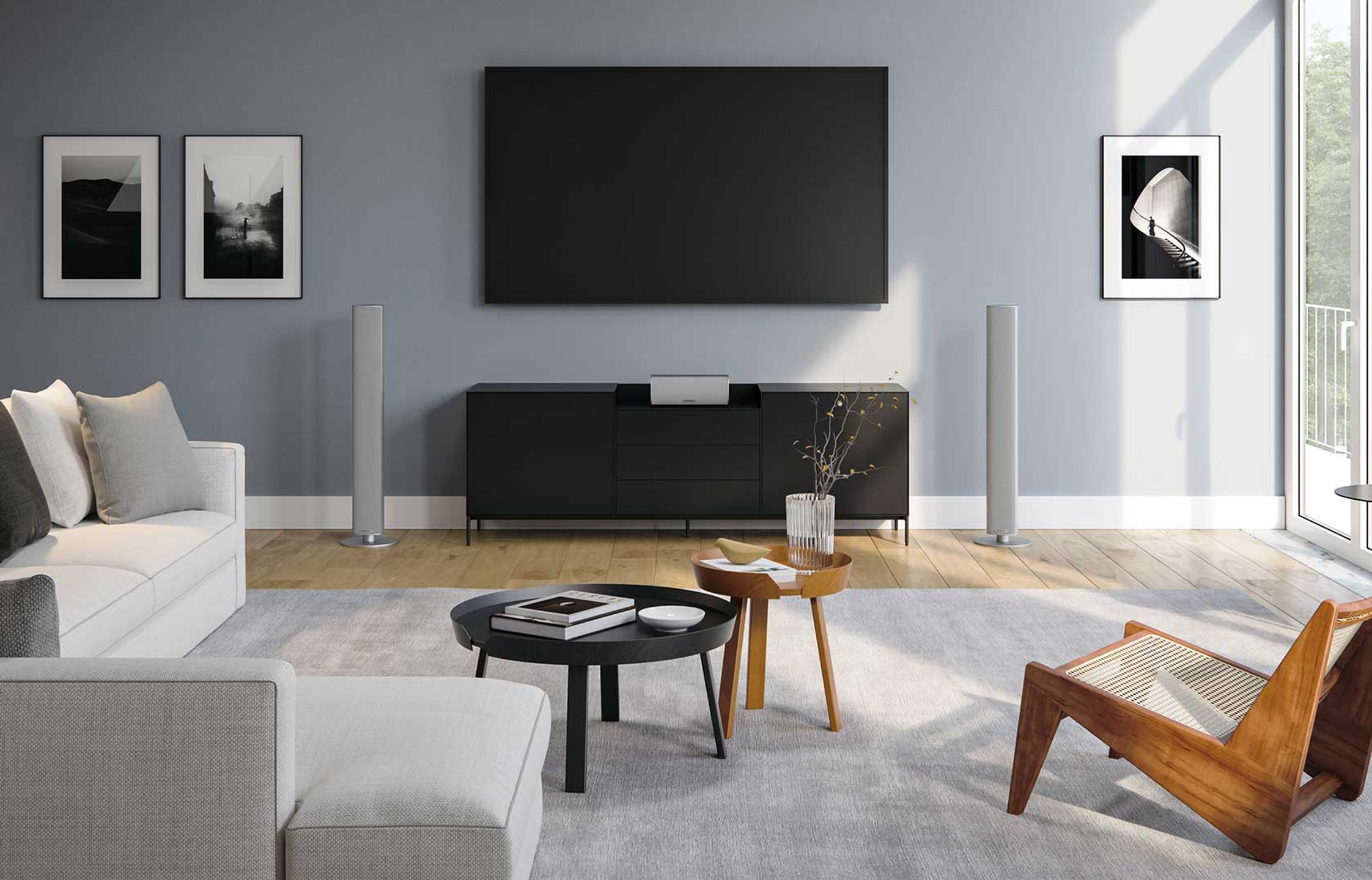
For home theater installations, the Ace 50 pairs with the Ace Center center speaker and the Ace 30 satellites, which share the same drivers and sonic signature. A wireless version, the Ace 50 Wireless, is also available, with built-in amplification and network connectivity.
The modest weight of 12 kg and height of just over one meter make handling and installation easy, while the circular base ensures good stability on flat floors.
Does the Ace 50 require break-in before reaching its optimal sound quality?
+
Like most speakers with brand-new drivers, the Ace 50 benefits from a few dozen hours of listening for the driver suspensions to loosen up. The bass then gains in fullness, and the treble loses its slight initial stiffness.
Can the speaker grilles be removed?
+
Yes, although Piega designs them to stay in place. They fit into the aluminum profile and must be carefully unclipped using a flat, thin tool. Most users keep them installed.
What type of speaker cable should be used for connection?
+
The Ace 50 features multi-way binding posts that accept banana plugs, spades, or bare wire. A cable with a cross-section of 2.5 to 4 mm² is suitable for lengths under 5 meters.
Does the speaker get warm during operation?
+
No. The aluminum cabinet remains cool to the touch even after several hours of listening at high volume. This is a characteristic of speakers with metal enclosures.
Can the Ace 50 be used with a tube amplifier?
+
Yes, provided the amplifier can handle a 4-ohm load. Some older or entry-level tube amplifiers are designed for 8 ohms only; check the specifications before purchasing.
How does the Ace 50 behave when placed close to a rear wall?
+
The front-firing bass-reflex port limits excessive bass reinforcement when placed near a wall. A distance of 10 to 30 cm is generally enough to achieve a good tonal balance.
User reviews
Marc
Very beautifully designed product! Easy to integrate! Quite an amazing sound given the compact size, delivering an astonishing bass volume!!
Comment from February 16, 2026
Automatically translated — Show original (French)
Produit de tres belle esthetique! Facile d'integration! Son assez prodigieux vu les dimensions restreinte donnant un volume de basse étonnant!!
Eco-contribution of €0.46 included in the sale price.
GTIN / EAN: 634154692080
Thank you for choosing us
To better understand our visitors, measure marketing effectiveness and personalise ads, we and our partners use cookies and mobile advertising identifiers on your device. This data makes it possible to display personalised and non-personalised ads and measure their performance. Some cookies, which are technically necessary, are exempt from consent. You can accept those that require your consent, refuse them by clicking "Refuse", or customise your choices via the settings screen.
To find out how Google uses the data collected once you have given your consent, see Google’s Business Data Responsibility site.
You can change or withdraw your consent at any time via the "Consent and cookies" link. Your choices will apply on our site for 12 months.