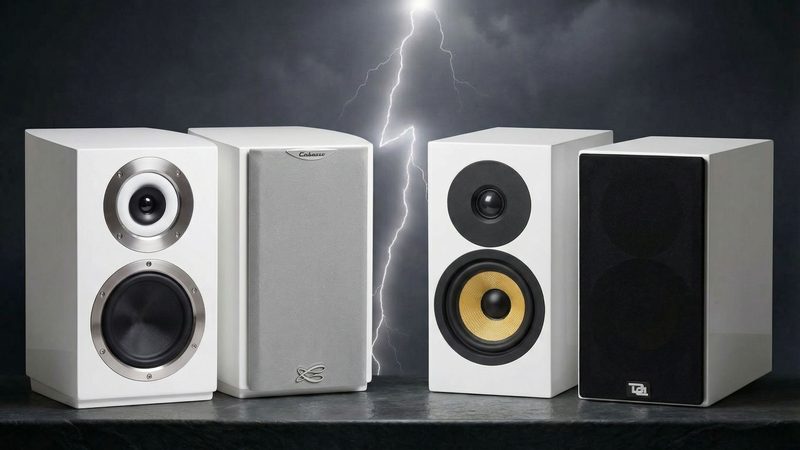
Cabasse Baltic 5 black on black stand


Overview
A 27-centimeter sphere that concentrates three transducers on the same acoustic axis: that has been Cabasse’s bold concept since 1993 with its Baltic range. This fifth generation perpetuates a distinctive approach to the coaxial speaker, completely redesigned around the TCA (Tri Coaxial Aramid) transducer. Manufacturing remains rooted at the CAC (Cabasse Acoustic Center) in Plouzané, Brittany, where each speaker is assembled and checked according to a 360° measurement protocol.
The point-source principle and its implications
The three-way coaxial architecture places the 2.5 cm tweeter, 10 cm midrange, and 20 cm woofer at a single emission point. This layout eliminates time offsets between different frequency ranges, a phenomenon that harms the coherence of the soundstage in traditional speakers where drivers are arranged vertically. The signal reaches the listener’s ear simultaneously, whatever the reproduced frequency.
The spherical enclosure reinforces this behavior by suppressing internal resonances and the typical diffraction found in rectangular cabinets. The rounded shape disperses sound energy evenly throughout the room, which Cabasse formalizes under the name HDSE (Homogeneous Distribution of Sonic Energy). Measurements taken in an anechoic chamber are not limited to the listening axis: they cover the entire radiation sphere to optimize filtering and ensure uniformity between direct and reflected sound.
The TCA transducer, heart of the fifth generation
To improve performance without changing the speaker’s diameter, the Cabasse team developed exclusive aramid film diaphragms, designed and produced in-house. These diaphragms use a honeycomb structure that combines lightness and rigidity, two qualities that are usually opposed. The profile of the midrange and woofer diaphragms has a constant, regular geometry, maximizing the radiating surface while reducing fixed areas likely to generate diffraction.
The magnetic motors use rare-earth magnets, more powerful than traditional ferrite magnets. This evolution simultaneously increases efficiency (91 dB/W/m) and power handling: the Baltic 5 takes 250 W continuously and tolerates peaks of 1,210 W. The two main diaphragms are produced simultaneously by a dedicated robot, which guarantees consistency from one unit to another and limits series dispersion.
Three configurations for different installations
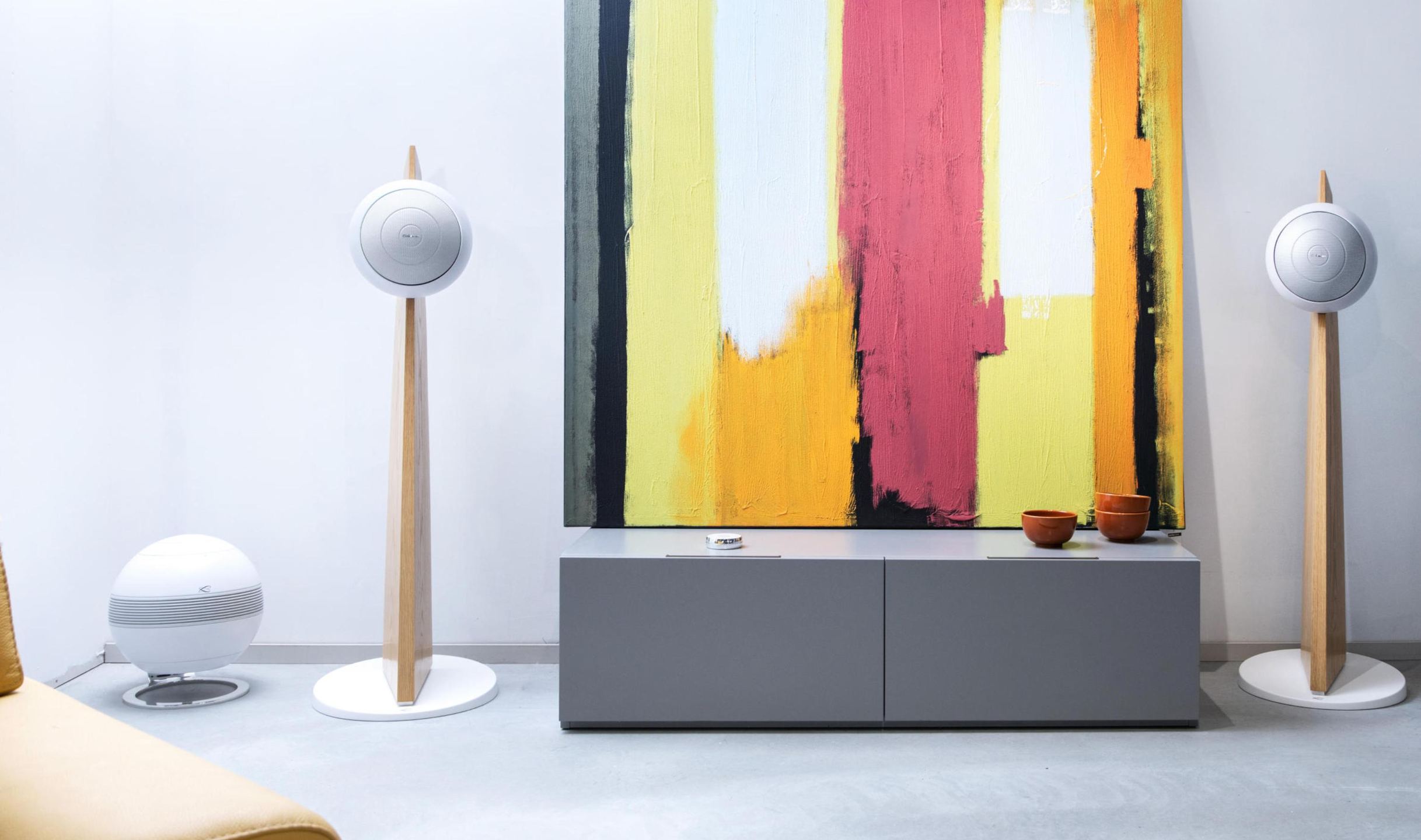
The Baltic 5 is available as a floorstanding model, a compact stand-mount, or a wall-mounted version. The floorstanding version rests on a brushed aluminum column that places the speaker at ear height in a seated position. The stand-mount model is designed for furniture or shelves, while the wall-mounted version integrates a swiveling magnetic bracket that allows the sphere to be aimed at the listening area. A single screw is enough to secure it to the wall.
The nominal impedance of 8 ohms (minimum 3.2 ohms) makes the speaker compatible with almost all hi-fi or home cinema amplifiers. The rear binding posts accept thick-gauge cables, banana plugs, and spades, making it easy to integrate into an existing system. The frequency response extends from 75 Hz to 25 kHz, with internal crossover frequencies set at 740 Hz and 3,500 Hz.
Bass extension and triphonic system
The low-frequency response, limited to 75 Hz, calls for pairing with a subwoofer to reproduce the full spectrum. Cabasse offers THE PEARL SUB, a connected active subwoofer that includes amplification for the satellites (2 × 300 W) in addition to its own 1,000 W module. This 2.1 system benefits from DEAP technology, a digital processing solution that optimizes the signal for each Cabasse speaker model (iO3, Riga 2, Baltic 5). The PEARL SUB also provides access to high-resolution streaming via the StreamCONTROL multiroom system, compatible with Qobuz, Tidal, Spotify, and other services.
Pairing two Baltic 5 speakers with a subwoofer creates what is known as a triphonic system, a configuration historically favored by Cabasse for its coaxial-driver speakers. This approach exploits the spatial coherence strengths of the coaxial in the midrange and treble, while entrusting the bass register to a specialized transducer that is better suited to the demands of large air displacement.
Technical specifications
Acoustic characteristics
- Number of ways: 3
- Configuration: TCA triaxial coaxial speaker (bass, midrange, treble)
- Sensitivity: 91 dB / 1 W / 1 m
- Frequency response: 75 – 25000 Hz
- Crossover frequencies: 740 – 3500 Hz
- Even, pure dispersion from the extreme high frequencies down to the bass
- Wide, stable, and natural soundstage thanks to HDSE crossovers
- Natural, precise sound, true to the ideal of a point source
Electrical characteristics
- Nominal impedance: 8 Ω
- Minimum impedance: 3.2 Ω
- Nominal power: 250 W
- Peak power: 1210 W
Technologies and design
- TCA triaxial speaker
- Midrange and bass / lower midrange cones in exclusive aramid films
- Constant, regular profile for maximum radiating surface area
- Lightweight, rigid honeycomb structure
- New rare-earth magnet motors for optimal efficiency and power handling
- Robotized production to ensure reliability and consistent performance
- HDSE crossovers
- 360° anechoic chamber measurements to control directivity and total power
- Even distribution of sound energy
- Perfectly balanced direct and reflected sound
Compatibility and extensions
- Available in floorstanding or wall-mounted version
- Compatible with THE PEARL SUB connected active subwoofer
- Phenomenal dynamic range
- Patented DEAP technology to optimize the digital signal
- Connection to major streaming services
Dimensions and weight
- Dimensions: 128 × 40 × 42.4 cm
- Weight: 19 kg
Frequently Asked Questions
What amplification should be used with the Baltic 5?
The 91 dB efficiency and 8-ohm impedance allow the use of most integrated amplifiers or power amps on the market. A model capable of delivering 50 to 100 W into 8 ohms is sufficient for home listening. Amplifiers that can handle loads down to 3.2 ohms are preferable if you want to fully exploit the speaker’s dynamics at high volume.
Can the Baltic 5 be used without a subwoofer?
The frequency response goes down to 75 Hz, which covers most voices and common instruments. For acoustic music or jazz recordings, listening without a subwoofer is perfectly viable. However, electronic music, movies, or organ music require a subwoofer to reproduce the infra-bass.
Can the wall-mounted version be aimed at different listening positions?
The magnetic base of the wall-mounted version allows the sphere to swivel in several directions. This flexibility makes installation easier in rooms where the listening point is not directly facing the mounting wall.
What is the difference compared to the Baltic 4?
The Baltic 5 retains the same sphere diameter (27 cm) but incorporates a completely redesigned TCA transducer. The aramid honeycomb diaphragms replace the materials used in the previous generation, and the rare-earth magnet motors are more powerful. The finishes are now matte, whereas the Baltic 4 offered more varied options.
Are the speakers sold individually or in pairs?
The Baltic 5 is sold individually, allowing you to build a stereo system, a 5.1 setup, or any other multichannel configuration by purchasing exactly the number of speakers you need.
Which cable should be used for connection?
The binding posts accept cables up to 4 mm² in cross-section, banana plugs, and spades. A standard-quality cable (2.5 to 4 mm² cross-section) is suitable for lengths under 5 meters. Beyond that, a larger cross-section will reduce losses.
Can the Baltic 5 be used as a center speaker in a home cinema setup?
The spherical shape and coaxial coherence make it an excellent center speaker, provided you have enough space. The stand-mount version can be placed horizontally under a screen, while the wall-mounted version can be fixed above or below it, depending on the configuration.
- Eco-contribution included in the sale price.
- Manufacturer reference: ENC1621A