

Audiolab 9000P silver




Overview
Eight years separate the 9000P from the last Audiolab power amplifier, the 8300XP. This new reference, designed by Danish engineer Jan Ertner (also responsible for the Quad series), incorporates the refinements developed for the 9000A integrated amplifier while benefiting from optimizations specific to separate components. The 9000P adopts a dual mono Class AB configuration and offers a bridged mode that transforms it into a 300 W mono block.
A complementary feedback amplification topology
The amplification circuit is based on CFB (Complementary Feedback) technology, a technical signature of Audiolab. In this configuration, the output transistors and driver transistors work together in a local feedback loop. The quiescent current of the output stage depends on the temperature of the driver transistors rather than the power transistors. This feature enables faster and more precise thermal regulation: the stabilization circuit does not need to integrate the thermal inertia of the main heatsink, which maintains stable quiescent current even during demanding musical passages.
The measured harmonic distortion drops below 0.002% at 1 kHz at two-thirds of maximum power. The signal-to-noise ratio exceeds 112 dB (A-weighted), a high value for this price category. Each channel can deliver up to 15 A of current, giving it the ability to drive low-impedance speakers or those with modest efficiency.
Linear power supply and mains filtering
The toroidal transformer, with a power rating of 320 VA, was specifically developed for this model. Four 15,000 µF capacitors each constitute a total reserve of 60,000 µF. This filtering capacity powers both channels in dual mono configuration, with each channel having its own power supply circuit.
Audiolab has integrated into the 9000P the mains filtering technology from its DC Block and DC Block 6 accessories. This circuit attenuates RFI and EMI interference present on the electrical network before it reaches the amplification stages. Standby consumption remains below 0.5 W.
Stereo mode and bridged mode
In stereo operation, the 9000P delivers 100 W per channel into 8 Ω and 160 W into 4 Ω. A switch located on the rear panel allows switching to bridged mode: the amplifier then becomes a mono block of 300 W into 8 Ω (380 W into 4 Ω). Purchasing two units opens up the possibility of a monoblock configuration offering absolute channel separation and substantial power reserves for the most demanding speakers.
A second switch allows selection between the unbalanced RCA input (1 Vrms sensitivity) and the balanced XLR input (2 Vrms sensitivity). The 10 kΩ input impedance ensures compatibility with most preamplifiers and sources with variable output.
Construction and system integration
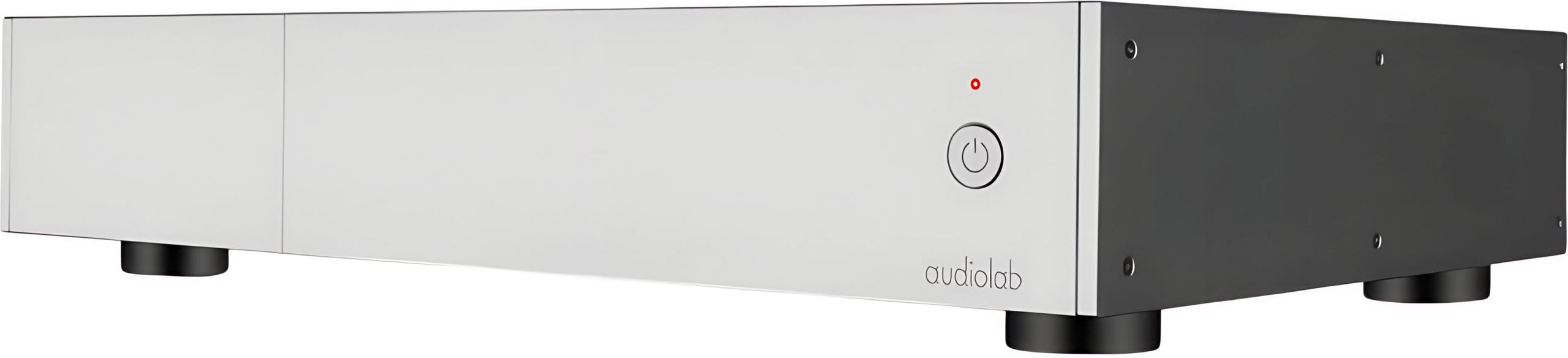
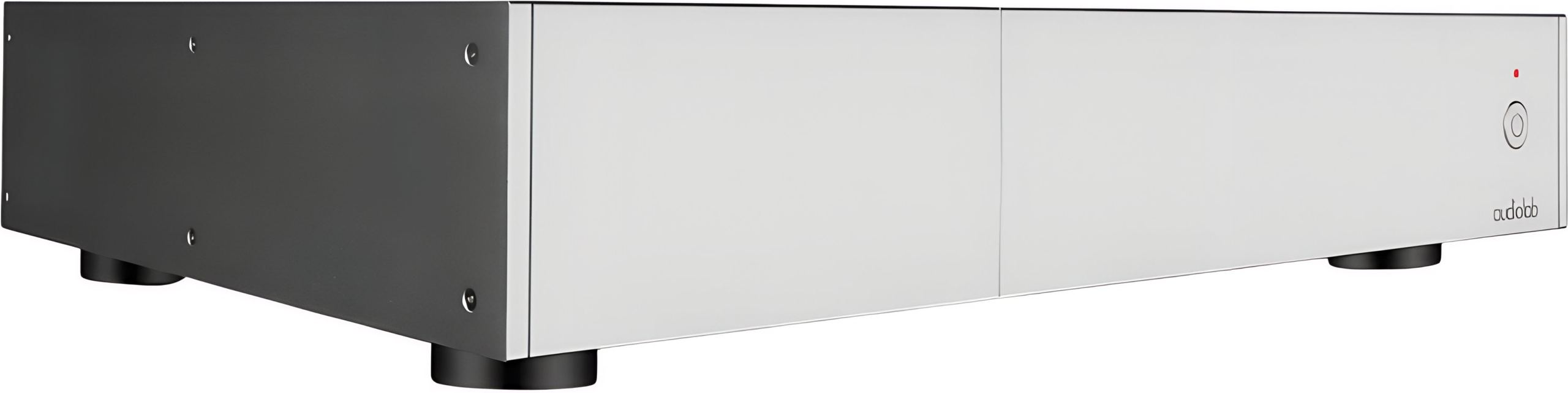
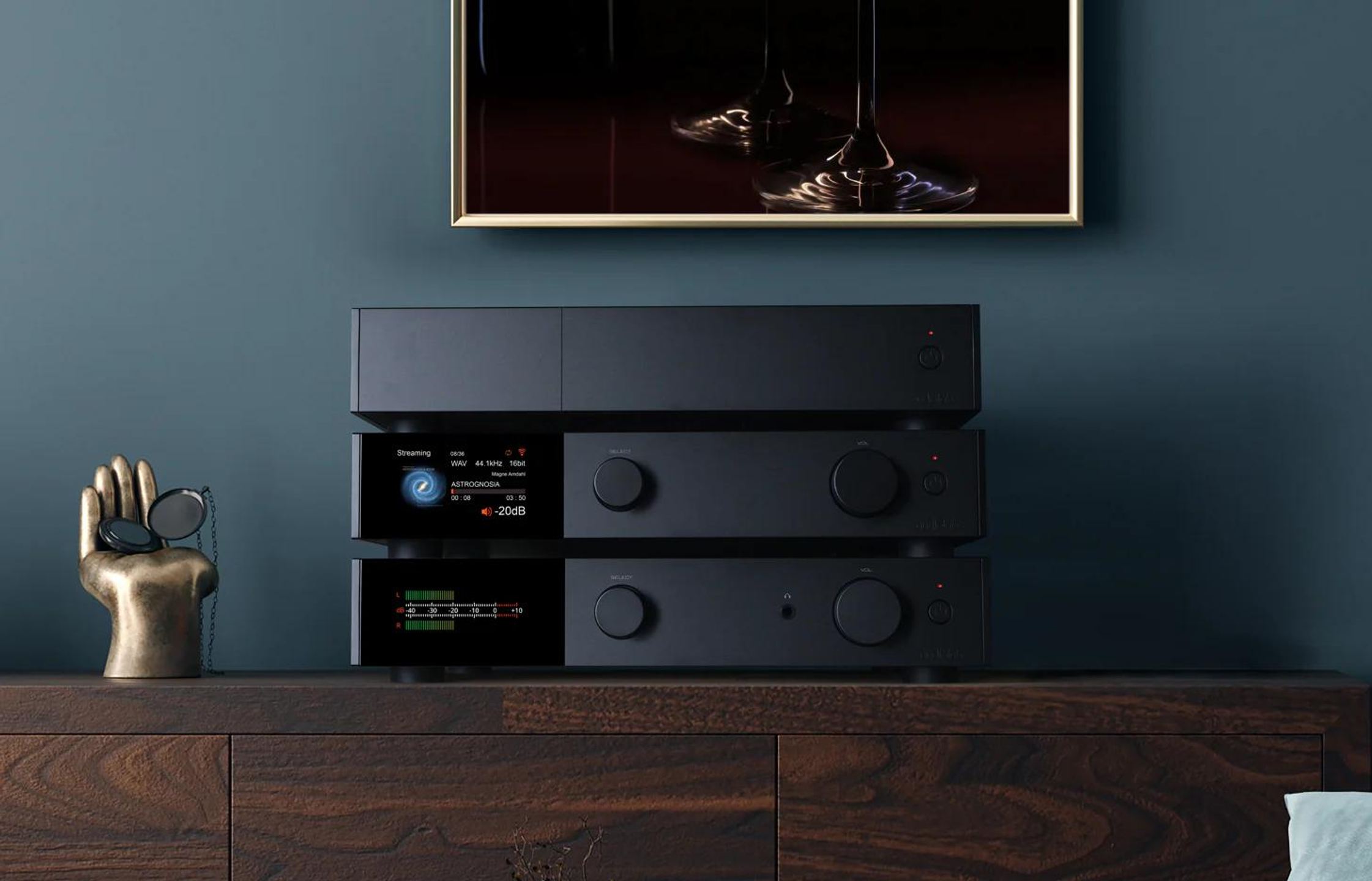
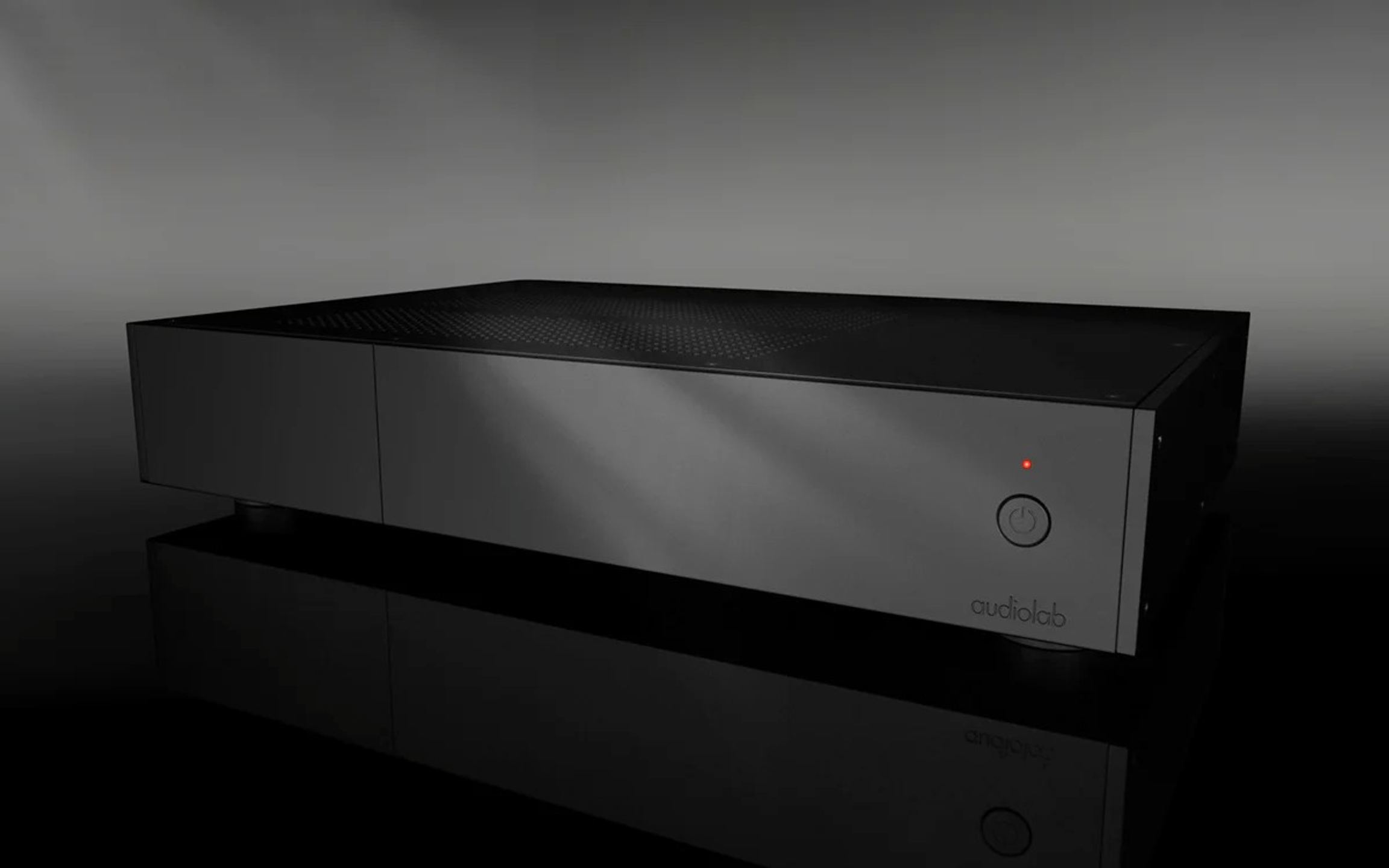
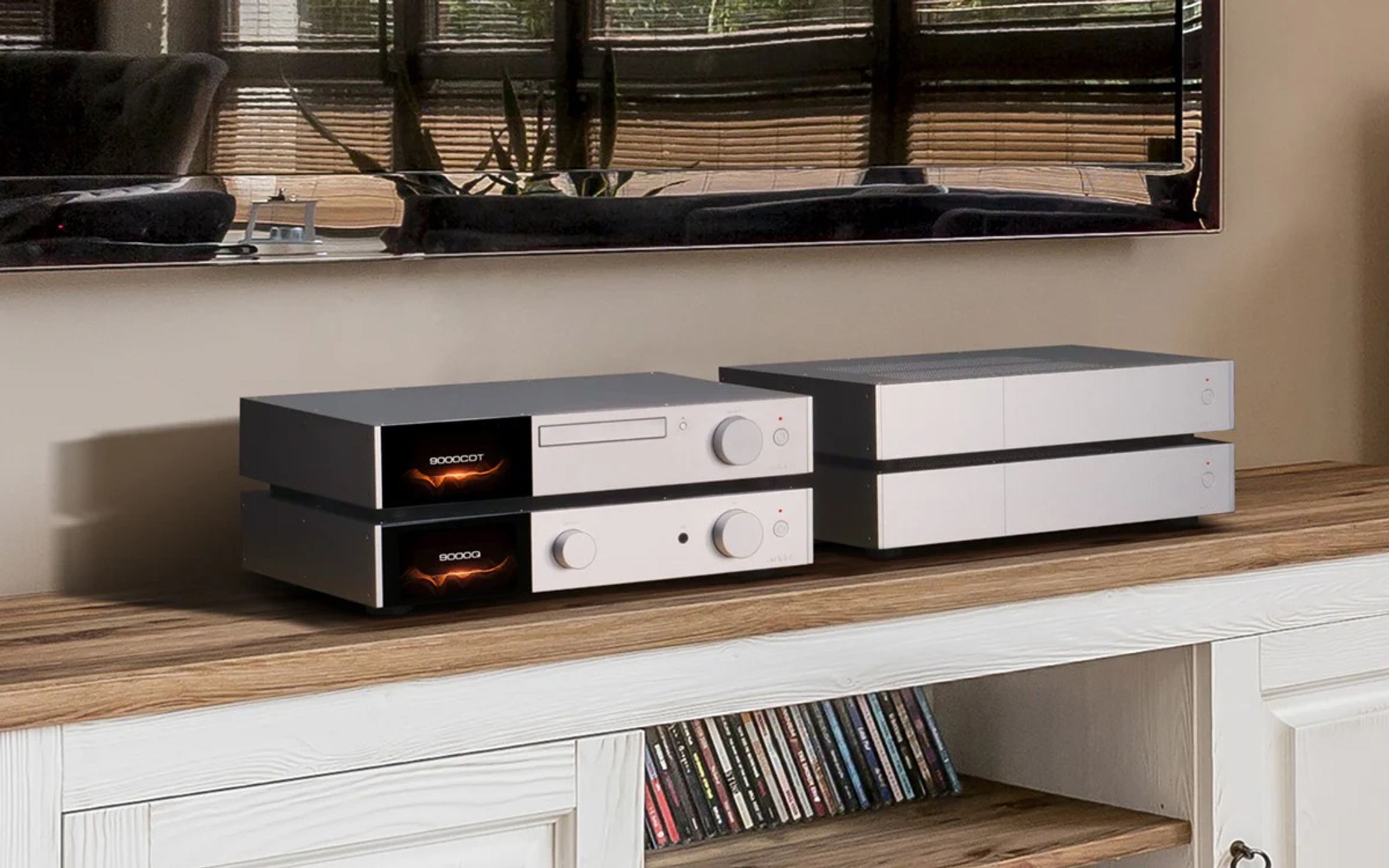
The aluminum chassis measures 444 × 90 × 327 mm and weighs 9.2 kg. The front panel, extremely minimalist, features only a standby button and a status LED. This simplicity contrasts with the 9000Q preamplifier and its displays, but maintains visual coherence through a vertical line placed in the same location as the preamplifier’s screen. Two finishes are available: black and silver.
The 12 V trigger allows automatic power on and off of the amplifier from the 9000Q preamplifier or other compatible sources. Thermal management relies on internal heatsinks that maintain a moderate operating temperature even during prolonged use.
Sonic signature and recommended pairings
The 9000P displays a presentation oriented toward neutrality with a slight freshness in the upper spectrum. The bass is tight, precise, with good transient control but without the fullness or warmth found in some competitors. The soundstage extends widely between the speakers with good depth and stable positioning of sound sources.
This signature suits systems equipped with speakers having a warm or dark tonality, to which the 9000P will bring definition and dynamics. Pairing with the 9000Q preamplifier, the 9000N network player or the 9000CDT CD transport forms a coherent ensemble both sonically and aesthetically. The 9000P can also complement the 9000A integrated amplifier in passive bi-amplification or serve as the main amplification with a variable volume source.
Documentation
Technical specifications
Amplification
- Type: Class AB power amplifier
- Technology: CFB (Complementary Feedback)
- Operating modes: Stereo / Bridged (mono)
Output power
- Stereo mode
- 2 × 100 W into 8 Ω (THD < 1%)
- 2 × 160 W into 4 Ω (THD < 1%)
- Bridged (mono) mode
- 300 W into 8 Ω (THD < 1%)
- 380 W into 4 Ω (THD < 1%)
Audio performance
- Frequency response: 20 Hz – 20 kHz (± 0.3 dB)
- Total harmonic distortion: < 0.002% at 1 kHz
- Signal-to-noise ratio: > 112 dB (A-weighted)
- Maximum output current: 15 A
Connectivity
- Inputs
- 1 × analog RCA
- 1 × balanced XLR
- 1 × 12 V trigger
- Outputs
- 1 × stereo speaker pair
Electrical characteristics
- Input sensitivity
- 1 Vrms (RCA)
- 2 Vrms (XLR)
- Input impedance: 10 kΩ
Power supply
- Mains power: 220 – 240 V / 50 – 60 Hz (depending on region)
- Standby consumption: < 0.5 W
- Toroidal transformer: 320 VA
- Capacitors: 4 × 15000 µF (60000 µF total)
Dimensions and weight
- Dimensions: 444 × 90 × 327 mm
- Net weight: 9.2 kg
- Gross weight: 10.6 kg
Finishes and accessories
- Available finishes: Black / Silver
- Included accessories
- Power cord
- User manual
Frequently Asked Questions
Can the 9000P replace an integrated amplifier?
No, the 9000P is a power amplifier without volume control or source selection. It requires a preamplifier like the 9000Q or a source with a variable level output (network player, DAC with volume control).
What is the difference between stereo mode and bridged mode?
In stereo mode, a single 9000P powers both speakers. In bridged mode, it becomes a mono amplifier powering a single speaker with triple the power. This configuration requires two 9000Ps for a complete stereo system.
Can the 9000P be stacked on the 9000Q preamplifier?
It is possible but not recommended. Stacking can affect the noise floor and heat dissipation. A space or separate shelf preserves optimal performance.
Is the 9000P suitable for low-efficiency speakers?
With 100 W per channel and a current delivery capacity of 15 A, the 9000P drives most speakers on the market without difficulty. For particularly demanding models or high listening volumes, the dual monoblock configuration provides additional headroom.
- Eco-contribution included in the sale price.