

Gold Note HP-5.2
Specifications and features


Overview
With the HP-10, Gold Note had introduced a different approach to headphone amplification: rather than simply “driving” transducers, the idea was to match them precisely to the electronics. The HP-5.2 follows this philosophy in a more compact format and enhances it with Bluetooth 5.2 HD aptX. The anodized aluminum chassis of the new 5.2 series houses a dual-mono Class A output stage capable of delivering up to 5 W, enough to power both sensitive in-ear monitors and high-impedance planar headphones.

A dual-mono Class A design with discrete components
The HP-5.2 electrically separates the left and right channels in a dual-mono topology, with each channel having its own amplification stage. This separation reduces crosstalk between channels and keeps the noise floor very low. The amplification operates in Class A with discrete components (no integrated circuits in the audio path), which keeps the output stage permanently biased. Gold Note specifies a linear frequency response from 20 Hz to 20 kHz (±0 dB), total harmonic distortion of 0.015% at 1 kHz, and a signal-to-noise ratio of 105 dB.
The 5 W maximum power makes it possible to stay in the amplifier’s linear range even with hard-to-drive headphones or during demanding dynamic passages.
Studio suite: adaptation tools, not effects
The HP-5.2 inherits its advanced control section from the HP-10, which Gold Note calls “Studio.” These settings operate entirely in the analog domain, with no intermediate digital conversion.
Crossfeed partially blends the left and right channels to recreate a soundstage close to that of a pair of speakers. It can be adjusted in full mode or by frequency band (bass, mids, treble separately), making it possible to tailor the effect to the type of music or personal preferences.
Harman equalization applies a response curve optimized for headphone listening, based on Harman International’s research into average listening preferences. Superflat linearizes the high-frequency response for headphones that show irregularities in the treble.
The adjustable Damping Factor (two positions) makes it possible to match the amplifier’s damping to the impedance of the connected headphones. High-impedance headphones do not behave like low-impedance models under the same output load. The left/right Balance setting compensates for hearing differences or variations between transducers.
Three gain levels (Low, Mid, High) cover the sensitivity range of headphones on the market, from ultra-sensitive in-ear monitors to current-hungry planar headphones.
Four headphone outputs for all cabling types
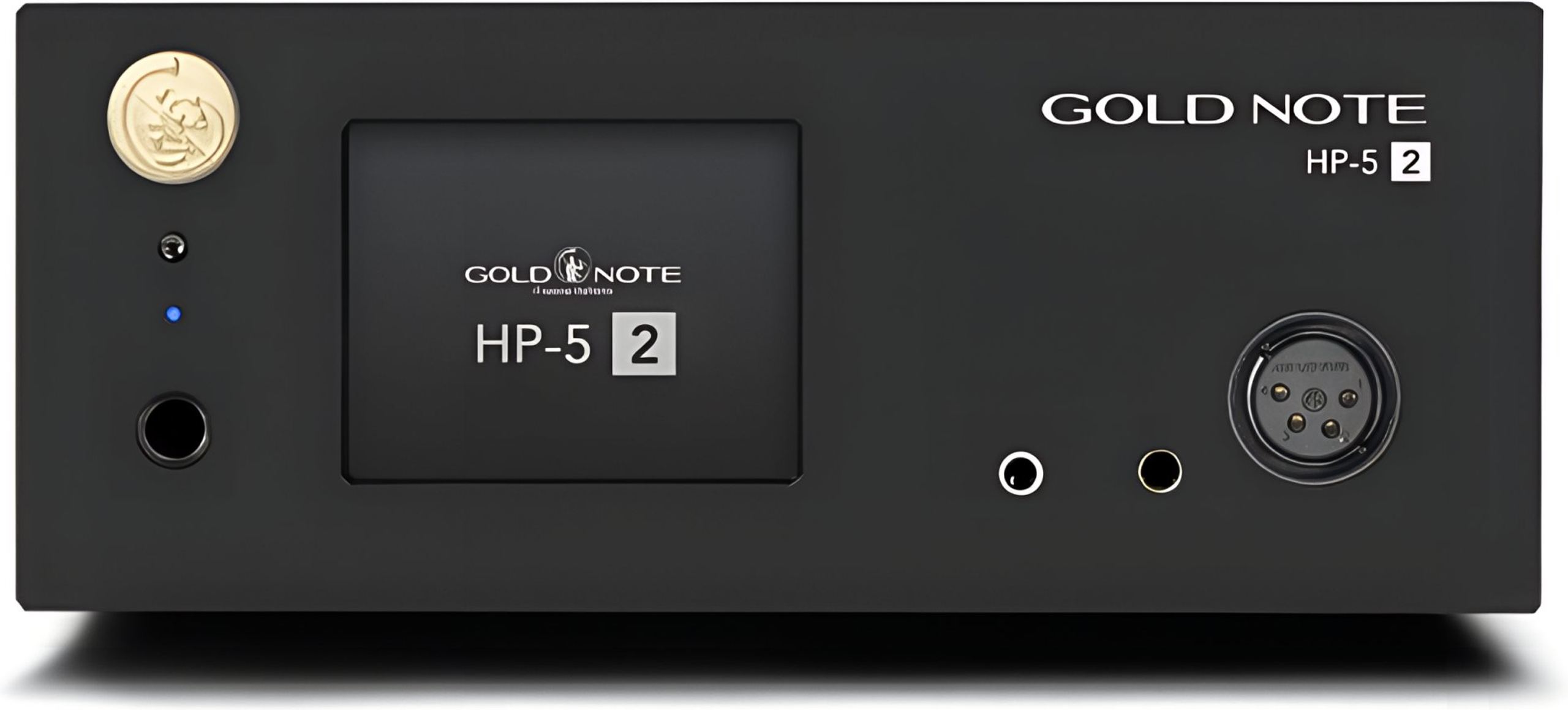
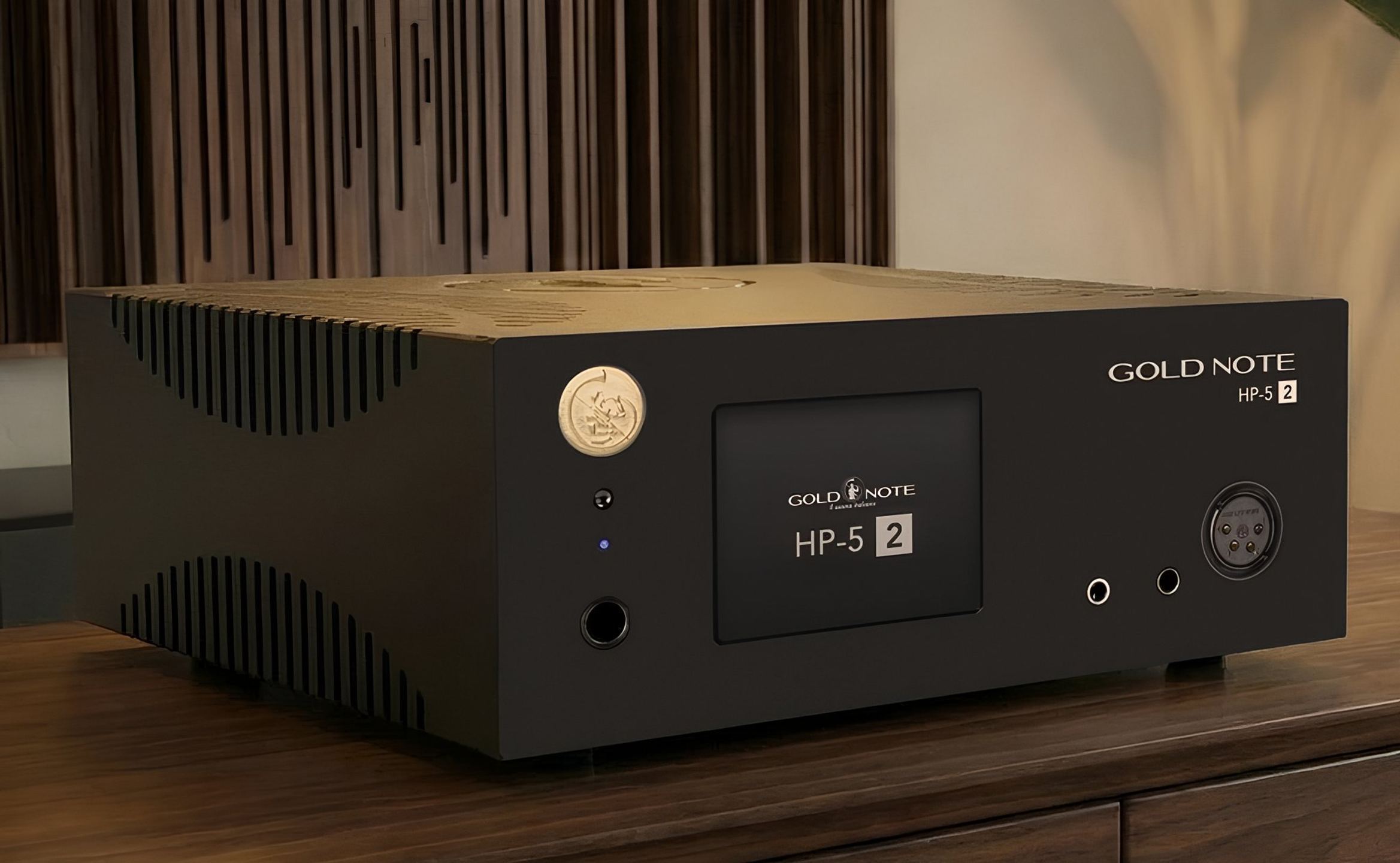
The front panel brings together four outputs: 3.5 mm jack and 6.3 mm jack in single-ended, 4.4 mm Pentaconn jack and 4-pin XLR in balanced. This variety eliminates the need for adapters and allows any headphones to be connected directly.
Complete connectivity: analog, digital, wireless
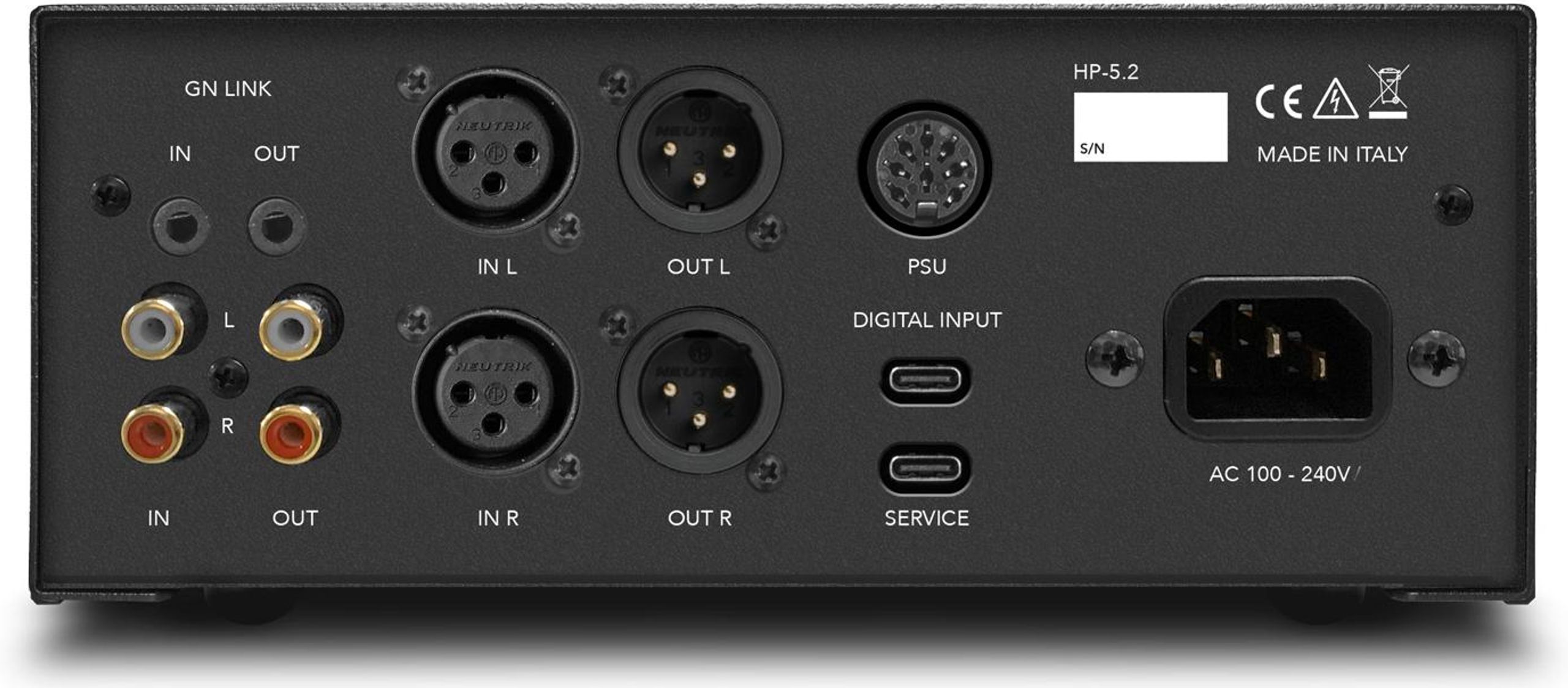
On the input side, the HP-5.2 accepts analog sources via RCA (single-ended, 5 Vrms max) or XLR (balanced, 8 Vrms max). The USB-C digital input handles PCM up to 48 kHz via an ESS SABRE ES9023 converter. Bluetooth 5.2 HD aptX 24-bit enables wireless streaming from smartphones, tablets, or computers with higher quality than standard Bluetooth codecs.
The RCA and XLR line outputs allow the HP-5.2 to be used as a preamplifier for a speaker system, while retaining access to all Studio settings.
Bypass mode for uncompromising integration
Bypass mode is intended for systems that already have a preamplifier. It allows the HP-5.2 to be inserted into the chain without changing the existing cabling. When a headphone output is selected and the device goes into standby (LED red), the signal passes through the device unaltered to the main preamplifier. Switching between headphone listening and speaker listening requires no rewiring. Technical condition: source and preamplifier must use the same type of connection (both in RCA or both in XLR).
Touch interface and remote control
The front touchscreen provides access to all parameters: input selection, output selection, Studio settings, gain, balance. Navigation remains smooth despite the density of available options. The supplied infrared remote replicates all functions, avoiding the need to get up to adjust a setting while listening. Standby is activated by a long press on the screen or via the remote control button.
Physical design and power supply
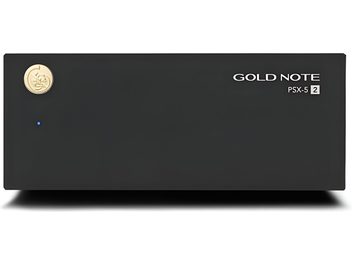
The black anodized aluminum chassis measures 20 × 8 × 26 cm and weighs 3 kg. Gold Note designed this structure for its mechanical rigidity and electrical isolation, two parameters that influence the operation of Class A circuits. The universal internal power supply (100-240 V, 50-60 Hz) consumes a maximum of 25 W. A dedicated external power supply, the PSX-5.2, is available as an option to further improve performance.
Documentation
Technical specifications
Architecture and amplification
- Type: Class A Dual-Mono headphone amplifier
- Headphone power: 5 W max
- Frequency response: 20 Hz – 20 kHz (±0 dB)
- Total harmonic distortion + noise (THD+N): 0.015% at 1 kHz
- Signal-to-noise ratio (SNR): 105 dB
- Gain: Low / Mid / High
- Damping factor: adjustable
- Can be used as a preamplifier
Digital-to-analog converter
- Integrated DAC: SABRE ES9023
Advanced audio functions (analog processing)
- Crossfeed: recreates a speaker-like soundstage
- Adjustable in full mode or by frequency band
- Harman: headphone-optimized equalization
- Superflat: ultra-linear frequency response
- Damping factor: adaptation to headphone impedance
- Left / right balance: precise channel adjustment
- Stereo / mono modes
- All settings are applied in real time in the analog domain, without digital degradation
Intelligent Bypass mode
- Allows integration into an existing system with preamplifier
- Simple switching between headphones and speakers
- No rewiring required
- RCA or XLR compatible (same type required for input and output)
Connectivity
- Inputs
- 1x RCA (unbalanced analog)
- 1x XLR (balanced analog)
- 1x USB-C (PCM 48 kHz)
- Bluetooth 5.2 HD aptX (24-bit)
- Headphone outputs
- 3.5 mm jack (unbalanced)
- 6.3 mm jack (unbalanced)
- 4.4 mm jack (balanced)
- 4-pin XLR (balanced)
- Line outputs
- 1x RCA
- 1x XLR
User interface
- Intuitive touchscreen
- Remote control included
Power supply
- Input voltage: 100–240 V / 50–60 Hz
- Maximum power consumption: 25 W
- Fuse: 2 A T
Dimensions and weight
- Dimensions: 20 × 8 × 26 cm
- Net weight: 3 kg
- Packaged weight: 4 kg
Frequently Asked Questions
Can the HP-5.2 drive demanding planar magnetic headphones?
With 5 W of maximum power and a dual-mono Class A stage, the HP-5.2 has the current reserve needed for planar headphones, even those known to be difficult such as Audeze or HiFiMAN models. The adjustable damping factor makes it possible to optimize diaphragm control according to the headphone impedance.
What is the difference compared with the HP-10?
The HP-10 is the flagship model in the range, offered in three versions (Classic, BT, Deluxe) with an AKM AK4493 DAC on the Deluxe version and 10 W per channel output. The HP-5.2 includes Bluetooth 5.2 HD aptX and USB-C with an ESS SABRE ES9023 DAC as standard, in a more compact format. Both share the Studio philosophy and dual-mono Class A architecture.
Does the USB-C input support high-resolution files?
The USB-C input accepts PCM up to 48 kHz, which corresponds to standard CD quality. For native hi-res (96 kHz or higher), you need to use the analog inputs from an external DAC. aptX HD Bluetooth goes up to 24 bits but remains limited to 48 kHz.
Can you connect Bluetooth headphones to the HP-5.2?
Yes. The Bluetooth 5.2 HD aptX module works both ways: receiving from a smartphone or transmitting to compatible wireless headphones. Pairing is managed via the touchscreen.
Does the external PSX-5.2 power supply provide an audible improvement?
Gold Note designed the PSX-5.2 as an optional upgrade that provides a more stable and better-filtered power supply than the internal unit. The gains are mainly in the noise floor and definition in the lower part of the spectrum. The improvement depends on the quality of the mains power supply and the sensitivity of the headphones used.
- Eco-contribution included in the sale price.