

Lehmann Audio Linear D MKII black



Specifications and features

Overview
Since 2004, Lehmann Audio’s Linear range has been giving headphones a second life by freeing them from the mediocre outputs of conventional amplifiers. The Linear D added an integrated digital-to-analog converter. This MKII version keeps the same compact chassis, but features a completely redesigned analog board and more selectively chosen components. Manufactured in Cologne, it combines three functions: headphone amplifier, converter, and preamplifier.
Three devices in a 28 cm enclosure
The Linear D MKII is a hybrid device. It amplifies the headphone signal thanks to a discrete class A output stage. It converts digital streams via an ESS Sabre K2M chip. And it can serve as a preamplifier to drive active speakers or a power amplifier, thanks to its RCA line output.
This versatility makes it a natural companion for CD players, network players, and turntables (via an upstream phono preamp). Connected digitally to a network player, it allows listening through headphones and speakers without multiplying boxes. When the gain is set to 0 dB and no headphones are connected, it works as a full-fledged preamplifier.
An analog board thoroughly reworked
The most significant change compared with the first version of the Linear D lies in the analog board. Lehmann Audio has adopted the so-called “Low-Z Copper” technology: a low-impedance manufacturing process that increases the cost of bare printed circuit boards by about ten times, according to the manufacturer. The copper traces are six times thicker than on the previous model, which reduces the electrical resistance of the signal path.
The capacitors in the audio path are Mundorf MLytic units, whereas the first version used standard-grade components. The internal wiring is upgraded to OFC (oxygen-free) copper. These component choices come in part from the Linear SE, the range’s purely analog high-end model. The measured result: better dynamic figures, and more faithful transient reproduction.
Digital conversion and source management
The digital section is based on an ESS Sabre K2M chip, mounted on a four-layer printed circuit board protected against high-frequency interference. Mica capacitors (low-loss) filter the analog signal at the conversion output, and fast amplification stages on the converter board preserve transient quality.
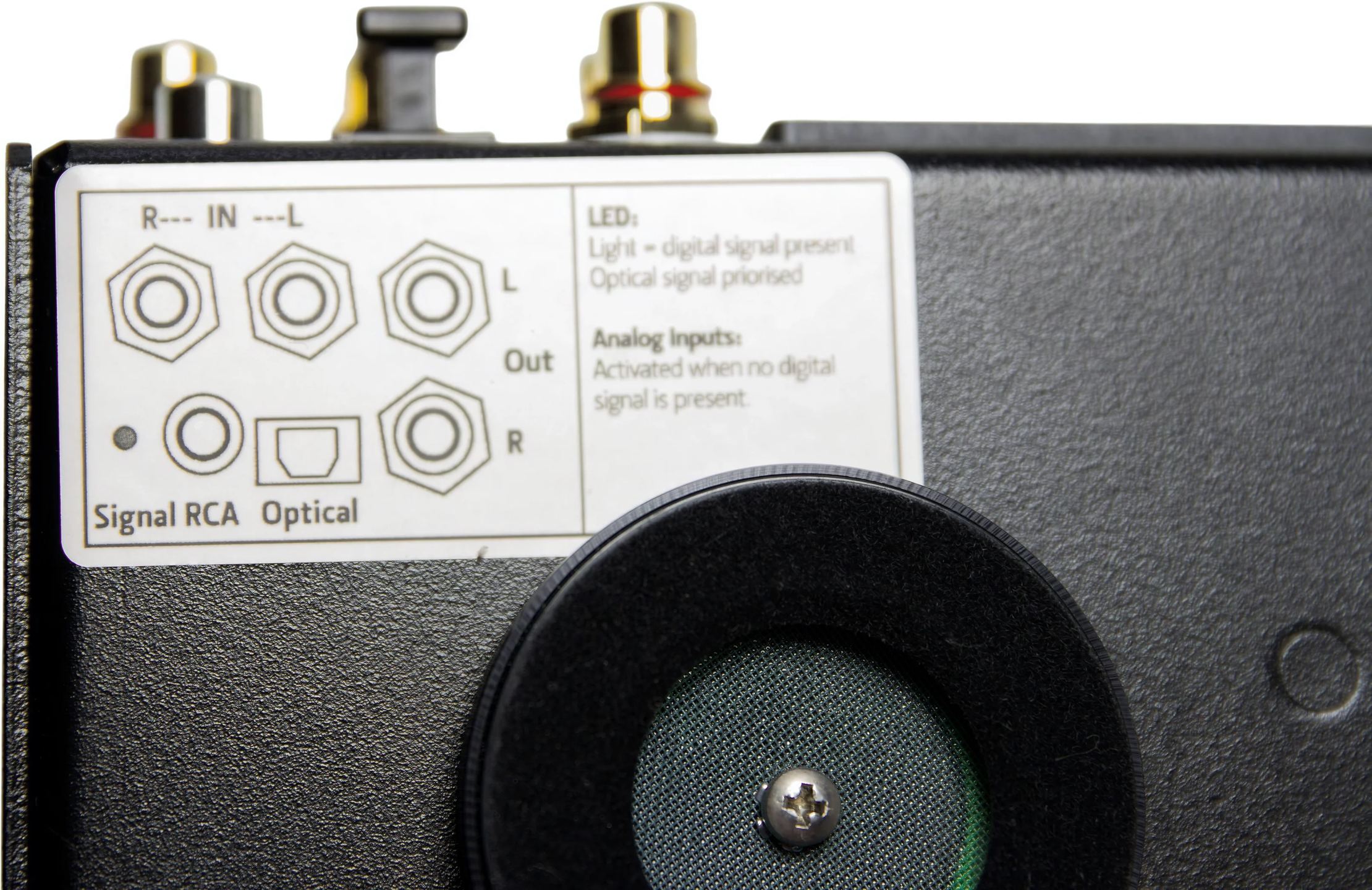
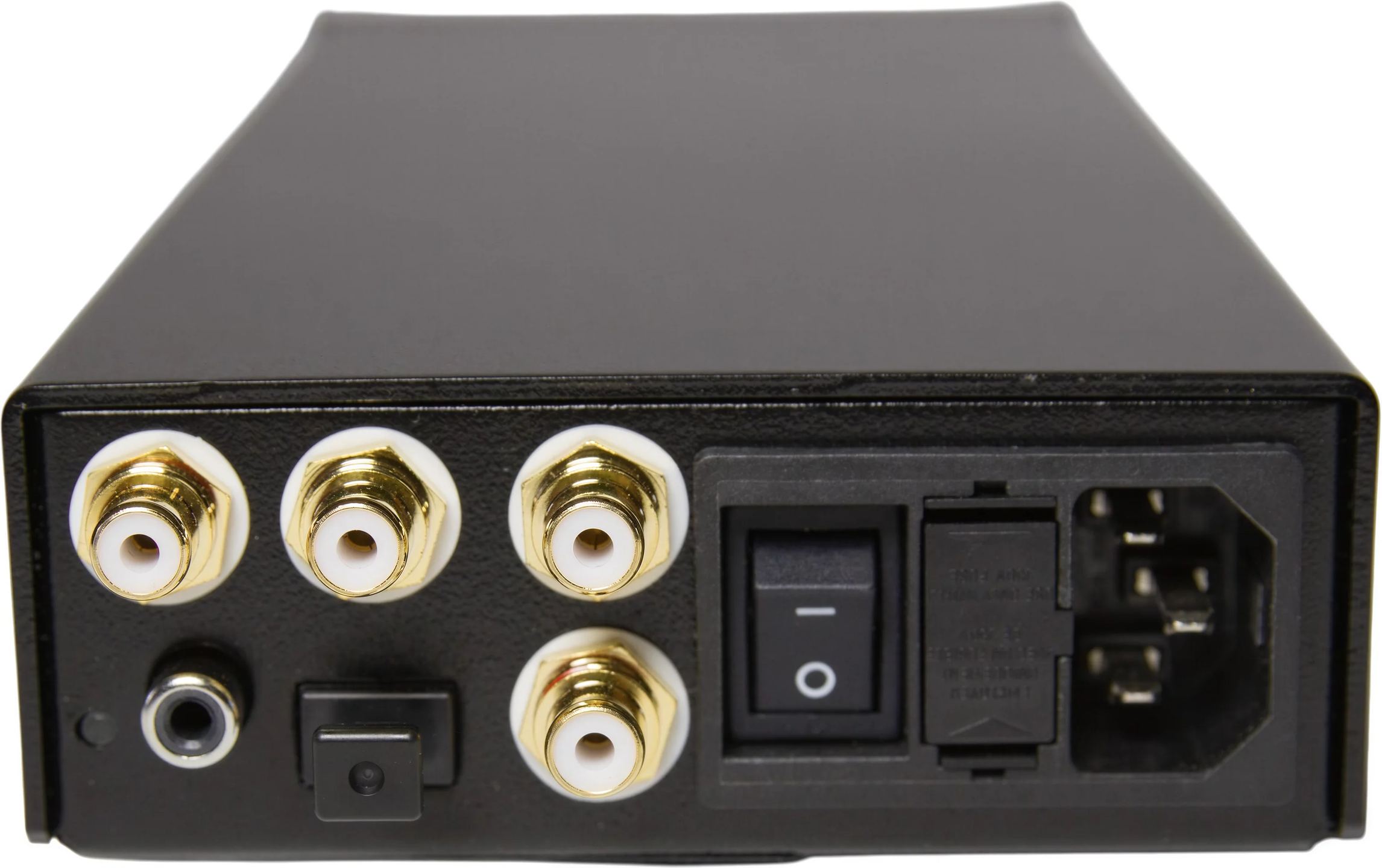
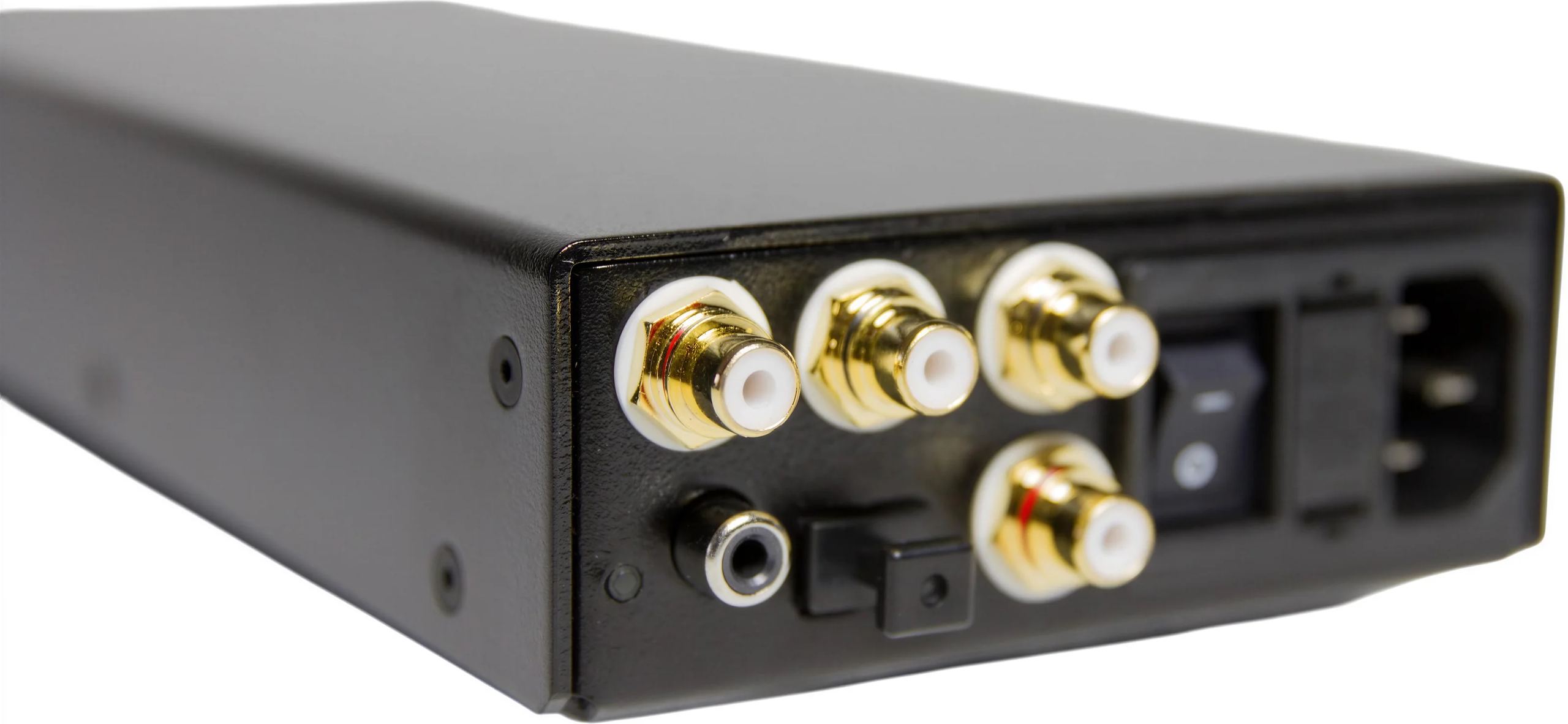
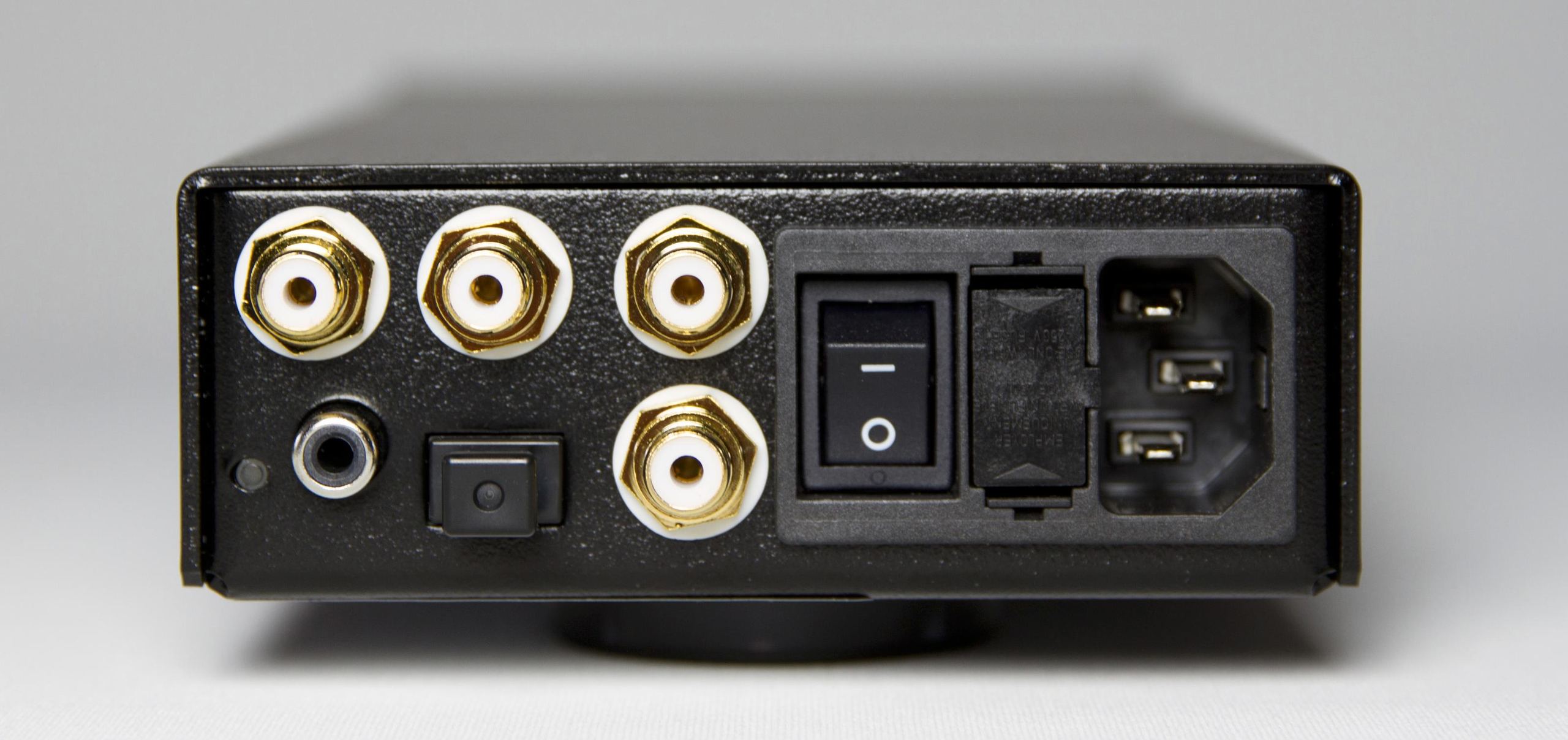
Two digital inputs are available: one optical (Toslink) and one coaxial (S/PDIF). The device handles streams up to 24 bits / 192 kHz. Source selection is automatic: if a digital signal is detected, it takes priority (with the optical input taking priority over the coaxial one). In the absence of a digital signal, the Linear D MKII switches to the analog RCA input. There is no input selector on the front panel, which contributes to the device’s minimalism, but also means that the switching logic cannot be controlled manually.
Headphone outputs and gain adjustment
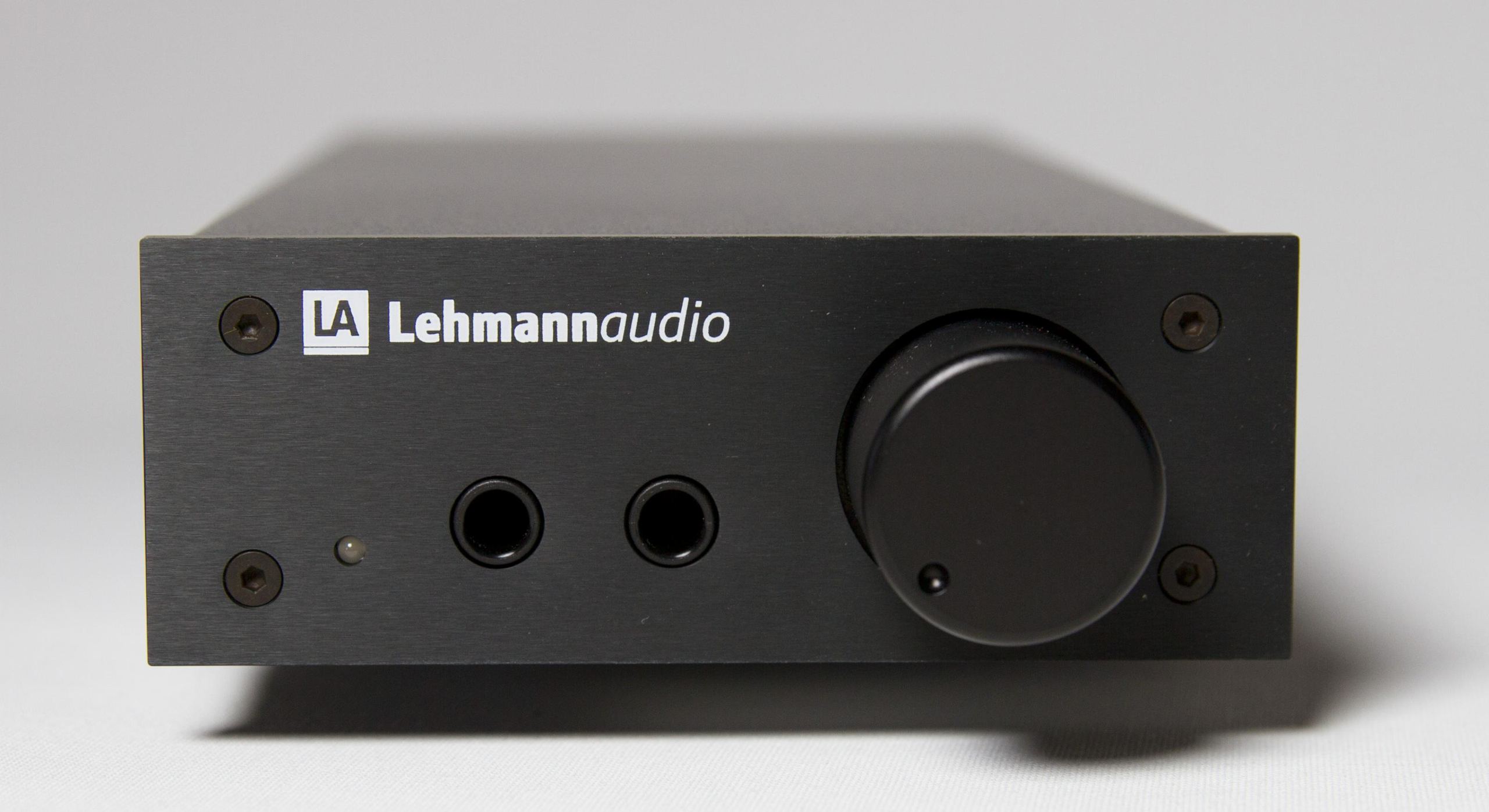
Two 6.35 mm jack sockets fitted with Neutrik connectors with gold-plated contacts are located on the front panel. Both outputs work in parallel and can simultaneously power two headphones of the same impedance, without noticeable signal degradation. The left output automatically cuts the rear RCA line output when headphones are plugged into it: a useful function for silently switching between headphone listening and speaker listening.
With 400 mW into 60 Ω and 200 mW into 300 Ω, the class A output stage is sized to power high-impedance headphones as well as current-hungry planar magnetic models. The output impedance is 5 Ω, low enough not to alter the response curve of most dynamic headphones.
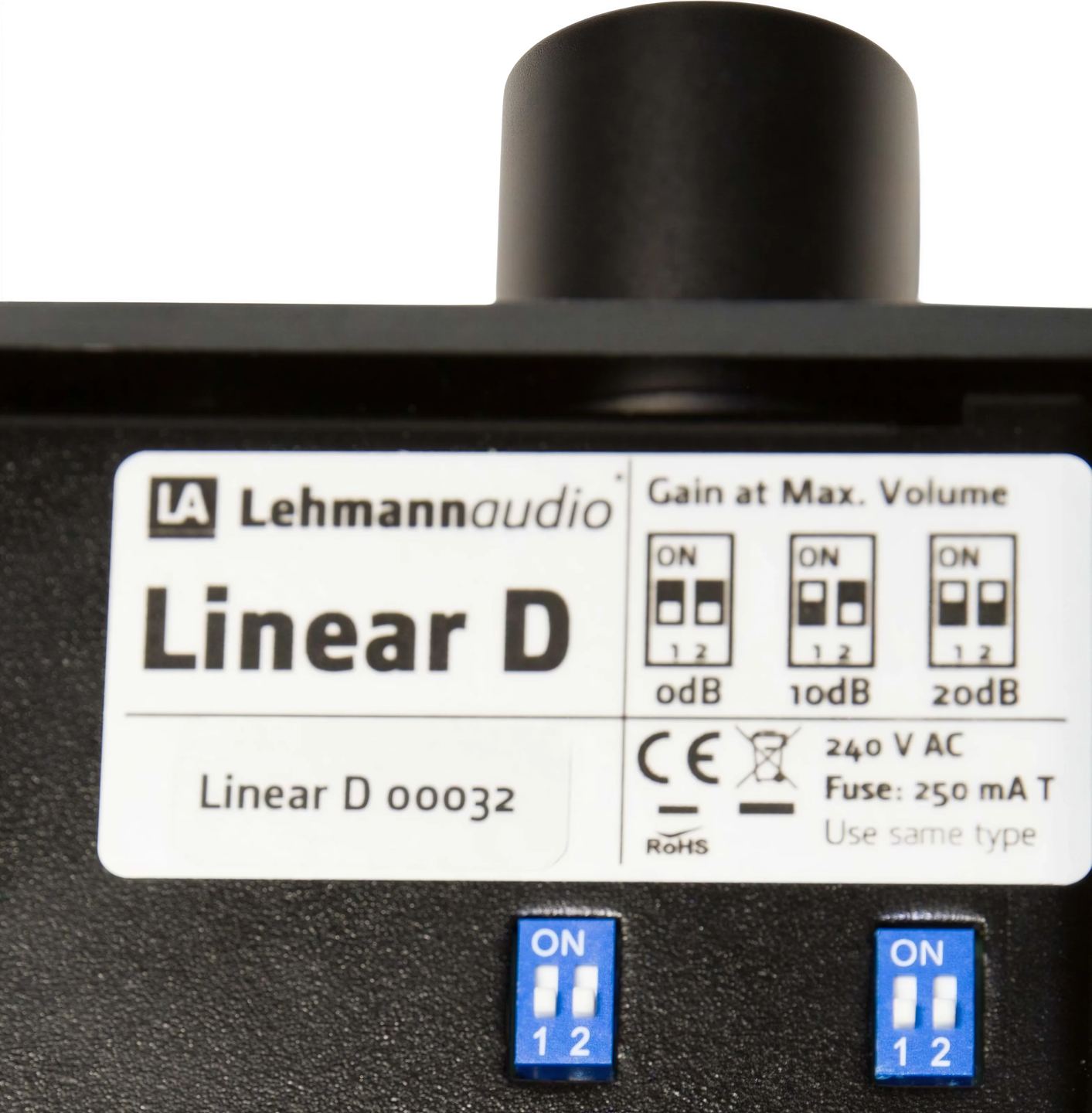
Four gain levels are available (0 dB, 10 dB, 18 dB, 20 dB), adjustable via micro-switches located under the chassis. This placement avoids any accidental handling, but requires turning the device over to change the setting. Lehmann Audio had the good idea of printing the adjustment instructions directly under the enclosure.
Mechanical isolation and construction
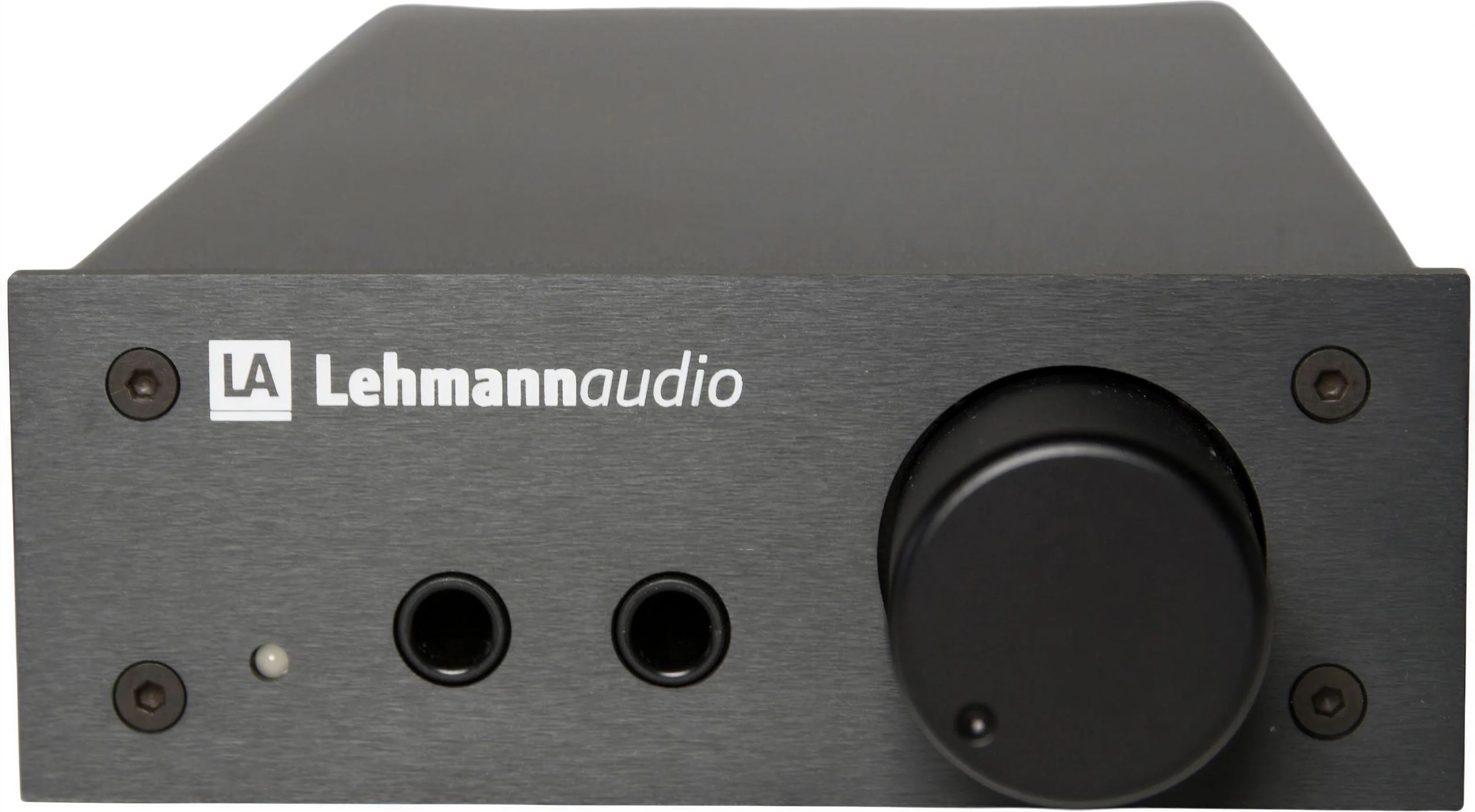
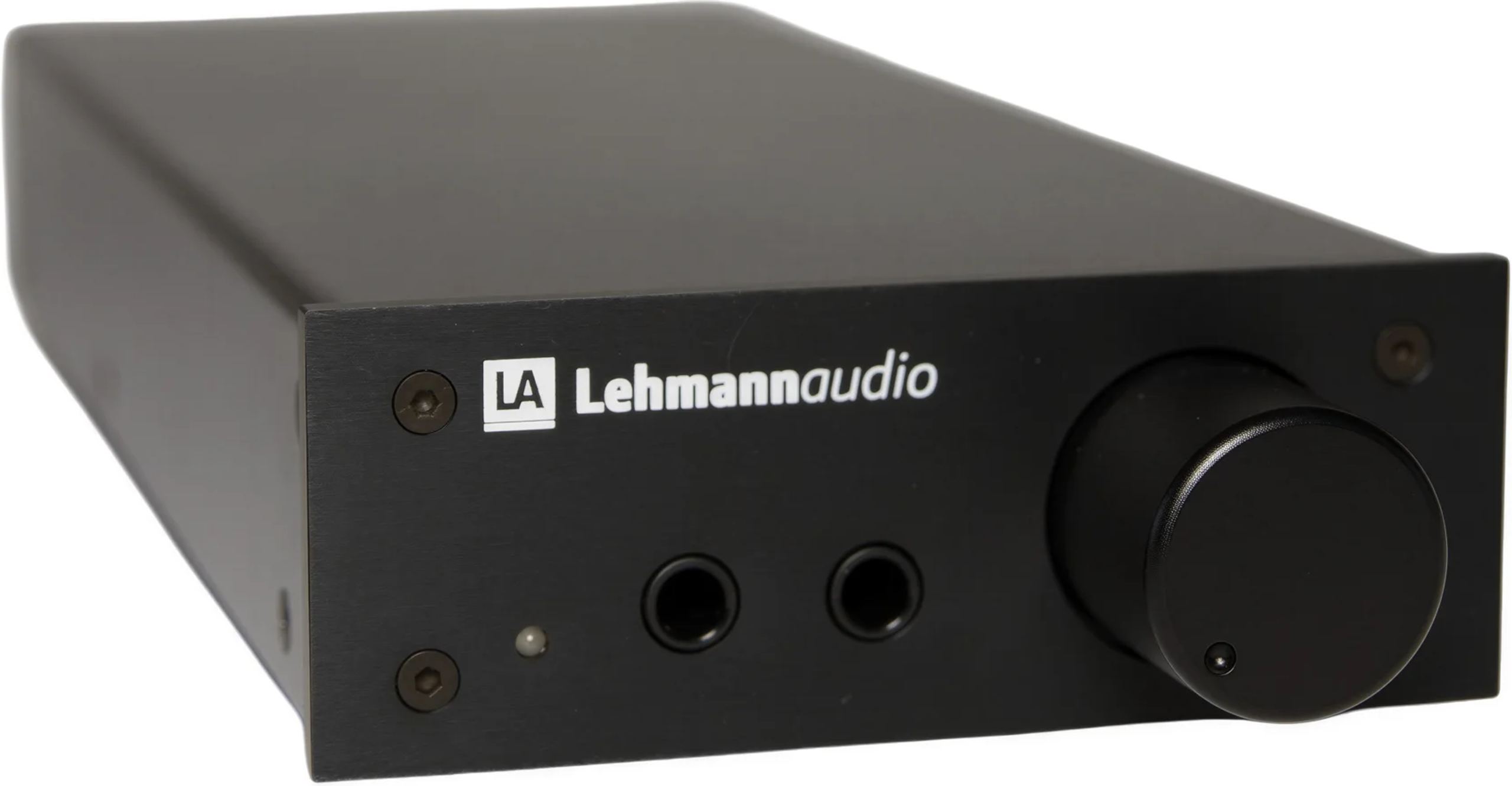
The aluminum chassis measures 11 × 28 × 5 cm and weighs about 1.5 kg. Its front panel is understated: a single volume knob, substantial and damped, and the two headphone outputs. Nothing else. Three finishes are offered: black, silver, and chrome.
Under the enclosure, three 3S absorber feet (formerly SSC) provide mechanical decoupling. These feet use a string suspension system (String Suspension Concept) developed by Manfred Diestertich, chief engineer at Audio Physic. The principle: micro-vibrations picked up by the chassis are converted into heat by a three-part suspension element incorporating a technical textile. The same type of technology equips Audio Physic speakers. On a headphone amplifier, the benefit mainly concerns reducing parasitic mechanical noise transmitted by the furniture.
What changes compared with the Linear D (first generation)
For owners of the original Linear D, the MKII is not just a simple cosmetic refresh. The analog board is fundamentally different: Low-Z copper, Mundorf MLytic capacitors, OFC wiring. The 3S absorber feet replace the standard feet. Lehmann Audio also offers an upgrade from the old board to the new one for owners of previous models, all Linear generations included, with installation of the 3S feet as an option.
Total harmonic distortion remains below 0.001% (at 6 mW / 300 Ω), the signal-to-noise ratio exceeds 100 dB at zero gain, and the frequency response extends from 10 Hz to 35 kHz. The measured specifications are comparable, but the gains are in the area of micro-dynamics and spatial reproduction, parameters that raw figures capture only imperfectly.
Technical specifications
Architecture
- Class A design
- Double-sided printed circuit boards with optimized layout, high-purity copper
- Mundorf MLytic audiophile capacitors
- High-performance OFC copper internal wiring
Performance
- Output power
- 400 mW into 60 Ω
- 200 mW into 300 Ω
- Frequency response: 10 Hz (± 0.3 dB) to 35 kHz (± 1 dB)
- Signal-to-noise ratio: greater than 100 dB (0 dB gain)
- Total harmonic distortion (THD): less than 0.001% (6 mW / 300 Ω)
- Output impedance: 5 Ω
Settings
- Adjustable gain: 0 dB, 10 dB, 18 dB, 20 dB (switches located under the chassis)
Digital conversion
- Latest-generation ESS Sabre converter
- Maximum resolution: up to 24 bits / 192 kHz
- Precise and natural reproduction, close to an analog signature
- Source management: automatic detection with priority given to the analog input
Connectivity
- Inputs
- 1 stereo analog input (RCA)
- 1 coaxial digital input (SPDIF)
- 1 optical digital input (Toslink)
- Outputs
- 2 6.35 mm jack outputs (Neutrik connectors, gold-plated contacts)
- 1 pre-out output (RCA) for active speakers or power amplifier
Mechanical isolation
- Integrated SSC (String Suspension Concept) feet for effective vibration reduction
General characteristics
- Dimensions: 11 x 28 x 5 cm
- Weight: approximately 1.5 kg
- Power consumption: approximately 15 W
- Available finishes: black, silver, chrome
Improvements over the previous version
- Printed circuit board: double-sided in high-purity copper (vs. standard on the V1)
- Capacitors: Mundorf MLytic (vs. audiophile standard on the V1)
- Internal wiring: high-performance OFC copper (vs. standard on the V1)
- Isolation: SSC feet included (vs. standard feet on the V1)
- Sound reproduction: more detailed, with better micro-dynamics
Frequently Asked Questions
Does the Linear D MKII have a USB input?
No. The model with a USB input is the Linear USB II, a separate device sold at the same price. The Linear D MKII offers optical (Toslink) and coaxial (S/PDIF) digital inputs, which makes it better suited to CD players, network players, and TV decoders than to a direct connection with a computer.
Can it be used only as a preamplifier, without headphones?
Yes. By setting the gain to 0 dB and with no headphones connected, the rear RCA line output delivers a preamplified signal that can be used by active speakers or a power amplifier. The line output impedance is 50 Ω.
Are the two headphone outputs independent?
They are wired in parallel on the same output stage. Two headphones of the same impedance can be used simultaneously without any perceptible loss of quality. On the other hand, the left output cuts the RCA line output when headphones are connected to it, while the right output remains neutral with respect to the line output.
Which headphones are compatible?
All dynamic and planar magnetic headphones with a 6.35 mm jack connector. The output stage handles both low-impedance headphones (30-60 Ω) and high-impedance models (250-600 Ω), with an appropriate gain setting. Very sensitive in-ear monitors can be used with the gain set to 0 dB.
- Eco-contribution included in the sale price.