Pro-Ject Tube Box S3 B silver


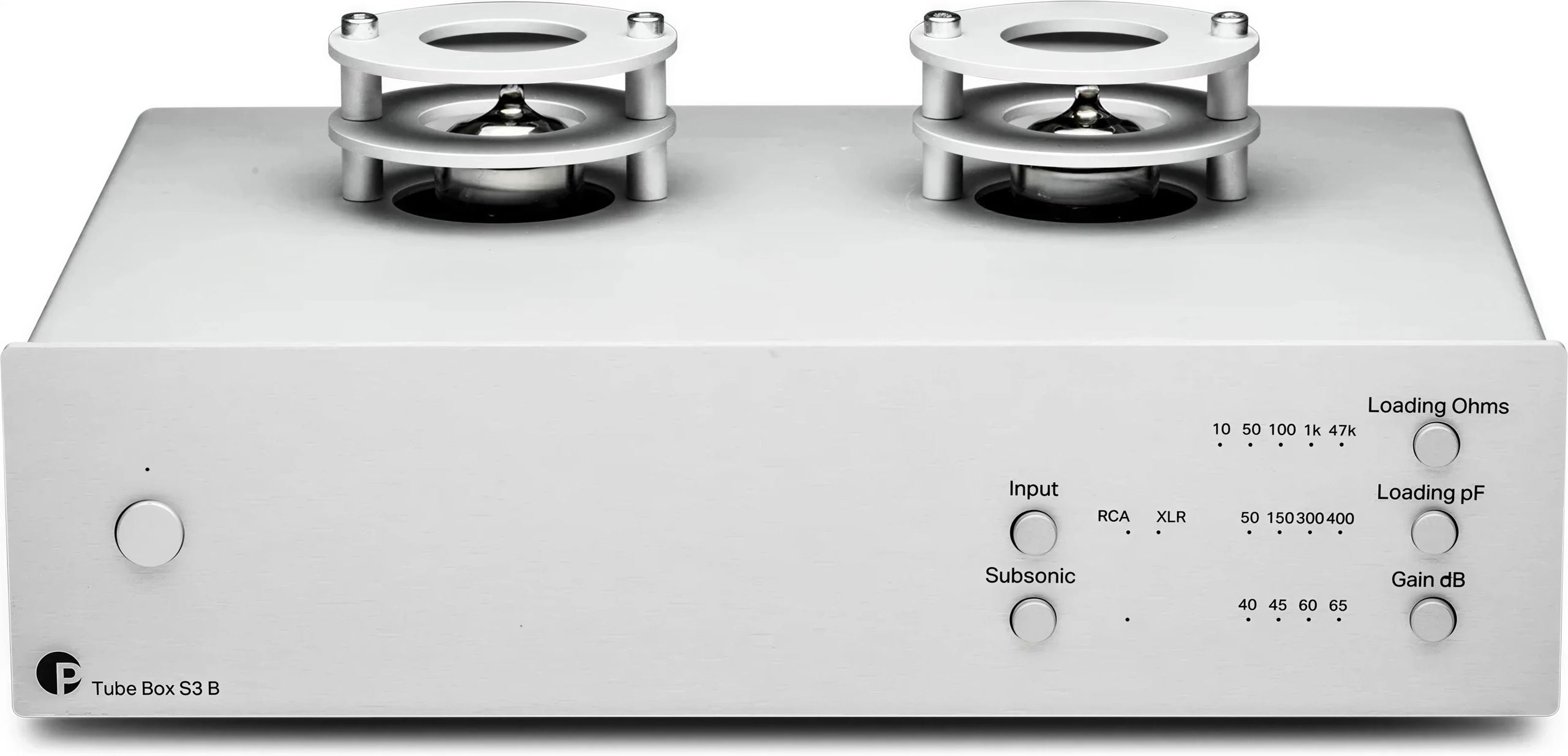
Pro-Ject Tube Box S3 B: the tube phono preamp goes balanced
With the Tube Box S2, Pro-Ject laid the foundations for a compact tube phono preamp, with no operational amplifier and replaceable tubes. The Tube Box S3 B takes this formula and transforms it deeply: fully balanced design, 5-pin mini XLR input, XLR outputs, discrete dual-mono gain stage. The enclosure has doubled in volume to accommodate these additional circuits, and all settings have moved to the front panel. This is a tube phono preamp that speaks the language of balanced operation from end to end.
A discrete, balanced gain stage
The “B” in the name stands for “balanced,” and it is not just a cosmetic label. The Tube Box S3 B features two separate amplification chains, one per polarity (+ and –), built from individual components with no integrated circuits. This dual-mono topology allows the gain stage to subtract common-mode noise, meaning interference picked up along the signal path. The result is reflected in the measurements: a signal-to-noise ratio of 97 dBV in MM (105 dBV A-weighted) and 83 dBV in MC (88 dBV A-weighted), representing a very clear improvement over the Tube Box S2 and its stated 77 dBA.
The harmonic distortion rate is specified at less than 0.005% at 1 kHz in MM and less than 0.01% in MC. Across the entire frequency range (20 Hz – 20 kHz), these figures remain below 0.1% in MM and below 0.03% in MC. The semi-passive RIAA equalization provides accuracy better than 0.4 dB across the entire audible spectrum.
ECC83 tubes in the loop
The two ECC83 tubes (or 12AX7, according to American nomenclature) handle part of the amplification and give the signal that characteristic coloration of tube stages: a present midrange, a softened top end, and dynamics that Pro-Ject describes as “warm.” The tubes are accessible on the top of the unit and replaceable, which opens the door to “tube rolling,” the practice of testing different brands or tube variants to tailor the sonic character to one’s taste.
This is a feature inherited from the Tube Box S2, which introduced this possibility in the Pro-Ject range. The difference here lies in the context: the tubes operate within a discrete balanced stage, not a conventional single-ended circuit. The sonic behavior is therefore not strictly comparable.
Balanced connection from turntable to amplifier
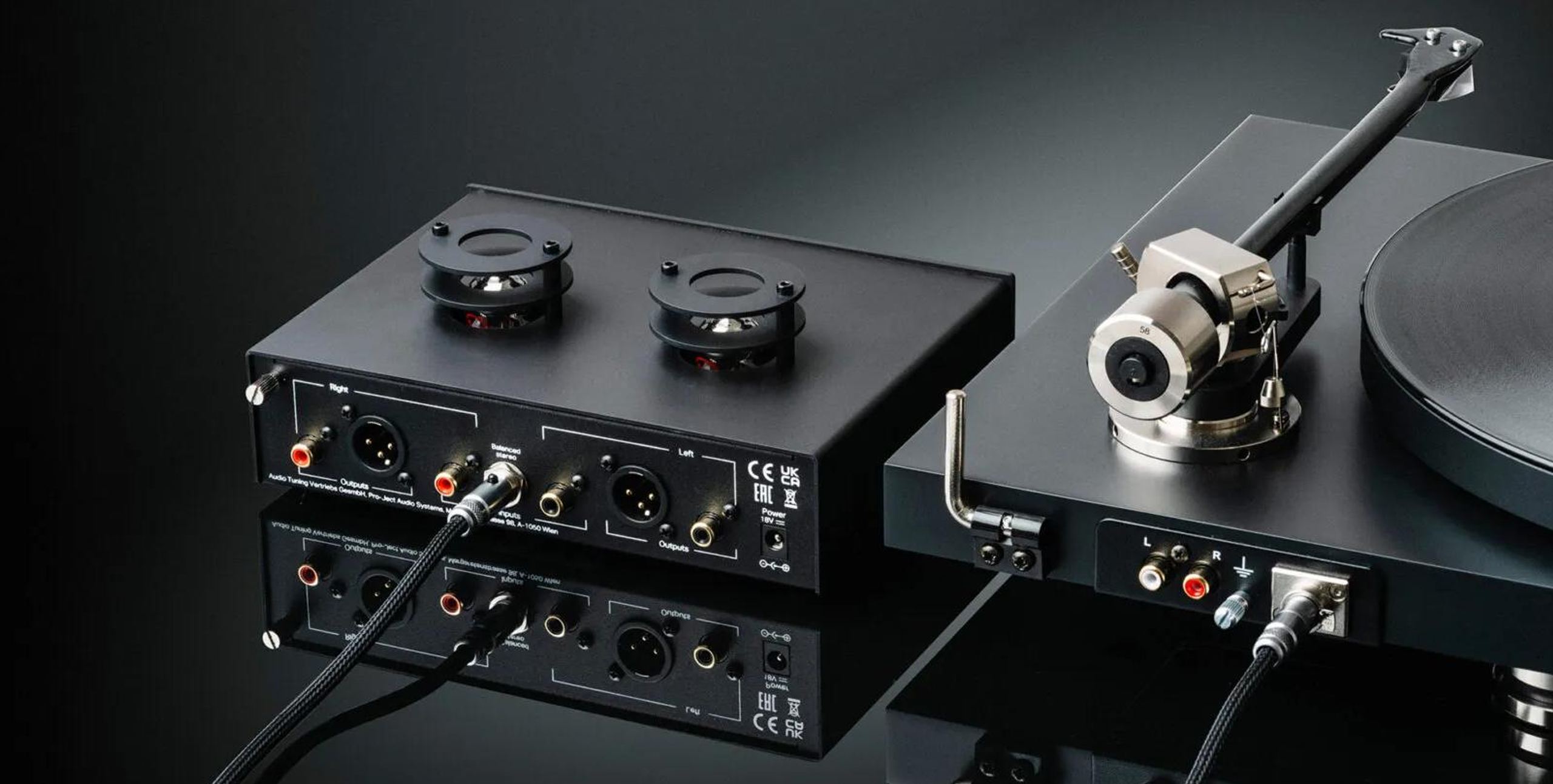
The Tube Box S3 B accepts two sources simultaneously. The 5-pin mini XLR input accommodates a Pro-Ject True Balanced Connection cable (or any compatible cable), while the RCA input remains available for a turntable wired single-ended. A selector on the front panel lets you switch between the two inputs, and the load settings associated with each are stored.
On the output side, a pair of XLR connectors provides a balanced signal with an additional 6 dB of gain, and a pair of RCA connectors delivers the single-ended signal taken directly from the RIAA equalization stage. It is possible to connect the preamp to an amplifier via XLR while keeping a turntable connected via RCA: the conversion is handled internally.
One point to keep in mind: to fully benefit from the balanced connection, you need an MC cartridge (moving-coil cartridges are inherently balanced transducers) or the Pro-Ject Pick it PRO Balanced (MM) cartridge. With a standard MM cartridge connected via RCA, the Tube Box S3 B works perfectly, but in traditional single-ended mode.
Load settings accessible from the front panel
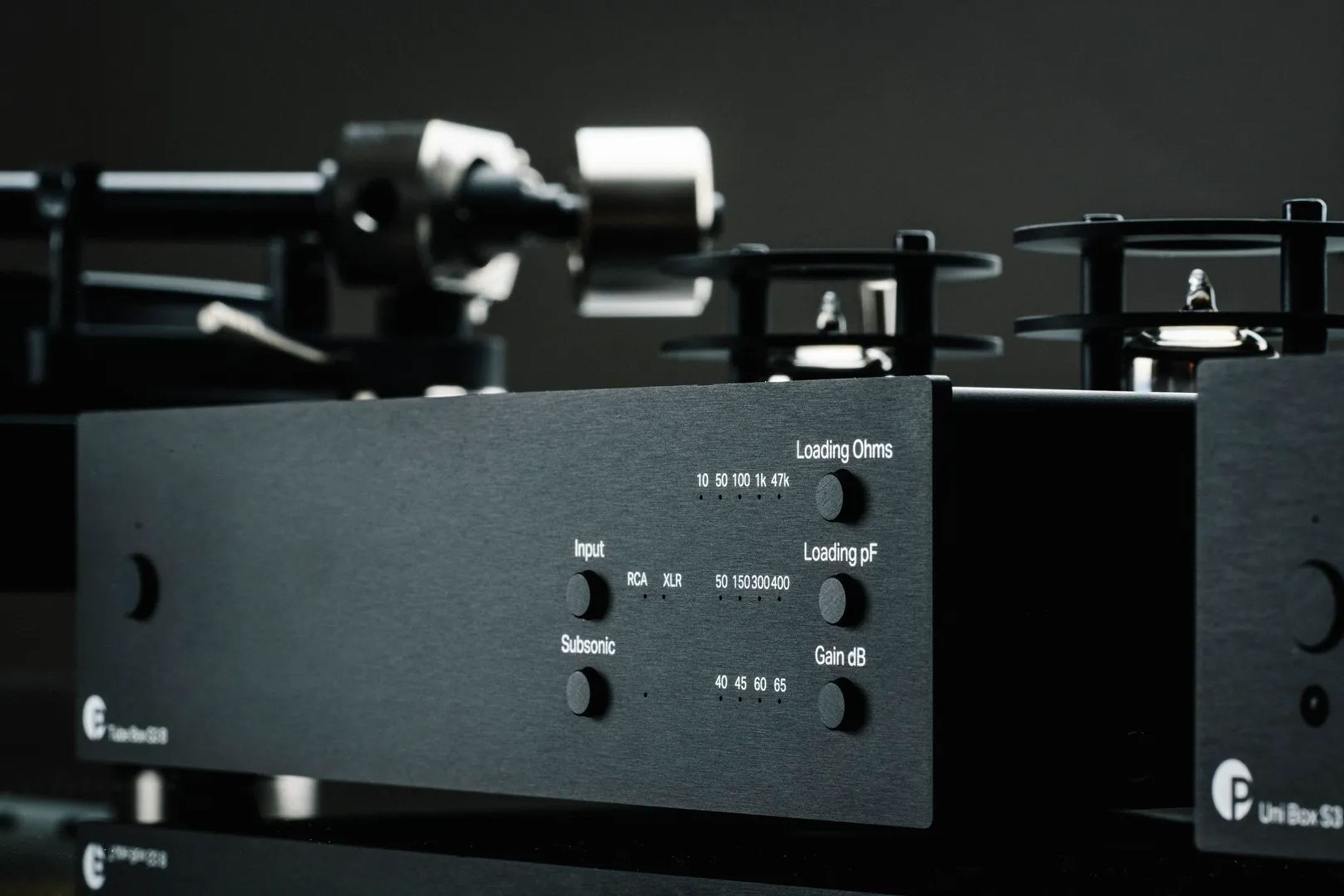
The Tube Box S2 required turning the unit over and manipulating DIP switches to change input impedance and capacitance. The Tube Box S3 B places all settings on the front panel, with rotary knobs and indicator lights.
Input impedance can be set to five positions: 10, 50, 100, 1,000 and 47,000 ohms. Input capacitance offers four values: 50, 150, 300 and 400 pF. Gain can be selected from four steps (40, 45, 60 and 65 dB), with an additional 6 dB available on the XLR output. A 20 Hz subsonic filter, with a slope of 18 dB per octave (versus 12 dB/octave on the S2), can be activated with a dedicated button.
The low impedance (10 ohms) and capacitance (50 pF) values deserve special attention: they make it possible to compensate for situations where the cabling between the turntable and the preamp has high parasitic capacitance, or to accommodate MC cartridges with very low internal impedance. This flexibility in adjustment covers the vast majority of MM and MC cartridges on the market.
Construction and format
The aluminum enclosure measures 206 × 81 × 153 mm (164 mm including connectors) and weighs 1,010 g without the power supply. It is noticeably larger than the Tube Box S2 (103 × 37 × 119 mm): the move to balanced dual mono required greater volume. The aluminum provides shielding against electromagnetic interference, and the format remains compact for a tube phono preamp equipped with this connectivity.
The power supply is external (18 V / 1,000 mA DC), a classic choice to keep the transformer away from the audio circuit and limit interference. Standby power consumption is less than 0.5 W. Two finishes are available: silver and black. Manufacturing is European.
Positioning in the Pro-Ject range
The Tube Box S3 B sits above the Tube Box E (entry-level tube model, RCA only) and logically replaces the Tube Box S2. It shares its balanced connectivity and discrete topology with the Phono Box S3 B (the all-transistor version in the S3 B range), but differs through its ECC83 tube stage. Higher up in the catalog, the Phono Box DS3 B and the Phono Box RS2 offer higher-end performance and pricing, but without tubes.
For owners of Pro-Ject turntables equipped with a mini XLR output (X1 B, X2 B, XA B, Debut Pro B, among others), the Tube Box S3 B forms a coherent setup with the brand’s True Balanced Connection cables. With an RCA-output turntable, the unit remains fully usable without restriction, in single-ended mode.
Documentation
Technical specifications
Main features
- Balanced 5-pin mini XLR input
- Balanced XLR outputs
- Fully balanced and discrete gain stage
- Easy front-panel parameter adjustment
- 2 ECC83 tubes (replaceable)
- MM and MC compatible
- Dual mono design
- Semi-passive RIAA equalization
- Low noise and low distortion
- Aluminum chassis protecting against interference
Tube section
- Configuration: 2 ECC83 tubes (12AX7)
- Warm and dynamic sound reproduction with a smooth top end
Amplification stage and performance
- Gain (+ 6 dB with XLR output): 40, 45, 60, 65 dB
- MM signal-to-noise ratio (40 dB): 97 dBV, 105 dBV A-weighted
- MC signal-to-noise ratio (60 dB): 83 dBV, 88 dBV A-weighted
- THD at 1 kHz: < 0.005% MM, < 0.01% MC
- THD (20 Hz - 20 kHz): < 0.1% MM, < 0.03% MC
- RIAA equalization curve accuracy: < 0.4 dB / 20 Hz - 20 kHz
- Subsonic filter: at 20 Hz with a slope of 18 dB / octave
Cartridge loading options
- Input impedance: 10, 50, 100, 1k, 47k ohms
- Input capacitance: 50, 150, 300, 400 pF
Connectivity
- Inputs
- 1 5-pin mini XLR
- 1 pair of RCA phono sockets
- Line-level outputs
- 1 RCA pair
- 1 XLR pair
- Balanced mini XLR connection: interference-free connection with your turntable
- RCA input: standard RCA phono input
- Balanced XLR output: interference-free connection with your amplifier
- RCA output: standard RCA line output
Chassis
- Aluminum chassis ensuring interference-free performance
- Available in silver or black finish
Power supply
- DC power supply: 18 V / 1000 mA
- Consumption: 18 V / 800 mA DC, < 0.5 W in standby
Dimensions and weight
- Dimensions (W x H x D): 206 x 81 x 153 mm (164 mm with connectors)
- Weight: 1010 g without power supply
Frequently Asked Questions
Can the Tube Box S3 B be used with a turntable that only has RCA outputs?
Yes. The RCA input is a standard phono input. The preamp then operates in single-ended mode, with all adjustment functions available. The balanced connection via mini XLR is an option, not a requirement.
Are the supplied ECC83 tubes of good quality, or should they be replaced right away?
Pro-Ject ships the unit with functional, broken-in tubes. Replacement is not necessary for initial use. Tube rolling is a matter of personal experimentation: some prefer ECC83 tubes from brands such as Mullard, Telefunken or JJ Electronic to fine-tune the sound, but it is a choice, not a necessity.
What is the difference between the Tube Box S3 B and the Phono Box S3 B?
The Phono Box S3 B is an all-transistor phono preamp (without tubes), with identical balanced connectivity. The Tube Box S3 B adds an ECC83 tube stage to the amplification circuit, which changes the sonic character: denser midrange, smoother top end. Distortion and signal-to-noise ratio measurements differ between the two models.
Can two turntables be connected at the same time?
Yes. One turntable on the mini XLR input and another on the RCA input. The “Input” button on the front panel switches between the two sources, and the load settings (impedance, capacitance, gain) are stored for each input.
Does the subsonic filter affect listening in an audible way?
The filter cuts at 20 Hz with a slope of 18 dB per octave. It attenuates frequencies below 20 Hz (record warp, tonearm resonances, flatness defects) without noticeably encroaching on audible bass. Its activation can be reversed at any time from the front panel.
Is a specific cable required for the balanced connection?
The balanced input uses a 5-pin mini XLR connector. Pro-Ject markets several compatible True Balanced Connection cables (Connect it E, Connect it S, Connect it DS), with different turntable-side connectors (RCA, mini XLR, 5-pin DIN). Third-party cables in 5-pin mini XLR format may work, but Pro-Ject recommends its own references to guarantee pinout compatibility.
Is the external power supply interchangeable?
The unit requires an 18 V / 1,000 mA DC power supply, included with the product. Pro-Ject advises against using a different power supply. For those who want to go further, the brand offers upgraded power supplies in its accessories range (such as the Power Box).
- Eco-contribution of €0.12 included in the sale price.
- GTIN / EAN: 9120129869980