Pro-Ject MC Step Up Box S3 silver


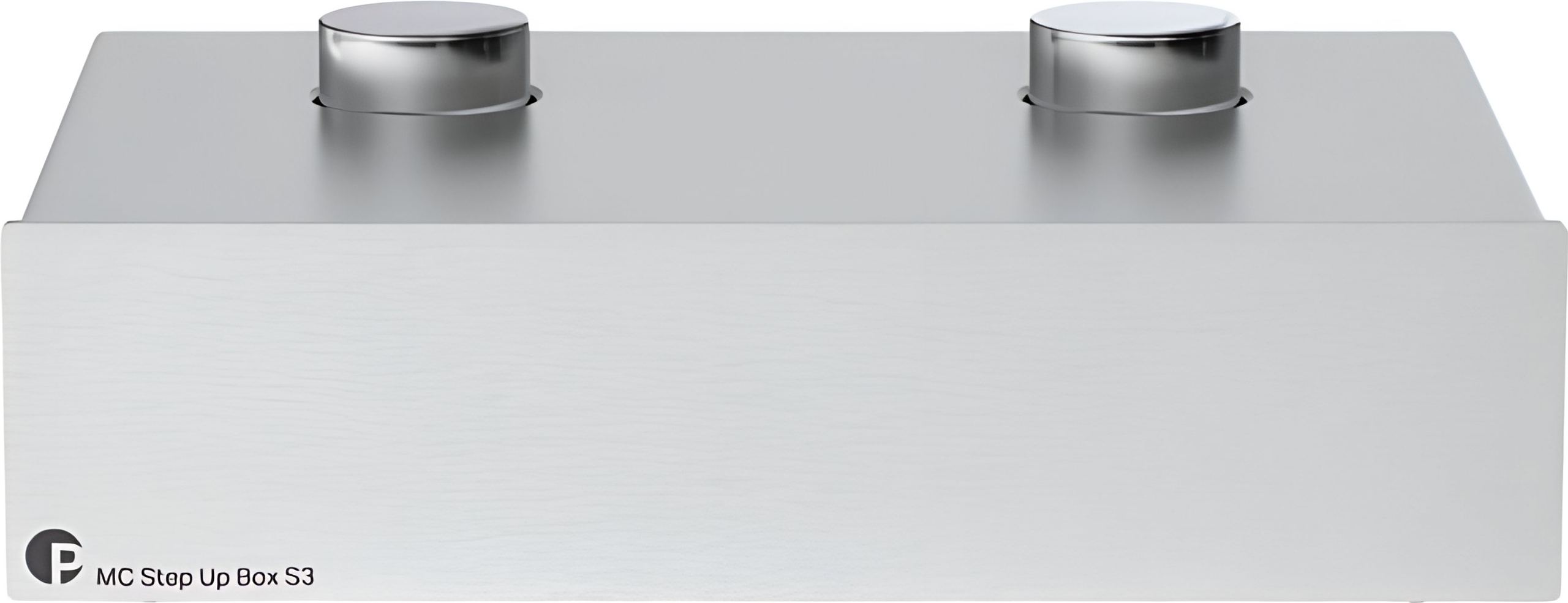
Pro-Ject MC Step Up Box S3: step-up transformer for MC cartridges
Rather than an active MC phono preamplifier, some music lovers prefer an older and more direct approach: the step-up transformer (or SUT, for step-up transformer). The MC Step Up Box S3 is the first transformer of this type offered by Pro-Ject in its S range. Completely passive, with no power supply, it sits between a low-output MC cartridge and an MM phono preamplifier to raise the signal to a usable level.
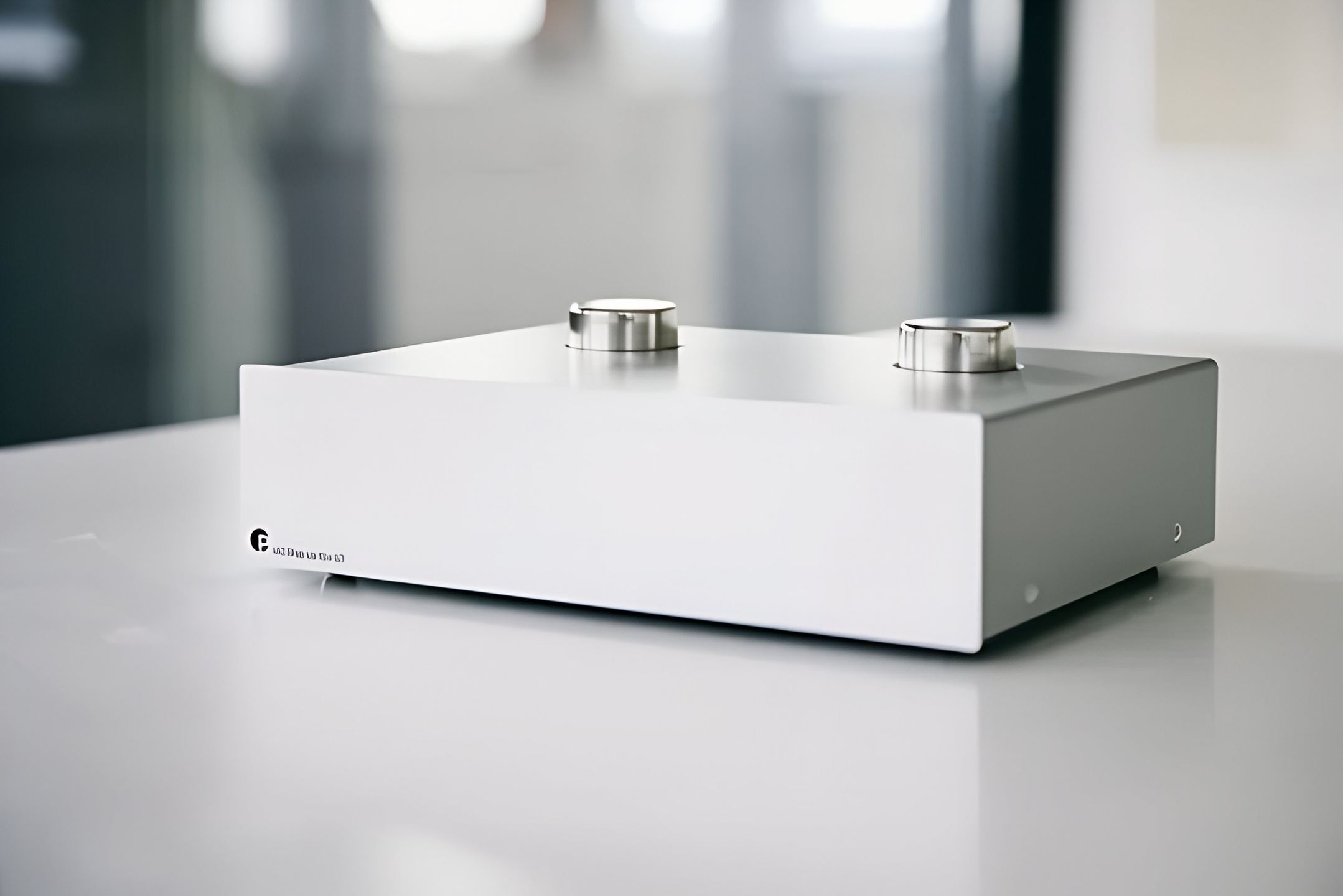
A signal path without active amplification
The principle of a step-up transformer differs radically from that of a conventional MC phono preamplifier. Where an active stage amplifies the signal with electronic components powered from the mains, the MC Step Up Box S3 uses the transformation ratio of its windings (1:16) to convert high current into higher voltage. No external energy is involved in the process: the voltage increase is obtained through a corresponding decrease in current, according to the fundamental laws of the transformer.
The practical advantage of this approach lies in noise. An active MC preamplifier must apply high gain (often 60 dB and more) to make use of the very weak signal from an MC cartridge, whose output level is about ten times lower than that of an MM cartridge. This substantial gain can generate hiss and distortion. The transformer, by contrast, boosts the signal by 21 or 24 dB depending on the selected impedance setting, bringing the output voltage to a level comparable to that of an MM cartridge. The MM phono preamplifier that takes over then only needs to apply moderate gain, under much more favorable signal-to-noise conditions.
Pro-Ject recommends this combination (step-up transformer + MM preamplifier) rather than a dedicated MC preamplifier, and notes that the pairing works very well with tube phono preamplifiers.
Two impedance positions depending on the cartridge
A selector located on the rear of the unit allows you to choose between two impedance matching ranges: 10-40 Ω and 40-150 Ω. The gain varies accordingly: 21 dB at 1 kHz for the first position, 24 dB for the second. This distinction corresponds to the two major families of low-output MC cartridges.
Cartridges whose internal impedance is between about 2 and 15 Ω (Ortofon Cadenza, Dynavector DV-20X2, etc.) will find their best match in the 10-40 Ω position. Cartridges with higher internal impedance, between 30 and 100 Ω, will use the 40-150 Ω position. Correct impedance matching determines both the frequency response and the dynamic behavior of the signal sent to the preamplifier.
The recommended output load is 47 kΩ / 100 pF, which corresponds to the standard of most MM phono inputs.
Dual mono design and mu-metal shielding
Each channel has its own transformer, enclosed in mu-metal shielding. This dual mono layout promotes channel separation and limits interactions between the two channels. Mu-metal, a nickel alloy with very high magnetic permeability, protects the windings from stray magnetic fields that could induce noise in the signal.
The solid aluminum chassis adds protection against external electromagnetic interference. The choice of aluminum also ensures the mechanical rigidity of the whole and limits sensitivity to vibrations, a parameter not to be overlooked when handling signals of very low amplitude. The whole weighs 940 g and measures 206 x 65 x 153 mm (164 mm including the connectors), a compact format that fits easily beside a phono preamplifier.
Connectivity and integration into the system
The connectivity consists of one pair of RCA inputs and one pair of RCA outputs, all gold-plated. The signal path is simple: phono cable from the turntable to the input of the MC Step Up Box S3, then interconnect cable to the MM input of the phono preamplifier. No power cable, no on/off switch.
This installation scheme means that the downstream phono preamplifier must have an MM input (or an input set to MM parameters: 47 kΩ, standard gain). The MC Step Up Box S3 does not replace a phono preamplifier: it complements it by handling the first stage of boosting the MC signal. The MM phono stage then applies the RIAA equalization curve and the remaining gain.
Owners of integrated amplifiers equipped with an MM phono input will find in it a way to use an MC cartridge without changing amplifier or adding an external phono preamplifier.
Bandwidth and frequency behavior
The stated frequency response extends from 10 Hz to 55 kHz with a tolerance of ± 1 dB. The lower limit at 10 Hz covers the entire useful audio spectrum and even extends below musical frequencies, which allows the record’s infrabass to pass without attenuation. In practice, a downstream subsonic filter (often integrated into the phono preamplifier) remains recommended for turntables sensitive to record warping.
The upper limit at 55 kHz, far beyond audibility, indicates that the transformer does not restrict instrument harmonics or fast transients. It is a good indicator of the quality of the winding manufacture.
Documentation
Technical Specifications
Main Features
- Sound enhancement for your MC cartridge
- Particularly recommended for tube phono preamplifiers
- Fully passive signal path, no power supply
- Superior sound quality
- Dual mono design
- Maximum channel separation
- Solid aluminum housing protecting against interference
Technical Specifications
- Frequency response 10 Hz - 55 kHz: +/- 1 dB
- Gain at 10-40 Ohm: 21 dB at 1 kHz
- Gain at 40-150 Ohm: 24 dB at 1 kHz
- Recommended load: 47 kOhm / 100 pF
- Transformation ratio: 1:16
- Input impedance matching: 10 or 100 Ohms
- Transformer with mu-metal shielding
Connectivity
- MC input: 1 pair of RCA phono sockets
- Output: 1 pair of RCA phono sockets
- Gold-plated RCA terminals
Dimensions and weight
- Dimensions: 206 x 65 x 153 mm (164 mm with sockets)
- Weight: 940 g
Frequently asked questions
Does the MC Step Up Box S3 require a power supply?
No. Operation is entirely passive. The transformer takes advantage of the winding ratio to raise the signal voltage without any external energy source. It simply needs to be connected between the turntable and the MM phono preamplifier.
Can it be used with any MC cartridge?
The impedance selector covers two ranges (10-40 Ω and 40-150 Ω) that encompass the vast majority of low-output MC cartridges available on the market. High-output MC cartridges, whose signal is already comparable to that of an MM cartridge, do not need a step-up transformer.
What is the difference between the S3 and the DS3 B?
The DS3 B uses Lundahl LL 1678 transformers, offers balanced XLR connections, allows a choice between 24 and 30 dB of gain, and provides more extensive impedance adjustment. The S3 is limited to RCA connections with a fixed 1:16 transformation ratio and a gain of 21 or 24 dB depending on the impedance position.
Do you need a phono preamplifier in addition to the MC Step Up Box S3?
Yes. The step-up transformer does not perform RIAA correction. It raises the MC signal to the level of an MM signal, then an MM phono preamplifier (external or integrated into the amplifier) takes over to apply the RIAA equalization and final gain.
Does the choice of impedance position have an audible impact?
Yes, and not only in terms of volume. Incorrect impedance matching can affect the frequency response (rolled-off highs or a bump in the bass), dynamics, and the cartridge’s overall behavior. You should refer to the internal impedance of the MC cartridge used: if it is below 15-20 Ω, the 10-40 Ω position is generally the right one; beyond that, the 40-150 Ω position will be more suitable.
Where should the MC Step Up Box S3 be placed physically?
As close as possible to the turntable, so that the cable carrying the MC signal (very weak) remains short. The mu-metal shielding and aluminum chassis protect against interference, but proximity to a power transformer, power supply unit, or screen can introduce noise. A little distance from these sources is preferable.
- Eco-contribution of €0.12 included in the sale price.
- GTIN / EAN: 9120129860390