

Samsung HW-Q930H 2026


Specifications and features


Samsung HW-Q930H: 9.1.4 Dolby Atmos soundbar
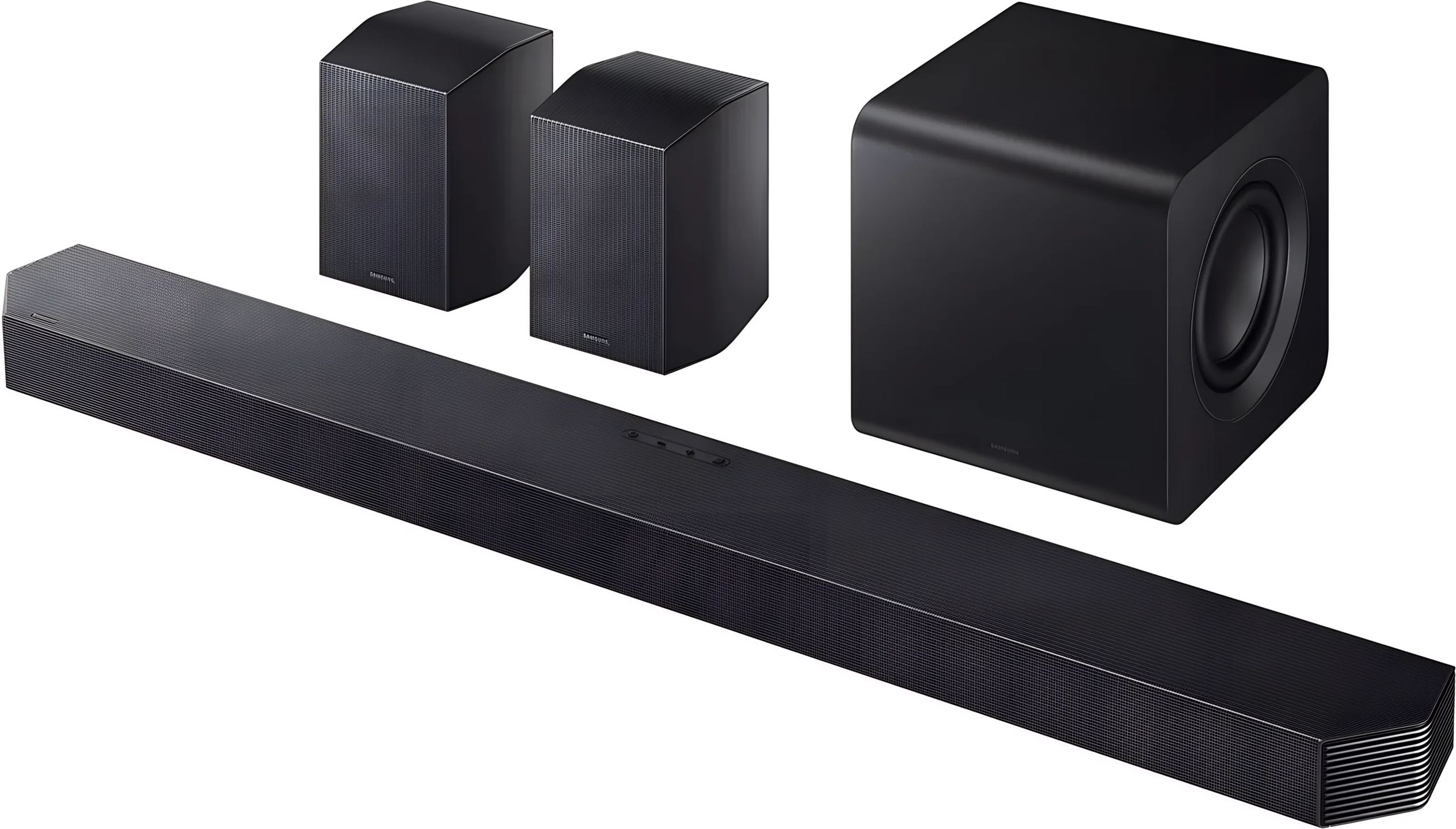
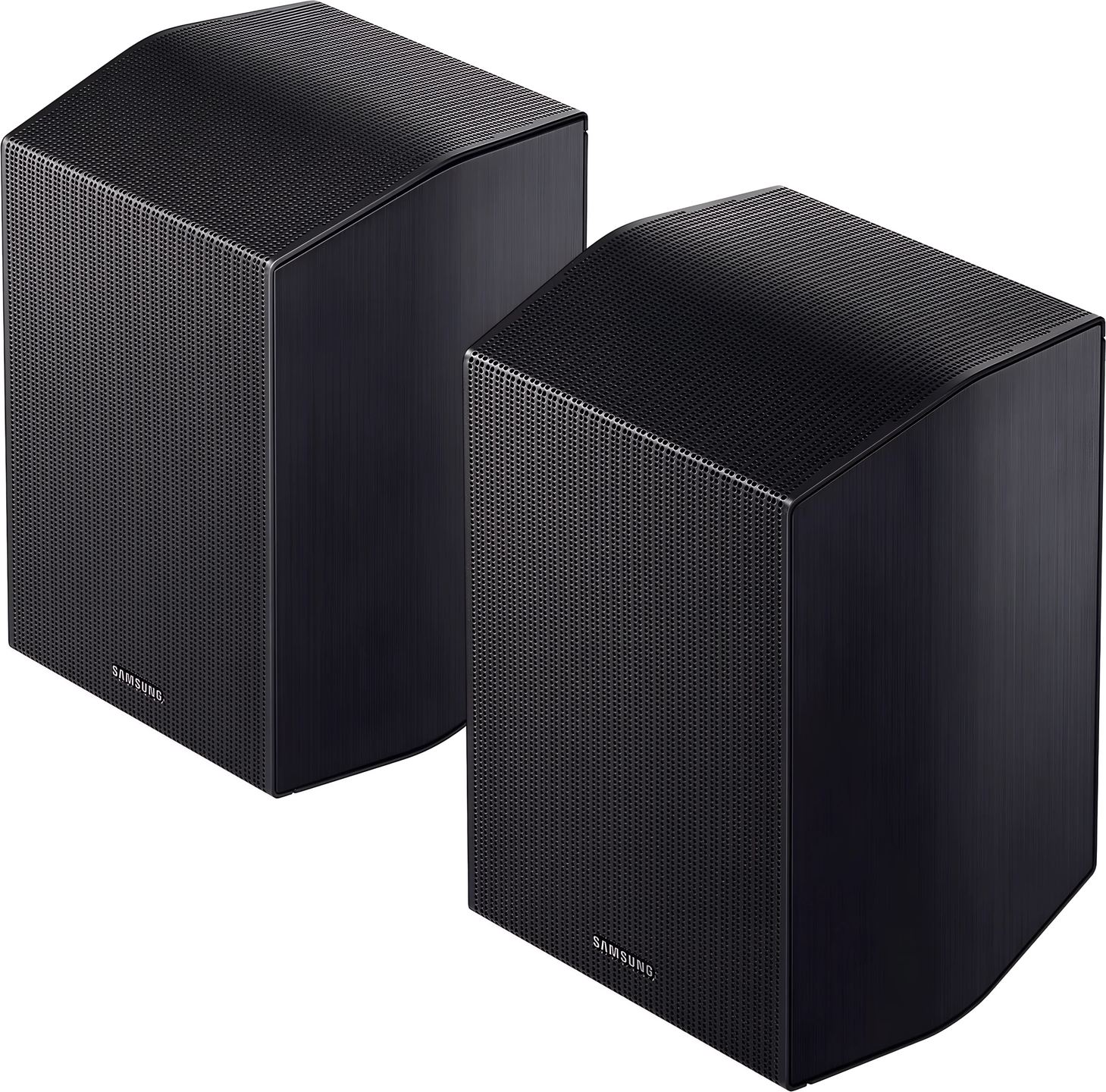
Reproducing the scale of a movie theater in a living room depends less on the number of speakers than on how the sound moves around the listener. The HW-Q930H relies on a 9.1.4 configuration powered by seventeen speakers, a wireless subwoofer, and two rear speakers that are also wireless. It occupies the middle position in Samsung’s 2026 Q-Series lineup, below the HW-Q990H.
Seventeen speakers for three-dimensional sound
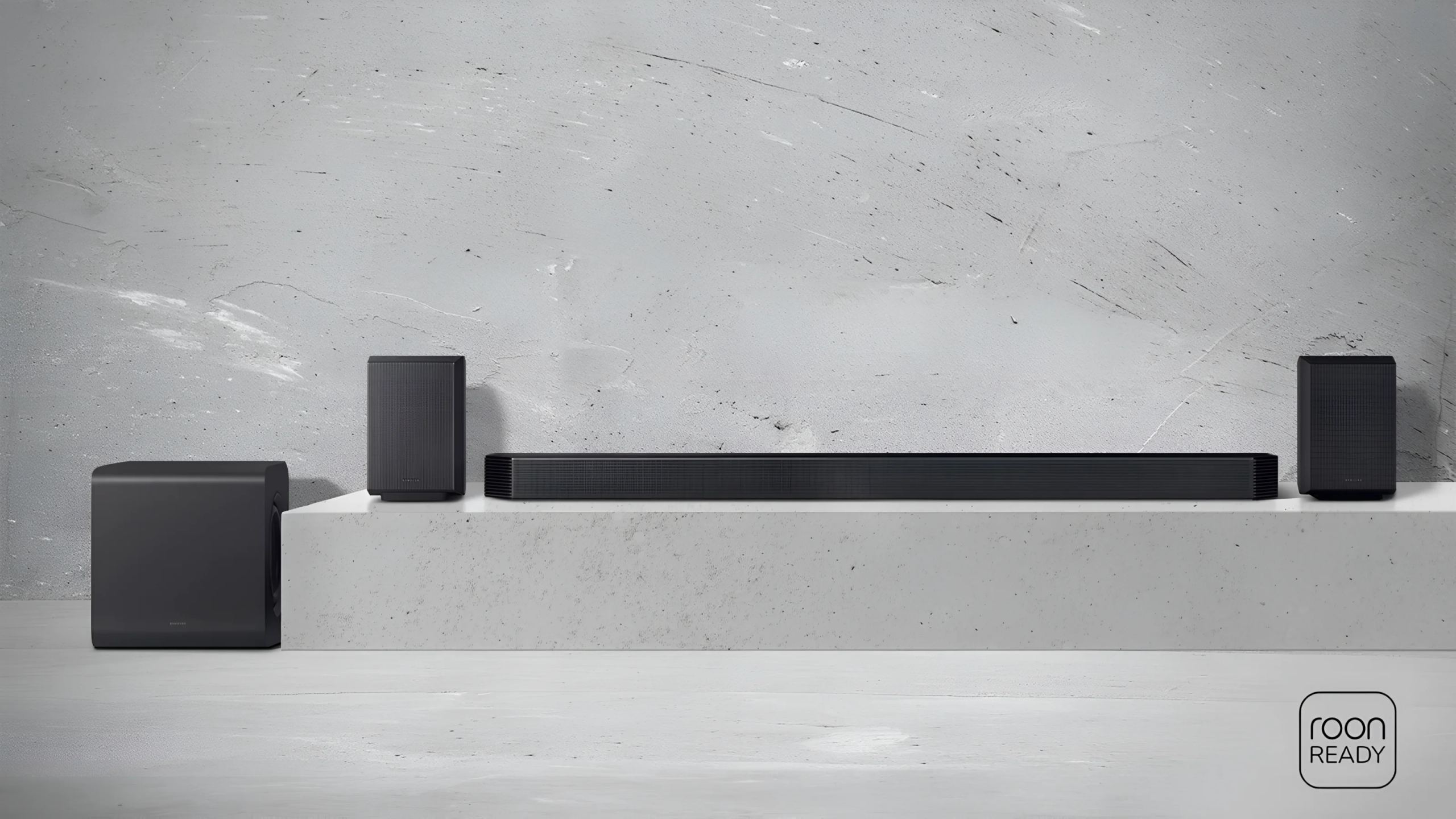
The 9.1.4 designation describes the sound distribution: nine channels at ear level and around the listener, one channel dedicated to the subwoofer, and four channels aimed at the ceiling. On the soundbar, there is a center speaker for dialogue, two upward-firing speakers aimed at the ceiling, two side speakers, and two speakers placed at the ends to widen the soundstage. The wireless subwoofer and the two wireless rear speakers complete the system, with the latter adding rear surround and a height component.
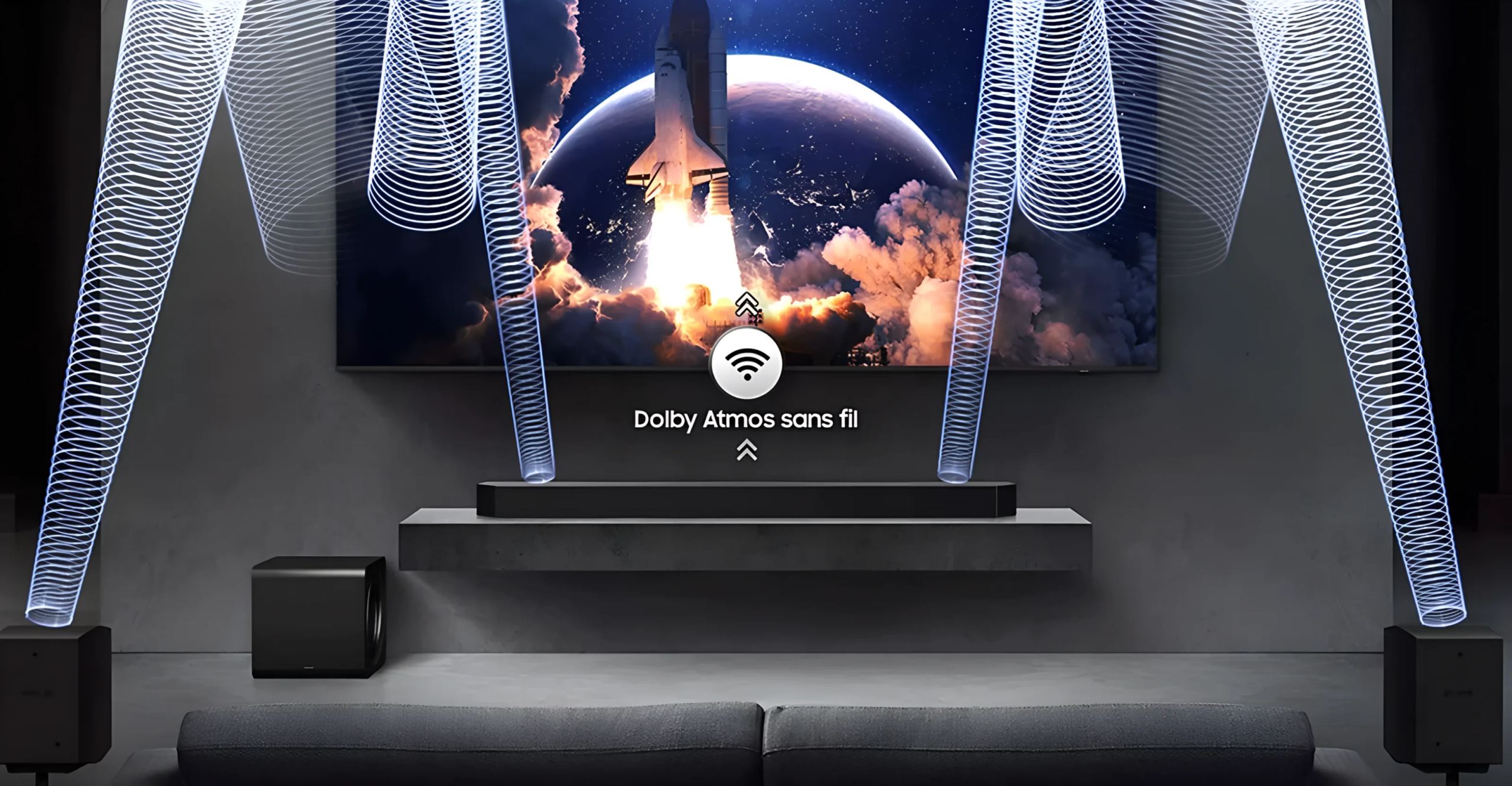
The ceiling-directed channels bounce part of the sound downward after reflection, creating sound height above the viewer. This is the principle of Dolby Atmos: placing effects in a three-dimensional space rather than on a flat plane. The result depends on the room, especially the height and nature of the ceiling, with a low, flat ceiling giving better results than a high or sloped ceiling.
A more compact subwoofer
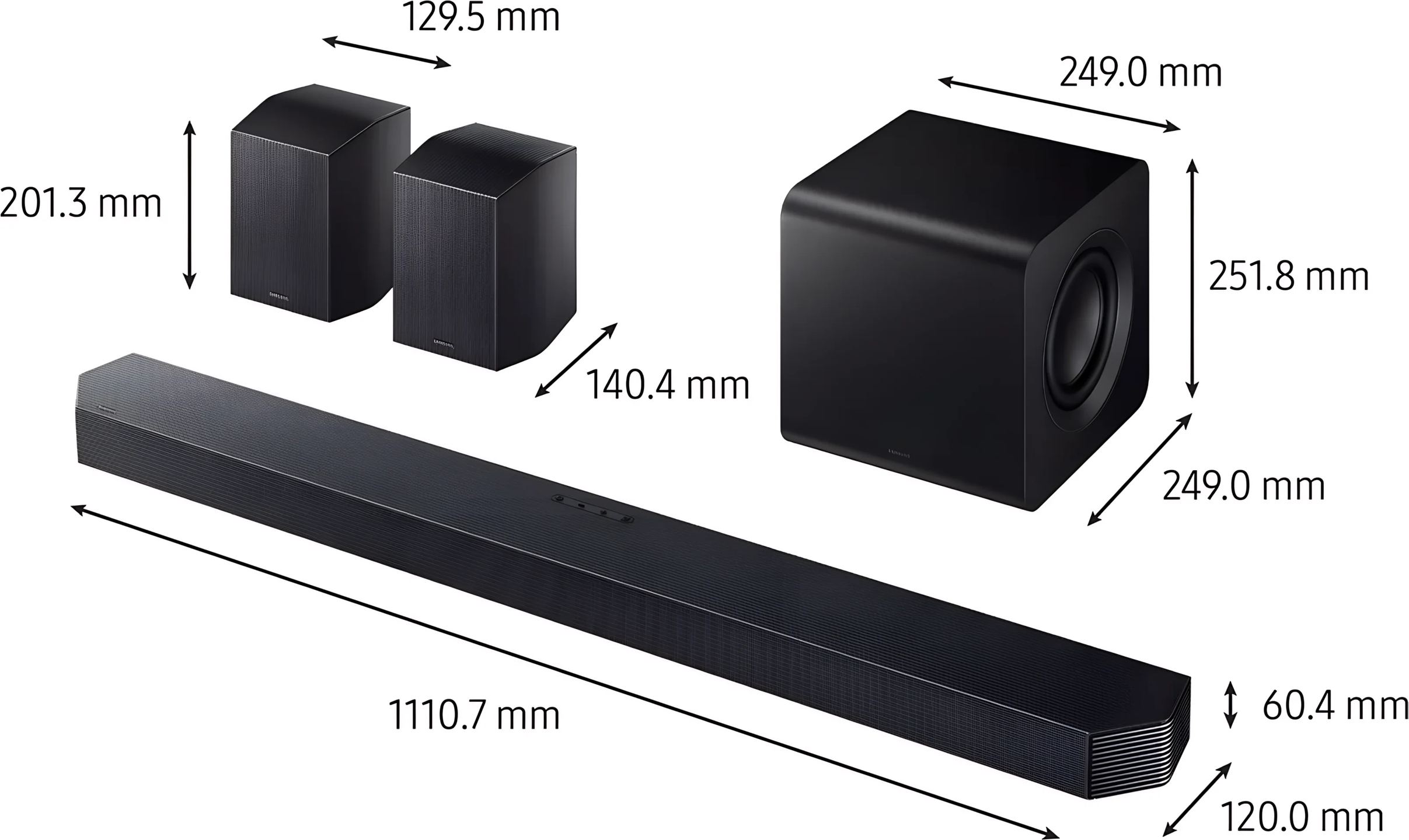
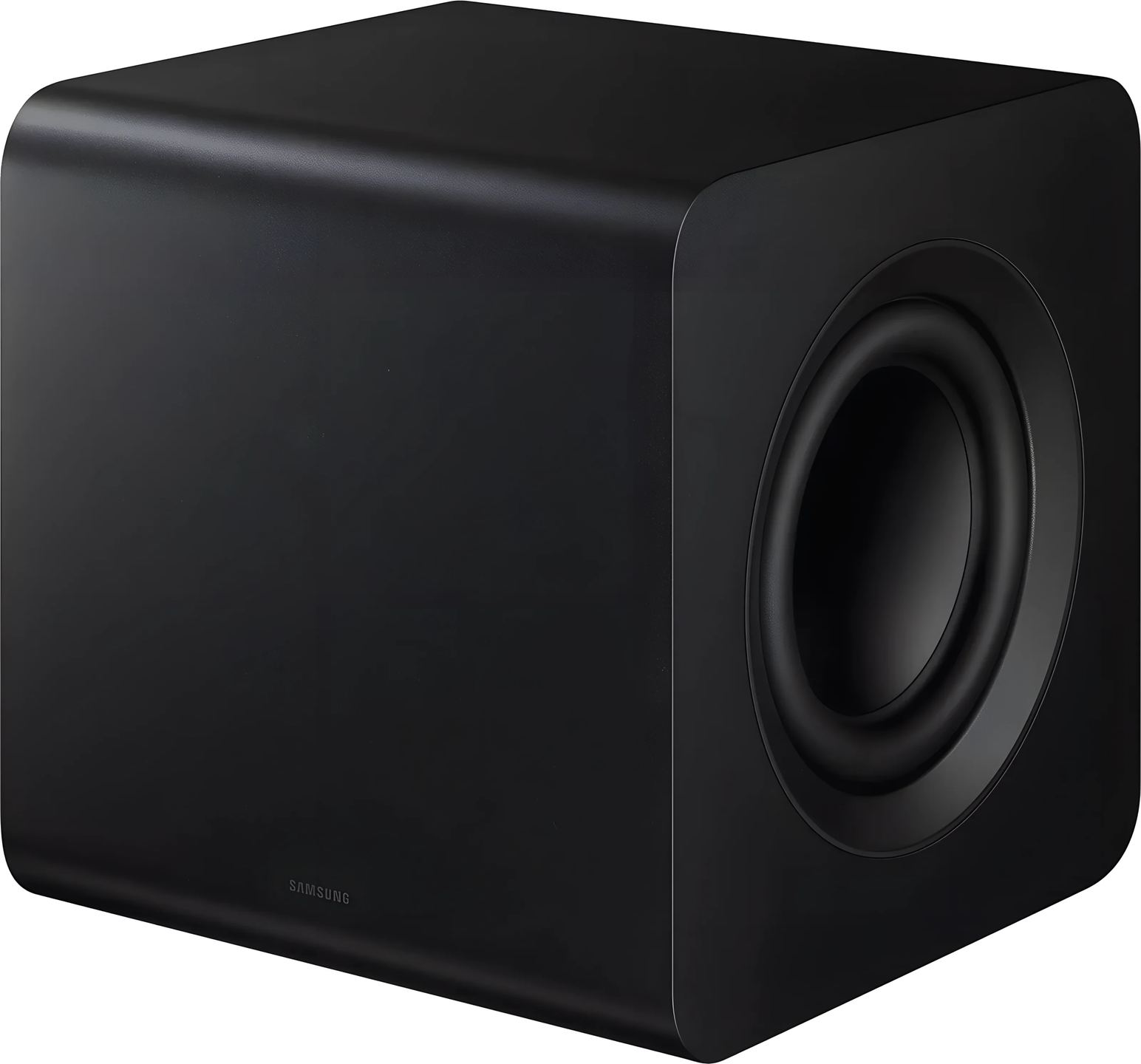
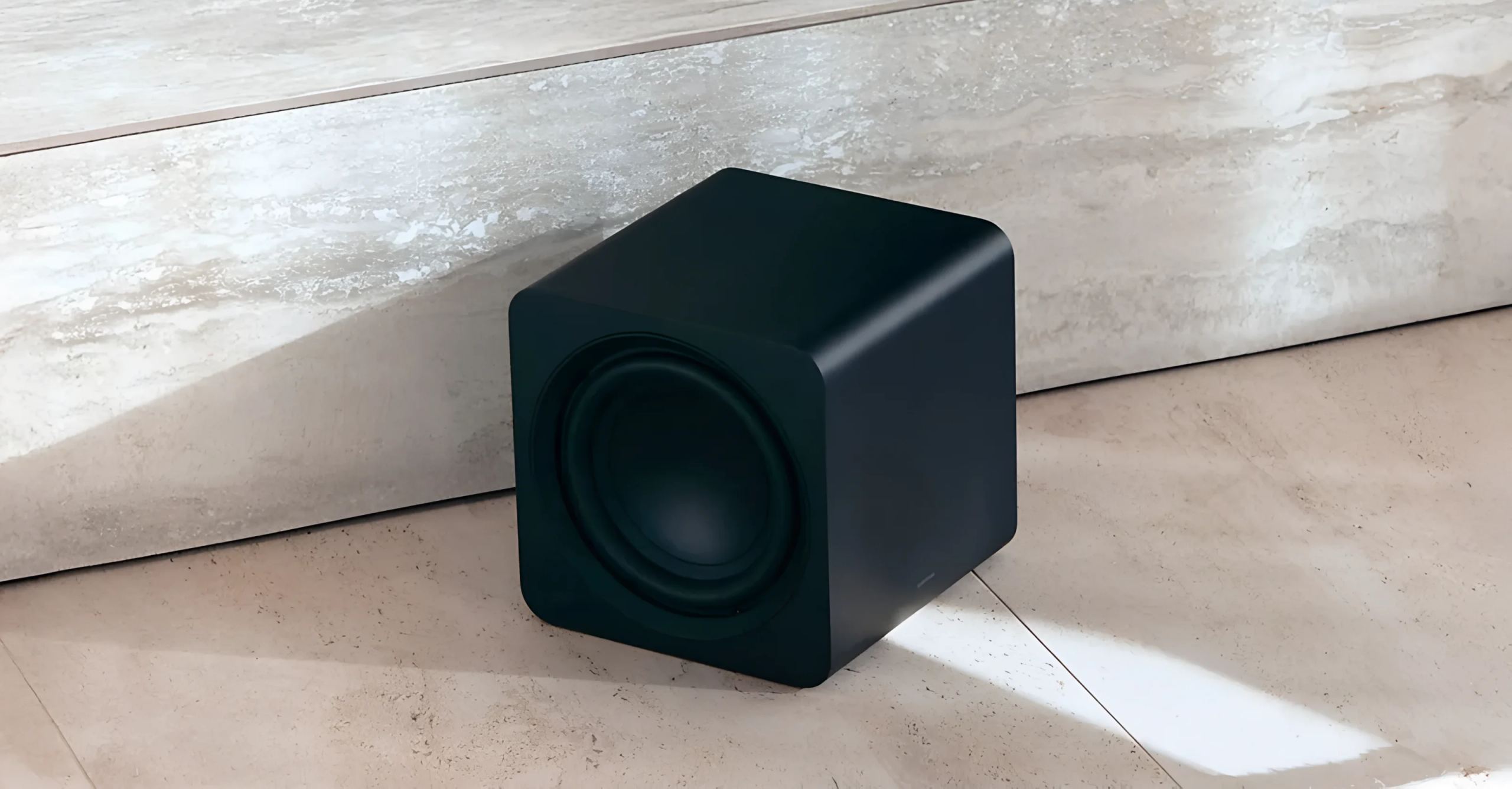
Samsung announces a subwoofer 58% more compact than the one from the 2024 generation. With dimensions close to a 25-centimeter cube and a weight of 7.2 kilograms, it fits more easily against a piece of furniture or in a corner, without giving up low-frequency reproduction. Its connection to the soundbar is wireless, but it requires a power outlet, as do the two rear speakers.
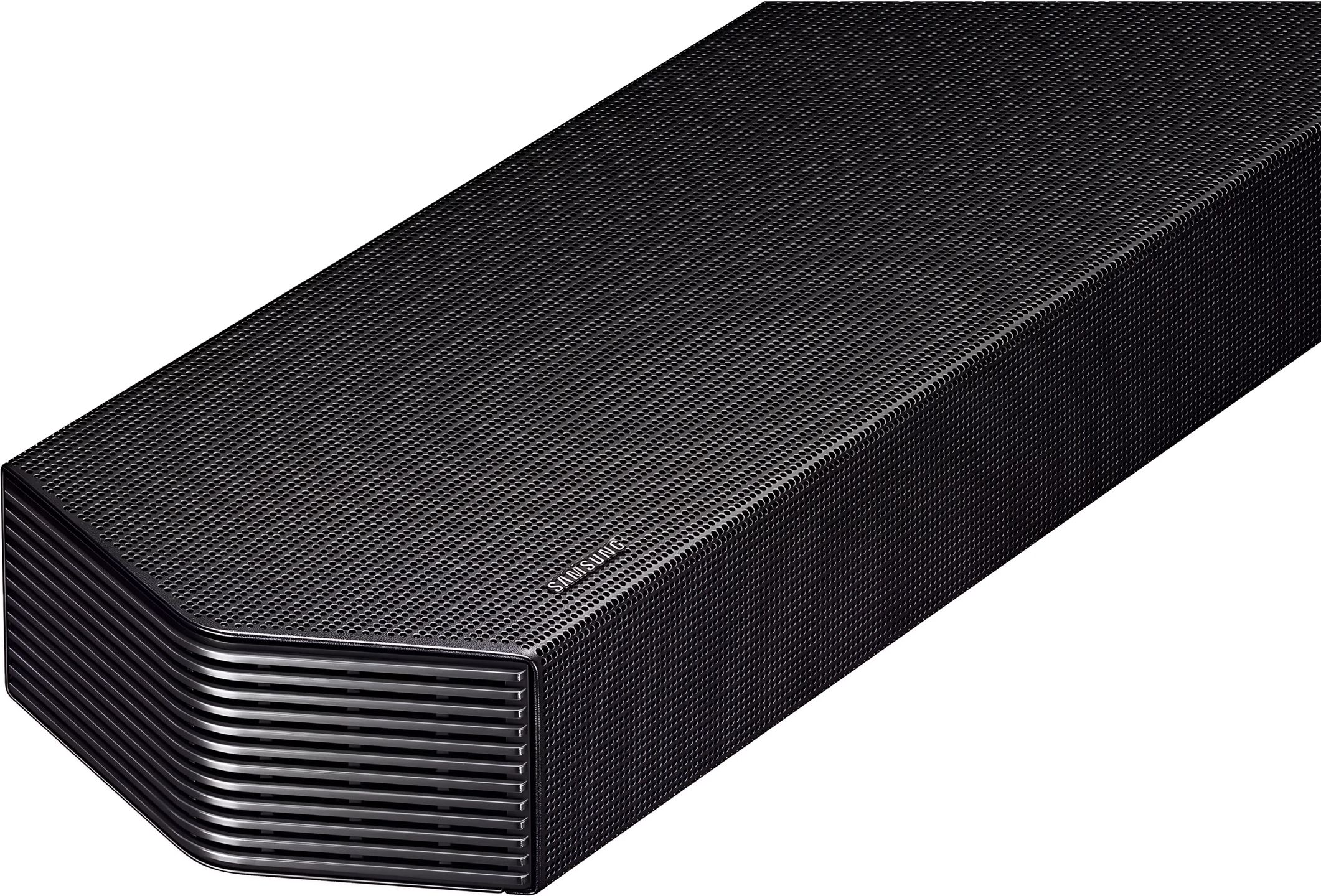
The soundbar itself measures 1.11 meters wide and 6 centimeters high. This low profile allows it to be placed in front of a TV without blocking the bottom of the screen or the infrared sensor. The finish, in Titan Black with an angular texture around the edges, remains understated. A wall mount is included for those who prefer to attach the soundbar below a wall-mounted screen.
Acoustic calibration and AI-driven modes
The HW-Q930H adjusts its sound output according to the room thanks to SpaceFit Sound Pro. The soundbar emits a series of test tones, analyzes their frequency response, echo, and return speed, then adjusts its equalization to compensate for the acoustic characteristics of the space. This measurement works with Samsung TVs from model years 2020 to 2026.
Several processing features rely on artificial intelligence. AVA Pro (Active Voice Amplifier) monitors the ambient sound level and boosts dialogue when outside noise risks covering it. AI Adaptive Sound mode analyzes each scene and adapts the equalization to the content, whether it is a busy soundtrack or a dialogue-heavy passage. In addition to these settings, there is a Game Pro mode for video games, a Sound Elevation mode that redirects part of the sound toward the top of the image, as well as Standard, Surround Sound Expansion, and Auto Volume modes, the latter limiting volume differences between programs and commercials.

Q-Symphony: making the TV play together with the soundbar
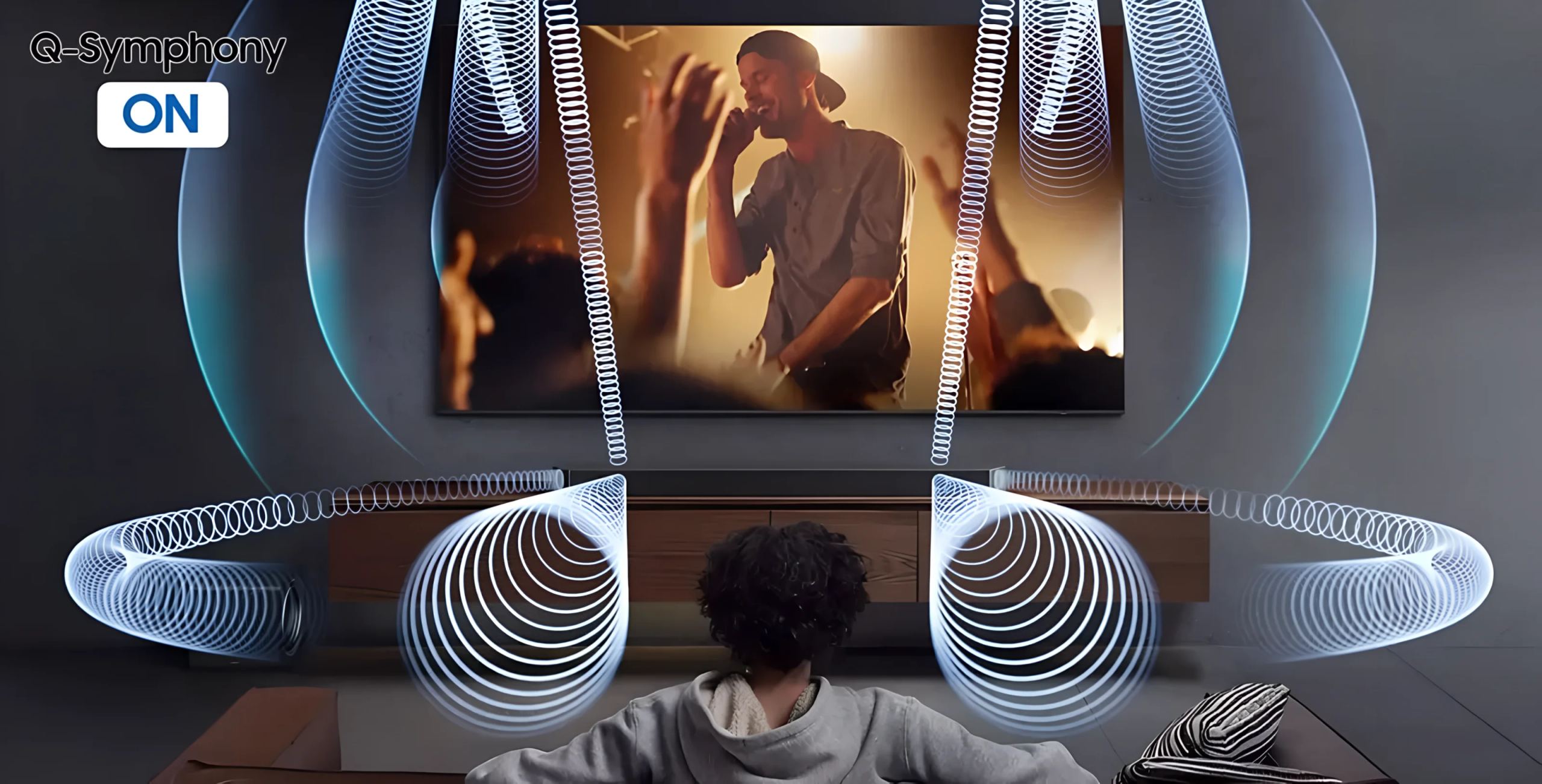
Rather than turning off the TV’s speakers, Q-Symphony makes them work at the same time as the soundbar. The screen’s speakers handle part of the channels, which widens the soundstage upward and to the sides. The feature requires a compatible Samsung TV, starting from 2020 models (TU8000 series and above), and an HDMI, optical, or Wi-Fi connection.
AI Q-Symphony goes further on recent TVs equipped with an NPU processor. The TV then separates voices from surround effects and distributes each component to the best-positioned speakers across both the soundbar and the screen. This version requires a Samsung model from 2023 onward (Q70C series and above). With devices all from the 2026 lineup, up to five products can be linked in Q-Symphony; the total drops to three for devices from model years 2023 to 2025.
Connections, wireless streaming, and supported formats
The connectivity remains simple: one HDMI 2.1 input, one HDMI 2.1 output compatible with eARC, and one digital optical input. There is no analog input. The simplest setup is to connect the soundbar to the TV via the eARC port, then connect the sources (player, console) directly to the TV. Since the soundbar has only one HDMI input, connecting several devices directly is not possible; routing through the TV becomes the rule as soon as there is more than one source.
The HDMI 2.1 port provides 4K 60 Hz video pass-through, with HDR10+ support. Gamers using a console capable of 120 Hz will therefore need to connect it to the TV rather than to the soundbar to keep the maximum refresh rate. The HW-Q930H also supports wireless Dolby Atmos: with a compatible Samsung TV (2022 models and newer), the Atmos track is transmitted over Wi-Fi, without an HDMI cable.
For audio streaming, the soundbar includes Bluetooth 5.3, Wi-Fi, AirPlay 2, Chromecast, and Spotify Connect, and carries Roon Ready certification for users of this music library. Alexa is built in for voice control; adjusting settings from a smartphone is done through the SmartThings app, as the soundbar does not have a built-in smart home hub. It plays MP3, AAC, OGG, and WAV files as well as lossless FLAC, AIFF, and ALAC formats, and supports Eclipsa Audio, a three-dimensional surround sound codec developed by Samsung and Google for online content.
One point to know before buying: the HW-Q930H decodes Dolby formats (Atmos, TrueHD, Digital Plus) but not DTS tracks, which are still present on some Blu-ray discs. The TV or player then handles converting these tracks before sending them to the soundbar.
The HW-Q930H versus the HW-Q990H
At the top of the 2026 Q-Series lineup, the HW-Q990H offers an 11.1.4 configuration with twenty-three speakers. The HW-Q930H differs with a 9.1.4 configuration and seventeen speakers: it has two upward-firing speakers, two side speakers, and two angled speakers on the soundbar, whereas the HW-Q990H has four upward-firing, four side, and two angled speakers. The soundstage is therefore a little less dense, especially for height and width effects.
The other differences concern connectivity and usage. The HW-Q990H has two HDMI 2.1 inputs and 4K 120 Hz video pass-through, compared with only one input and pass-through limited to 60 Hz on the HW-Q930H. The higher-end model supports DTS and includes a SmartThings hub, two elements absent here. On the other hand, the subwoofer and rear speakers are identical on both soundbars, which puts bass and rear surround at the same level.
Technical specifications
General configuration
- Product type: soundbar with subwoofer and rear speakers
- Configuration: 9.1.4 channels
- Number of speakers: 17
- 2 upward-firing speakers
- 2 side speakers
- 2 corner speakers
- Built-in center speaker
- Wireless subwoofer included
- Wireless rear speakers included
- Color: Titanium Black
- Total power: not specified
- Subwoofer power: not specified
Audio technologies
- Supported Dolby formats: Dolby Atmos, Dolby TrueHD, Dolby Digital Plus, Dolby 5.1ch
- Wireless Dolby Atmos
- DTS Digital Surround: not supported
- Sound modes: Surround Sound Expansion, Game Pro, Standard, AI Adaptive Sound, Sound Elevation, Auto Volume
- SpaceFit Sound Pro
- Q-Symphony
- AVA (Active Voice Amplifier) Pro
- Eclipsa Audio
Compatible audio formats
- MP3, AAC, OGG, WAV, FLAC, AIFF, ALAC
Wireless and network connectivity
- Wi-Fi
- Bluetooth 5.3
- AirPlay 2, Chromecast, Alexa
- Spotify Connect
- Roon Ready
- SmartThings (app only, no built-in hub)
Wired connectivity
- 1 HDMI 2.1 input
- 1 HDMI 2.1 output
- eARC
- HDMI-CEC
- 4K Pass-Through at 60 Hz
- HDR 10+
- 1 optical digital audio input
- USB port (service only)
- Analog audio input: not available
Q-Symphony compatibility
- Q-Symphony
- 2020 TV models from the TU8000 onward
- 2021 TV models from the AU7000 onward
- 2022 TV models from the BU8000 onward
- 2023 TV models from the CU7000 onward
- 2024 TV models from the DU7000 onward
- 2025 TV models from the U8000F onward
- 2026 TV models from the U8000H onward
- The Frame and The Frame Pro 2022-2026
- AI Q-Symphony
- 2023 TV models from the Q70C onward
- 2024 TV models from the Q70D onward
- 2025 TV models from the QN70F onward
- 2026 TV models from the M80H onward
- The Frame and The Frame Pro 2024-2026
Dimensions and weight
- Soundbar: 1110.7 × 60.4 × 120 mm, 5.3 kg
- Subwoofer: 249 × 251.8 × 249 mm, 7.2 kg
- Rear speakers (×2): 129.5 × 201.3 × 140.4 mm, 3.1 kg
Power consumption
- Soundbar
- Operating: 42 W
- Standby: 0.5 W
- Subwoofer
- Operating: 26 W
- Standby: 0.5 W
Included accessories
- HDMI cable
- Wall mount
- One Remote Control
- Wireless rear speaker kit
- Optical cable: not included
Positioning compared with the Q990H
- 9.1.4-channel configuration versus 11.1.4 channels on the Q990H
- 17 speakers versus 23 on the Q990H
- Speaker distribution: 2 upward-firing / 2 side / 2 corner speakers (versus 4 / 4 / 2 on the Q990H)
- 4K Pass-Through limited to 60 Hz versus 120 Hz on the Q990H
- Only 1 HDMI 2.1 input versus 2 on the Q990H
- DTS Digital Surround not included
- SmartThings Hub not built in (SmartThings app only)
- Subwoofer and rear speakers identical to those of the Q990H
Frequently Asked Questions
Do you need a Samsung TV to use the HW-Q930H?
No. The soundbar connects to any recent TV via HDMI eARC or the optical input, and plays sound without difficulty. A Samsung TV is still required for features that depend on the brand’s ecosystem: Q-Symphony, SpaceFit Sound Pro calibration, and wireless Dolby Atmos over Wi-Fi. Without a Samsung TV, these features are not accessible, but the soundbar retains its Dolby Atmos decoding over HDMI cable.
Are the subwoofer and rear speakers really wireless?
The audio link with the soundbar is wireless, so no cable runs between the soundbar, the subwoofer, and the rear speakers. Each element must, however, be plugged into a power outlet for power. You therefore need to plan for an outlet near the subwoofer location and each of the two rear speakers, generally placed behind the sofa.
Can you connect a console and a Blu-ray player to the soundbar at the same time?
Not directly. The HW-Q930H has only one HDMI 2.1 input. To use multiple sources, the most practical method is to connect them to the TV, then send the sound back to the soundbar through the HDMI eARC port. The TV then handles source switching, and the soundbar receives the audio track regardless of the selected device.
Is the HW-Q930H also suitable for music listening?
Yes. For music, it works as a connected speaker thanks to Bluetooth 5.3, Wi-Fi, AirPlay 2, Chromecast, and Spotify Connect. Roon Ready certification integrates it into libraries managed by this software. It plays common compressed formats as well as lossless FLAC, ALAC, and AIFF formats, allowing a music library to be streamed in good quality.
Does wireless Dolby Atmos replace the HDMI connection?
It is another way to transmit the Atmos track. With a Samsung TV from 2022 or newer, the Dolby Atmos soundtrack goes over Wi-Fi, without an HDMI cable between the screen and the soundbar. This option simplifies installation, but an HDMI eARC connection remains useful for other formats and for maximum stability.
- Eco-contribution of €0.75 included in the sale price.
- Manufacturer reference: HW-Q930HZF
- GTIN / EAN: 8806099027094