Van den Hul The Wave RCA 1,2m
Overview
Connecting a turntable to an amplifier, routing a coaxial S/PDIF stream, or carrying a composite video signal: three uses for a single cable. Van den Hul built The Wave around a 75-ohm impedance and a silver-plated copper center conductor, drawing on materials expertise refined over more than twenty-five years. The rest comes down to the details of its coaxial construction.
A solid silver-plated copper core
At the center is a solid conductor 0.9 millimeter in diameter, equivalent to AWG 19. The copper used is matched-crystal OFC (oxygen-free copper), covered with a dense layer of silver. This plating is not cosmetic: at high frequencies, current flows mainly on the surface of the conductor due to the skin effect, and silver, being a better conductor than copper, then takes over on this outer layer. The core sits in a foamed polyethylene dielectric whose air pockets lower the cable’s capacitance to 57 picofarads per meter. Low capacitance limits treble attenuation at the source output. As for conductor resistance, at 2.7 ohms per 100 meters, it remains negligible over a 0.80-meter connection.
Triple shielding against interference
The shielding includes two silver-plated OFC copper braids, one with 96 strands, the other with 112, separated by a thin metal foil. Van den Hul describes the assembly as triple shielding: the two braids and the intermediate foil form three successive layers. The logic lies in a dual role of coaxial cable shielding that is often overlooked. It serves both as the return conductor for the signal and as a barrier against external disturbances, whether radio frequencies or the magnetic field from a nearby power supply. By distributing these functions across several layers, the brand aims for better noise rejection without degrading conduction linearity. The braids use the same silver-plated copper as the central core, for electrical consistency.
One cable for both audio and video
The characteristic impedance of 75 ohms is the reference value for composite video, antenna and television connections, and coaxial S/PDIF digital audio. The Wave covers these uses just as well as an analog line-level audio connection, between a CD player and an amplifier for example.
One nuance should be made clear. In analog audio, the signal wavelength remains huge compared with the length of the cable, and impedance matching does not have the impact it is sometimes given: capacitance and shielding are what matter most. It is in S/PDIF digital and video, where frequencies rise and signal reflections become real, that a controlled 75-ohm impedance becomes truly worthwhile. The Wave therefore remains consistent across all of these connections, with a more pronounced technical advantage on the digital and video side.
The Hulliflex jacket and the GreenCare approach
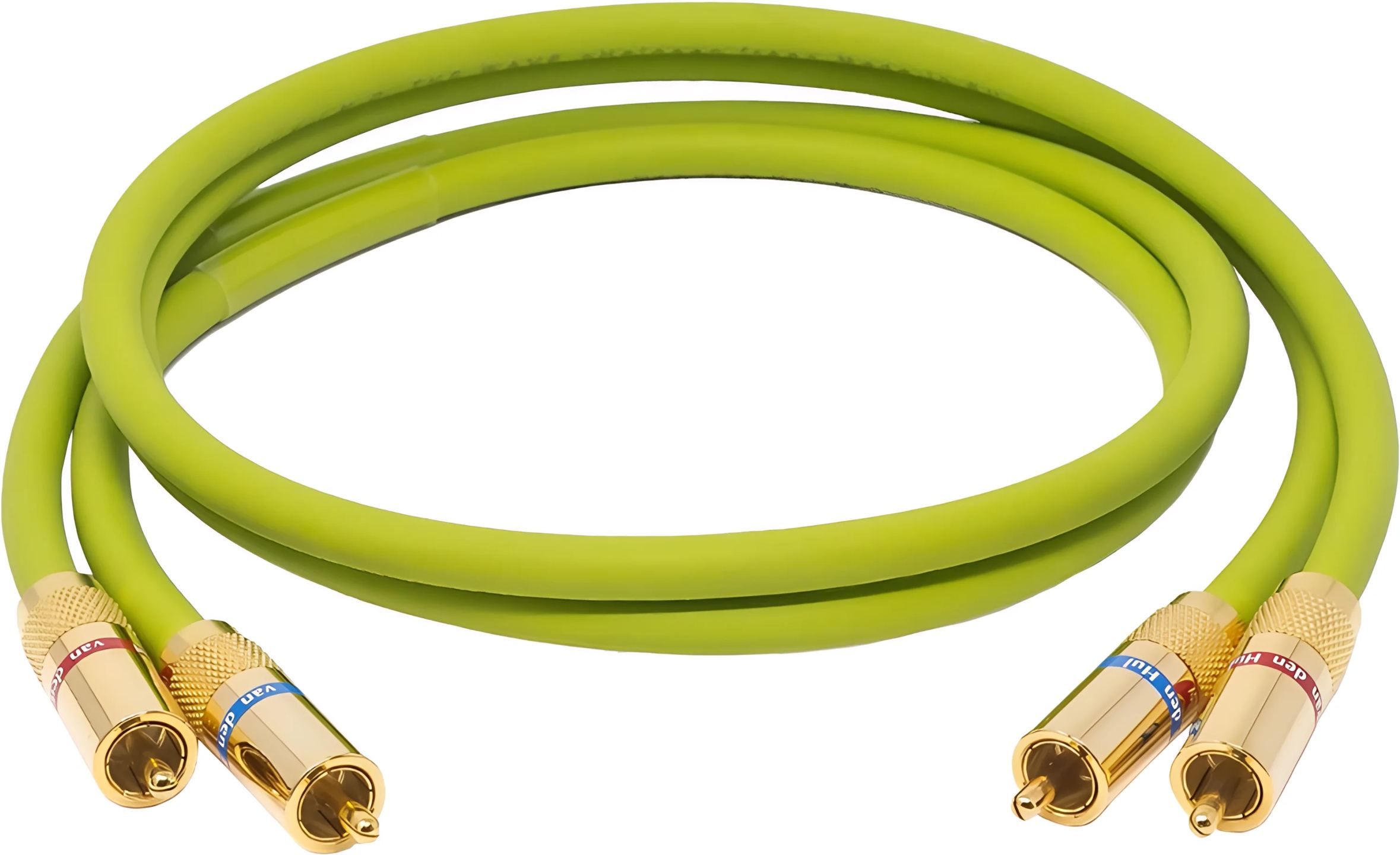
The outer jacket, in green Hulliflex, measures 7.3 millimeters in diameter. This in-house, halogen-free material resists chemical attack and maintains a dielectric strength of at least 300 Vrms. Van den Hul developed it a quarter of a century ago when moving away from halogenated compounds: it is the starting point of its GreenCare program, whose twenty-fifth anniversary The Wave celebrates. All of the cable’s materials follow this approach, remaining halogen-free from end to end. Manufacturing takes place in the European Union.
Factory-fitted RCA connectors
The cable ends in gold-plated RCA connectors, Cinch C-7.3 type, factory-fitted. The stereo pair includes four of them, two per cable. The gold plating protects the contact from oxidation and preserves connection quality over time. The 0.80-meter length is aimed at setups where the source and amplifier are on the same piece of furniture or close together: a network player, CD player, or DAC placed near the amplifier. For a connection to a distant subwoofer, this length will often be too short.
Technical specifications
Cable type
- Unbalanced analog interconnect coaxial cable
- Versatile AV use: line audio, video, antenna and TV, S / PDIF digital audio
- Characteristic impedance: 75 Ω
- GreenCare program, halogen-free materials
Conductor
- Solid high-purity oxygen-free copper (OFC) core, matched crystal
- Dense silver coating
- Central core diameter: 0.9 mm, AWG 19 equivalent
- Foamed polyethylene dielectric insulation
Shielding
- Double shielding
- Two silver-plated OFC strand braids: 96 strands and 112 strands
- Thin intermediate metal foil separating the two braids
Jacket
- Green HULLIFLEX jacket
- Outer diameter: 7.3 mm
- Dielectric strength: 300 Vrms minimum
- Environmentally friendly, halogen-free materials
Electrical data
- Core resistance: 0.027 Ω / m, or 2.7 Ω / 100 m
- Shield resistance: 0.0055 Ω / m, or 0.55 Ω / 100 m
- Capacitance: 57 pF / m
- Characteristic impedance: 75 Ω
Connectivity
- RCA version, Cinch C-7.3 type
- Stereo pair fitted with 4 gold-plated unbalanced RCA connectors, two per cable
- Factory-assembled connectors
Frequently asked questions
Does The Wave require a break-in period?
A cable does not have measurable electrical break-in in the sense used for a speaker or phono cartridge. The changes sometimes reported in the first few hours have more to do with listener acclimatization than with any evolution in the conductor. You can use The Wave as soon as it is connected without worrying about missing a step. Above all, make sure the connector contact is clean and firm, as that has more impact on the result than any amount of operating time.
How does The Wave differ from The Name, in the same range?
The Name is the brand’s entry-level cable: solid silver-plated OFC conductor, double shielding, RCA connectors. The Wave builds on this base and adds an extra shielding layer as well as matched-crystal OFC copper for the central core. Both share a 75-ohm impedance and a similar outer diameter. The difference lies in the rigor of the shielding and the quality of the central conductor. The Name remains the entry-level option in the range.
Can it be used to connect a turntable?
It all depends on where in the chain. Between a phono preamp and the amplifier, the signal is already at line level and The Wave is perfectly suitable. Directly from the turntable output, the phono signal is very weak and the turntable also requires a separate ground wire: since The Wave is a coaxial cable with two RCA connectors, it does not carry this separate grounding. For this application, a dedicated phono cable with a ground connection remains more suitable.
Is The Wave suitable for a subwoofer?
In terms of the signal, yes: the LFE output of a home theater amplifier is an RCA line-level connection that The Wave handles without difficulty. The limitation is practical rather than electrical. At 0.80 meter, the cable assumes a subwoofer placed very close to the amplifier, which is rarely the case, since a subwoofer is often positioned away from it, in a corner or against a wall. For this need, a longer length of the same model avoids stretching the connection.
Does the digital signal pass as well as with a dedicated S/PDIF cable?
Yes, because the key factor here is impedance, and The Wave maintains the 75 ohms required by the coaxial S/PDIF standard. A dedicated S/PDIF cable is, in practice, simply a 75-ohm coaxial cable terminated with RCA connectors, a specification that The Wave meets. Digital transmission remains binary: either the stream gets through intact, or errors appear. A cable with the correct impedance and good shielding puts the odds firmly on the right side over domestic lengths.
- Eco-contribution included in the sale price.
- Manufacturer reference: B61BA012
- GTIN / EAN: 8718058015380