
Paradigm Premier 620C v2 black wood



Overview
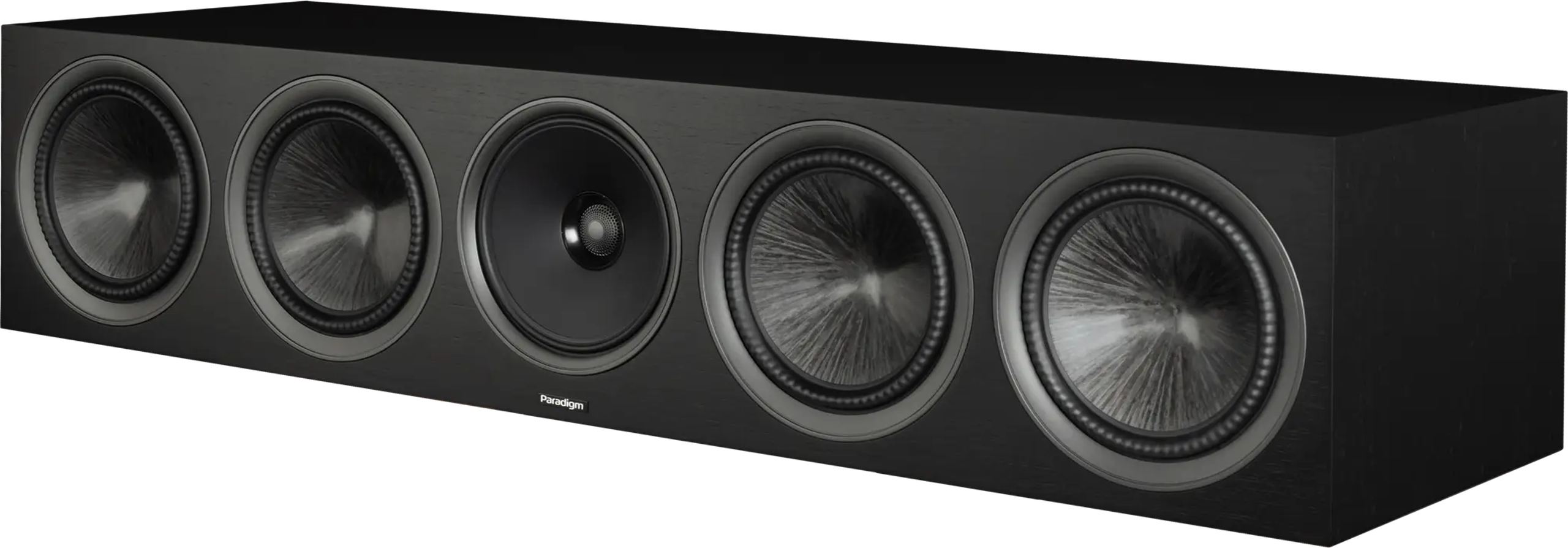
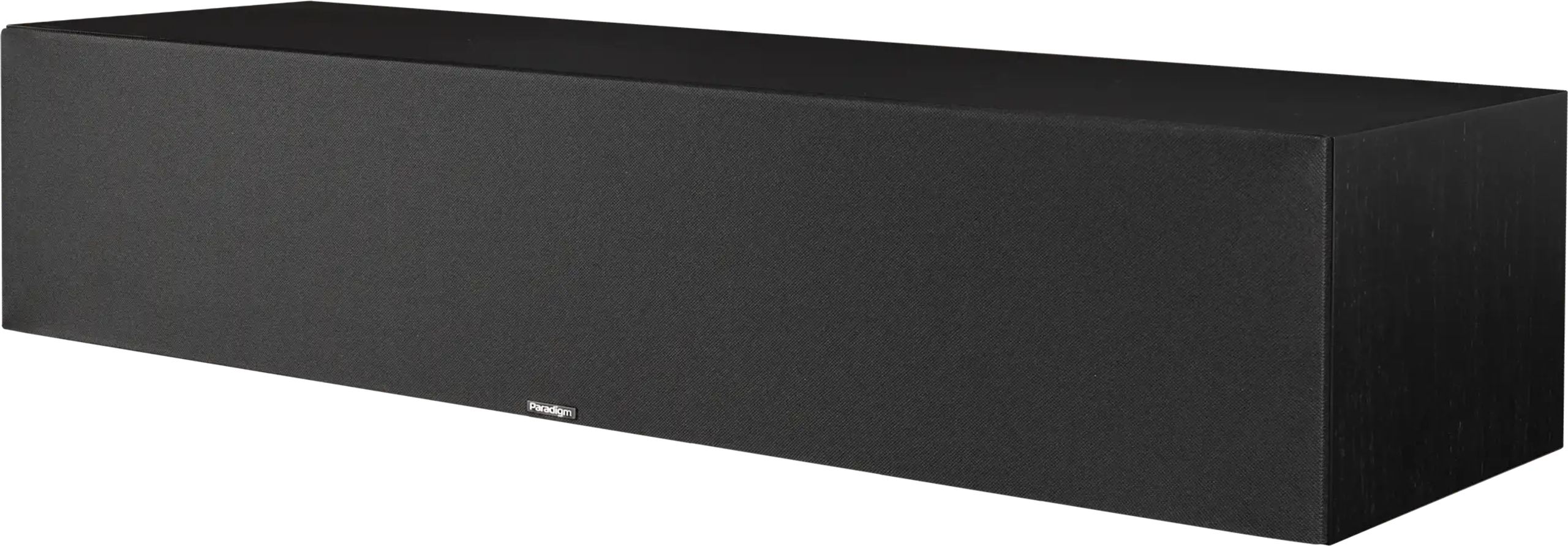
A large center speaker from Paradigm’s Premier v2 range, the 620C v2 combines a coaxial midrange driver, two 177 mm Carbon-X woofers, and two passive radiators in a one-meter-wide sealed enclosure. Its high sensitivity and extended bass make it well suited to large home theater systems, where it delivers clear dialogue and a cohesive front soundstage.
The coaxial midrange that locks voices in place
Most center speakers align their drivers horizontally, on either side of the tweeter. This layout causes a known flaw: as soon as you move away from the center seat, sounds coming from spaced-apart points reach the ear with slight delays, creating dips in the response, a phenomenon called “comb filtering.” The timbre of a voice then starts to vary depending on which seat you occupy.
Paradigm avoids this flaw by placing the 25 mm AL-MAC tweeter at the exact center of the 152 mm AL-MAG midrange cone. The two drivers radiate from a single point, what is known as a “point source.” Voices keep the same tonal balance across the entire width of the sofa, not just in the center seat. The dome, made from an aluminum, magnesium, and ceramic alloy, gains rigidity, which pushes upward the resonances likely to color the treble; an OSW waveguide and a perforated PPA lens regulate its dispersion. The midrange, for its part, relies on a 50 mm voice coil and Paradigm’s patented Dual-Sync Continuous Flux motor. The crossover divides the ranges at 1.7 kHz between the tweeter and the midrange, then at 750 Hz between the midrange and the bass drivers.
Bass driven by Carbon-X cones
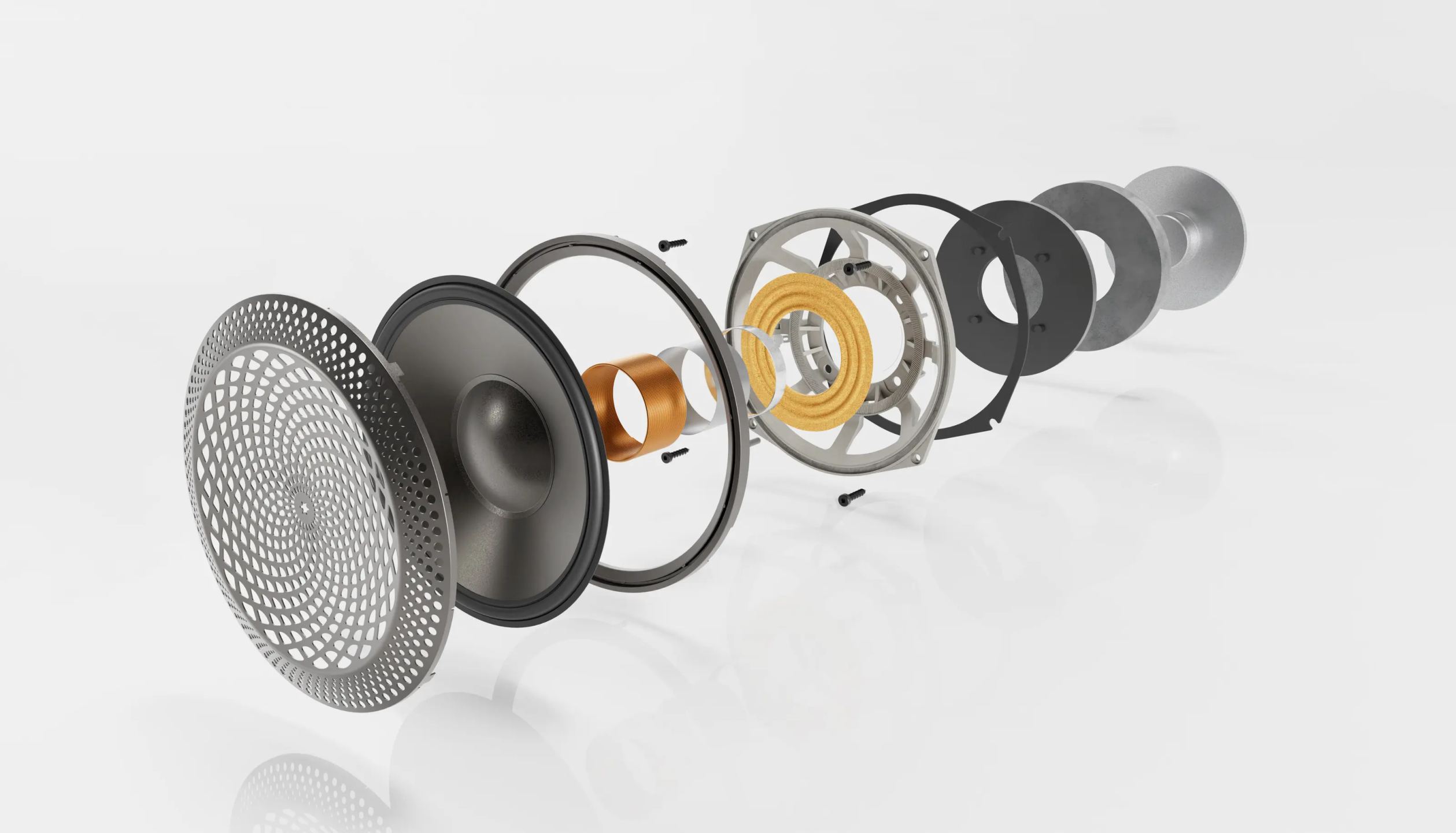
The bass relies on two 177 mm drivers with Carbon-X cones, a single-piece part that combines rigidity and lightness. A rigid cone deforms little under pressure; a light one accelerates and stops quickly, which results in clean bass rather than lingering bass. Third-generation Active Ridge Technology suspensions allow for long excursion, useful for sustaining high output without hardening on dense scenes.
Added to these two drivers are two 177 mm passive radiators, also in Carbon-X. A passive radiator is a cone without a motor, set in motion by the air pressure the woofers create inside the enclosure. It extends the bass downward as a port would, without the air noise or placement sensitivity that a port imposes. The enclosure therefore remains sealed, and the 620C v2 reaches down to 33 Hz according to DIN measurement, with a response held to ±3 dB from 49 Hz. Such extension allows the center speaker to reproduce the body of deep voices and the lower midrange without delegating everything to the subwoofer.
A size that dictates its installation
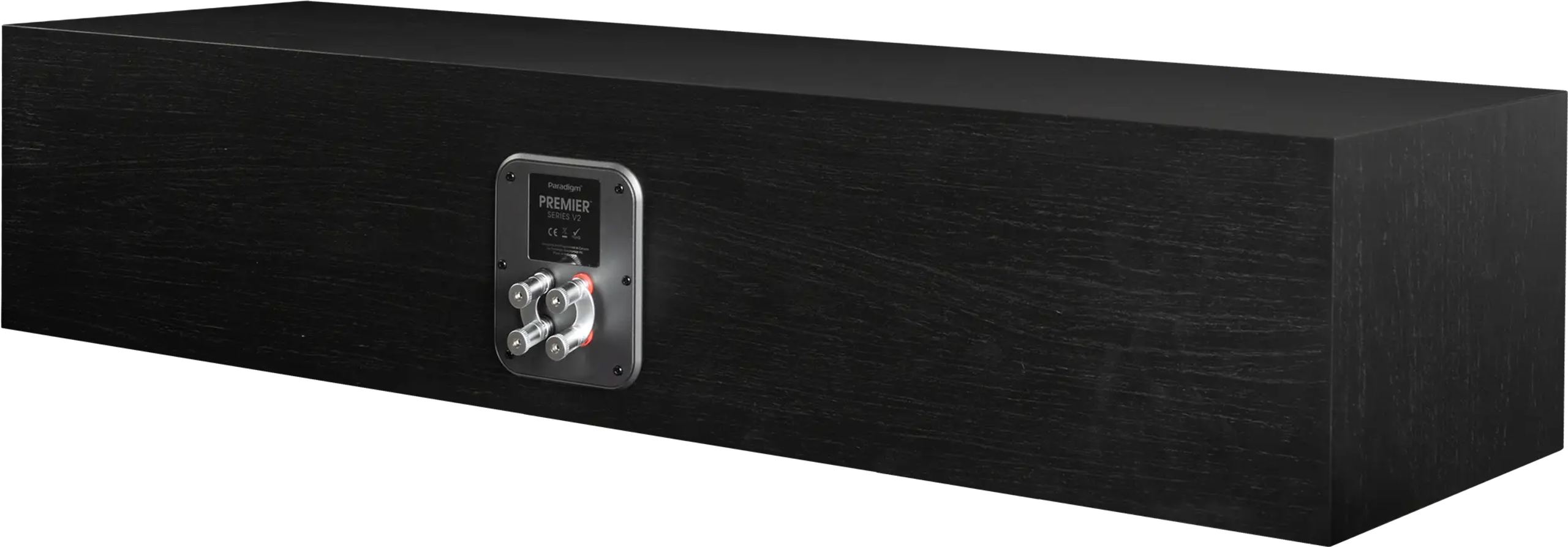
The enclosure is made of heavily braced MDF, with internal reinforcements and a thickened baffle that contain unwanted vibrations. On a center speaker of this volume, that rigidity matters: a panel that resonates adds its own coloration to the voice it is supposed to reproduce faithfully.
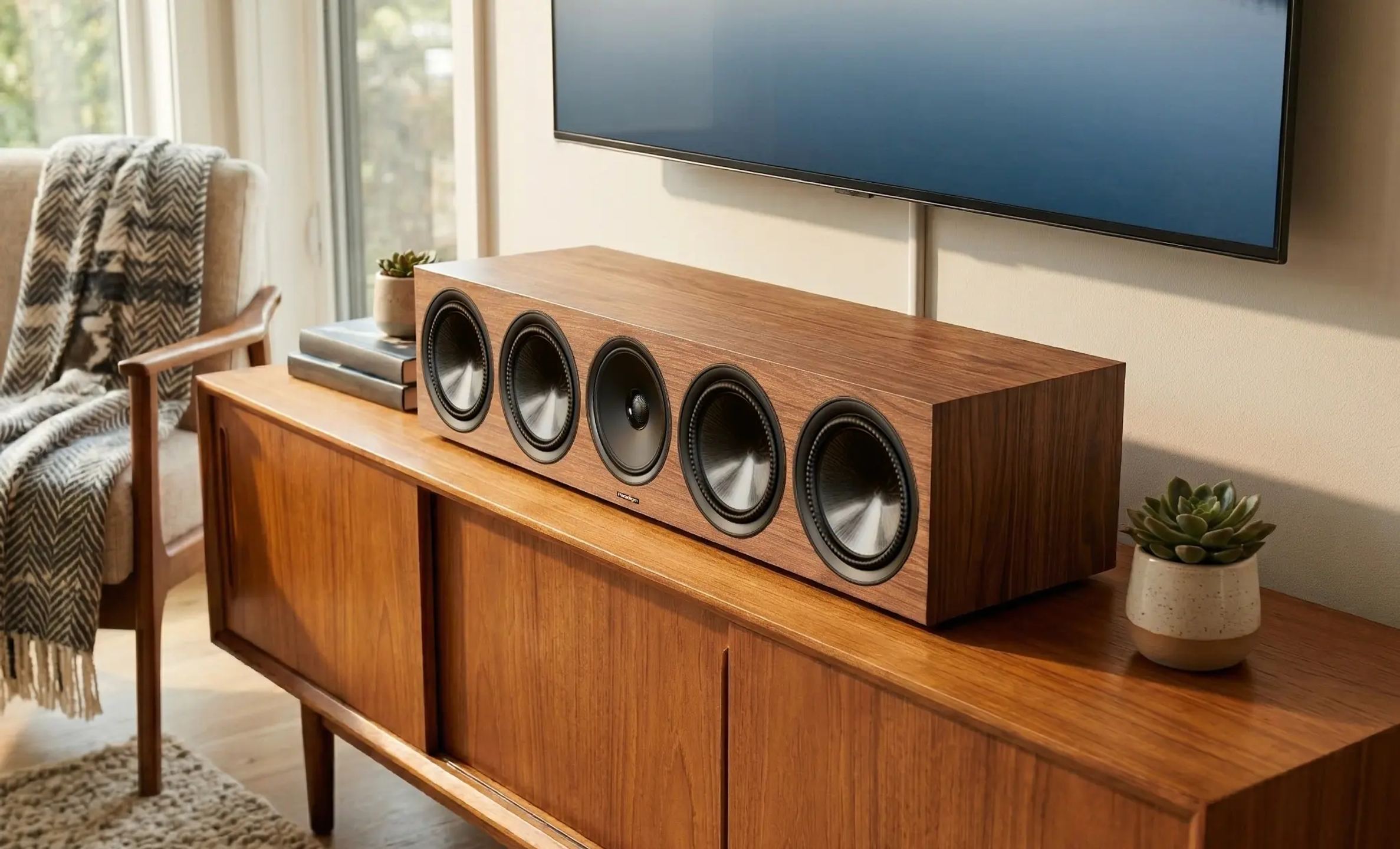
That leaves the question of size. With 104.1 cm in width, 22.6 cm in height, and 34.8 cm in depth for 21.8 kg, the 620C v2 requires a wide, stable, and deep support: a large-format TV stand or a dedicated shelf, not a narrow bookcase shelf. The absence of a port makes it tolerant of placement near a wall or inside a closed cabinet, where a ported speaker would require more clearance. Placed low, under a television, it benefits from being tilted slightly toward the listeners to direct the treble toward their ears. Three finishes are available: gloss black, walnut, and black walnut.
Amplification and system integration
With a sensitivity of 93 dB, the 620C v2 needs little power to play loud, and its 8-ohm-compatible impedance does not trouble any home theater amplifier. Paradigm specifies an amplification range of 15 to 180 W and a power handling of 120 W. The gap between these two figures is nothing unusual: the first describes the range of suitable amplifiers, the second the continuous power the drivers can handle without damage. A powerful amplifier helps preserve headroom on peaks, not drive the speaker to its limits all the time.
For a cohesive front stage, the 620C v2 shares its driver families with the 820F and 720F floorstanding speakers and the 220B and 120B bookshelf speakers in the Premier v2 range. A voice moving across the screen from left to right keeps the same timbre from one speaker to the next, without a break when passing through the center.
The evolution since the first generation
The original Premier range dates back to 2018. This second generation has been redesigned from top to bottom, and the differences are first visible in the materials. The tweeter moves on from the old X-PAL aluminum dome to an AL-MAC ceramic dome, whose stiffer alloy pushes back the resonances that muddy the treble. The bass cones move to one-piece Carbon-X, whereas the first version used carbon-loaded polypropylene cones. The ART suspensions have advanced by one generation.
On the center speaker, two design choices widen the gap with the past: the coaxial midrange, which replaces the classic horizontal layout and corrects the dispersion flaw described above, and the addition of two passive radiators, absent from the old sealed center speaker. Some of these solutions come from the more expensive Founder series, which Paradigm manufactures in its own Canadian factory.
Technical specifications
Tweeter
- 25 mm AL-MAC ceramic dome tweeter (Aluminum, Magnesium and Ceramic)
- OSW (Oblate Spheroid Waveguide) waveguide
- PPA (Perforated Phase-Aligning) acoustic lens
- Ferrofluid cooling
- Detailed, natural and perfectly controlled high-frequency reproduction, inherited from Paradigm’s higher ranges
- Improved sound dispersion and spatial precision thanks to OSW™ and PPA™ technologies for a more realistic soundstage
Midrange
- 152 mm AL-MAG coaxial midrange
- Aluminum / magnesium cone
- 50 mm high-temperature voice coil
- Patented Dual-Sync Continuous Flux motor
- Coaxial configuration optimizing coherence between frequency ranges and ensuring extremely accurate reproduction of dialogue and voices
Bass
- Two 177 mm Carbon-X woofers with very long excursion
- One-piece Carbon-X cones
- Gen3 Active Ridge Technology (ART) surround
- Excellent balance between rigidity and lightness of the Carbon-X cones for deep, fast and perfectly controlled bass, even at high volume levels
Passive radiators
- Two 177 mm Carbon-X passive radiators
- Gen3 ART technology
- Impressive bass extension while retaining the advantages of a sealed enclosure, making integration into furniture or under a screen easier
Acoustic performance
- Frequency response: 49 Hz to 23 kHz (±3 dB)
- Off-axis response (30°): 49 Hz to 20 kHz (±3 dB)
- Bass extension: 33 Hz (DIN)
- Sensitivity: 93 dB
- Compatible impedance: 8 ohms
- Recommended power: 15 to 180 W
- Power handling: 120 W
Construction and integration
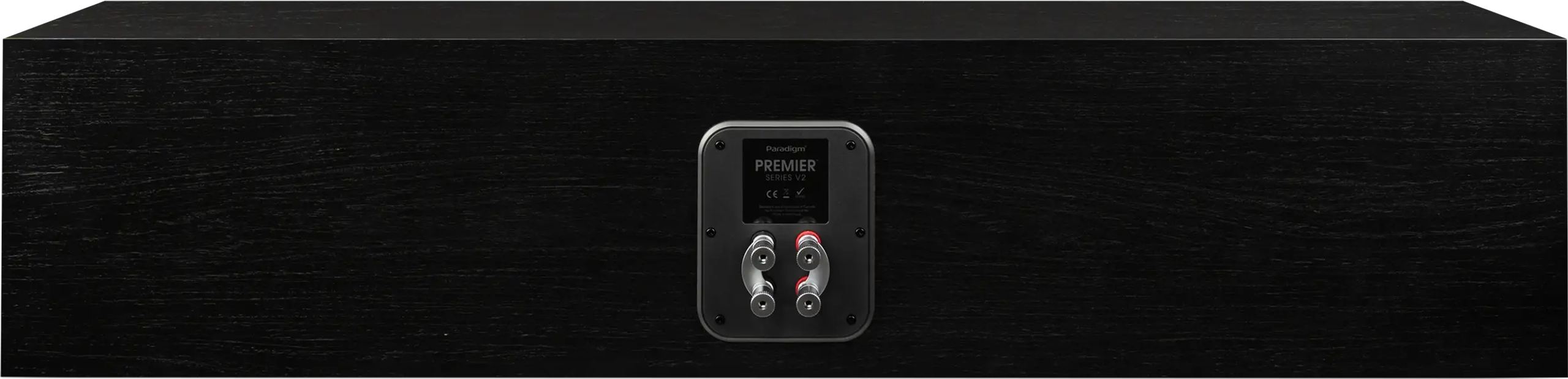
- Sealed acoustic enclosure (sealed enclosure)
- Internal bracing reducing unwanted vibrations
- Highly reinforced MDF cabinet
- Designed for installation in furniture or on a stand without performance degradation
Dimensions and weight
- Dimensions (W x H x D): 104.1 x 22.6 x 34.8 cm
- Weight: 21.8 kg
Frequently Asked Questions
How does the 620C v2 differ from the 520LCR in the same range?
Both share the same driver families and the same coaxial midrange. The 520LCR is smaller and more versatile: it can be laid horizontally as a center or stood upright as a left, right, or even surround speaker. The 620C v2 goes lower and plays louder, at the cost of a significantly larger footprint. It is the choice for large rooms and ambitious front stages, when space under the screen allows it.
Do you still need a subwoofer with this center speaker?
In a complete home theater system, yes. Even though the 620C v2 goes low for a center speaker, the deepest bass almost always goes through a dedicated subwoofer, to which low frequencies are redirected, with a crossover around 80 Hz being common. The center speaker then focuses on the body of voices and the lower midrange, without saturating when the action becomes dense. In stereo music listening, its own extension may be enough depending on the room.
Is a standard home theater amplifier enough to drive it?
Yes. The 620C v2 has good efficiency and an easy-to-drive impedance, so a standard audio-video amplifier delivering a few dozen watts per channel drives it without difficulty in most living rooms. A separate power amp only brings a real benefit in very large rooms or at high listening levels, where the extra dynamic headroom can be heard on sound peaks.
Is the 620C v2 oversized for a small room?
It is aimed at large rooms, where its bass volume and output make full sense. In a small room, it works without issue, but some of its capabilities remain unused, and its one-meter width is poorly matched to a modestly sized television placed on a narrow piece of furniture. For this type of space, a more compact center speaker often creates a better balance between the furniture, the screen, and the room.
- Eco-contribution included in the sale price.