Canton Ergo 620 cherry (pack of 2)


Overview
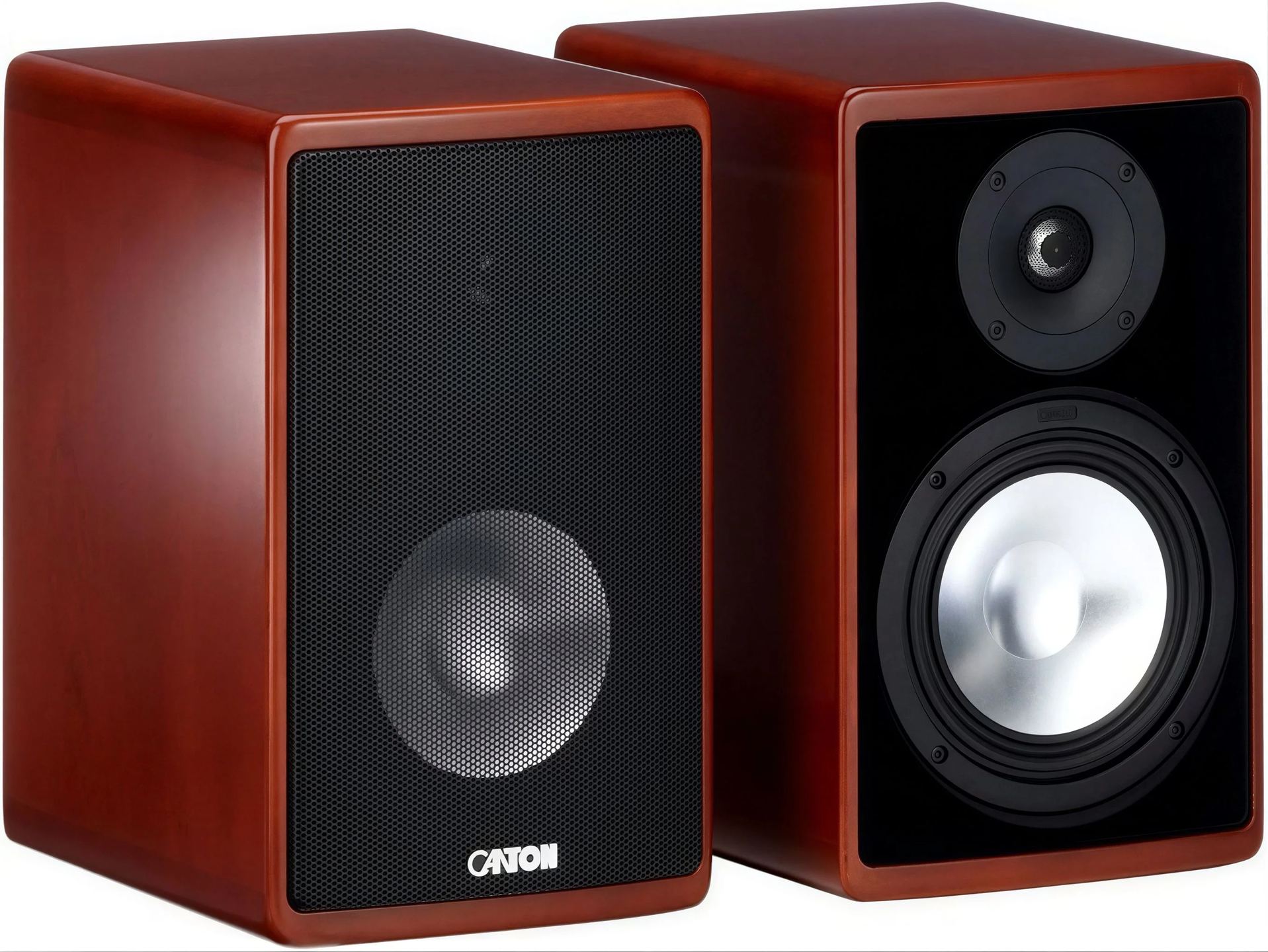
In the Canton catalogue, the Ergo line holds a special place: it is the German brand’s oldest range, regularly updated to incorporate technologies developed for its higher-end series. The 620 is its compact bookshelf speaker, manufactured like the entire Canton catalogue in Weilrod, in the Taunus region. It adopts the two-way bass-reflex configuration and the sonic signature that have made the series renowned for several decades.
Cabinet design and finishes
The cabinet remains compact: 34 cm high, 20.5 cm wide, 27.5 cm deep, weighing 7.5 kg. Canton has reinforced the structure with several internal braces and damping positioned at different points within the cabinet, two choices intended to reduce unwanted vibrations. The front panel features an aluminium plate with an acoustic function: Canton describes it as a waveguide contributing to the tweeter’s directivity. The edges are rounded, and the finish combines real wood veneer with a perforated metal grille that fits into place.
The aluminium-manganese tweeter
At the top of the front panel, a 25 mm dome made from an aluminium-manganese alloy covers the high-frequency range. The distinctive feature of this driver is its one-piece construction: the dome and voice-coil former are machined from a single piece, improving heat dissipation and allowing an extended response up to 40 kHz according to the brand. This extension goes well beyond the human audible range, but it contributes to response consistency in the upper audible spectrum, where the ear remains sensitive.
Aluminium bass driver and Wave Surround suspension
The bass/midrange driver measures 174 mm. Its cone is made of aluminium, a classic Canton choice for its rigidity and controlled flex behaviour. It is the suspension that draws attention: Canton uses its triple-fold Wave Surround technology, comprising three precisely defined arcs in the surround. The aim is to allow substantial excursion while maintaining movement symmetry, a requirement for linear bass at high levels. The bass-reflex port is positioned at the rear of the cabinet, meaning some clearance from the rear wall should be provided to optimise low-frequency response.
DC filtering and connections
The crossover frequency between the two drivers is set at 3,000 Hz. Canton incorporates its DC technology, for Displacement Control, into the crossover: a high-pass filter placed upstream of the bass driver, preventing it from attempting to reproduce signals below 20 Hz (infrasound). These signals are not audible, but they produce unnecessary excursions that generate harmonic distortion in the audible bass range. DC leaves the transducer with its useful bandwidth and removes what disrupts it. The terminals accept banana plugs and offer bi-wiring and bi-amplification configurations.
Documentation
Technical specifications
Acoustic design
- Acoustic principle: 2-way bass reflex
- Passive resonator principle: bass reflex
- Resonator radiation direction: backfire
- Front transmission plate
- DC crossover technology
Tweeter
- Quantity: 1
- Size: 25 mm
- Material: aluminum-manganese
Woofer / midrange driver
- Quantity: 1
- Size: 174 mm
- Material: aluminum
- Wave surround for the woofer
- Wave surround for the midrange
Electroacoustic performance
- Nominal power: 70 watts
- Music power: 130 watts
- Frequency response: 33 to 40,000 Hz
- Crossover frequency: 3,000 Hz
- Impedance: 4 to 8 ohms
- Sensitivity (2.83 V / 1 m): 86.5 dB
Connectivity
- Banana plug compatible
- Bi-wiring / bi-amplification terminal
Finish and trim
- Front cover material: aluminum
- Front grille mounting type: push-fit
Weight and dimensions
- Weight: 7.5 kg
- Packaging dimensions: 48.5 x 39.5 x 41 cm
- Packaging weight: 16.245 kg
Frequently Asked Questions
What amplifier power should I plan for the Canton Ergo 620?
With a sensitivity of 86.5 dB and an impedance between 4 and 8 ohms, the 620 works easily with an amplifier delivering 40 to 100 watts per channel into 8 ohms. Its rated music power of 130 watts provides headroom for dynamic peaks without risk of saturation.
How far from the rear wall should the speaker be placed?
As the bass-reflex port faces the rear, a space of 20 to 40 cm between the wall and the back of the subwoofer is recommended. Closer placement tends to boost the bass in an uncontrolled way and may introduce coloration in the lower midrange.
Can it be used as surround speakers in a home theater system?
Yes, the compact format is suitable for use as rear or side surround channels. To preserve tonal consistency, it is best paired with a center speaker and front speakers from the same Ergo range.
What does the DC technology used by Canton mean?
DC stands for Displacement Control. It is a high-pass filter integrated into the crossover filter that prevents the woofer from reproducing frequencies below the threshold of audibility. The benefit is reduced distortion in the audible bass range and better control of the driver’s excursion.
Does bi-wiring provide an audible improvement?
The terminal supports bi-wiring and bi-amping configurations. Simple bi-wiring, with two pairs of cables from the same amplifier, provides a modest effect, mainly noticeable on the most resolving systems. Bi-amping, with two separate stages for the treble and bass, offers a more noticeable improvement in dynamics and frequency range separation.
Is the Canton Ergo 620 suitable for a large room?
Its compact format and 174 mm woofer make it better suited to rooms of 15 to 30 m². For a larger space or sustained high-volume use, adding a subwoofer or upgrading to a floorstanding model from the same range provides the necessary energy reserve in the lower end of the spectrum.
- Eco-contribution included in the sale price.
- Manufacturer reference: 02495
- GTIN / EAN: 4010243024950